

Audi A6, S6, Q7 Park Assist Module Failure: The Critical Guide to Component Protection and Coding (2007-2012)
From constant beeping to a silent system, this guide covers the diagnosis, replacement, and mandatory programming for the park assist control module in your 2007-2008 Audi A6, 2007-2008 Audi S6, 2007-2008 Audi A6 Quattro, and 2007-2012 Audi Q7.
- This module requires mandatory programming to remove 'Component Protection' by a dealer or specialist with online tools; it is not a DIY-finishable job.
- A single faulty sensor or wiring issue can disable the entire system and mimic a module failure. Always diagnose with a VAG-specific scanner before replacing the module.
- Water intrusion into the module itself (located in the trunk) or bumper wiring connectors is a common cause of failure.
- When buying a used module, you must match the part number and budget for the additional cost of professional programming.
Symptoms of a Failing Park Assist Control Module
When the park assist module in your Audi A6, S6, or Q7 begins to fail, the symptoms are usually very noticeable. Because a fault in the system causes it to deactivate for safety reasons, you won't just get incorrect readings; the entire feature will stop working.
- "Park Assist Malfunction" Message: A warning message will often appear on the instrument cluster display.
- Long, Continuous Beep: When you select reverse gear, you may hear a single, three-second long beep instead of the normal, short chirp that indicates system activation. This long tone signifies a system fault.
- Flashing Park Assist Button: The light on the dashboard button used to manually activate or deactivate the parking system may flash continuously.
- No Sound or Visuals: The system will be completely unresponsive. There will be no beeping as you approach obstacles, and the graphical display on the MMI screen (if equipped) will not appear.
- Inability to Communicate with Scanner: In cases of complete module failure, often due to water damage or internal short circuits, a diagnostic scanner may report "No Communication" with the Park Assist module (Address 10 or 76).
Common Diagnostic Trouble Codes (DTCs)
A VAG-specific diagnostic tool like VCDS (VAG-COM) is essential for proper diagnosis. Generic OBD-II scanners often cannot read the specific control modules in your Audi. Common fault codes include:
- 01549 - Supply Voltage for Parking-Aid Sensor: This is a very common code that doesn't necessarily mean the module is bad. It often indicates that a single faulty sensor or a wiring short is dragging down the voltage for the entire sensor circuit.
- 65535 - Control Unit Defective: This code points directly to an internal failure of the park assist control module itself.
- Faults for individual sensors (e.g., "Parking Aid Sensor; Front Left - Open Circuit/Short to Ground"): These codes suggest the problem lies with a specific sensor or its wiring, not the module. However, a single sensor fault will still disable the entire system.
Diagnosing the Problem: Module, Sensor, or Wiring?
Before condemning the control module, it's important to rule out more common and less expensive failures. A single bad sensor or a corroded wire is often the true culprit.
- Scan with VCDS: The first step is always to scan the Park Assist module (Address 10 or 76) for fault codes. This will provide the best clues to the source of the problem.
- Check for Water Damage: Water intrusion is a primary cause of park assist failures. A Technical Service Bulletin (TSB) for later models highlights issues with water getting into the main bumper wiring harness connector. Inspect the connectors for the bumper harnesses for any green or white corrosion. The module itself, located in the trunk, can also be damaged if water leaks into the rear of the vehicle.
- Test the Sensors: If the system is powered, you can perform a simple test. With the ignition on and the system active (or trying to be), place your ear close to each sensor on the bumpers. You should hear a faint, rapid clicking or buzzing sound. A sensor that is silent is likely dead. You can also use a smartphone's audio recording app held near the sensor to see the ultrasonic pulses on the waveform.
- Isolate the Fault: If you have a "Supply Voltage" fault, a common diagnostic trick is to unplug sensors one by one (clearing codes and re-scanning each time) to see when the fault disappears. The sensor that was last unplugged when the fault clears is the one causing the issue.
CRITICAL WARNING: Component Protection is Active on This Module
The most important thing to understand before buying a replacement module is that these vehicles use Audi's Component Protection (CP) system. This is an anti-theft feature that links the module to the car's original VIN at the factory.
If you install a used (or even a new) Park Assist Control Module, it will trigger a "Component Protection Active" fault in the vehicle's gateway module. The part will not function correctly until this protection is removed. This is not a defect in the used part; it is by design.
Removing Component Protection is NOT a DIY job. It requires special diagnostic tools (like ODIS) with a live, online connection to Audi's factory servers in Germany. This procedure must be performed by an Audi dealership or a qualified independent specialist with the proper equipment and subscriptions. There is no known way to bypass this with tools like VCDS.
Buying a Used Park Assist Control Module
A used OEM module is an excellent, cost-effective alternative to a new dealer part, but you must be aware of the programming requirements. Given that programming is mandatory, the condition and compatibility of the used part are key.
- Match the Part Number Exactly: While several part numbers may be listed as compatible, your best chance at a smooth programming process is to match the original part number from your failed module precisely. Check for numbers like 4F0910283F, 4F0910283N, 4F0919283D, or 4F0919283F.
- Inspect for Water Damage: When the part arrives, carefully inspect the case and, more importantly, the connector pins. Look for any signs of white or green corrosion, which indicates past exposure to moisture and could mean the module is already damaged.
- Factor in Programming Costs: Remember that the price of the used module is not your final cost. You must budget for the labor to have Component Protection removed and the module coded to your vehicle's specific options (e.g., front sensors, rear sensors, graphical display).
- Why Used OEM is a Good Choice: Unlike some aftermarket electronics that can have spotty compatibility, a used Genuine Audi module is guaranteed to communicate correctly with your vehicle's systems once the Component Protection is removed.
Replacement Location and Procedure
Physically replacing the module is straightforward for a DIY mechanic. The main challenge is the required programming afterward.
- Location on A6/S6/A6 Quattro: The module is located in the trunk, behind the right-side trim panel. You will need to remove the floor covering and unclip the side panel to gain access.
- Location on Q7: The location is similar to the A6. It is in the right rear luggage compartment, behind the side access panel.
The general replacement steps are:
- Disconnect the vehicle's battery.
- Remove the necessary trunk trim panels to access the module.
- The module is typically held in a plastic bracket. Unclip it from the bracket.
- Press the release tabs on the electrical connectors and carefully unplug them.
- Install the new module, reconnect the electrical plugs, and secure it in its bracket.
- Reinstall the trim panels and reconnect the battery.
- The vehicle must then be taken to a dealer or specialist for Component Protection removal and coding.
Cost to Replace a Park Assist Control Module
| Part or Service | Estimated Cost |
|---|---|
| New OEM Module | $450 - $650 |
| Used OEM Module | $50 - $150 |
| Shop Labor (Physical Install) | $100 - $200 (approx. 1 hour) |
| Shop Labor (Component Protection & Coding) | $150 - $350 (1-2 hours, dealer/specialist rate) |
Frequently Asked Questions (FAQ)
Do I have to get a used park assist module programmed?
Yes, absolutely. Due to Audi's Component Protection system, any replacement module (new or used) must be adapted to your vehicle's VIN by a dealer or a specialist with online access to Audi's servers. It will not work correctly without this step.
Can I replace the park assist module myself?
You can perform the physical swap of the module yourself, as it is generally accessible in the trunk area. However, you cannot complete the job yourself, as the final, mandatory step is Component Protection removal and coding, which requires specialized tools.
My park assist gives one long beep then shuts off. Is the module bad?
Not necessarily. A long beep on startup is the system's general fault indicator. While it can mean a bad module, it is more frequently caused by a single failed parking sensor or a wiring issue. A diagnostic scan with a tool like VCDS is needed to read the specific fault code before replacing parts.
Why did my park assist stop working after a car wash?
This strongly suggests water has entered a sensor or a wiring connector. High-pressure water can force its way past seals. The issue may be temporary and resolve as the component dries out, but it often points to a failing seal that will cause persistent problems in wet weather. Check the main wiring connectors for the bumpers for signs of moisture.
Technical Specifications
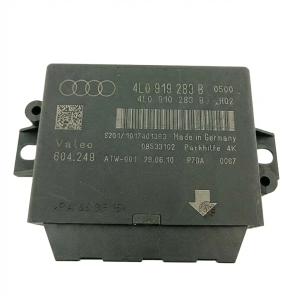
OEM Part Numbers: 4F0910283F 4F0910283N 4F0919283D 4F0919283F 4L0919283C
Controls 8-channel (4 front, 4 rear) or 4-channel (rear only) ultrasonic parking sensors. Communicates on the vehicle's CAN bus network. Subject to Component Protection.
We Have This Part in Stock




The information in this article is provided for general reference and educational purposes only. Vehicle specifications, procedures, and part compatibility can vary by production date, trim level, and region. Always consult your vehicle's factory service manual and verify part numbers before purchasing or performing repairs. Safety-critical components such as airbags, seat belts, and braking systems should be installed by a qualified professional.
- Audi A6:
- Audi Q7:
- Audi S6:
- Audi A6 Quattro:
- 🛍️ Shop This Part
- Symptoms of a Failing Park Assist Control Module
- Common Diagnostic Trouble Codes (DTCs)
- Diagnosing the Problem: Module, Sensor, or Wiring?
- Buying a Used Park Assist Control Module
- Replacement Location and Procedure
- Cost to Replace a Park Assist Control Module
- Frequently Asked Questions (FAQ)
- 🎟️ Get 5% Off