

U3000 on 2014-2017 Mazda MAZDA6: Decoding the Control Module Fault
The U3000 code on a 2014-2017 Mazda6 indicates a general fault in an electronic control module. The specific problem depends on which module stored the code, most commonly the Forward Sensing Camera (FSC), Blind Spot Monitor (BSM), or the SAS (Airbag/Stability) Control Module. Diagnosis requires a high-end scan tool like FORScan or the dealer's M-MDS to identify the failing module and the specific two-digit failure type code (e.g., :04, :49, :54).
- U3000 is a general code; you MUST use a professional scan tool to find out which module is at fault and get the specific failure type code (e.g., :04, :49, :54).
- The most common causes on a 2014-2017 Mazda6 are failures of the Forward Sensing Camera, Blind Spot Monitors, or the SAS (Airbag/Stability) Control Module.
- Check for relevant Technical Service Bulletins (TSBs) once you have the full code, as Mazda has documented several known issues.
- This is not a DIY-friendly repair. Most fixes involve replacing expensive electronic modules that require professional calibration or programming to function correctly.
- Do not immediately replace parts. Accurate diagnosis to pinpoint the specific faulty module is critical to avoid wasting money.
What's Unique About the 2014-2017 Mazda MAZDA6

The third-generation Mazda6 (2014-2017) is equipped with Mazda's i-ACTIVSENSE, a suite of advanced safety features relying on a network of sensors and modules like the Forward Sensing Camera (FSC) and Blind Spot Monitors (BSM). Code U3000 is a common flag for when one of these modules experiences a hardware failure, software issue, or environmental problem like overheating. Mazda has issued multiple Technical Service Bulletins (TSBs) for this code, each addressing a different module (FSC, BSM, SAS), which highlights the platform's complexity and the diagnostic challenge. Forum discussions frequently mention the frustration of diagnosing this code without a dealer-level tool due to the variety of potential sources.
Diagnostic Flowchart

Tap your situation to follow the diagnostic path that matches what you're seeing on this vehicle.
Symptoms You May Notice

- Smart Brake Support (SBS) or Smart City Brake Support (SCBS) warning light on.
- Lane-keep Assist System (LAS) or Lane Departure Warning System (LDWS) warning light on.
- High Beam Control (HBC) warning light on.
- Blind Spot Monitoring (BSM) OFF indicator light flashing.
- ABS, TCS/DSC, and TPMS warning lights on.
- Airbag warning light on.
- Error message on the center display (e.g., "Forward Smart City Brake Support Malfunction").
- Master Warning Light illuminated.
- Replacing other control modules without first identifying which one stored the U3000 code.
- Replacing a wheel speed sensor when ABS/TCS lights are on, when the actual fault is U3000:49 in the SAS module.
- Replacing the FSC for a U3000:98 code without understanding it is a temporary thermal shutdown.
Most Likely Causes

- Forward Sensing Camera (FSC) Internal Failure 🔴 High Probability Mazda has issued multiple TSBs for internal FSC failures on this platform. TSB #15-002-21-3812 states the cause is a hardware failure of an internal device within the FSC, for which the production process was later modified.
How to confirm: A professional scan tool will show DTC U3000:04-0A stored in the FSC module, which cannot be erased. This is a hard fault indicating a permanent internal malfunction.
Typical fix: The Forward Sensing Camera must be replaced with a modified part (e.g., Part No. GHP9-67-XCXA). After replacement, the new camera must be configured and calibrated using the Mazda M-MDS or equivalent tool, which involves a dynamic aiming procedure while driving on a clearly marked road.
Est. part cost: $500-$1200 - Blind Spot Monitor (BSM) Module Failure or Misalignment 🔴 High Probability BSM modules are located in the rear bumper corners, making them susceptible to moisture, corrosion, and misalignment from minor impacts. TSB #09-007-15-3011 also identified inadequate control logic in the original modules for pre-August 2014 vehicles, causing false U3000:54 codes.
How to confirm: A scan tool will find a U3000 code stored in the BSM (L) or BSM (R) module. U3000:54 indicates a misalignment or performance issue. A user on the Mazdas247 forum reported a U3000:54 code and a dealer quote of $2300 for replacement of both sensors.
Typical fix: First, inspect the rear bumper for damage, dirt, or obstructions. For U3000:54 on earlier models, the TSB fix requires replacing BOTH the left and right BSM modules with updated parts (e.g., Part No. GJR9-67-Y30F) and then performing a BSM radar test with a scan tool. A minor impact may also cause misalignment, requiring realignment and testing.
Est. part cost: $300-$800 per module - SAS Control Module Internal Failure 🟡 Medium Probability Mazda issued TSB #08-001-15-3017 for an internal failure of the SAS (Steering Angle Sensor) Control Module, which also integrates the vehicle's stability control and airbag systems.
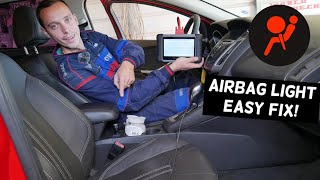
How to confirm: A scan tool will show DTC U3000:49 stored in the 'Standard Deployment Control System' (the SAS module). This is typically accompanied by a cluster of warning lights including ABS, TCS/DSC, and Airbag. 🎬 Watch: Troubleshooting the U3000 code and airbag light fix.
Typical fix: The SAS control module, located under the center console, 🎬 See this walkthrough on how to replace the SRS module. must be replaced. Crucially, before removing the old module, a 'Configuration' or 'Programmable Module Installation' procedure must be run with the M-MDS to save the vehicle's data. This data is then written to the new module after installation.
Est. part cost: $400-$900 - Forward Sensing Camera (FSC) Overheating ⚪ Low Probability Per TSB #15-002-18-3502a, the FSC has a thermal protection function. In very hot weather, it can temporarily shut down to prevent damage, logging U3000:98. This is considered normal operation by Mazda, though a later TSB provided a more heat-durable part.
How to confirm: A scan tool shows DTC U3000:98 in the FSC module. The issue typically occurs during hot weather and may resolve itself after the cabin cools down. The warning lights should turn off once the camera cools, even without cycling the ignition.
Typical fix: No parts are required if it's an isolated incident. The system should resume normal function once the cabin temperature is reduced. If the issue is persistent, the TSB recommends replacing the FSC with a modified, more heat-durable part.
Est. part cost: $0
Rare But Worth Checking
- Low Battery Voltage:
- Poor Ground Connection:
Diagnosis Steps
- As a preliminary step, check the 12V battery. Ensure it is fully charged and passes a load test. A healthy resting voltage is ~12.6V. Low voltage can cause spurious module errors.
- Connect a professional-grade scan tool capable of reading Mazda-specific codes from all vehicle modules (e.g., Mazda M-MDS, FORScan with a quality adapter).
- Perform a full vehicle network scan (DTC scan) to identify which specific module(s) have stored the U3000 code.
- Record the full DTC, including the two-digit failure type suffix (e.g., :04, :49, :54, :98). This suffix is critical for diagnosis.
- If U3000:04-0A is stored in the Forward Sensing Camera (FSC), this indicates a permanent hardware failure requiring replacement per TSB #15-002-21-3812.
- If U3000:98 is in the FSC, confirm if the fault occurred in high-temperature conditions. If so, it is likely a normal thermal shutdown.
- If U3000:54 is stored in a Blind Spot Monitor (BSM) module, inspect the rear bumper for damage and follow diagnostics for BSM failure or misalignment per TSB #09-007-15-3011.
- If U3000:49 is stored in the SAS Control Module, inspect the battery and main ground connections before condemning the module. If those are good, follow the diagnostic procedure in TSB #08-001-15-3017 which leads to module replacement and configuration.
Parts You'll Likely Need
- Forward Sensing Camera (FSC)
(OEM #GHP9-67-XCXA)— A common point of failure causing U3000:04-0A, as documented in multiple TSBs. This part was modified to improve durability.
Trusted brands: Mazda (OEM)
OEM price range: $800-$1200
Aftermarket price range: $500-$800 - Blind Spot Monitor (BSM) Module
(OEM #GJR9-67-Y30E)— Frequently fails due to location and software logic issues, causing a flashing BSM light and U3000 codes. An owner complaint (ODI #11495196) and forum posts confirm this is a costly repair.
Trusted brands: Mazda (OEM)
OEM price range: $400-$600
Aftermarket price range: $250-$450 - SAS Control Module
(OEM #GHR1-67-CS0B)— Identified in TSB #08-001-15-3017 as the cause for U3000:49 and multiple dashboard warning lights. Requires replacement and configuration.
Trusted brands: Mazda (OEM)
OEM price range: $500-$900
Related Codes That Often Appear With This One
- U3000:04-0A — This is a specific failure type indicating a non-erasable internal hardware malfunction, frequently seen with a failed Forward Sensing Camera per TSB #15-002-21-3812.
- U3000:49 — This failure type byte indicates an internal electronic malfunction and is specifically linked to the SAS Control Module failure in TSB #08-001-15-3017.
- U3000:54 — This failure type byte indicates a radar performance or misalignment issue, commonly associated with the Blind Spot Monitoring (BSM) modules per TSB #09-007-15-3011.
- U3000:98 — This failure type byte indicates the module has stopped functioning due to high temperature, specifically seen with the Forward Sensing Camera in hot weather per TSB #15-002-18-3502a.
Technical Service Bulletins (TSBs) & Recalls
- 15-002-21-3812: Addresses U3000:04-0A in the Forward Sensing Camera (FSC) due to internal hardware failure.
- 08-001-15-3017: Addresses U3000:49 in the SAS Control Module, causing multiple warning lights.
- 09-037/14: Addresses U3000:54 in the Blind Spot Monitoring (BSM) modules due to inadequate control logic.
- 15-002-18-3502a: Explains the U3000:98 code from the FSC as a normal thermal protection shutdown in hot weather.
- 09-022/14: Details potential for multiple electrical issues, including module faults, from poor ground connections after body repairs.
Platform-Specific Known Issues
- TSB #15-002-21-3812 and #15-002-19 address permanent internal failures of the Forward Sensing Camera (FSC) indicated by DTC U3000:04-0A.
- TSB #15-002-18-3502a explains that in hot weather, the FSC may temporarily shut down and log U3000:98 as a normal protective measure.
- TSB #08-001-15-3017 links a variety of warning lights (ABS, TCS, TPMS, Airbag) to an internal failure of the SAS Control Module, which stores DTC U3000:49.
- TSB #09-037/14 and an owner complaint (ODI #11495196) point to failures of the Blind Spot Monitoring (BSM) modules, which can log U3000:54 due to software logic or misalignment.
Hidden / Shadow Codes Worth Checking
- U3000:04: Indicates a generic internal electronic failure within a module. When shown as U3000:04-0A in the FSC, it signifies a permanent, non-erasable hardware fault. (see via Mazda M-MDS or a compatible professional scan tool (like FORScan) that can read manufacturer-specific failure type bytes.)
- U3000:49: Indicates an internal electronic malfunction. On the Mazda6 platform, this is most commonly associated with the SAS (Airbag/DSC) Control Module or the ABS module. (see via Mazda M-MDS or a compatible professional scan tool that can read DTCs from the ABS and SAS modules.)
- U3000:54: Indicates a 'Radar performance malfunction', specifically a misalignment detected by the module itself. This is almost exclusively related to the Blind Spot Monitoring (BSM) modules. (see via Mazda M-MDS or a compatible professional scan tool that can read DTCs from the BSM modules.)
- U3000:42: Indicates a 'General Memory Failure'. While more commonly cited for the Connectivity Master Unit (CMU) on other Mazdas, it shows the granularity of the failure type system. (see via Mazda M-MDS or a compatible professional scan tool.)
Scan Tool Commands That Help
- Mazda M-MDS / FORScan: FSC Aiming (Dynamic Aiming) — Required after replacing the Forward Sensing Camera (FSC). The procedure is initiated with the scan tool, then requires driving the vehicle on a road with clear lane markings until the calibration completes and warning lights turn off.
- Mazda M-MDS / FORScan: BSM Radar Test (Configuration) — Required after replacing one or both Blind Spot Monitoring (BSM) modules to resolve a U3000:54 fault. TSBs note a specific step: after the M-MDS instructs to start the engine, wait at least five seconds before confirming on the scan tool.
- Mazda M-MDS: SAS Control Module Configuration (Read/Write Function) — This is a two-part process critical for SAS module replacement. Before removing the old module, the 'Configuration' function must be run to read and store the vehicle's specification data. After installing the new module, the same function is used to write this stored data to the new part.
Wiring & Ground Locations
- Main Harness Ground — On the fender stay, sometimes located under the right (passenger side) headlight area in the engine bay.. A poor connection at this ground point due to corrosion or paint can cause a U3000:49 code in the ABS/DSC module, mimicking an internal module failure. Cleaning this ground is a critical diagnostic step before replacing the expensive module.
Real Owner Repair Stories
- Reddit user comment in r/MechanicAdvice (2016 Mazda 3 (similar platform and systems to Mazda6)) — Brake light, ABS light, and DSC light all on simultaneously with code U3000-49 stored.
❌ Tried (didn't work) The owner was considering replacing the ABS module as per the code definition.
✅ What actually fixed it A responding mechanic advised that before replacing the module, the owner must first test the battery and alternator, and specifically 'Check and clean the main harness ground to the fender stay under the right headlight.' This suggests a poor power or ground connection is a known underlying cause for this specific fault code.
OEM Part Supersession History
Various older BSM modules→GJR9-67-Y30F (for Mazda6)— To correct inadequate control logic that caused false U3000:54 codes.
Heads up: When performing the fix for TSB #09-007-15, BOTH the left and right BSM modules must be replaced as a pair to ensure compatibility and correct operation.Initial FSC Part→GHP9-67-XCXA (or later revision)— A 'modified part' was released to fix an internal hardware failure that caused a permanent U3000:04-0A fault.
Model Year Variations Within This Range
- 2014 - Early 2015: Vehicles produced before August 7, 2014, were subject to TSB #09-007-15 for a logic flaw in the BSM modules causing U3000:54. Later models had updated modules from the factory.
- 2016-2017: The 2016 model year introduced a major refresh including a redesigned dashboard with a 'floating' 7-inch Mazda Connect display, an electronic parking brake, and new LED headlights. It also added G-Vectoring Control (GVC), which integrates more deeply with the DSC/ABS module, potentially affecting diagnostics for codes like U3000:49.
Helpful Videos

We Have This Part in Stock




The information in this article is provided for general reference and educational purposes only. Vehicle specifications, procedures, and part compatibility can vary by production date, trim level, and region. Always consult your vehicle's factory service manual and verify part numbers before purchasing or performing repairs. Safety-critical components such as airbags, seat belts, and braking systems should be installed by a qualified professional.
- Mazda MAZDA6:
- 🎬 Helpful Videos
- 🛍️ Shop This Part
- What's Unique About the 2014-2017 Mazda MAZDA6
- Diagnostic Flowchart
- Symptoms You May Notice
- Most Likely Causes
- Rare But Worth Checking
- Diagnosis Steps
- Parts You'll Likely Need
- Related Codes That Often Appear With This One
- Technical Service Bulletins (TSBs) & Recalls
- Platform-Specific Known Issues
- Hidden / Shadow Codes Worth Checking
- Scan Tool Commands That Help
- Wiring & Ground Locations
- Real Owner Repair Stories
- OEM Part Supersession History
- Model Year Variations Within This Range
- 🎟️ Get 5% Off