

U3000 on 2020 Honda FIT: SRS Control Unit Internal Failure Guide
On a 2020 Honda Fit, code U3000, specifically U3000-49, indicates an internal failure within the Supplemental Restraint System (SRS) or airbag control unit. This is a critical safety issue that requires professional diagnosis. While the SRS unit itself may have failed, diagnosis should first rule out issues with related components like seat weight sensors, which are subject to a safety recall. The airbag system is disabled when this code is present.
- Code U3000-49 on a 2020 Fit means there's a fault in the airbag (SRS) system, which is a critical safety issue.
- The SRS warning light will be on, and your airbags will not deploy in a crash.
- A primary cause is a faulty passenger seat weight sensor, which is covered by Honda Safety Recall 24-050. Check if your vehicle is affected.
- Diagnosis must follow Honda's procedure, testing sensors and wiring before condemning the expensive SRS control unit.
- Repair requires professional service and calibration with Honda-specific tools.
What's Unique About the 2020-2020 Honda FIT
Honda has issued a Technical Service Bulletin (TSB #A21100B) and a wider Safety Recall (Campaign 24-050) that directly address issues leading to the U3000-49 code for the 2020 Honda Fit, among other models. The TSB and official diagnostic procedures clarify that while the code means 'Internal Failure of the SRS Unit,' technicians must first rule out other causes. Specifically, improperly manufactured front passenger seat weight sensors are a known cause of this code, prompting the recall. The SRS unit itself should be the last component to be replaced after thoroughly troubleshooting these other potential causes.
Diagnostic Flowchart
Tap your situation to follow the diagnostic path that matches what you're seeing on this vehicle.
Symptoms You May Notice
- SRS (Airbag) warning light illuminated on the dashboard.
- Passenger airbag 'OFF' indicator may stay lit regardless of seat occupancy.
- In some cases where the fault is related to the multipurpose camera, additional warnings for Adaptive Cruise Control (ACC), Lane Keeping Assist (LKAS), and Collision Mitigation System may appear.
- Replacing the SRS unit without proper diagnosis. The official Honda TSB advises that the SRS unit should be the last component replaced, after ruling out other causes like the seat weight sensors.
Most Likely Causes
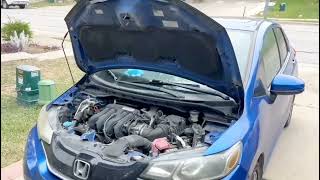
- Internal Failure of the SRS Control Unit 🔴 High Probability This is a known issue acknowledged by Honda's TSB A21100B. The failure is often due to an internal hardware malfunction within the module itself, which cannot be repaired by reprogramming. 🎬 Watch: Understanding the U3000 internal failure code diagnosis
How to confirm: After ruling out all other possibilities (wiring, sensors, power/ground issues) via the manufacturer's diagnostic procedure, the SRS unit is condemned. A professional scan tool is required to confirm the code does not return after testing other components.
Typical fix: Replace the SRS control unit and perform the necessary ODS/SWS (Occupant Detection System/Seat Weight Sensor) calibration.
Est. part cost: $480-$650 - Faulty Seat Weight Sensor (SWS) 🔴 High Probability Honda issued Safety Recall 24-050 for 2020 Fits because the seat weight sensors may not have been built to proper specifications, leading to cracks or short circuits. TSB 24-041 for the Civic explicitly links a faulty SWS to DTC U3000-49.
How to confirm: A technician can follow the TSB's diagnostic tip: disconnect the seat weight sensors and clear the DTC. If the U3000-49 code does not return, the sensor (or the seat frame/rail it's part of) is the culprit.
Typical fix: Replace the faulty seat weight sensor. This may require replacing the entire seat rail assembly, which should be covered under the recall.
Est. part cost: $220-$580 - Low Battery Voltage or Power Supply Issue ⚪ Low Probability Like many control modules, the SRS unit is sensitive to voltage. A weak or failing 12V battery, or a loose battery terminal, can cause various modules to store internal failure codes as a glitch.
How to confirm: Perform a load test on the 12V battery. Check and clean the battery terminals and main power/ground connections to the SRS unit. A forum user reported their SRS light issue was resolved by tightening a loose negative battery terminal.
Typical fix: Replace the weak 12V battery and clear the codes. If connections are corroded or loose, clean and tighten them.
Est. part cost: $150-$300
Rare But Worth Checking
- Wiring Harness Issue: A short to power, short to ground, or open circuit in the wiring between the SRS unit and its sensors (like the seat weight sensor) can mimic a module failure. The official diagnostic procedure includes steps to check for these wiring faults.
- Faulty Multipurpose Front Camera: Though less common for an SRS-only light, a U3000-49 code can also point to an internal failure of the multipurpose camera unit used for Honda Sensing features. This is typically accompanied by multiple ADAS warnings (ACC, LKAS, etc.). Owners on Reddit and Honda-Tech forums have confirmed needing to replace this camera to resolve the code.
Diagnosis Steps
- Verify the complaint: Confirm the SRS warning light is on.
- Scan for codes: Use a Honda-compatible scan tool (like the HDS) to read the SRS module. Confirm that U3000-49 is the active code.
- Check for Recalls and TSBs: Check the vehicle's VIN for eligibility in Safety Recall 24-050 regarding the seat weight sensor. Review TSB A21100B and TSB 24-041 (for Civic, but relevant) for diagnostic guidance.
- Inspect Battery and Connections: Ensure the 12V battery is fully charged and passes a load test. Inspect battery terminals and SRS module power/ground connections for integrity, as loose connections have been reported to cause this issue.
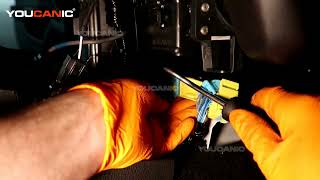
- Follow TSB Diagnostic Procedure: Per TSB 24-041, the primary test is to disconnect the seat weight sensor connectors, clear the DTCs, and see if U3000-49 returns. If it does not, the SWS is faulty. If it does return, the issue lies elsewhere.
- Isolate the Fault: If the SWS test is inconclusive, check the wiring harness for shorts or open circuits per the service manual. If wiring and sensors test good, the failure is likely internal to the SRS unit.
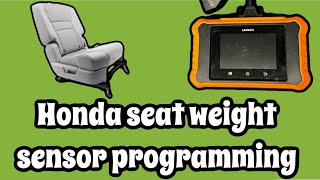
- Replace and Calibrate: If the SRS unit is confirmed to be faulty, replace it. After replacement, the system must be calibrated using a compatible scan tool. This includes the ODS/SWS initialization. 🎬 See how to perform the seat weight sensor initialization
Parts You'll Likely Need
- SRS Control Unit
(OEM #77960-T5R-A23)— This is the indicated failure when the code U3000-49 is set, though it should only be replaced after ruling out sensor and wiring issues.
Trusted brands: Honda (Genuine OEM)
OEM price range: $480-$650
Aftermarket price range: Not Recommended - Front Passenger's Seat Weight Sensor
(OEM #81205-TG7-A02 (Rail Assembly))— This is a common point of failure that can trigger a U3000-49 code and is subject to a safety recall. It should be investigated before replacing the more expensive SRS unit.
Trusted brands: Honda (Genuine OEM)
OEM price range: $220-$330
Aftermarket price range: Not Available
Technical Service Bulletins (TSBs) & Recalls
- A21100B: 'SRS DTC U3000-49 Internal Failure of the SRS Unit' - Notes that there are several possible causes and the SRS unit should be the last part replaced during troubleshooting.
- 24-050: 'Safety Recall: 2020–22 Multi-Model Seat Weight Sensor Campaign Notice' - Includes the 2020 Fit. States improperly built sensors can crack or short, illuminating the SRS indicator.
- 24-041: 'Safety Recall: 2022 Civic Seat Weight Sensor (DTC U3000-49)' - Provides a clear diagnostic path for U3000-49, directly linking it to a faulty seat weight sensor and instructing technicians on how to isolate the fault.
- 16-090: 'Safety Recall: Electric Parking Brake and VSA DTC U3000-49' - While for a 2016 Civic, it shows a history of U3000-49 being used for various module communication errors in the Honda family.
Mechanic-Grade Diagnostic Values
- SWS+/PWR SWS line to power short check — expected: 0.2 V or less. Failure: Voltage greater than 0.2 V indicates a short to power in the harness.
- SWS+/PWR SWS line to ground short check — expected: At least 1 MΩ (Megaohm). Failure: Low resistance indicates a short to ground in the harness.
- Front Passenger's Weight Sensor (SWS) Data List Check (empty seat) — expected: Weight reading (T0) should be within ±0.35 kg (±0.77 lbs) of zero after initialization.. Failure: A reading outside this range after initialization indicates a faulty sensor or incorrect initialization.
- Battery Voltage Check — expected: Above 12.4V. Failure: Voltage below this level can cause spurious control module codes.
Hidden / Shadow Codes Worth Checking
- B2A60-54: Static Camera Aiming Incomplete (see via This code may appear in the ADAS/Integrated Driver Support System module after replacing a faulty multipurpose camera that was causing the primary U3000-49 code. It is visible with a professional scan tool like the Honda HDS and indicates the new camera requires calibration, not that it is faulty.)
Scan Tool Commands That Help
- Honda HDS (or equivalent): SWS Initialization — This function is mandatory after replacing the seat weight sensors or the SRS control unit. It zeroes out the empty seat weight, which is the baseline for the occupant detection system. The typical path is SRS -> Adjustment -> SWS Initialization.
- Honda HDS (or equivalent): All DTC Check — Used as the first step to confirm which module is storing the U3000-49 code and to verify if the code returns after a diagnostic step (like disconnecting the SWS).
- Honda HDS (or equivalent): Steering Neutral Position Learn Procedure — Required after completing the SWS initialization as part of the recall repair procedure to ensure all related safety systems are correctly calibrated.
Wiring & Ground Locations
- SRS Control Unit — Under the center console, towards the front.. This is the location of the primary module associated with DTC U3000-49. Access requires removing the center console to disconnect connectors and unbolt the unit.
- SRS Unit Connector B (39P) — On the SRS control unit under the center console.. The official diagnostic procedure requires disconnecting this connector to perform wiring checks for shorts to power and ground between the SRS unit and the Seat Weight Sensors.
- Seat Weight Sensor Connectors — Under the front passenger's seat.. These connectors are disconnected as the primary step in Honda's recall procedure to determine if the fault lies with the sensors or the SRS unit. If the U3000-49 code does not return with these unplugged, the sensors are the cause.
Real Owner Repair Stories
- Honda-Tech forum user (2018 Honda Fit (similar platform)) — U3000-49 Multipurpose Camera Unit Internal Electronic failure, along with ADAS warnings.
❌ Tried (didn't work) Initial diagnosis pointed towards the ACC (Adaptive Cruise Control) unit or SRS system.
✅ What actually fixed it The problem was a defective Honda Sensing multipurpose camera unit. The owner replaced it with a used part from a 2019 Honda Fit purchased on eBay, which resolved the code without needing dealer calibration. - Ford Edge Forum user (cross-platform example) (2013 Ford Edge) — U3000-49 Control Module Internal Electronic Failure, along with U0401-68.
❌ Tried (didn't work) Considered replacing the PCIM (Powertrain Control Interface Module) or wheel sensors.
✅ What actually fixed it Replacing an old 12V battery resolved the code. This highlights that low or unstable system voltage can cause control modules to erroneously report internal failures.
OEM Part Supersession History
77960-T5R-A22→77960-T5R-A23— Part number has been updated by Honda. 77960-T5R-A23 is the current specified SRS unit for a 2020 Honda Fit.
Helpful Videos
We Have This Part in Stock

The information in this article is provided for general reference and educational purposes only. Vehicle specifications, procedures, and part compatibility can vary by production date, trim level, and region. Always consult your vehicle's factory service manual and verify part numbers before purchasing or performing repairs. Safety-critical components such as airbags, seat belts, and braking systems should be installed by a qualified professional.
- Honda FIT:
- 🎬 Helpful Videos
- 🛍️ Shop This Part
- What's Unique About the 2020-2020 Honda FIT
- Diagnostic Flowchart
- Symptoms You May Notice
- Most Likely Causes
- Rare But Worth Checking
- Diagnosis Steps
- Parts You'll Likely Need
- Technical Service Bulletins (TSBs) & Recalls
- Mechanic-Grade Diagnostic Values
- Hidden / Shadow Codes Worth Checking
- Scan Tool Commands That Help
- Wiring & Ground Locations
- Real Owner Repair Stories
- OEM Part Supersession History
- 🎟️ Get 5% Off