

U3000 on 2010-2020 Ford Vehicles: Control Module Fault Causes and Fixes
On most 2010-2020 Ford vehicles, a U3000 code indicates a control module failure, but it's often caused by a weak battery or a software glitch. Before replacing any expensive parts, fully test the battery and check for software updates. Diagnosis requires a scan tool that can read the module and the two-digit suffix code (e.g., U3000:96).
- U3000 is a generic 'Control Module Failure' code; you MUST find out which module it's in and what the 2-digit suffix is.
- Always test the 12V battery and check its connections first. This is the most common and cheapest fix, especially for power steering faults.
- Check for software updates (TSBs) before replacing any hardware. A simple reprogram by a dealer can often fix the issue.
- This code often involves safety-critical systems like steering and brakes, so professional diagnosis is highly recommended if you are not an experienced DIYer with the right tools.
- Do not replace any control module unless you are certain the battery is good, the software is current, and the wiring is intact.
What's Unique About the 2010-2020 Ford Various

On many modern Fords within this year range, the U3000 code is less about a hardware failure and more often a symptom of two common issues: low system voltage from an aging battery, or a software bug in a module. Ford has released numerous Technical Service Bulletins (TSBs) where the prescribed fix is simply to update the module's software or to address a low voltage condition, not to replace the module itself. For example, TSB SSM 51226 directly links U3000:96 in the Power Steering Control Module (PSCM) on 2021-2023 F-150s to low voltage at startup. This is a shift from older vehicles where a module fault code almost always meant the module was bad.
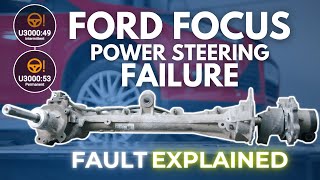
Generation note: This code applies to a wide range of Ford models from this period, including but not limited to the F-150, Focus, Fusion, Edge, and Escape. While the general meaning is the same, specific TSBs and common failure points (like water ingress on Focus/C-Max steering racks) 🎬 See common causes for Ford Focus power steering failure. can be model-specific.
Symptoms You May Notice
- Illumination of ABS, Traction Control, or Brake warning lights.
- "Power Steering Assist Fault" or "Service AdvanceTrac" message on the dashboard.
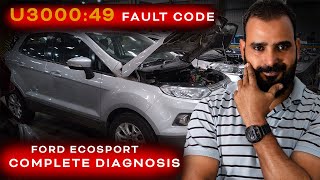
- Complete loss of power steering, making the wheel very heavy to turn. 🎬 Watch: A mechanic explains U3000 codes and steering loss.
- Failure of specific electronic systems, like the power liftgate or driver-assist features.
- Vehicle may enter a 'safety mode' or have certain functions disabled.
- Intermittent failure of electronic systems that resolves after restarting the vehicle.
- Immediately replacing a control module without first testing the battery. A weak battery is a very common and much cheaper fix.
- Replacing a module when only a software update was needed. This leads to unnecessary expense and the new module may still have the same issue if not updated.
- Replacing wheel speed sensors when a U3000:49 code is present in the ABS module. The U3000 code indicates an internal module fault, which should be addressed first, as it can cause false wheel speed sensor codes.
Most Likely Causes

- Weak or Failing 12V Battery 🔴 High Probability Modern Fords have a high electrical demand, and many modules are sensitive to voltage drops during engine startup. A battery that is even slightly degraded can trigger transient low-voltage conditions, especially in the Power Steering Control Module (PSCM).
How to confirm: Use a multimeter to check battery voltage (should be ~12.6V with engine off) and a dedicated battery tester to check its state of health. This is the most common cause for a U3000:96 code in the PSCM, as noted in Ford TSB SSM 51226 for the F-150. The power steering assist may return once sufficient voltage is supplied.
Typical fix: Recharge or replace the 12V battery. After replacement, perform a Battery Monitoring System (BMS) reset using a scan tool like FORScan to ensure the charging system works correctly. Ensure battery terminals and ground connections are clean and tight.
Est. part cost: $150-$350 - Module Software Glitch 🔴 High Probability As vehicle systems become more complex, software bugs are more common. Ford frequently issues TSBs to resolve these issues via software updates.
How to confirm: Use a Ford-specific scan tool (like FDRS or FORScan) to check for available software updates for the module that stored the code. Cross-reference the vehicle, module, and code with known TSBs. For example, TSB SSM 52729 addresses U3000:49 in the ABS module of some models with a software update. NHTSA ODI #11534192 describes a case where a dealer resolved a U3000 code by reprogramming the ABS, PCM, and IPC modules and performing a battery disconnect.
Typical fix: Reprogram the affected module to the latest software calibration level using a dealer-level scan tool. In some cases, a module reset or recalibration procedure in FORScan can resolve the issue.
Est. part cost: $0 (if done under warranty) - $200 (dealer labor) - Internal Module Failure (Hardware) 🟡 Medium Probability This is the default meaning of the code, especially with suffix :49 (Internal Electronic Failure). On models like the 2010-2015 Focus and C-Max, this is often caused by water ingress into the electric power steering rack, damaging the internal electronics and torque sensor. NHTSA ODI #11504310 notes that a pinpoint test for codes U3000:49 and U3000:53 led to a diagnosis of an internal fault with the steering gear.
How to confirm: After ruling out battery and software issues, the module itself is the likely culprit. Inspect the module and its connectors for physical damage or signs of water intrusion. For ABS modules, if codes return immediately after clearing, it strongly points to internal hardware failure.
Typical fix: Replace the faulty module and program the new one to the vehicle, or send the original module to a service like ACTRONICS for remanufacturing, which can be significantly cheaper. Programming the new module with the vehicle's 'As-Built' data is required.
Est. part cost: $300-$1500+
Rare But Worth Checking
- Wiring or Connector Issue: While less common than battery or software issues, a damaged wire or corroded connector pin for the affected module can interrupt power, ground, or communication, leading to a U3000 code. NHTSA ODI #11725446 suggests that U3000:89 and U3000:49 can be caused by faulty cable connections where condensation has caused corrosion.
- Impact Damage: Following an accident, especially involving a front wheel, the electric power steering rack can suffer internal damage that is not visually apparent, triggering a U3000 code. One F-150 owner reported a persistent U3000:96 after replacing suspension components from an accident, with the likely cause being an internally damaged steering rack.
Diagnosis Steps
- Connect an advanced OBD-II scanner (such as FORScan or a professional-grade tool) capable of reading manufacturer-specific codes from all vehicle modules.
- Identify which specific module has stored the U3000 code (e.g., PSCM, ABS, IPMA, BCM).
- Record the critical two-digit suffix (e.g., :49, :96, :53).
- CRITICAL FIRST STEP: Thoroughly test the 12V battery. Check its voltage at rest (~12.6V), during cranking (should stay above 10V), and its overall state of health with a proper battery tester. Low voltage is a primary cause.
- Inspect the battery terminals and main chassis ground points for cleanliness and tightness. A poor ground can mimic a bad battery.
- Check for any available Technical Service Bulletins (TSBs) for your vehicle's year, model, and the specific U3000 code and suffix. Check NHTSA's website or professional repair databases.
- If TSBs suggest a software update, have the module reprogrammed. For DIYers, FORScan may offer module reset or calibration procedures that can resolve software glitches.
- If the battery is healthy and no software updates are available, inspect the wiring harness and connectors going to the affected module for any visible damage, corrosion, or loose pins.
- If the code points to the ABS module (especially U3000:49) and returns immediately after clearing, internal failure is highly likely.
- If the code points to the PSCM and is not resolved by a battery or software fix, suspect the steering rack itself, especially on models prone to water intrusion like the Focus/C-Max.
- If all other steps fail to resolve the issue, the control module itself is the most likely cause and will need to be replaced or remanufactured. Replacement requires programming with the vehicle's As-Built data.
Parts You'll Likely Need
- 12V Vehicle Battery — A weak or failing battery is the most common trigger for U3000 codes, especially U3000:96 in the power steering module.
Trusted brands: Motorcraft, Interstate, DieHard
OEM price range: $200-$350
Aftermarket price range: $150-$250 - ABS Control Module
(OEM #DT4Z2C405F)— A common failure point, especially with code U3000:49. The ATE MK100 unit used in many Fords is known to fail internally and can often be remanufactured.
Trusted brands: Motorcraft, ATE (OEM), ACTRONICS (Remanufacturing Service), Module Master (Remanufacturing Service)
OEM price range: $800-$1500
Aftermarket price range: $200-$500 (for remanufacturing service) - Electric Power Steering Rack Assembly — On models like the Focus, C-Max, and Explorer, the internal control module (PSCM) is integrated into the rack. Failure of the module, often from water ingress or internal electronics, requires replacement of the entire assembly.
Trusted brands: Motorcraft, Cardone (Remanufactured), Bosch
OEM price range: $1200-$2000
Aftermarket price range: $600-$1200
Related Codes That Often Appear With This One
- U3003:16 / U3003:13 — This code indicates low battery voltage. It frequently appears alongside U3000, especially U3000:96, and strongly suggests the battery is the root cause.
- U3000:49 — This suffix indicates an 'Internal Electronic Failure' and is a common variant of the U3000 code, often pointing to a true hardware fault within the module, such as the ABS or PSCM.
- U3000:96 — This suffix often relates to an internal component or communication failure within the module, frequently triggered by low voltage in the Power Steering Control Module (PSCM).
- C102D-00 — On Ford Focus and C-Max models, this code for 'High Friction Inside Power Steering' often accompanies U3000 codes and points to mechanical failure or water ingress within the steering rack.
Technical Service Bulletins (TSBs) & Recalls

- SSM 51226: Addresses U3000:96 and U3001:89 in the PSCM of 2021-2023 F-150s, identifying low battery voltage as the cause and providing a reset procedure.
- SSM 52729: Pertains to U3000:49 in the ABS module of some models, with the fix being a software update.
- TSB 19-2314: An earlier TSB that may relate to module software updates for similar communication codes.
- SSM 50484: Predecessor to SSM 51226, also linking power steering faults to low voltage.
Platform-Specific Known Issues
- On 2010-2015 Ford Focus and C-Max models, water can leak past the bulkhead boot and enter the electric power steering rack, causing corrosion and triggering U3000:49, which can become a permanent U3000:53 code.
- On 2021-2023 F-150s, TSB SSM 51226 notes that U3000:96 can be set in the PSCM if battery voltage drops below 8 volts during startup.
Mechanic-Grade Diagnostic Values
- CAN Bus Communication Line Voltage (PSCM) — expected: Approximately 2.5V on each of the two CAN lines (CAN-High and CAN-Low) with key on, engine off.. Failure: Significant deviation from 2.5V, or one line being shorted to ground (0V) or power (5V/12V), indicates a wiring or module communication fault.
- PSCM Main Power Supply Voltage — expected: Should be equal to battery voltage (approx. 12.6V with engine off, ~14V+ with engine running).. Failure: Low or no voltage at the PSCM main power feed connector indicates a blown fuse (often a large 80-125A fuse), corroded connection, or wiring failure between the battery/fuse box and the steering rack.
Hidden / Shadow Codes Worth Checking
- U3000:53: Control Module: Deactivated/Not Configured. This code often sets after a U3000:49 has been flagged multiple times. It becomes a hard, non-erasable fault stored in the module's EEPROM, indicating a permanent internal failure has been logged. (see via Ford-specific scanners like FORScan or IDS.)
- U3000:97: Component or System Obstructed/Blocked. Often seen in radar-based modules like Blind Spot Monitoring (BSM). It indicates the sensor's performance is degraded, possibly due to dirt, ice, or a misaligned bumper cover blocking the radar's view. (see via Ford-specific scanners like FORScan or IDS.)
Scan Tool Commands That Help

- FORScan / Ford IDS: Programmable Module Installation (PMI) — This function is used when replacing a control module. It downloads the configuration data (As-Built data) from the old module and uploads it to the new one, ensuring all vehicle-specific options are correctly configured.
- FORScan / Ford IDS: Module Configuration (As-Built format) — Used to manually edit a module's configuration data. This is necessary if the original module is dead and its data cannot be retrieved via PMI, or for retrofitting features. The correct As-Built data for the specific VIN must be obtained from Ford's service site.
- FORScan: PSCM Reset / ABS Self-Test — These are service procedures that can sometimes resolve temporary software glitches or communication errors. Running a self-test can confirm if the module is communicating and functioning correctly after a potential fix (like a battery replacement).
Wiring & Ground Locations
- Main Battery Ground (F-150) — On the body sheet metal just in front of the washer fluid reservoir in the engine bay.. Corrosion at this primary ground point can cause widespread, intermittent low voltage issues, tricking modules like the PSCM or ABS into setting U3000 codes. It mimics a failing battery.
- PCM Grounds (F-150) — Located on the firewall in the engine compartment. There can be one or two ground studs depending on the model year and engine.. While primarily for the Powertrain Control Module, a poor ground here can introduce electrical noise and instability to the entire vehicle network, potentially causing communication-related U-codes in other modules.
- Passenger Compartment Ground Bundle (F-Series) — Behind the passenger-side kick panel, where a large number of ground wires converge on a single stud.. This ground point is notorious for corrosion, especially in wet climates. A failure here can affect numerous interior modules, including the Body Control Module (BCM) or Instrument Panel Cluster (IPC), leading to various U-codes.
Real Owner Repair Stories
- Ford Focus Fanatics & ECU Testing Reports (2010-2015 Ford Focus/C-Max) — Sudden loss of power steering with "Power Steering Fault" message. Codes U3000:49 and eventually a non-erasable U3000:53.
❌ Tried (didn't work) Replacing the battery., Clearing codes with a basic scanner.
✅ What actually fixed it The root cause was water ingress into the electric power steering rack's torque sensor housing. This required replacing the entire steering rack assembly. The U3000:53 code indicates a permanent fault has been logged that cannot be cleared, necessitating hardware replacement. - Ford Edge Forum / Reddit MechanicAdvice (2014 Ford Edge Limited) — ABS, AdvanceTrac, and Adaptive Cruise Control (ACC) warning lights on. Intermittent faults.
❌ Tried (didn't work) Replacing the 12V battery.
✅ What actually fixed it FORScan revealed a U3000:49 in the ABS module. After ruling out wiring, the ABS module itself was determined to have an internal electronic failure. The common fix is to either replace the module and have it programmed by a dealer, or send the original module to a remanufacturing service like ACTRONICS or Module Master, which is often cheaper and may not require reprogramming. - F150Forum.com (2021 Ford F-150 King Ranch) — "Adaptive Steering Fault" message with code U3000:96 after an accident and replacement of front suspension components.
❌ Tried (didn't work) Clearing codes., Ensuring all new suspension parts were installed correctly.
✅ What actually fixed it The impact from the accident caused internal, non-visible damage to the electronic steering rack assembly. Even though the power assist was still working, the internal sensors detected a fault. The resolution required replacing the entire steering rack assembly. - NHTSA ODI #11447182 — An owner reported that their power steering became inoperative with code U3000 stored. The solution required replacing the PSCM, which is integrated into the steering rack, and programming the new unit.
OEM Part Supersession History
Various (ATE MK100 ABS Module)→Various revisions— The ATE MK100 ABS module, used widely across the Ford lineup (Fiesta, Focus, Edge, etc.) from around 2012 onwards, is a known high-failure part for U3000:49.
Heads up: When replacing, the new module must be programmed with the vehicle's As-Built data. A cheaper and often more reliable solution is to have the original module remanufactured by a specialist service, which repairs the internal flaws and typically does not require reprogramming upon reinstallation.
Model Year Variations Within This Range
- 2013-2019 (Explorer): On the 5th generation Explorer, a U3000 code in the PSCM is very frequently a sign of a catastrophic, non-repairable failure of the entire power steering rack, requiring replacement.
- 2020 (Explorer): On the 6th generation 2020 Explorer, Ford issued TSBs indicating that U3000 codes in the ABS, camera, or cruise control modules are often software glitches that can be resolved with a simple module reprogram, rather than a hardware replacement.
- 2010-2015 (Focus/C-Max): These models are highly prone to power steering failure from water ingress damaging the EPAS rack's internal electronics and torque sensor, leading to U3000:49 and U3000:53 codes.
Diagnostic Flowchart
Other Known Issues on This Vehicle
Issues unrelated to this code that are worth knowing about as an owner of this generation:
- DPS6 PowerShift Transmission Failure 🔴 High — Extremely common on 2012-2016 Focus and 2011-2016 Fiesta. Issues include shuddering, hesitation, and complete loss of drive, often within 30k-60k miles. (Ref: Multiple lawsuits and extended warranties (e.g., 10yr/150k miles) were issued, but no full safety recall in the US.)
- 3.5L EcoBoost Timing Chain Rattle on Cold Start 🔴 High — Common on first-generation 3.5L EcoBoost engines (approx. 2011-2015) in F-150s and other models, typically appearing after 60,000 miles. Can lead to catastrophic engine failure if ignored. (Ref: Ford issued multiple TSBs, including 15-0131, which updated the repair procedure to include replacing cam phasers along with the timing chain.)
- MyFord Touch / SYNC Infotainment System Failures 🟠 Medium — Widespread on many 2011-2016 Ford and Lincoln models. Symptoms include system freezing, unresponsiveness to touch/voice commands, and navigation failure. (Ref: Resulted in a $17 million class-action lawsuit settlement. The fix was primarily software updates, with some owners receiving small cash payments.)
- Internal Water Pump Failure (3.5L/3.7L Duratec V6) 🔴 High — Affects models like Edge, Flex, and Taurus with the transverse-mounted V6. The internally-mounted, chain-driven water pump can fail without warning, leaking coolant directly into the engine oil, causing catastrophic engine damage. Often occurs between 80k-120k miles.
- 1.6L EcoBoost Engine Overheating/Coolant Leaks 🔴 High — Common in Ford Escape and Fusion models. Prone to coolant leaks and overheating, which can lead to cracked cylinder heads and engine fires. (Ref: Subject to multiple recalls (e.g., NHTSA recall 17V-209) and customer satisfaction programs.)
Used vs. New Parts: Buying Guide for This Vehicle
When a used part is the smart pick: A used part can be a cost-effective option for a complete steering rack assembly, especially if the failure is mechanical. However, for purely electronic modules like an ABS controller, buying a used part is only recommended if your plan is to immediately send it to a reputable remanufacturing service before installation. This avoids installing another potentially faulty used unit.
Donor-vehicle mileage cap: roughly under 80000 miles for the part to have meaningful remaining life.
What to inspect on the donor part:
- Inspect all electrical connectors for corrosion, bent pins, or cut wires.
- Check the module housing for cracks or signs of being opened previously.
- For steering racks, check the boots for tears and look for signs of significant rust or water damage on the assembly.
- Obtain the VIN of the donor vehicle to check its history for major accidents, which could have caused unseen internal damage.
OEM-only on this vehicle (don't cheap out):
- Due to the critical need for VIN-specific programming ('As-Built' data), replacing a failed module with a brand new OEM part from a dealer is the most straightforward, albeit expensive, path. A used module may be VIN-locked or have an incompatible software version, causing programming headaches.
Aftermarket brands forum-validated for this vehicle:
- ACTRONICS (Module Remanufacturing)
- ECU Testing (Module Remanufacturing)
- Module Master (Module Remanufacturing)
- Cardone (Remanufactured Steering Racks)
Brands owners have reported issues with on this vehicle:
- Unknown, no-name electronic modules from online marketplaces. These often have high failure rates and can be difficult or impossible to program correctly.
Documented NHTSA Reports
NHTSA ODI #11555924
An owner reported a cylinder 4 misfire (P0304) alongside code U3000-04. The report mentions constant coolant leaks with no visible external leak, similar to issues described in other Ford recalls.
NHTSA ODI #11725446
A report describes other systems being disabled with DTCs C1001:31, U3000:89, and U3000:49. The issue was attributed to faulty cable connections where condensation caused corrosion.
Real Owner Stories
Aggregated from forums and TSBs cited above. Mileages and costs reflect what owners reported in those sources.
Ford F-150
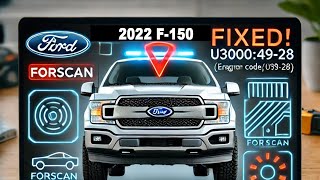
Symptoms: A U3000:49 code was present in the Image Processing Module A (IPMA).
What fixed it: The owner ran a module recalibration service procedure using FORScan software, which resolved the fault without replacing parts.
Source hint: YouTube video demonstrating a FORScan-based fix for U3000:49 in an F-150 IPMA module.
2010-2015 Ford Focus
Symptoms: Loss of power steering with a U3000:49 code, which eventually became a permanent U3000:53 code.
What fixed it: The root cause was water leaking past the bulkhead boot and into the electric power steering rack, requiring repair of the leak and replacement or remanufacturing of the steering rack.
Source hint: vehicle_specific_issues
Ford Edge
Symptoms: ABS and Traction Control lights were on due to a U3000:49 code stored in the ABS module.
What fixed it: After ruling out other causes, the fix is to replace the ABS module and program the new unit with the vehicle's 'As-Built' data.
Source hint: Ford Edge forum user details their diagnosis of U3000:49 in the ABS module, including As-Built data retrieval.
Ford Fiesta
Symptoms: A U3000:49 code was present, prompting investigation.
What fixed it: The owner was advised that the critical first step is to thoroughly test the 12V battery, as low voltage is a primary cause of this code before condemning the module itself.
Source hint: Reddit thread discussing U3000:49 on a Fiesta and the importance of checking battery voltage first.
Related OBD-II Codes
Frequently Asked Questions
My 2014 Focus lost power steering. Could this be the known water leak issue?
I have a U3000:49 code in my ABS module. Does TSB SSM 52729 mean I just need a software update?
My F-150 is showing a 'Power Steering Assist Fault' and has a U3000:96 code. What does TSB SSM 51226 say about this?
I just replaced the battery in my Ford Edge but still have electronic issues. What did I miss?
The dealer wants to replace the ABS module for $1500. Is there a cheaper option?
My Lincoln MKX has a U3000:49 code. Is this the same problem as on the Ford Edge?
Helpful Videos


The information in this article is provided for general reference and educational purposes only. Vehicle specifications, procedures, and part compatibility can vary by production date, trim level, and region. Always consult your vehicle's factory service manual and verify part numbers before purchasing or performing repairs. Safety-critical components such as airbags, seat belts, and braking systems should be installed by a qualified professional.
- Ford Various:
- 🎬 Helpful Videos
- What's Unique About the 2010-2020 Ford Various
- Symptoms You May Notice
- Most Likely Causes
- Rare But Worth Checking
- Diagnosis Steps
- Parts You'll Likely Need
- Related Codes That Often Appear With This One
- Technical Service Bulletins (TSBs) & Recalls
- Platform-Specific Known Issues
- Mechanic-Grade Diagnostic Values
- Hidden / Shadow Codes Worth Checking
- Scan Tool Commands That Help
- Wiring & Ground Locations
- Real Owner Repair Stories
- OEM Part Supersession History
- Model Year Variations Within This Range
- Diagnostic Flowchart
- Other Known Issues on This Vehicle
- Used vs. New Parts: Buying Guide for This Vehicle
- Documented NHTSA Reports
- NHTSA ODI #11555924
- NHTSA ODI #11725446
- Real Owner Stories
- Ford F-150
- 2010-2015 Ford Focus
- Ford Edge
- Ford Fiesta
- Related OBD-II Codes
- Frequently Asked Questions
- 🎟️ Get 5% Off