

U3000 on 2017-2018 Ford Fusion: Control Module Fault Causes and Fixes
The U3000 code on a 2017-2018 Ford Fusion means a control module has an internal failure. It's critical to identify which module is affected (e.g., airbag, cruise control, SYNC, or power steering). The most common fix, documented in multiple Ford TSBs, is a software update performed by a dealer. A weak battery or a faulty Power Steering Control Module (PSCM) are other notable causes.
- U3000 is a generic internal failure code; you MUST use a good scanner to find out which module is at fault.
- For the 2017-2018 Fusion, check for TSBs first. A software update at the dealer is the most common and official fix.
- Before considering expensive module replacement, always test the battery and charging system. Low voltage is a common trigger for this code.
- If the airbag light is on, treat the issue as a high-priority safety concern as the system may be disabled.
- Do not replace any parts until you have a specific diagnosis pointing to a module that has the latest software and has been confirmed to be faulty.
What's Unique About the 2017-2018 Ford FUSION

On this generation of Ford Fusion and its platform-mate the Lincoln MKZ, the U3000 code is exceptionally well-documented in manufacturer Technical Service Bulletins (TSBs). [SSM 48049, SSM 46901, SSM 46109, SSM 46048] Unlike many vehicles where this code might point to a bad module or wiring, on the Fusion it very frequently indicates a software glitch. Ford has issued multiple software updates to resolve this code in various modules, from the airbag system to the adaptive cruise control, making a trip to the dealer for reprogramming a common and effective solution.
Diagnostic Flowchart
Tap your situation to follow the diagnostic path that matches what you're seeing on this vehicle.
Symptoms You May Notice
- Air Bag warning lamp illuminated on the dashboard. [SSM 46109]
- "Collision Warning Not Available" message in the instrument cluster. [SSM 48049]
- "Adaptive Cruise Fault" message. [SSM 48049]
- SYNC 911 assist not operational message. [SSM 46901]
- Sudden loss of power steering assist, making the wheel extremely hard to turn, often upon starting the vehicle.
- ABS and Traction Control lights may illuminate, sometimes in conjunction with a power steering fault.
- Replacing a control module before checking for software updates. Given the number of TSBs for this issue, reprogramming should be the first step. One owner on Reddit reported a dealer quoted a new RCM, but an independent shop performed the TSB software update and fixed it for a fraction of the cost.
- Ignoring a weak battery. Many owners chase complex electronic issues when the root cause is simply an old battery causing voltage drops.
- Replacing a battery without performing a Battery Management System (BMS) reset. The system will continue to treat the new battery like the old, degraded one, leading to incorrect charging and potential recurrence of electrical faults.
Most Likely Causes

- Control Module Software Glitch 🔴 High Probability Ford has released multiple Technical Service Bulletins (TSBs) to address software anomalies in the RCM, CCM, and APIM that cause a U3000 code. This is the most common documented cause.
How to confirm: A Ford dealer or a shop with an IDS/FDRS scan tool can check the current software calibration of the affected module against the latest available version referenced in the TSBs.
Typical fix: Reprogramming the specific control module (RCM, CCM, or APIM) to the latest software level. Forum users report dealer costs for this service are typically around one hour of labor ($150-$200).
Est. part cost: $0 - Low Battery Voltage or Weak Battery 🟡 Medium Probability These vehicles use a Battery Management System (BMS) that monitors battery health. An aging battery can cause voltage drops during startup, triggering internal fault codes in sensitive modules before the alternator takes over.
How to confirm: Test the battery voltage with a multimeter. A healthy, fully charged battery should read approximately 12.6 volts with the engine off. Check the charging system voltage (should be ~13.7-14.7 volts) with the engine running. If replacing the battery, the BMS must be reset.
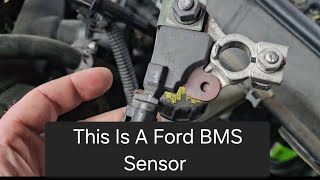
Typical fix: Charge or replace the vehicle's 12V battery. After replacement, perform a BMS reset. This can be done with a tool like FORScan or via a specific sequence of flashing the high beams and pressing the brake pedal. 🎬 Watch: How to perform a manual BMS reset yourself Failure to reset the BMS can lead to improper charging and a return of electrical issues.
Est. part cost: $150-$300 - Faulty Control Module ⚪ Low Probability While less common than software issues, the module itself can fail internally due to hardware problems. This is particularly noted with the Power Steering Control Module (PSCM), which is often integrated into the steering rack.
How to confirm: This is a diagnosis of exclusion. If the battery is healthy and the module's software is up-to-date according to TSBs, and the code persists after being cleared, the module itself is suspect. For the PSCM, if the code won't erase, the entire steering rack/module assembly often needs replacement.
Typical fix: Replace the failed module (e.g., RCM, CCM, APIM, or the entire steering rack for a PSCM failure) and program the new unit to the vehicle.
Est. part cost: $300-$1500
Rare But Worth Checking
- Wiring Harness or Connector Issue: A poor connection, corrosion, or damaged wire leading to the affected module can cause communication errors and trigger a U3000 code. This should be investigated before replacing an expensive module.
- Faulty Power Steering Control Module (PSCM) / Steering Rack: Multiple owner forums report a U3000 code stored in the PSCM, resulting in a complete and sudden loss of power assist. In these cases, reprogramming is often ineffective, and the entire electronic power steering rack, which contains the module, must be replaced.
Diagnosis Steps
- Connect a high-quality OBD-II scanner capable of reading manufacturer-specific codes from all modules (e.g., FORScan with a compatible adapter).
- Identify which specific module has stored the U3000 code (e.g., RCM, CCM, APIM, PSCM). Note any suffix codes (e.g., :49, :04). 🎬 Watch: Using FORScan to diagnose and fix U3000:49 codes
- Check and record the vehicle's battery voltage with the engine off and while running. A stable voltage is critical. Check the battery's age, as batteries over 4-5 years old are suspect.
- Search for Technical Service Bulletins (TSBs) related to the U3000 code for your specific vehicle and the identified module. The NHTSA website is a good source for these.
- If a TSB exists recommending a software update (like SSM 48049, 46901, or 46109), this is the most likely solution. This requires a trip to a dealer or a shop with Ford's IDS/FDRS software.
- If the battery is weak, replace it and perform a BMS reset using FORScan or the manual procedure (flashing high beams 5 times, pressing brake 3 times within 10 seconds). Then clear codes and see if they return.
- If no TSB applies or reprogramming does not fix the issue, inspect the wiring and connectors going to the affected module for any signs of damage, corrosion, or looseness.
- If wiring, power supply, and software are all confirmed good, the module itself is likely faulty and requires replacement and subsequent programming.
Parts You'll Likely Need

- Cruise Control Module (CCM)
(OEM #HG9T-9G768-BG)— If the CCM has failed (and reprogramming doesn't work), it will need to be replaced to restore adaptive cruise control functions. TSB 48049 points to software as the primary fix.
Trusted brands: Motorcraft
OEM price range: $400-$700
Aftermarket price range: $250-$500 - Restraints Control Module (RCM)
(OEM #HS7T-14B321-AD (Note: Part numbers are VIN-specific, always verify))— A faulty RCM will keep the airbag light on and must be replaced to ensure the safety system is operational. This is a safety-critical part. Often fixed by a software update per TSBs 46901/46109.
Trusted brands: Motorcraft
OEM price range: $300-$500
Aftermarket price range: $200-$400 - Accessory Protocol Interface Module (APIM) — This module controls the SYNC infotainment system. A U3000 code here might be fixed by clearing it, but a persistent code could require module replacement to fix SYNC issues.
Trusted brands: Motorcraft
OEM price range: $500-$800
Aftermarket price range: $350-$600
Related Codes That Often Appear With This One
- U2100, U2101, U2300 — These are also communication or configuration codes that are often logged alongside U3000 in the RCM, as noted in TSBs SSM 46901 and SSM 46109. 🎬 See this walkthrough for fixing U3000 airbag light codes
- U3000:49 — This specific variation points to an internal electronic failure within the module. TSB SSM 48049 links this directly to the Cruise Control Module (CCM) needing a software update on Fusions and other Ford/Lincoln models.
- U3000:04 — This suffix is mentioned in TSB SSM 46048 for the APIM (SYNC module) and TSB SSM 47223 for the BECM (on hybrid models), where it can sometimes be ignored if no symptoms are present.
Technical Service Bulletins (TSBs) & Recalls
- SSM 48049: Adaptive Cruise Fault message and DTC U3000:49 in the CCM.
- SSM 46901: Air bag and SYNC 911 assist issues with DTC U3000 in the RCM.
- SSM 46109: Air bag lamp on with DTC U3000 in the RCM.
- SSM 46048: DTC U3000:04 in the APIM with no symptoms.
- SSM-45809: General TSB for U3000 in the SYNC 3 APIM.
Platform-Specific Known Issues
- SSM 48049: Some 2017-2018 Fusions may show 'Collision Warning Not Available' or 'Adaptive Cruise Fault' messages with DTC U3000:49 in the CCM. The official fix is to reprogram the CCM.
- SSM 46901 & 46109: These bulletins address an airbag light with U3000 (and other codes) in the RCM. The fix is to reprogram the RCM. SSM 46109 applies to vehicles built on or before August 18, 2016.
- SSM 46048: This addresses U3000:04 in the APIM (SYNC 3 module). If no other symptoms are present, Ford advises to simply clear the code.
Mechanic-Grade Diagnostic Values
- PSCM Main Power Supply Voltage — expected: 12 Volts (Battery Voltage) at the large gauge wire (e.g., Yellow/Red) on the PSCM connector with key on.. Failure: Voltage significantly below battery voltage indicates a problem with the power feed fuse (often a large 125A fuse) or wiring.
- PSCM Module Power Supply Voltage — expected: 12 Volts (Battery Voltage) at the smaller gauge power wire (e.g., Brown/White) on the PSCM connector with key on.. Failure: No voltage indicates a blown fuse (e.g., 10A fuse in the engine compartment fuse box) or a wiring issue.
- PSCM Motor Ground Circuit Voltage Drop — expected: Less than 100 millivolts (0.1V) between the main ground wire at the PSCM connector and a known good chassis ground.. Failure: Higher voltage indicates a poor ground connection, which can cause the module to malfunction under load.
- CAN Bus Voltage (at module connector) — expected: CAN High (HS-CAN+) should be around 2.6V and CAN Low (HS-CAN-) should be around 2.4V with the key on.. Failure: Voltages that are stuck high, low, or match each other indicate a network communication problem, not necessarily an internal module fault.
Hidden / Shadow Codes Worth Checking
- U3000:49: Internal Electronic Failure. This is the most common suffix code seen with U3000 on this platform and is specifically called out in TSB SSM 48049 for the CCM and is frequently seen with ABS and PSCM failures. (see via FORScan, Ford IDS/FDRS, or other professional-grade scan tools that can read manufacturer-specific DTCs.)
- U3000:04: System Internal Failures. This suffix is mentioned in TSB SSM 46048 for the APIM (SYNC) module. Ford's advice is often to clear this code and take no further action if no symptoms are present. (see via FORScan, Ford IDS/FDRS, or other professional-grade scan tools.)
Scan Tool Commands That Help

- FORScan / Ford IDS/FDRS: PSCM - Reset the Power Steering Control Module — This service function should be used after a battery replacement, after clearing codes related to low voltage, or as a first step when a U3000 is found in the PSCM. A TSB for some Ford models notes this can restore function after a code is set by a battery charger.
- FORScan / Ford IDS/FDRS: RCM - Self Test — To command the Restraints Control Module to perform an internal diagnostic check. This can help confirm if a U3000 code is a hard, persistent fault before attempting to reprogram or replace the module.
- FORScan / Ford IDS/FDRS: BMS Reset — This is a critical step after replacing the vehicle's 12V battery. It tells the Battery Management System the state-of-charge and health of the new battery, ensuring proper charging strategy and preventing spurious low-voltage codes.
- Ford IDS/FDRS: Programmable Module Installation (PMI) — This function is required when a new control module (like a PSCM, RCM, or APIM) is installed. It downloads the correct software and configuration data (As-Built data) for that specific vehicle's VIN and options.
Wiring & Ground Locations
- G111 / G112 — Located on the left front of the engine compartment.. These are primary engine compartment grounds. A loose or corroded connection here can cause unstable voltage to multiple modules, including the PSCM and CCM, potentially triggering a U3000 code.
- G200 / G201 — Located at the left center of the dash, typically behind the lower dash panels.. These are major interior ground points. Modules like the RCM (Airbag) and APIM (SYNC) rely on these grounds. A poor connection can lead to internal fault codes.
- PSCM Connector — On the electronic power steering rack itself, under the vehicle.. This is the primary connection for all power, ground, and communication signals to the power steering system. It is exposed to road debris and moisture, making it a point of failure. Verifying power and ground at this connector is a key diagnostic step before condemning the entire rack.
Real Owner Repair Stories
- Ford Fusion Owners Club Forum (Ford Fusion (year not specified, but relevant to EPAS)) — Complete loss of power steering, making the wheel extremely hard to turn. Steering indicator light was on. The issue would typically appear on startup.
❌ Tried (didn't work) Attempting to clear the U3000 code with a scan tool. The code would not erase.
✅ What actually fixed it The entire power steering rack assembly, which includes the integrated Power Steering Control Module (PSCM), had to be replaced. The source notes that if the U3000 code will not erase, replacement is the most likely fix. - Reddit r/MechanicAdvice (2013 Ford Edge with 163k miles (similar ABS system)) — Brake, ABS, and AdvanceTrac warning lights on. DTC U3000-49 was present in the ABS module.
❌ Tried (didn't work) A mechanic suggested replacing and reprogramming the ABS module for $1100. The owner noted the lights were intermittent, coming on for weeks at a time and then disappearing.
✅ What actually fixed it The user was still in the diagnostic process, but was advised by others to check wheel speed sensors and clean the module grounds before paying for a full module replacement, especially since the fault was intermittent and had no drivability symptoms. This highlights the importance of checking basic inputs and connections before expensive module replacement.
When the Usual Fixes Don't Work
- While software updates and battery issues are the most common fixes, there are numerous documented cases, particularly for the Power Steering Control Module (PSCM), where the U3000 code indicates a non-recoverable internal hardware failure. In these instances, no amount of reprogramming or battery replacement will resolve the issue. The code will refuse to be cleared, and the only solution is the physical replacement of the entire steering rack assembly, which contains the integrated PSCM. This is a diagnosis of exclusion after software and power/ground integrity have been confirmed.
OEM Part Supersession History
HS7T-14B321-AD→HS7T-14B321-AE, AF, AG— Internal revisions and software updates to the Restraints Control Module (RCM).
Heads up: While later revisions should be backward compatible when properly programmed, using a module from a different vehicle without performing the PMI (Programmable Module Installation) with Ford IDS/FDRS will result in a U3000 or other configuration codes. Services exist to reset crash data from used modules, but they must match the original part number family.
Model Year Variations Within This Range
- 2017: TSB SSM 46109 specifically calls out 2017 Fusion/MKZ vehicles built on or before 18-AUG-2016 for an RCM reprogram to fix a potential U3000 code. Vehicles built after this date likely have the updated software from the factory.
Helpful Videos
![Avoid Expensive Shop Repairs: DIY Reset the Ford Vehicle Battery Monitoring System [BMS]](https://img.youtube.com/vi/QTtb7rKaZTE/mqdefault.jpg)
Used OEM Parts in Stock


New Aftermarket Parts Available


The information in this article is provided for general reference and educational purposes only. Vehicle specifications, procedures, and part compatibility can vary by production date, trim level, and region. Always consult your vehicle's factory service manual and verify part numbers before purchasing or performing repairs. Safety-critical components such as airbags, seat belts, and braking systems should be installed by a qualified professional.
- Ford FUSION:
- 🎬 Helpful Videos
- 🛍️ Shop This Part
- What's Unique About the 2017-2018 Ford FUSION
- Diagnostic Flowchart
- Symptoms You May Notice
- Most Likely Causes
- Rare But Worth Checking
- Diagnosis Steps
- Parts You'll Likely Need
- Related Codes That Often Appear With This One
- Technical Service Bulletins (TSBs) & Recalls
- Platform-Specific Known Issues
- Mechanic-Grade Diagnostic Values
- Hidden / Shadow Codes Worth Checking
- Scan Tool Commands That Help
- Wiring & Ground Locations
- Real Owner Repair Stories
- When the Usual Fixes Don't Work
- OEM Part Supersession History
- Model Year Variations Within This Range
- 🎟️ Get 5% Off