

OBD-II Code U2701: Network Communication Fault
What U2701 means, why it triggers, and how to fix it
- U2701 is a manufacturer-specific code indicating a CAN bus communication failure, requiring a full-system scan tool to identify the offline module.
- Check the basics first: over 50% of U2701 codes stem from a weak battery (under 12.4V), a blown module fuse, or a corroded ground wire.
- Expect multiple dashboard warning lights and a forced 'limp mode' that restricts vehicle speed to 35-45 mph to protect the powertrain.
- Never replace a $500+ control module without first using a multimeter to verify it receives full battery voltage and has a ground voltage drop under 0.1 volts.
What Does U2701 Mean?
U2701 is a manufacturer-specific network trouble code. It indicates a specific control module on your vehicle's communication network (the CAN bus) has stopped talking or is sending invalid data. Your car's computers operate as a synchronized team; this code means one module has gone silent, causing a system-wide fault.
Technical definition: There is no standardized SAE/ISO definition for U2701; its exact meaning depends on the vehicle's make and model. However, all 'U' codes relate to faults in the Controller Area Network (CAN bus). The code sets when a module fails to send or receive messages within a specified timeframe. A U-code logged by a specific module means that module cannot hear from another module on the network.
Can I Drive With U2701?
Yes, But With Caution. You can drive, but it is highly dangerous. The vehicle enters a 'limp mode,' limiting speed to 35-45 mph and locking the transmission in a single gear. This creates a significant safety hazard in traffic due to poor acceleration. Furthermore, critical safety systems like ABS, traction control, and stability control are disabled. Drive only a short distance to a repair facility.
Common Causes
- Poor Battery Voltage or Bad Ground Connection (Very Common) — Vehicle computers require a stable 12-volt supply. A weak battery (under 12.4V), a failing alternator, or a corroded main ground wire causes unpredictable communication dropouts between modules.
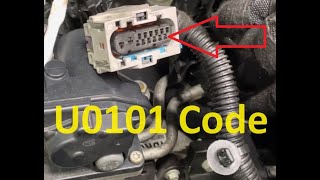
- Corroded, Damaged, or Loose Wiring (Very Common) — Vibration, moisture, and physical damage break wires or corrode connector pins, interrupting the CAN bus signal. 🎬 Watch: A pro mechanic's guide to troubleshooting CAN communication faults. This is especially common in harnesses exposed under the vehicle.
- Aftermarket Devices (OBD-II Plug-ins) (Common) — Plug-in insurance trackers, fleet monitors, custom tuners, or remote starters frequently interfere with the CAN bus. Always unplug these devices first when diagnosing network faults.
- Blown Module Fuse (Common) — Every control module has a dedicated fuse. If this fuse blows, the module loses power and drops off the network, triggering U-codes in all other modules trying to communicate with it.
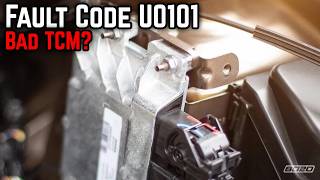
- Faulty Control Module (ABS, TCM, BCM) (Less Common) — The electronic module itself fails internally due to heat, moisture, or age. This is common with ABS modules and Transmission Control Modules (TCM) mounted in harsh environments. 🎬 See how to diagnose and fix lost communication with the TCM.
- Software Glitch (Rare) — The fault is sometimes a software bug within a module rather than a physical failure. Manufacturers release Technical Service Bulletins (TSBs) with updated software to patch these communication errors.
Symptoms
- Multiple Warning Lights On — Expect the Check Engine, ABS, Traction Control, and Transmission warning lights to illuminate simultaneously.
- Vehicle Enters 'Limp Mode' — The main computer limits engine power and vehicle speed (usually to 35-45 mph) to protect the powertrain when it loses communication with the transmission or ABS.
- Erratic or Dead Instrument Gauges — The speedometer, tachometer, or gear indicator drops to zero or behaves erratically because gauge data is shared over the offline network.
- No-Start or Stalling — If communication with the immobilizer or fuel pump module drops, the engine cranks but will not start, or stalls unexpectedly while driving.
- Scan Tool Cannot Communicate (scan-tool only — no driver-felt sign) — A severe short in the CAN bus wiring brings the entire network down, preventing a diagnostic scanner from connecting to any modules.
Diagnostic Flowchart
Tap your situation to follow the diagnostic path that matches what you're seeing on this code.
Common Fixes & Costs
- Remove Aftermarket OBD-II Device — Parts: $0, Labor: $0, ~0.1 hr book time (DIY)
- Clean or Repair a Ground Connection — Parts: $5-$15, Labor: $75-$150, ~0.8 hr book time (DIY)
- Replace a Blown Fuse — Parts: $1-$10, Labor: $0-$50, ~0.1 hr book time (DIY)
- Repair Damaged Wiring or Connectors — Parts: $10-$50, Labor: $200-$800+, ~2.5 hr book time (Intermediate)
- Replace a Faulty Control Module — Parts: $500-$1,800, Labor: $150-$400, ~2.0 hr book time (Professional)
DIY vs Professional
- Remove Aftermarket OBD-II Device — Beginner:
Tools: None. - Clean or Repair a Ground Connection — Beginner:
Tools: Socket set, wire brush, dielectric grease. - Replace a Blown Fuse — Beginner:
Tools: Fuse puller. - Repair Damaged Wiring — Beginner:
Tools: Multimeter, wire strippers, soldering iron, heat shrink. - Replace a Faulty Control Module — Beginner:
Tools: J2534 Pass-Thru device, manufacturer software subscription.
Used vs. New Parts: Buying Guide
When a used part is worth it: For vehicles over 10 years old where a new OEM module is discontinued or prohibitively expensive.
Donor-vehicle mileage cap: roughly under 100000 miles for the part to have meaningful remaining life.
Donor quality checklist:
- Verify the part number matches EXACTLY.
- Obtain the donor vehicle's VIN to assist with programming.
- Avoid parts from flood-damaged vehicles.
Decision logic:
- If The faulty module is a TIPM, ABS, or TCM on a modern vehicle → Buy a new OEM part or use a professional remanufacturing service. Used modules often fail programming.
- If Your original module can be repaired/rebuilt → Choose this option. It avoids VIN programming issues entirely and is cheaper than buying new.
Warranty tradeoff: Used parts have a 30-90 day warranty covering only the part. New OEM parts offer 1-2 year warranties.
Worst-case if a used part fails: $400-$800 in wasted diagnostic and programming labor if a used module is dead on arrival.
What Happens If You Wait — Timeline
- 0-2 weeks: Warning lights illuminate. Safety systems are disabled. The fault is often intermittent. (MPG impact: 0%% · Added cost: $0, but a significant safety risk is present.)
- 2 weeks - 3 months: Vehicle enters 'limp mode' consistently. Driving in limp mode puts severe strain on the transmission. (MPG impact: 5%% · Added cost: $0-$200 in diagnostic fees. Potential for increased transmission wear.)
- 3-6 months: An intermittent wiring short becomes permanent, bringing the entire network down and causing a no-start condition. (MPG impact: N/A% · Added cost: $150 (towing) + $300-$600 (increased diagnostic labor).)
- 6+ months: A persistent short to power damages other modules on the network, turning a single-module problem into a multi-module failure. (MPG impact: N/A% · Added cost: $1000-$3000+ to replace multiple damaged control modules.)
Cost of Not Fixing It
- Immediate: Disabled safety systems (ABS, Traction Control) and forced limp mode create a severe safety hazard. (Added cost: High risk of accident.)
- Weeks to Months: Driving in limp mode destroys transmission clutches and the torque converter due to excessive strain. (Added cost: $2000-$5000 for transmission replacement.)
- Months: An ignored electrical short damages other sensitive control modules on the network, causing cascading failures. (Added cost: $800-$2000 per additional damaged module.)
Diagnosis Steps
- Unplug Aftermarket Devices and Scan All Modules
Unplug any insurance trackers, tuners, or remote starters from the OBD-II port. Use an advanced scanner to perform a full system scan (Network Topology map). Identify which specific module is 'Not Responding'—this is your target.
Tools: Advanced OBD-II Scanner (Beginner) - Inspect Battery, Grounds, and Fuses
Test the battery (must be >12.4V off, 13.7-14.7V running). Inspect the main engine and body ground straps for corrosion. Visually inspect all fuses related to the offline module identified in Step 1.
Tools: Multimeter, Socket Set, Fuse Puller (Beginner) - Verify Power and Ground at the Offline Module
Unplug the suspect module. Turn the key on. Use a multimeter to confirm the power pins receive full battery voltage. Reconnect the module and perform a voltage drop test on the ground pin; a reading over 0.1V indicates a bad ground.
Tools: Multimeter, Vehicle-Specific Wiring Diagram (Advanced) - Perform a Visual Inspection of Wiring
Trace the wiring harness leading to the offline module. Look for chafed wires near engine mounts, rodent damage, melted plastic near the exhaust, or green corrosion inside the connector pins.
Tools: Flashlight, Inspection Mirror (Intermediate) - Test CAN Bus Resistance at the OBD-II Port
Disconnect the battery. Measure resistance between OBD-II Pin 6 (CAN High) and Pin 14 (CAN Low). A healthy network reads ~60 ohms. 120 ohms means an open circuit or offline terminating resistor. 0 ohms means a short circuit.
Tools: Multimeter (Advanced) - Check CAN Bus Voltages
Reconnect the battery. Turn the key on (engine off). Measure DC voltage at the OBD-II port. Pin 6 to ground should be ~2.6V. Pin 14 to ground should be ~2.4V. If both show 0V or 12V, you have a hard short to ground or power.
Tools: Multimeter, OBD-II Breakout Box (Professional) - Isolate the Faulty Module
If CAN resistance is incorrect, unplug modules on the network one by one. When the resistance returns to 60 ohms, the last module unplugged (or its wiring) is the source of the short.
Tools: Multimeter, Wiring Diagram (Advanced) - Analyze the CAN Signal with an Oscilloscope
Connect a 2-channel oscilloscope to CAN High and CAN Low. You should see a clean, mirror-image square wave. A noisy, distorted, or flat signal instantly confirms physical network damage or a corrupted module.
Tools: 2-Channel Automotive Oscilloscope (Professional)
When This Code Triggers (Freeze-Frame Conditions)
- System Voltage: < 11.5V (Faults frequently occur during engine cranking when system voltage drops to its lowest point.)
- Vehicle Speed: 0 mph (Network integrity checks run at startup (Key On, Engine Off), logging the fault before the vehicle moves.)
Related Codes
- U0073 — Generic code for 'Control Module Communication Bus A Off.' If you have U2701 and U0073, the entire primary CAN bus is shut down, usually due to a hard short.
- U0101 — 'Lost Communication With TCM.' If your car sets U2701 and has shifting problems, U0101 pinpoints the transmission module circuit as the failure point.
- U0121 — 'Lost Communication With ABS Module.' If the ABS light is on with U2701, focus diagnosis entirely on the ABS module's power, ground, and connector.
Climate & Environmental Factors
- High Humidity / Moisture: Moisture accelerates corrosion on wiring, connector pins, and ground points. This increased resistance is the leading cause of intermittent network faults.
- Cold Weather: Cold temperatures reduce battery efficiency, causing voltage drops that trigger U-codes. Metal contraction also turns marginal connections into open circuits.
- Road Salt: Corrosive winter slush sprays onto under-vehicle wiring harnesses, rapidly destroying exposed connectors and ground straps.
How to Talk to a Mechanic About This Code
Say this: "I have a network communication code, U2701, with multiple warning lights on. Please perform a full network scan to identify the offline module, and verify its power, ground, and CAN bus resistance before recommending a replacement."
This directs the technician to follow a logical diagnostic process (checking wiring first) rather than jumping to the most expensive conclusion (replacing a module). It protects you from paying for a new module when the real issue is a broken wire.
Avoid saying:
- 'My check engine light is on, can you just fix it?'
- 'I think it needs a new computer.'
Questions to ask before authorizing the repair:
- Which specific module was not communicating with the scan tool?
- Did you verify it has proper battery voltage and a ground voltage drop under 0.1V?
- What was the CAN bus resistance reading at the diagnostic port?
- Does the quoted module replacement price include VIN programming?
Where to Take It: Dealer vs Independent vs Chain
- Dealer:
Best for: Vehicles under warranty., Known manufacturer-specific issues covered by recalls (e.g., Ford lead frame)., Complex repairs requiring proprietary programming software.
Downsides: Significantly higher labor rates ($150-$250/hr)., Tendency to replace large, expensive assemblies instead of repairing wiring. (Typical cost: +50% vs. baseline) - Independent Shop:
Best fit. A reputable independent shop with strong electrical diagnostic skills is ideal for tracing wiring faults without overcharging.
Best for: Out-of-warranty vehicles., Diagnosing wiring, ground, or power issues (the most common causes of U2701).
Downsides: May lack the ability to program certain new modules, requiring a final trip to the dealer. (Typical cost: +0% vs. baseline) - Chain Shop:
AVOID. Network communication faults require diagnostic expertise not found at chain repair shops.
Best for: Routine maintenance like oil changes and tires.
Downsides: Technicians lack the specialized training and oscilloscopes required for complex network diagnostics., High likelihood of misdiagnosing a wiring fault as a failed module. (Typical cost: -10% vs. baseline)
When to Walk Away From the Repair
If the estimated repair cost exceeds 40-50% of the car's private-party value, sell or trade in the vehicle.
- Car worth $4000, fix is $2200: Walk away. The repair cost is over 50% of the car's value.
- Car worth $12000, fix is $1800: Fix it. The repair cost is only 15% of the vehicle's value.
What Scan Tool You Need for This Code
Minimum: A scan tool capable of a 'Full System Scan' to communicate with the ABS, TCM, and BCM, not just the engine computer.
A basic $20 code reader only talks to the engine. It cannot tell you that the ABS module is offline, leaving you guessing at the cause of the U-code.
Budget: Ancel BD310 or XTOOL A30D (~$60-90) — Performs an all-system scan to show which modules are communicating and which have fault codes, providing the necessary starting point.
Mid-range: Foxwell NT809 or Innova 5610 (~$300-400) — Provides full system diagnostics and bidirectional controls to command modules to perform self-tests, confirming if a module is truly dead.
Professional: Autel MaxiCOM MK808S or TOPDON Phoenix (~$500-1200) — Offers a Network Topology map that graphically displays all modules on the CAN bus and their status, instantly showing where the communication break is.
Rent vs buy: Buying a mid-range scanner is cheaper than paying for a single diagnostic hour at a shop ($150-$200). Auto parts store rental tools are insufficient for network codes.
How to Clear the Code After You Fix It
- Reconnect the battery if disconnected.
- Use an OBD-II scan tool to perform a 'Clear All Codes' command across all modules.
- Drive the vehicle for 15-20 minutes to verify the code does not return.
Drive cycle (~30 minutes): Perform a cold start, idle for 3 minutes with the A/C on, followed by 15 minutes of mixed city/highway driving including steady cruising at 55 mph.
Readiness monitors affected: Comprehensive Component Monitor
Before emissions retest: drive at least 50 miles to fully set monitors.
Watch out for:
- Using a basic $20 code reader only clears the engine computer, leaving the U-code active in the transmission or body modules.
- The code returns immediately upon key-on if the physical wiring short or blown fuse has not been fixed.
Will This Fail Emissions / State Inspection?
Yes — this code typically fails an OBD-II emissions inspection.
- California: A 'U' code illuminating the Check Engine Light is an automatic failure. You must complete a drive cycle after repair to set readiness monitors.
- New York: The NYVIP3 inspection fails any vehicle with an active 'U' code that triggers the Malfunction Indicator Lamp.
Most Commonly Affected Vehicles
- General Motors Silverado, Sierra, Terrain, Equinox (2007-2021) — Prone to network faults from corroded under-vehicle connectors and poor Body Control Module grounds (specifically G218 on trucks).
- Ford F-150, Fusion, Focus (2009-2018) — Known for TCM and ABS communication failures. F-150 harsh shifting is frequently linked to a faulty transmission lead frame covered under extended warranty.
- Chrysler/Dodge/Jeep Grand Caravan, Ram 1500, Wrangler (2004-2016) — The Totally Integrated Power Module (TIPM) is a notorious failure point causing widespread communication codes and bizarre electrical issues.
- Nissan Altima, Maxima, Rogue (2005-2015) — Prone to CAN faults caused by poor grounds, failing CVTs, or faulty camshaft sensors that disrupt network stability.
- Volkswagen/Audi Jetta, Golf, A4 (2006-2015) — CAN Gateway module issues are common. The gateway acts as a router; its failure prevents communication across all vehicle networks.
Manufacturer-Specific Notes
- General Motors: GM TSB 13-08-116-001A warns that aftermarket devices plugged into the OBD-II port cause a host of communication codes. Always remove these before diagnosing.
- Chrysler/Dodge/Jeep: Before condemning any module, suspect the Totally Integrated Power Module (TIPM). Internal relay failures cause stalling and U-codes.
- Ford: On 6R80 transmissions (F-150), a faulty molded leadframe causes U-codes and sudden downshifts. Ford Customer Satisfaction Program 19N01 extends the warranty for this part.
Real Owner Stories
2011 Chevy Silverado - The $15 Fix
ABS, StabiliTrak, and Check Engine lights illuminated. The truck shifted hard and the speedometer dropped to zero.
What they tried:
- Feared a bad ABS module quoted at $1,000.
- Checked common GM ground points based on forum advice.
Outcome: The body control module ground (G218) under the driver's door was corroded. The owner cleaned the contact surfaces to bare metal and re-secured the bolt. Total cost: $15 for cleaning supplies. All codes cleared permanently.
Lesson: Always clean main battery and module ground connections before assuming a major component has failed.
2013 Ford F-150 - The Warranty Save
Vehicle randomly downshifted to 1st gear on the highway. Codes U0101 and U2701 were present.
What they tried:
- Mechanic suggested a failing TCM with a $500 diagnostic estimate.
- Owner searched TSBs for 'F-150 sudden downshift'.
Outcome: The issue was a faulty transmission molded leadframe. Ford Customer Satisfaction Program 19N01 covered the repair for free at the dealership.
Lesson: Search for Technical Service Bulletins (TSBs) and warranty extensions related to your symptoms before paying for diagnostics.
How to Prevent This Code From Triggering
- Clean battery terminals. (Every 12 months) — Corroded terminals cause unstable voltage, a primary trigger for network communication faults.
- Apply dielectric grease to exposed connectors. (When performing under-vehicle maintenance) — Creates a waterproof seal that prevents moisture and road salt from corroding connector pins.
- Avoid cheap OBD-II plug-in devices. (Daily habit) — Low-quality trackers and tuners broadcast electrical noise that interferes with normal module communication.
Frequently Asked Questions
What is a CAN bus?
The Controller Area Network (CAN) bus is the primary communication system in your car. It allows all electronic modules to share information using just two wires (CAN High and CAN Low).
Can a bad battery cause code U2701?
Yes. Control modules are highly sensitive to voltage drops. A weak battery or failing alternator causes unstable voltage, leading to communication dropouts and triggering network codes.
What is the most common misdiagnosis?
The most common mistake is replacing a control module without testing its power and ground circuits. The actual cause is usually a broken wire, corroded ground, or blown fuse. Always verify wiring integrity before condemning a module.
Why did my mechanic say they can't communicate with the car?
A major CAN bus fault, like a short circuit, brings the entire network down. This prevents a diagnostic scan tool from communicating with any modules. A technician must manually diagnose the network with a multimeter to find the short.
Is it expensive to fix?
Costs vary widely based on the root cause. A blown fuse or loose ground costs under $20 to fix, while tracing a complex wiring short takes hours of labor ($300-$800). Replacing a major module like a TCM costs $800 to $2,000+.
Why do so many U-codes appear at once?
When one essential module goes offline, every other module expecting data from it logs a 'U' code. For example, if the ABS module fails, the Engine and Transmission computers both log codes for losing communication with it. This pinpoints the ABS module as the root problem.
Can I fix a U2701 code myself?
You can easily check fuses, test the battery, and remove aftermarket OBD-II devices. However, diagnosing network wiring requires vehicle-specific diagrams and multimeter proficiency. Replacing a module requires professional programming, making it a job for a qualified shop.
What's the difference between a P-code and a U-code?
P-codes (Powertrain) indicate a mechanical or sensor problem with the engine or transmission. U-codes (Network) indicate a communication failure between the vehicle's computers. A U-code means the modules cannot talk to each other properly.
Key Takeaways
- U2701 is a manufacturer-specific code indicating a CAN bus communication failure, requiring a full-system scan tool to identify the offline module.
- Check the basics first: over 50% of U2701 codes stem from a weak battery (under 12.4V), a blown module fuse, or a corroded ground wire.
- Expect multiple dashboard warning lights and a forced 'limp mode' that restricts vehicle speed to 35-45 mph to protect the powertrain.
- Never replace a $500+ control module without first using a multimeter to verify it receives full battery voltage and has a ground voltage drop under 0.1 volts.
Helpful Videos
![How To Test CAN BUS With A Multimeter [CAN Bus Resistance Check] Mechanic Mindset](https://img.youtube.com/vi/JPE42HSJxAk/mqdefault.jpg)


The information in this article is provided for general reference and educational purposes only. Vehicle specifications, procedures, and part compatibility can vary by production date, trim level, and region. Always consult your vehicle's factory service manual and verify part numbers before purchasing or performing repairs. Safety-critical components such as airbags, seat belts, and braking systems should be installed by a qualified professional.
- 🎬 Helpful Videos
- What Does U2701 Mean?
- Can I Drive With U2701?
- Common Causes
- Symptoms
- Diagnostic Flowchart
- Common Fixes & Costs
- DIY vs Professional
- Used vs. New Parts: Buying Guide
- What Happens If You Wait — Timeline
- Cost of Not Fixing It
- Diagnosis Steps
- When This Code Triggers (Freeze-Frame Conditions)
- Related Codes
- Climate & Environmental Factors
- How to Talk to a Mechanic About This Code
- Where to Take It: Dealer vs Independent vs Chain
- When to Walk Away From the Repair
- What Scan Tool You Need for This Code
- How to Clear the Code After You Fix It
- Will This Fail Emissions / State Inspection?
- Most Commonly Affected Vehicles
- Manufacturer-Specific Notes
- Real Owner Stories
- 2011 Chevy Silverado - The $15 Fix
- 2013 Ford F-150 - The Warranty Save
- How to Prevent This Code From Triggering
- Frequently Asked Questions
- What is a CAN bus?
- Can a bad battery cause code U2701?
- What is the most common misdiagnosis?
- Why did my mechanic say they can't communicate with the car?
- Is it expensive to fix?
- Why do so many U-codes appear at once?
- Can I fix a U2701 code myself?
- What's the difference between a P-code and a U-code?
- Key Takeaways
- 🎟️ Get 5% Off