

OBD-II Code U2617: Lost Communication With Right Front TPMS Sensor
The Ultimate 2026 Guide: What U2617 means, why it triggers, and how to fix it for good
- Code U2617 indicates a total communication loss with the right front TPMS sensor, triggering a warning light that flashes for 60-90 seconds at startup.
- The most common cause is a dead internal sensor battery, which has a strict 5-10 year lifespan and requires replacing the entire $40-$100 sensor unit.
- Before replacing parts, unplug all aftermarket 12V accessories like phone chargers and dash cams, as they frequently emit radio frequency interference that blocks the 315/433 MHz sensor signal.
- Do not attempt to clear this code with a basic OBD-II scanner; a successful repair requires a dedicated TPMS tool to electronically register the new sensor's unique ID to the vehicle.
What Does U2617 Mean?

U2617 means your car's main computer (ECU) lost communication with the right front tire pressure sensor. This is a system hardware fault, not a low tire pressure alert. The module is no longer receiving the 315 MHz or 433 MHz radio signal from that specific wheel.
Technical definition: SAE/ISO defines U2617 as "Lost Communication With Tire Pressure Monitor Control Module." However, automakers widely use this U-class network code to specify a signal loss from the right front tire pressure sensor. The TPMS module failed to receive the expected data transmission within its programmed polling interval.
Can I Drive With U2617?
Yes, But With Caution. You can drive, but your TPMS is disabled. You will not receive low-pressure alerts for the right front tire. NHTSA data shows functional TPMS reduces severely underinflated tires by 55.6%, and 75% of roadside flats start as slow leaks. Ignoring this code significantly increases your risk of a sudden blowout and loss of vehicle control.
Common Causes

- Dead battery in the TPMS sensor (Very Common) — Each sensor contains a sealed, non-replaceable 3-volt lithium-ion battery with a strict 5-10 year lifespan. This is the most frequent cause of a U2617 code.
- Damaged TPMS sensor (Common) — Sensors are vulnerable to physical destruction from severe potholes, curb impacts, or improper technique during tire mounting and dismounting.
- Incorrectly programmed or incompatible sensor (Common) — If a universal aftermarket sensor is installed without being programmed for your specific VIN, or if the wrong frequency (315 vs 433 MHz) is used, the vehicle will ignore the signal.
- Corroded valve stem assembly (Common) — On clamp-in style sensors, road salt causes galvanic corrosion between the metal valve stem and the wheel, compromising the seal and destroying the integrated sensor electronics.
- Radio Frequency (RF) interference (Uncommon) — Cheap aftermarket electronics (phone chargers, dash cams, LED lighting) emit strong radio signals that overpower and block the weak TPMS sensor transmission.
- Faulty TPMS control module or receiver (Less Common) — The central receiver module fails to process incoming signals. This usually triggers codes for all four wheels simultaneously, not just the right front.
- Wiring harness or connector issue (Less Common) — Corrosion, chafing, or a disconnected plug on the wiring between the TPMS receiver and the vehicle's main CAN bus network disrupts data transfer.
- Internal tire sealant use (Uncommon) — Emergency aerosol tire sealants clog the sensor's pressure port and coat its electronics, causing immediate hardware failure.
Symptoms

- Flashing TPMS warning light — The dashboard TPMS symbol flashes for 60-90 seconds at startup before turning solid. This specific sequence indicates a system hardware fault, not low tire pressure.
- Blank pressure reading for right front tire — On vehicles with individual tire pressure displays, the right front tire shows dashes (--) or a blank space.
- Warning message in driver display — Text alerts such as "Tire Pressure Monitor Fault" or "Service TPMS System" appear in the instrument cluster.
- TPMS relearn procedure fails (also visible on scanner) — When attempting to calibrate the system after a tire rotation, the process aborts because the module receives no response from the right front wheel. 🎬 Watch: How to perform a TPMS relearn on a Mazda 3
Diagnostic Flowchart

Tap your situation to follow the diagnostic path that matches what you're seeing on this code.
Common Fixes & Costs
- Replace right front TPMS sensor — Parts: $40-$100, Labor: $50-$100 (includes tire dismount/mount, balancing, and relearn), ~0.8 hr book time (Professional)
- Replace all four TPMS sensors — Parts: $160-$400, Labor: $150-$250 (Recommended if sensors are over 7 years old), ~2.5 hr book time (Professional)
- Remove or shield RF interference — Parts: $0-$50 (for ferrite chokes if shielding is required), Labor: $0-$150, ~1.0 hr book time (Beginner)
- Replace TPMS Control Module/Receiver — Parts: $150-$500, Labor: $100-$200 (requires programming by a dealer or qualified shop), ~1.5 hr book time (Professional)
- Repair wiring harness to TPMS module — Parts: $20-$60, Labor: $150-$450, ~2.0 hr book time (Professional)
DIY vs Professional
- Replace TPMS sensor — Beginner:
Tools: Tire changing machine, wheel balancer, TPMS relearn tool. - Replace TPMS Control Module — Beginner:
Tools: Trim removal tools, socket set, pro-level scan tool for programming. - Remove or shield RF interference — Beginner:
Tools: Basic hand tools, ferrite chokes.
Used vs. New Parts: Buying Guide
When a used part is worth it: Never buy a used TPMS sensor. The internal battery has a strict 5-10 year lifespan. A used sensor has an unknown remaining battery life and will likely fail shortly after you pay for installation.
Donor quality checklist:
- Only buy 'new old stock' (NOS) if the seller can verify a recent manufacturing date.
- Avoid sensors pulled from salvage vehicles entirely.
- Ensure the transmission frequency (315 MHz or 433 MHz) exactly matches your vehicle.
Decision logic:
- If The part is a TPMS sensor → Buy new from an OEM or a reputable aftermarket brand like Schrader, VDO, Dorman, or Autel.
- If The part is a TPMS Control Module → A used module from a low-mileage vehicle is cost-effective, but verify the part number is an exact match and expect to pay for dealer programming.
Warranty tradeoff: Used parts carry a 30-day warranty, which is useless when a weak battery fails in month two. New aftermarket sensors offer a 1-year warranty, and new OEM parts carry a 12-month/12,000-mile warranty.
Worst-case if a used part fails: $150. If a used sensor fails, you lose the part cost plus the labor to dismount, mount, and balance the tire a second time.
What Happens If You Wait — Timeline
- Immediate: TPMS light flashes for 60-90 seconds and stays solid. The pressure display for the right front tire shows '--'. There are no physical driving symptoms. (MPG impact: 0%% · Added cost: $0)
- 1-3 months: If a slow leak develops in the unmonitored tire, it becomes underinflated, causing a slight decrease in fuel economy and uneven tread wear. (MPG impact: 1-3% (if tire becomes underinflated)% · Added cost: $10-30 in wasted fuel)
- 3-6 months: Continued driving on an underinflated tire causes accelerated shoulder wear, drastically shortening the tire's life and compromising handling. (MPG impact: Up to 5% (if tire is severely underinflated)% · Added cost: $200-$400 for one premature tire replacement)
- 6+ months: Driving on a severely underinflated tire generates excessive heat, leading to a sudden blowout, loss of control, and secondary vehicle damage. (MPG impact: N/A% · Added cost: $500-$5000+ (for a new wheel, tire, and accident damage))
Cost of Not Fixing It
- Immediate: Loss of safety. You will not be alerted to a slow leak in the right front tire, increasing the risk of a blowout. (Added cost: $0)
- 1-6 months: An unnoticed slow leak causes the underinflated tire to wear out prematurely and unevenly, requiring early replacement. (Added cost: $200-$400 (for one new tire))
- 6+ months: Continued driving on a severely underinflated tire leads to catastrophic tire failure (blowout), causing an accident and suspension damage. (Added cost: $500-$5000+ (accident damage, new wheel, and repairs))
Diagnosis Steps
- Verify Tire Pressures Manually
Check all four tires with an accurate digital gauge. This confirms you are diagnosing a communication fault, not an actual flat tire.
Tools: Digital tire pressure gauge (Beginner) - Test the Sensor with a TPMS Diagnostic Tool
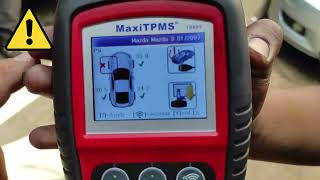
Hold a dedicated TPMS tool against the right front tire sidewall near the valve stem and trigger it. A successful read displays the sensor ID, pressure, and battery status. No response confirms a dead battery or destroyed sensor. A 'LOW' battery reading confirms imminent failure.
Tools: TPMS diagnostic tool (Intermediate) - Isolate and Eliminate RF Interference
Unplug all aftermarket 12-volt accessories (chargers, dash cams, inverters) and turn off aftermarket LEDs. Drive for 15 minutes. If the fault clears, the accessory was blocking the signal.
Tools: None (Beginner) - Attempt a TPMS Relearn
Follow the owner's manual procedure to put the car in 'learn mode'. Use a TPMS tool to trigger each sensor in the specified order. This forces the module to re-establish the connection.
Tools: Owner's manual, TPMS diagnostic tool (Intermediate) - [PRO TIP] Check Live Data with a Bi-Directional Scan Tool
Connect a pro-level scanner to the OBD-II port. View the TPMS live data stream. Look for the right front sensor's battery voltage PID. A healthy battery reads near 3.0V. If voltage drops sharply when the tool forces a transmission, the battery is failing under load.
Tools: Professional bi-directional scan tool (Advanced) - Inspect the TPMS Receiver and Wiring
Locate the TPMS receiver module (often behind the glove box or above the headliner). Visually inspect the connector and wiring for corrosion, water intrusion, or pinched wires.
Tools: Flashlight, trim removal tools, vehicle service manual (Advanced) - [PRO TIP] Perform a Voltage Drop Test on the Receiver Circuit
Back-probe the power and ground wires at the TPMS receiver connector. A ground reading above 0.10V indicates excessive resistance. A power drop of more than 0.5V from battery voltage indicates a feed issue.
Tools: Digital multimeter, vehicle-specific wiring diagram (Advanced) - Check Network Communication with an Oscilloscope
Connect to the TPMS module's CAN bus wires. A healthy high-speed CAN waveform shows CAN High rising to ~3.5V and CAN Low dropping to ~1.5V. A distorted signal proves a wiring fault or a failing module.
Tools: Oscilloscope, wiring diagram (Expert)
When This Code Triggers (Freeze-Frame Conditions)
- Vehicle Speed: 20-55 mph (The fault sets after the vehicle drives above a minimum speed threshold (often 15-20 mph) for several minutes, triggering the TPMS module to actively poll for sensor signals.)
- Time Since Engine Start: 5-15 minutes (The module requires a sustained period of failed communication attempts before flagging a persistent fault.)
- TPMS Module Voltage: 11.8V - 14.5V (Confirms normal operating voltage, ruling out a primary power supply issue to the module itself.)
- Last Signal Received: > 10 minutes ago (Shows a timestamp outside the normal polling interval, confirming a transmission timeout.)
Related Codes
- U2616, U2618, U2619 — Identical 'Lost Communication' faults for the Left Front, Left Rear, and Right Rear sensors. If multiple codes appear simultaneously, the central receiver or wiring failed, not the individual sensors.
- B124D — A Ford-specific code for 'Tire Pressure Sensor Signal Failure.' It accompanies U2617 to indicate an intermittent or weak signal, often caused by RFI from a DC/AC inverter.
- C0760 — A GM-specific Chassis code for the Right Front sensor. It is a common companion to U2617 on GM vehicles, confirming a specific sensor-level fault detected by the module.
- B1325 — Indicates 'Device Power 1 Circuit Malfunction.' If the TPMS module loses its primary power feed, it stores this code alongside U-codes for all sensors.
Climate & Environmental Factors
- Cold Weather: Cold temperatures reduce the chemical efficiency of the sensor's lithium-ion battery. A sensor with an aging battery may lack the voltage to transmit in the cold, triggering U2617. The fault often disappears as driving warms the tires.
- Road Salt: Road salt acts as an electrolyte that accelerates galvanic corrosion on clamp-in style aluminum valve stems. This corrosion destroys the air seal and the integrated sensor body.
How to Talk to a Mechanic About This Code
Say this: "I have a U2617 code and my TPMS light is flashing. I'd like to book a diagnostic. Can you please use a TPMS tool to check the signal and battery status of the right front sensor before we discuss replacing any parts?"
This signals you understand the code relates to a specific sensor communication fault. It directs the technician to perform the correct initial test, preventing them from quoting a sensor replacement without proof.
Avoid saying:
- 'My tire light is on.' (Too vague, could be pressure or a fault)
- 'Just fix the TPMS.' (Invites replacement of parts without proper diagnosis)
- 'The internet said I need a new sensor.' (Lets them know you're guessing, not diagnosing)
Questions to ask before authorizing the repair:
- Did the TPMS tool confirm the sensor has a low battery or is not transmitting?
- Does your quoted price include dismounting/mounting the tire, balancing the wheel, and performing the TPMS relearn procedure?
- What brand of sensor are you using (OEM or an aftermarket brand like Schrader or Autel)?
- What is the warranty on the new sensor and the labor?
Where to Take It: Dealer vs Independent vs Chain
- Dealer:
Recommended only if a simple sensor replacement at a tire shop fails to solve the issue.
Best for: Vehicles under warranty., Complex cases where initial diagnosis suggests a faulty control module (BCM/RTM) or a wiring issue., Repairs related to a specific Technical Service Bulletin (TSB) or recall.
Downsides: Highest cost, with labor rates often 1.5-2x higher than independent shops., Defaults to expensive OEM parts when high-quality aftermarket options are sufficient. (Typical cost: +50% vs. baseline) - Independent Shop:
Good choice. Most competent independent shops easily handle a TPMS sensor replacement.
Best for: Out-of-warranty vehicles where cost is a consideration., Building a long-term relationship with a trusted mechanic.
Downsides: Quality and equipment vary widely; ensure they have modern TPMS diagnostic tools., May be less familiar with brand-specific module programming than a dealer. (Typical cost: +0% vs. baseline) - Chain Shop:
Best fit for most cases. A dedicated tire shop is the most efficient and cost-effective place to replace a faulty TPMS sensor.
Best for: This specific repair. National tire chains (Discount Tire, Pep Boys) perform this job daily., Competitive pricing and immediate sensor availability.
Downsides: Technician skill varies., Less equipped to diagnose deeper electrical or module issues if a new sensor doesn't fix the problem. (Typical cost: -10% vs. baseline)
When to Walk Away From the Repair
If the estimated repair cost exceeds 40-50% of the car's private-party value, evaluate whether to fix it, sell it as-is, or trade it in.
- Car worth $4000, fix is $150: Fix it. This is a low-cost repair for a critical safety system.
- Car worth $12000, fix is $150: Fix it. The repair cost is a tiny fraction of the vehicle's value.
- Car worth $2500, fix is $2500: Walk away. If diagnosis reveals a major module failure (like a Chevy Volt's BECM) that costs as much as the car is worth, the repair is not economically viable.
What Scan Tool You Need for This Code

Minimum: A dedicated TPMS activation or trigger tool. A basic OBD-II code reader is NOT sufficient.
A standard $20 code reader only shows the U2617 fault code. It cannot test the sensor's battery, force a transmission, or perform the mandatory relearn procedure after a new sensor is installed.
Budget: Autel MaxiTPMS TS401 / Foxwell T1000 (~$80) — Activates and reads data from existing sensors (ID, pressure, temperature, battery status). This definitively confirms a dead sensor before you pay for a repair.
Mid-range: Autel MaxiTPMS TS508WF / Foxwell T2000 Pro (~$250) — Reads existing sensors, programs blank universal aftermarket sensors, and performs OBD-II relearn procedures, making it a complete DIY solution.
Professional: Autel MaxiCOM MK900-TS / Autel ITS600 (~$450-900) — Integrates full bi-directional OBD-II diagnostics with advanced TPMS functions. Diagnoses the TPMS module itself and reads/clears codes from all vehicle modules.
Rent vs buy: Buy. Auto parts stores do not typically rent dedicated TPMS diagnostic and relearn tools; they only lend basic OBD-II code readers, which are insufficient for this job.
How to Clear the Code After You Fix It
- Use a TPMS-specific scan tool to perform the vehicle's relearn procedure, registering the new sensor ID to the right front wheel.
- Use an OBD-II scan tool to clear the U2617 fault code from the control module.
- Drive the vehicle to confirm the light stays off and the system reads the new pressure.
Drive cycle (~15 minutes): Drive the vehicle for at least 15 minutes at speeds consistently above 30 mph. This forces the TPMS module to receive multiple transmissions from the new sensor and confirm normal operation.
Readiness monitors affected: None
Watch out for:
- Clearing the code without performing the electronic TPMS relearn procedure guarantees the fault will return immediately.
- Using a generic OBD-II scanner instead of a dedicated TPMS tool makes it impossible to complete the repair.
Will This Fail Emissions / State Inspection?
No — by itself this code doesn't fail OBD inspection (but it can keep readiness monitors from setting, which causes a separate fail).
- California: A TPMS light will not fail a smog test. However, shops may note it as a safety concern on the inspection report.
- New York: An illuminated TPMS warning light causes an automatic failure of the annual state safety inspection.
- Texas: An illuminated TPMS light does not fail the state safety inspection, provided the tires physically appear properly inflated and have sufficient tread.
Most Commonly Affected Vehicles
- Ford F-150 (2015-2023) — TPMS integrates into the BCM via a Radio Transceiver Module (RTM). TSB 23-2218 addresses RFI from the onboard power inverter causing TPMS faults on 2021-2023 models.
- Chevrolet Volt (2016-2019) — Code U2617 is frequently a secondary symptom of a failing Battery Energy Control Module (BECM). If other U-codes are present, diagnose the BECM first to avoid a $2,500 misdiagnosis.
- Mazda 3 (2004-2009) — First-generation models frequently set U2617 due to age-related sensor battery failure. OEM sensor part number is BBM2-37-140B.
- Mazda RX-8 (2004-2011) — Experiences a high rate of TPMS sensor failure due to age. Owners frequently report multiple sensor failure codes simultaneously.
- Ford Edge (2015-2018) — Uses a remote antenna (RTM) located above the rear headliner. A simultaneous failure of all TPMS sensors and key fobs points directly to a faulty RTM or its wiring.
- Hyundai Elantra (2017-2020) — Issues with the main floor or body wiring harnesses cause intermittent communication codes, though sensor battery failure remains the primary culprit.
- Nissan Armada (2017-2021) — Features an 'Easy-Fill Tire Alert' system. A failure in this horn-honking system links directly to TPMS module communication faults.
- Jeep Wrangler (JL) (2024-2025) — NHTSA Recall 23V-792 covers models where a pinched remote start antenna cable disables the TPMS and causes communication faults.
Manufacturer-Specific Notes
- Ford: TPMS sensors report to a Radio Transceiver Module (RTM), which relays data to the Body Control Module (BCM). Diagnosing requires determining if the signal stops at the sensor, RTM, or BCM.
- General Motors: On EVs like the Chevy Volt, U2617 is often a red herring triggered by a major component failure, such as the Battery Energy Control Module (BECM), disrupting the entire network.
- Stellantis (Chrysler/Dodge/Jeep): NHTSA Recall 22V-406 covers 2022 Chrysler 300/Dodge Charger models for TPMS sensors with prematurely dying batteries straight from the factory.
- Subaru: Systems are highly sensitive to Radio Frequency Interference. Placing a mobile phone or bulky charger near the center console temporarily blocks sensor signals and triggers fault codes.
Real Owner Stories
2007 Mazda 3 with 100k+ miles
The TPMS warning light flashed at startup, and a scan revealed code U2617.
What they tried:
- A TPMS tool failed to read the right front sensor, confirming it was dead.
- A new universal sensor was programmed with a unique ID.
- The tire was dismounted, the new sensor installed, and the wheel balanced.
- A vehicle relearn procedure registered the new sensor ID with the car's computer.
Outcome: The U2617 code cleared, and the TPMS light went off.
Lesson: For vehicles over 7 years old, U2617 is almost always a dead sensor battery. Using a TPMS diagnostic tool to confirm the sensor is dead before removing the tire prevents costly misdiagnosis.
2017 Chevy Volt with multiple 'U' codes
The check engine light appeared alongside 'Shift to Park' messages. A scan showed U2617, U2618, U2619, and a dozen other network codes.
What they tried:
- The owner towed the car to a dealer.
- The dealer diagnosed a failed Battery Energy Control Module (BECM).
Outcome: Replacing the BECM resolved all codes. The TPMS communication faults were secondary symptoms of the BECM disrupting the entire vehicle network.
Lesson: If U2617 appears alongside many unrelated network codes, it is a red flag for a central module failure. Do not replace TPMS sensors until the primary network codes are resolved.
Subaru owner with intermittent TPMS light after new tires
The TPMS light appeared shortly after installing new tires. Pressures were correct.
What they tried:
- The original tire shop confirmed pressures but couldn't clear the light.
- A second shop identified the right front sensor was not reporting and replaced it for $65.
- The second shop advised the light would clear after driving, but it did not.
Outcome: The problem was a failed relearn procedure. The owner had to return to force the vehicle's computer to recognize the new sensor's ID.
Lesson: A U2617 fault after a tire change means the sensor was damaged or the shop skipped the relearn procedure. Simply replacing the sensor isn't enough; the car must be electronically programmed to listen for the new ID.
How to Prevent This Code From Triggering
- Replace TPMS service kits with every tire change (Every time a tire is dismounted from a wheel) — Using a new nickel-plated valve core and sealing cap prevents moisture and road salt from causing galvanic corrosion, which destroys the sensor body.
- Use care during tire mounting/dismounting (During any tire service) — Improper tire machine technique crushes the sensor body. Technicians must position the wheel so the sensor is 90-180 degrees away from the bead breaker.
- Proactively replace all sensors based on age (Every 7-10 years, or when buying new tires on an older car) — Sensor batteries have a finite 5-10 year life. Replacing all four at once saves you from paying redundant labor costs to dismount tires as the remaining sensors inevitably fail.
Frequently Asked Questions
Why is my TPMS light flashing instead of just staying on?
A flashing TPMS light for 60-90 seconds at startup indicates a system malfunction, like a U2617 communication failure. A solid light indicates low tire pressure.
Can I just replace the battery inside the TPMS sensor?
No. The 3V lithium-ion battery is permanently sealed inside the sensor housing to survive the harsh environment inside a tire. You must replace the entire sensor unit.
A shop replaced my sensor, but the U2617 code came back. Why?
This happens if the shop failed to perform the electronic relearn procedure, installed an incompatible sensor, or misdiagnosed the issue. The root cause might be a faulty receiver or RF interference, not the sensor itself.
Can cold weather cause a U2617 communication code?
Cold temperatures reduce battery voltage. If a sensor battery is already near the end of its 5-10 year lifespan, a cold snap drops the voltage below the transmission threshold, triggering the U2617 code.
What is the difference between direct and indirect TPMS?
Direct TPMS uses physical pressure sensors inside each wheel, which trigger codes like U2617. Indirect TPMS uses ABS wheel speed sensors to calculate pressure differences and cannot generate specific sensor communication codes.
My scan tool shows codes for all four sensors. Do I need to replace them all?
If codes for all four sensors appear simultaneously, do not replace the sensors. This indicates a central failure with the TPMS receiver module, its wiring, or severe RF interference blocking all signals.
Do I need to go to the dealer to fix this?
No. Any reputable tire shop has the diagnostic tools to test, replace, and program TPMS sensors. You only need a dealer or specialist if the diagnosis points to a failed Body Control Module or complex wiring issue.
Key Takeaways
- Code U2617 indicates a total communication loss with the right front TPMS sensor, triggering a warning light that flashes for 60-90 seconds at startup.
- The most common cause is a dead internal sensor battery, which has a strict 5-10 year lifespan and requires replacing the entire $40-$100 sensor unit.
- Before replacing parts, unplug all aftermarket 12V accessories like phone chargers and dash cams, as they frequently emit radio frequency interference that blocks the 315/433 MHz sensor signal.
- Do not attempt to clear this code with a basic OBD-II scanner; a successful repair requires a dedicated TPMS tool to electronically register the new sensor's unique ID to the vehicle.
Helpful Videos

The information in this article is provided for general reference and educational purposes only. Vehicle specifications, procedures, and part compatibility can vary by production date, trim level, and region. Always consult your vehicle's factory service manual and verify part numbers before purchasing or performing repairs. Safety-critical components such as airbags, seat belts, and braking systems should be installed by a qualified professional.
- 🎬 Helpful Videos
- What Does U2617 Mean?
- Can I Drive With U2617?
- Common Causes
- Symptoms
- Diagnostic Flowchart
- Common Fixes & Costs
- DIY vs Professional
- Used vs. New Parts: Buying Guide
- What Happens If You Wait — Timeline
- Cost of Not Fixing It
- Diagnosis Steps
- When This Code Triggers (Freeze-Frame Conditions)
- Related Codes
- Climate & Environmental Factors
- How to Talk to a Mechanic About This Code
- Where to Take It: Dealer vs Independent vs Chain
- When to Walk Away From the Repair
- What Scan Tool You Need for This Code
- How to Clear the Code After You Fix It
- Will This Fail Emissions / State Inspection?
- Most Commonly Affected Vehicles
- Manufacturer-Specific Notes
- Real Owner Stories
- 2007 Mazda 3 with 100k+ miles
- 2017 Chevy Volt with multiple 'U' codes
- Subaru owner with intermittent TPMS light after new tires
- How to Prevent This Code From Triggering
- Frequently Asked Questions
- Why is my TPMS light flashing instead of just staying on?
- Can I just replace the battery inside the TPMS sensor?
- A shop replaced my sensor, but the U2617 code came back. Why?
- Can cold weather cause a U2617 communication code?
- What is the difference between direct and indirect TPMS?
- My scan tool shows codes for all four sensors. Do I need to replace them all?
- Do I need to go to the dealer to fix this?
- Key Takeaways
- 🎟️ Get 5% Off