

U2300 on 2017-2018 Ford Fusion: Airbag Module Configuration Fault Causes and Fixes
On a 2017-2018 Ford Fusion, code U2300 indicates a configuration error in the Restraints Control Module (RCM), which controls the airbags. The most common fix is a software update or reprogramming of the RCM by a dealer, often prompted by a Technical Service Bulletin (TSB). This is not a DIY repair for most owners, as it requires Ford-specific tools.
- U2300 on your Fusion means there's a configuration problem with the airbag control module (RCM).
- This is a critical safety issue; your airbags may not work until it is fixed.
- The most common cause is a software glitch that Ford can fix by reprogramming the module, as outlined in TSBs.
- This is not a DIY repair for most. It requires a trip to a dealer or a specialized shop with Ford-specific diagnostic equipment.
- Do not replace any parts until the RCM has been professionally diagnosed and a reprogramming attempt has been made.
What's Unique About the 2017-2018 Ford FUSION

For this generation of Ford Fusion, the U2300 code is well-documented in manufacturer Technical Service Bulletins (TSBs). Ford issued specific instructions (TSB SSM 46901 and SSM 46109) acknowledging that a software issue could cause this code to appear, along with a host of other RCM-related codes. The official fix in these cases is not to replace parts, but to reprogram the RCM with updated software, highlighting a known issue for this specific platform. This issue is shared with its platform-mate, the Lincoln MKZ.
Diagnostic Flowchart
Tap your situation to follow the diagnostic path that matches what you're seeing on this vehicle.
Symptoms You May Notice
- Airbag warning light is illuminated on the dashboard
- A 'not operational' message may be displayed in the instrument cluster
- Multiple other warning lights (ABS, Hill Start Assist) may appear simultaneously in some cases due to network communication errors stemming from the RCM fault.
- Replacing airbag sensors or other SRS components without first addressing the RCM configuration. The U2300 code is specific to the central module's programming, not usually an individual sensor.
- Assuming the RCM is faulty and replacing it before attempting a software update. The TSBs clearly indicate that reprogramming is the first and most common solution.
Most Likely Causes

- RCM Software Requires Update 🔴 High Probability Ford issued TSBs SSM 46901 and SSM 46109 specifically for this issue on 2017 Fusions, indicating a known software problem from the factory. These TSBs cover a wide range of codes, including U2300, that can be resolved with a software update.
How to confirm: A Ford dealer or a qualified shop with access to Ford's diagnostic system (IDS/FDRS) can check if the RCM's software level is outdated and if the TSBs apply.
Typical fix: Reprogram the Restraints Control Module (RCM) to the latest software level using Ford's diagnostic tools.
Est. part cost: $0 - Improper RCM Replacement/Programming 🟡 Medium Probability If the vehicle was in a prior accident or had SRS components replaced, the RCM may have been changed. A new or used RCM will always show a U2300:55 code until it is correctly configured for the vehicle's 'as-built' data.
How to confirm: Check the vehicle's repair history. A professional scan tool can read the 'as-built' data and see if it matches the vehicle's factory configuration. This is a common issue after collision repairs.
Typical fix: Perform a 'Programmable Module Installation' (PMI) procedure on the RCM using Ford's diagnostic software (IDS/FDRS) to load the correct 'as-built' data for the vehicle's VIN. Some independent shops and DIYers have successfully used FORScan for this procedure, though it is not the official method. 🎬 See this step-by-step guide for programming modules with FORScan
Est. part cost: $0 - Faulty Restraints Control Module (RCM) ⚪ Low Probability While less common than software issues, the module itself can fail internally. This can sometimes be triggered by low battery voltage or voltage spikes.
How to confirm: If the RCM fails to accept reprogramming, or if the code returns immediately after a successful reprogram and configuration, the module itself is likely defective. This should only be concluded after reprogramming has been attempted by a qualified technician.
Typical fix: Replace the RCM and program the new module with the vehicle's specific 'as-built' data. Part numbers like HS7T-14B321-AF are common for this model, but the exact part number is VIN-specific.
Est. part cost: $300-$600
Rare But Worth Checking
- Low Battery Voltage:
Diagnosis Steps
- Connect a Ford-compliant scan tool (like IDS, FDRS, or a high-end aftermarket tool with programming capabilities like FORScan) and perform a full network scan.
- Confirm the presence of U2300 in the Restraints Control Module (RCM). Note any suffix codes (:55, :64).
- Check for the applicability of TSBs SSM 46901 and SSM 46109 based on the vehicle's build date and symptoms.
- If a TSB applies, the primary step is to reprogram the RCM to the latest software version using IDS or FDRS. Ensure a stable power supply (battery charger) is connected during programming.
- If no TSB applies or if the RCM has been replaced, perform the 'Programmable Module Installation' (PMI) or 'As-Built' data configuration procedure.
- Clear all DTCs and cycle the ignition. Re-run the network scan.
- If U2300 returns immediately, verify the correct RCM part number is installed. Part numbers often start with HS7T-14B321 for this model, but must match the vehicle's specific configuration.
- If the part number is correct and programming fails repeatedly, the RCM may be faulty and require replacement.
- Consider using a mail-in reset service for modules with persistent crash data that cannot be cleared by other means. 🎬 Watch: How to reset a 2017 Fusion SRS airbag module
Parts You'll Likely Need

- Restraints Control Module (RCM)
(OEM #HS7Z-14B321-H (example, VIN specific))— This part is only needed if the original module is faulty and cannot be reprogrammed. In most cases, the fix is software-based and does not require a new part. Many part numbers exist, such as HS7T-14B321-AA through AK.
Trusted brands: Motorcraft
OEM price range: $300-$600
Aftermarket price range: Not Recommended
Related Codes That Often Appear With This One
- U3000 — Control Module Internal Failure. Often appears with U2300 when there's a software or hardware issue within the RCM, as noted in TSB SSM 46901.
- U2100 / U2101 — Control Module Configuration Incompatible / Initial Configuration Not Complete. These are variations of the same core issue as U2300 and are also listed in the relevant TSBs.
- U0452 — Invalid Data Received From Restraints Control Module. This code is set by other modules (like the APIM) when they detect a problem with the data coming from the RCM, as noted in TSB SSM 46109.
- B-series codes (e.g., B0080, B141B, B0054) — These are specific SRS fault codes that can be triggered alongside the U2300 as a result of the main configuration error, as noted in Ford's TSBs.
Technical Service Bulletins (TSBs) & Recalls
- SSM 46901: Addresses an airbag light and multiple RCM DTCs including U2300, U3000, and U2100 on 2017 models, recommending an RCM reprogram.
- SSM 46109: Similar to above, for Fusion/MKZ vehicles built on or before 18-Aug-2016, recommending an RCM reprogram for a list of codes including U2300.
- TSB 20-2373: While for the Edge/MKX, it details the procedure for resolving U2300 after RCM replacement, showing the process is common across Ford platforms and often requires loading updated as-built data.
Platform-Specific Known Issues
- Ford TSBs SSM 46901 and SSM 46109 directly address an issue on 2017 models where an airbag light and various RCM DTCs, including U2300, can be caused by a software glitch. The prescribed fix is to reprogram the RCM.
- A Reddit user with a 2017 Fusion Hybrid experienced a cascade of warning lights, including the restraint indicator, ABS, and park brake, along with over 60 codes in various modules (PCM, ABS, BCM, SRS). This highlights how a single module fault can disrupt the entire vehicle network.
Mechanic-Grade Diagnostic Values
- Minimum System Voltage — expected: > 10 Volts. Failure: If ignition voltage is less than 10V, the RCM may not program or operate correctly, potentially setting various codes.
Hidden / Shadow Codes Worth Checking
- U2300:55: Central Configuration: Not Configured. This subtype indicates the RCM has not been programmed with the vehicle's specific option content. It is the default code in a new, unprogrammed module. If it appears as an on-demand code, it means the RCM failed to receive the configuration message from the BCM or IPC. (see via Ford IDS/FDRS, FORScan, or other professional scan tools capable of reading manufacturer-specific DTCs.)
- U2300:64: Central Configuration: Signal Plausibility Failure. This subtype is set if the RCM receives configuration data that does not match the data it previously had stored. This often occurs if a Programmable Module Installation (PMI) was not performed correctly on a related module (like the BCM) or if incorrect As-Built data was manually entered. (see via Ford IDS/FDRS, FORScan, or other professional scan tools capable of reading manufacturer-specific DTCs.)
Scan Tool Commands That Help

- Ford IDS/FDRS: Programmable Module Installation (PMI) — Used when replacing a module. The tool reads the configuration from the old module, stores it, and then writes it to the new module. This is the standard procedure.
- Ford IDS/FDRS or FORScan: As-Built Data Configuration — Used when the original module is missing or its data is corrupt. This function writes the vehicle's original factory configuration data (downloaded from Ford's servers) directly to the module. This is often the required step for a new RCM.
- FORScan: Module Configuration (As-Built format) — This is a widely documented method used by independent shops and advanced DIYers to fix U2300. In some documented cases, FORScan has successfully programmed a module when the official Ford Diagnostic Software (IDS/FDRS) repeatedly failed.
Wiring & Ground Locations
- RCM Fuse — Fuse F35 (5A) in the Body Control Module (BCM) fuse panel, located under the instrument panel to the left of the steering column.. This fuse provides power to the Restraints Control Module. While a blown fuse would likely cause a no-communication error rather than a configuration error, verifying its integrity is a basic electrical check.
- RCM Communication Network — The RCM communicates with the BCM, IPC, and the diagnostic port via the High Speed Controller Area Network (HS-CAN).. A network issue (wiring damage, corrosion, or a fault in another module) could prevent the RCM from receiving the necessary configuration data from the BCM/IPC, leading to a U2300 code.
Real Owner Repair Stories
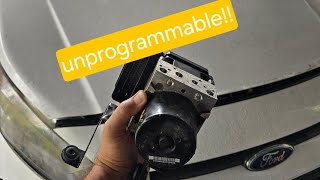
- YouTube channel 'G Auto Repair' (2015 Ford Transit Connect (demonstrates identical Ford electronic architecture and issue)) — ABS and other warning lights on, persistent U2300 code in the new ABS module after replacement.
❌ Tried (didn't work) Programming the replacement (used) module using an Autel scan tool's PMI function., Programming the module using the official Ford J2534 Diagnostic Software (FJDS). The software would report 'success' but the code and warning lights would remain.
✅ What actually fixed it Using the aftermarket software FORScan to perform the 'As-Built' data configuration on the ABS module. This procedure successfully programmed the module, cleared the U2300 code, and extinguished the warning lights when the official Ford tool could not. - Ford F150 Forum (2020 Ford F-150) — Airbag warning light on and a persistent DTC U2300:64-8B in the RCM after making changes with FORScan.
❌ Tried (didn't work) Clearing the DTC., Following the standard service manual pinpoint test for the code.
✅ What actually fixed it The owner discovered they had made a typographical error ('fat-fingered') in the As-Built data for the RCM. They had incorrectly changed a value from '86' to '66' in address 726-12-01. Correcting this single digit in the As-Built data using FORScan resolved the code.
OEM Part Supersession History
HS7T-14B321-xx (e.g., AF)→VIN-Specific— Module configurations are highly specific to the vehicle's factory-installed options.
Heads up: It is critical to match the part number exactly when replacing the RCM. Even if a module from another vehicle appears physically identical, it may not be compatible. Using an incorrect part number will almost certainly result in a U2300 code that cannot be cleared.
Model Year Variations Within This Range
- 2017 (specifically builds on or before 18-Aug-2016): Vehicles built in this timeframe are specifically called out in TSBs SSM 46109 and SSM 46901 for having a factory software issue that can cause U2300 and other RCM codes. The fix is a software update (reprogram), whereas on later models, the code is more likely due to a module replacement after a collision.
Helpful Videos

Used OEM Parts in Stock



New Aftermarket Parts Available


The information in this article is provided for general reference and educational purposes only. Vehicle specifications, procedures, and part compatibility can vary by production date, trim level, and region. Always consult your vehicle's factory service manual and verify part numbers before purchasing or performing repairs. Safety-critical components such as airbags, seat belts, and braking systems should be installed by a qualified professional.
- Ford FUSION:
- 🎬 Helpful Videos
- 🛍️ Shop This Part
- What's Unique About the 2017-2018 Ford FUSION
- Diagnostic Flowchart
- Symptoms You May Notice
- Most Likely Causes
- Rare But Worth Checking
- Diagnosis Steps
- Parts You'll Likely Need
- Related Codes That Often Appear With This One
- Technical Service Bulletins (TSBs) & Recalls
- Platform-Specific Known Issues
- Mechanic-Grade Diagnostic Values
- Hidden / Shadow Codes Worth Checking
- Scan Tool Commands That Help
- Wiring & Ground Locations
- Real Owner Repair Stories
- OEM Part Supersession History
- Model Year Variations Within This Range
- 🎟️ Get 5% Off