

OBD-II Code U2200: Invalid Data or Module Communication Error
What U2200 means, why it triggers, and how to fix it
- U2200 is a manufacturer-specific network code requiring a bi-directional scanner to read the exact definition, such as 'Invalid Data for Odometer' on Fords.
- Test the battery and ground connections first, as voltage dropping below 12.4V during startup is the primary trigger for U2200.
- Scan all modules for companion codes; U0155 points directly to a failed instrument cluster, while U0121 isolates the ABS module.
- Expect dashboard failures like a dead speedometer or flashing immobilizer light, which escalate into a complete no-start condition if left unaddressed.
What Does U2200 Mean?

U2200 is a network trouble code indicating a communication failure between your car's computers (modules). A specific module, such as the instrument cluster or body control module, received invalid or corrupted data from another module on the Controller Area Network (CAN bus). The exact definition varies significantly by manufacturer. Essentially, one computer is sending signals another cannot verify, or a module has stopped transmitting data entirely.
Technical definition: The SAE/ISO definition for U2200 is non-standardized. Common definitions include 'Invalid Data for Odometer' on Ford and Mazda vehicles, or a general communication fault. A U2200-00 on some Fords means 'Transmission Range Switch A,' indicating the TCM lacks the correct gear position signal. On certain Lincolns, it points to a 'Turbocharger Wastegate Actuator Circuit Malfunction.' This extreme variability requires an advanced scan tool to read the exact manufacturer-specific definition.
Can I Drive With U2200?
Yes, But With Caution. You can drive short distances, but critical systems are compromised. If the ABS or airbag light is on, those safety systems are disabled. Driving without ABS increases emergency stopping distance by over 20% on slippery surfaces, significantly raising collision risk. A dead speedometer risks traffic citations, and disabled warning lights mask critical engine or oil pressure problems, risking catastrophic engine damage. Address the code promptly to prevent a complete no-start condition.
Common Causes

- Low or Unstable Battery Voltage (Very Common) — A weak or improperly connected battery is the primary cause of communication glitches. Modules require a stable 9V-14.5V to operate. Voltage dropping below 12.4V during startup triggers spurious 'U' codes. If system voltage drops below 10V during operation, modules drop offline, reset, or send corrupt data packets. Poor ground connections produce the exact same voltage drop effect.
- Failing Instrument Panel Cluster (IPC) (Common) — The instrument cluster acts as a central communication gateway. Internal failures, typically cracked solder joints from heat and vibration, cause it to send corrupt data or stop communicating entirely. This is a notorious failure point on 2005-2011 Ford Focus models.
- Faulty ABS Control Module (Common) — The ABS module constantly broadcasts vehicle speed data. Internal solder joint failures cause it to send invalid data to the instrument cluster, frequently triggering U2200 alongside U0121 (Lost Communication With ABS).
- Faulty Body Control Module (BCM) (Common) — The BCM controls dozens of electronic accessories. Internal BCM failure disrupts the entire communication network, triggering U2200 alongside bizarre symptoms like a blank touchscreen, randomly honking horn, or flickering lights.
- Damaged Wiring or Corroded Connectors (Less Common) — The CAN bus requires intact wiring. Chafing, rodent damage, or botched repairs cause shorts or opens in the CAN_H or CAN_L wires. Corrosion in module connectors or main harness junctions, accelerated by humidity, creates intermittent network faults.
- Aftermarket Device Interference (Less Common) — Aftermarket remote starters, alarms, or OBD-II insurance dongles interfere with the CAN bus. They draw excess power, introduce electrical noise, or send conflicting data packets, triggering a flood of 'U' codes.
- Faulty CAN Gateway Module (Less Common) — In Volkswagen and Audi vehicles, a dedicated CAN Gateway module routes data between network branches. Gateway failure drops entire segments of the vehicle's network offline, logging multiple U-codes.
- Software Glitches or Corrupted Module Memory (Rare) — Failed software updates or corrupted internal EEPROM/flash memory create persistent 'U' codes. This occurs after dealer service, over-the-air updates, or severe voltage spikes. On Jaguars, this triggers a U2300 'Central Configuration' fault.
- Faulty Transmission Range Switch (Rare) — On specific Ford vehicles, U2200-00 points directly to the Transmission Range Switch. The Transmission Control Module (TCM) lacks the correct voltage signal for the selected gear due to a faulty switch or damaged wiring.
Symptoms
- Check Engine Light and Other Warning Lights On — The Check Engine Light illuminates, usually accompanied by a cascade of ABS, Airbag, Traction Control, or battery warning lights.
- Speedometer or Odometer Not Working — The speedometer drops to zero or stops working entirely. The odometer displays dashes ('------') or incorrect mileage, a classic symptom when the definition is 'Invalid Data for Odometer'. 🎬 Watch: Diagnosing U2200 and RPM issues on Ford vehicles
- Malfunctioning or Blank Information Displays — The central touchscreen or driver information center goes blank, freezes, or fails to boot.
- Erratic Electronic Accessory Behavior — Unrelated issues occur, such as the horn honking autonomously, inoperative power windows, or randomly cycling door locks, pointing to a BCM failure.
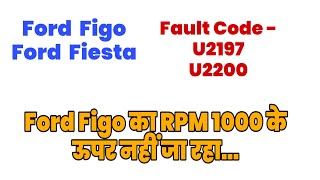
- Engine Hesitation, Stall, or No-Start Condition — The engine refuses to rev past 1,000 RPM or fails to start entirely. A no-start condition occurs when the instrument cluster fails to communicate with the immobilizer system.
Diagnostic Flowchart
Tap your situation to follow the diagnostic path that matches what you're seeing on this code.
Common Fixes & Costs
- Charging or Replacing the Vehicle Battery — Parts: $150-$400, Labor: $50-$100, ~0.5 hr book time (DIY)
- Repairing or Replacing the Instrument Panel Cluster (IPC) — Parts: $200-$600 (for repair service), $700-$1,500+ (for new replacement), Labor: $100-$300, ~1.2 hr book time (Intermediate)
- Repairing or Replacing the ABS Control Module — Parts: $150-$400 (for repair service), $800-$1,500+ (for new replacement), Labor: $150-$300 (plus mandatory programming/calibration fees of $125-$250), ~1.5 hr book time (Professional)
- Replacing the Body Control Module (BCM) — Parts: $300-$900, Labor: $150-$300 (plus mandatory programming fees of $100-$250), ~1.5 hr book time (Professional)
- Repairing Damaged CAN Bus Wiring — Parts: $20-$100, Labor: $250-$1000+, ~3.5 hr book time (Professional)
- Reprogramming or Updating Module Software — Parts: $0, Labor: $150-$300, ~1.0 hr book time (Professional)
DIY vs Professional
- Charging or Replacing the Vehicle Battery — Beginner:
Tools: Wrench set, terminal brush, digital multimeter. - Repairing or Replacing the Instrument Panel Cluster (IPC) — Beginner:
Tools: Trim removal tools, socket set, advanced scan tool with PATS/immobilizer programming function (e.g., FORScan for Ford). - Repairing or Replacing the ABS Control Module — Beginner:
Tools: Wrench set, flare nut wrenches, bi-directional scan tool with ABS programming/bleeding functions. - Replacing the Body Control Module (BCM) — Beginner:
Tools: Socket set, trim removal tools. Programming is required. - Repairing Damaged CAN Bus Wiring — Beginner:
Tools: Digital multimeter, oscilloscope, wiring diagrams, soldering iron, heat shrink.
Used vs. New Parts: Buying Guide
When a used part is worth it: For older, lower-value vehicles, a used electronic module (ABS, BCM, IPC) from a reputable salvage yard is a cost-effective solution. It makes the most sense when the cost of a new OEM part is prohibitively high.
Donor-vehicle mileage cap: roughly under 100000 miles for the part to have meaningful remaining life.
Donor quality checklist:
- Match the part number exactly. Do not rely on make/model/year alone.
- Purchase from a seller that offers a warranty and a return policy.
- Visually inspect connectors for corrosion or bent pins.
- Verify the donor vehicle was not scrapped due to flood or fire damage.
Decision logic:
- If The original module can be repaired (e.g., common solder joint failure) → Repairing is the best option; it's cheaper and requires no VIN programming.
- If The part requires VIN programming to function (most modern modules) → Factor in the cost of programming ($100-$250). A used part is not a bargain if it cannot be programmed to your vehicle.
- If The part is for a critical safety system like ABS or airbags → Favor new or professionally remanufactured parts with a warranty over a used part with an unknown history.
Warranty tradeoff: Used parts typically have a 30-90 day warranty, if any. Professionally remanufactured modules often come with a 1-year or lifetime warranty. New OEM parts carry a manufacturer's warranty, typically 1-2 years.
Worst-case if a used part fails: $300-$800 if a used module is dead on arrival or fails shortly after installation, covering repeat labor and diagnostic fees, plus the cost of another part.
What Happens If You Wait — Timeline
- Immediate: Warning lights (Check Engine, ABS, Airbag) illuminate. Critical safety systems like ABS and Traction Control are disabled. The speedometer stops working. (MPG impact: 0%% · Added cost: $150+ in potential traffic citations for inoperative speedometer or other lights.)
- 1-4 Weeks: The fault becomes frequent. Intermittent no-start conditions occur, especially on Fords with failing instrument clusters. The risk of being stranded is high. (MPG impact: 0-5%% · Added cost: $150-$450 for towing and emergency diagnosis if the vehicle becomes a no-start and leaves you stranded.)
- 1-6 Months: A failing module or persistent wiring short damages other modules via electrical stress. A bad BCM or IPC creates a parasitic drain, killing the battery overnight. (MPG impact: 5-10%% · Added cost: $500-$1500 as the initial fault cascades, requiring the replacement of a second module plus a new battery.)
- 6+ Months: Complete network failure renders the vehicle undrivable. Disabled warning lights mask critical engine issues (oil pressure, temperature), leading to catastrophic engine failure. (MPG impact: 10-20%% · Added cost: $2000-$5000+ for complex multi-module diagnosis and replacement, or potential engine replacement if a critical warning was missed.)
Cost of Not Fixing It
- Immediate: Critical safety systems like ABS and airbags are disabled. The speedometer is inoperative, risking traffic citations. (Added cost: $150+)
- 1-3 months: Continued driving leads to further electrical damage as failing modules or wiring faults stress other components. Intermittent no-start conditions leave you stranded. (Added cost: $500+)
- 3+ months: A complete communication network failure occurs, making diagnosis much more complex and expensive. In worst-case scenarios where warning lights for oil pressure or engine temperature are disabled, catastrophic engine damage results from an unrelated failure. (Added cost: $2000-$5000+)
Diagnosis Steps

- Check and Charge the Battery
A low battery is the #1 cause of communication codes. Test the state-of-charge voltage; it must be above 12.6V with the engine off. Alternator output must be 13.7V-14.7V running. Clean terminal corrosion and verify chassis ground connections show less than 0.5 ohms of resistance to the negative terminal. Clear codes and retest.
Tools: Digital Multimeter, Battery Charger, Terminal Brush (Beginner) - Perform a Full Network Scan
Use a bi-directional OBD-II scanner to read manufacturer-specific codes from ALL modules. U2200 rarely appears alone. Companion codes provide critical clues: U0121 isolates the ABS module, while U0155 isolates the instrument cluster. Document all codes and their host modules.
Tools: Advanced Bi-Directional OBD-II Scanner (Beginner) - Inspect Fuses and Disconnect Aftermarket Devices
Inspect underhood and in-cabin fuse boxes for blown fuses related to the IPC, BCM, ABS, and radio. A single blown fuse takes a module offline. Temporarily unplug all aftermarket devices (remote starters, OBD-II dongles) to verify they aren't crashing the network.
Tools: Fuse Puller, Vehicle Owner's Manual (Beginner) - Perform a Visual Inspection of Wiring
Inspect wiring harnesses around the IPC, ABS module, BCM, and transmission. Look for chafed wires, rodent damage, or connector corrosion near the firewall or wheels. On GM vehicles, check the transmission harness connector for backed-out terminals per TSB 08-07-30-021H.
Tools: Flashlight, Inspection Mirror (Intermediate) - Pro Tip: Test the CAN Bus Network Resistance
With the battery disconnected, measure resistance between DLC Pin 6 (CAN-H) and Pin 14 (CAN-L). A healthy high-speed network reads 60 Ω. A 120 Ω reading indicates an open circuit or missing terminating resistor. A 0 Ω reading indicates shorted CAN lines. Note: Gateway modules alter this test; consult a wiring diagram.
Tools: Digital Multimeter, DLC Breakout Box (recommended) (Advanced) - Pro Tip: Check CAN Bus Voltage and Resistance to Ground
With ignition ON (engine off), check DLC voltage. CAN-H (Pin 6) averages ~2.6V; CAN-L (Pin 14) averages ~2.4V. If both lines are stuck at 2.5V, they are shorted together. Next, disconnect the battery and measure resistance from CAN-H and CAN-L to chassis ground. Both must read as an open circuit (megaohms). Low resistance confirms a short to ground.
Tools: Digital Multimeter (Advanced) - Isolate the Faulty Module
If wiring passes, isolate the failing module. Disconnect modules one by one from the CAN network and re-check resistance or watch for scanner communication to restore. This requires a vehicle-specific network topology diagram.
Tools: Advanced Scan Tool, Wiring Diagrams (Expert) - Pro Tip: Analyze the CAN Signal with an Oscilloscope
Connect an oscilloscope to CAN-H and CAN-L. You must see a clean, mirrored square wave. CAN-H toggles from 2.5V to ~3.5V; CAN-L toggles from 2.5V to ~1.5V. Distorted signals, noise, or a 'stuck' line confirm a wiring fault or a failed module dragging the network down.
Tools: 2-Channel Automotive Oscilloscope (Expert) - Advanced: Verify Module Programming Power Supply
Before reprogramming a module, connect a stable automotive power supply. Voltage drops during programming permanently brick modules. Target voltages vary: Ford/Mazda (>13V), GM (13.4V), Chrysler (13.2V-13.5V), and BMW (14.2V). A dedicated power supply is mandatory.
Tools: Automotive Programming Power Supply, OEM Scan Tool/J2534 Interface (Advanced)
When This Code Triggers (Freeze-Frame Conditions)
- Module Voltage: 10.5-12.0V (During engine crank or low battery state)
- Vehicle Speed: Varies (Often occurs at 0 mph (at startup) or during a specific event like braking if the ABS module is faulty)
- RPM: 0 or 700-800 (Key-On Engine-Off (KOEO) or immediately after starting)
- System Status: N/A (The fault is often logged during the initial network 'handshake' between modules when the ignition is turned on)
Related Codes
- U0121 — 'Lost Communication With ABS Control Module.' Appears with U2200 when the ABS module is the source of the invalid data or has gone offline. If you cannot communicate directly with the ABS module using a scan tool, the issue is power, ground, or an internal failure of the ABS module itself.
- U0155 — 'Lost Communication With Instrument Panel Cluster (IPC) Control Module.' This code points directly to the instrument cluster as the likely culprit when seen with U2200. If the dashboard is dead or gauges are erratic, the IPC is the prime suspect.
- U2197 — On Fords, 'Invalid Data From Vehicle Speed' appears alongside U2200 during speed signal failures. If accompanied by a dead speedometer, the vehicle speed sensor (VSS) or its wiring is the primary suspect.
- B1318 — A Ford-specific code for 'Battery Voltage Low.' Seeing this code with U2200 is a strong indicator that a weak battery or charging system problem is the root cause. Address the B1318 code first by testing the battery and alternator output before chasing network faults.
- U3000 — 'Control Module Internal Failure.' This code, often with a suffix like :49 on Fords, indicates a module has detected an internal electronic failure. If a specific module logs a U3000 code alongside other modules logging a U2200, that module is the source of the bad data.
Climate & Environmental Factors
- High Humidity: Accelerates corrosion on module connectors and fuse block terminals. Moisture penetrates seals, causing short circuits and increased resistance on circuit boards, triggering intermittent communication faults.
- Extreme Cold: Increases electrical resistance in wiring, forcing the battery to work harder and causing voltage drops that corrupt data. Plastic connectors, wire insulation, and solder joints become brittle and crack, causing open circuits.
- Extreme Heat: Causes electronic components within the instrument cluster or engine-bay ABS module to fail prematurely. Thermal expansion and contraction cycles create microscopic cracks in solder joints.
How to Talk to a Mechanic About This Code
Say this: "I have a U2200 communication code. I authorize one to two hours of diagnostic time for a full network scan to isolate the source of the communication failure. Call me with the diagnostic results before replacing any parts."
This signals you know U2200 is a complex network issue, not a simple part failure. It establishes a clear scope and budget for the diagnosis, preventing the shop from immediately replacing expensive modules without proper testing. It positions you as an informed customer and directs the technician to find the root cause.
Avoid saying:
- 'My check engine light is on, can you just fix it?' (This is too vague and invites expensive guesswork).
- 'I think it's the [module name], just replace it.' (This is self-diagnosing; if you're wrong, you pay for a part you didn't need).
- 'Just do whatever you think is best.' (This gives up all control over the cost and repair process).
Questions to ask before authorizing the repair:
- What specific module or wiring path did your tests identify as the source of the fault?
- What other trouble codes did you find, and in which modules were they stored?
- Can you explain the tests you performed to confirm the failure (e.g., checking resistance, voltage, or using a scope)?
- If a module needs to be replaced, does it require programming, and is that cost included in the quote?
- What is the warranty on the proposed repair, including both parts and labor?
Where to Take It: Dealer vs Independent vs Chain
- Dealer:
A safe but expensive option. Best if you suspect a software update is needed or if the vehicle is still under warranty.
Best for: Vehicles under warranty or with a relevant recall/TSB., Complex, brand-specific electrical issues (especially on German brands like BMW, VW, Audi)., Repairs requiring proprietary software updates or module programming.
Downsides: Typically the highest labor rates and part costs., Defaults to replacing entire assemblies rather than attempting targeted wiring or component repairs. (Typical cost: +50% vs. baseline) - Independent Shop:
The best value, IF you choose the right shop. Seek out an independent shop that highlights 'electrical diagnostics' and has ASE-certified technicians. They are more likely to offer flexible repair options.
Best for: Out-of-warranty vehicles where cost is a factor., Shops that specialize in diagnostics or automotive electrical work., Common, well-documented failures (like Ford Focus clusters or Mazda ABS modules).
Downsides: Quality varies; general mechanics lack the specific tools and experience for CAN network diagnosis., You must vet the shop to ensure they have advanced diagnostic capabilities. (Typical cost: +0% vs. baseline) - Chain Shop:
AVOID for diagnosis. While they can replace a battery (a common cause), they are not equipped to diagnose the underlying network fault if the problem is more complex. This is not their area of expertise.
Best for: Simple, routine maintenance like oil changes, tires, and battery replacement.
Downsides: Technicians lack the advanced training and equipment for complex network diagnostics., High potential for misdiagnosis, leading to unnecessary replacement of parts., Business model often encourages upselling rather than in-depth problem-solving. (Typical cost: -10% vs. baseline)
When to Walk Away From the Repair
If the repair estimate exceeds 50% of the vehicle's private-party market value, sell or trade in the vehicle instead of repairing it.
- Car worth $3000, fix is $1600: Walk away or seek a cheaper alternative. The repair cost is over 50% of the car's value. Consider a specialist repair of the original module (if applicable) for under $500 before committing.
- Car worth $10000, fix is $1200: Fix it. The repair cost is only 12% of the vehicle's value and is a worthwhile investment to keep a reliable car on the road.
- Car worth $4500, fix is $2500: Walk away. The repair cost is nearly 56% of the car's value, and complex electrical issues have a high risk of leading to more costs.
What Scan Tool You Need for This Code
Minimum: A scanner that can perform a full system scan and read manufacturer-specific codes (U, B, C) from ALL vehicle modules, including the ABS, BCM, IPC, and TCM.
A basic $20 engine code reader is useless for U2200. It only scans the PCM and misses critical companion codes stored in the ABS or BCM. You are guessing without a full system scan.
Budget: BlueDriver Pro (~$90) — Connects to a smartphone app and can perform a full system scan to read and clear codes from modules like ABS, Airbag, and BCM on most vehicles. It also provides live data and repair reports generated from a database of fixes.
Mid-range: Foxwell NT809 / Autel MaxiCOM MK808S (~$300-400) — These are tablet-style scanners that offer full system diagnostics plus bi-directional controls (active tests). This allows you to command modules to perform actions (like turning on a fan or cycling an ABS valve), which is extremely useful for confirming if a module is working correctly.
Professional: Autel MaxiPRO MP808BT / Launch X431 Series (~$500-1200) — Offers professional-level, OE-grade diagnostics with extensive bi-directional control, special service functions (like module programming/coding on some models), and wireless connectivity. These tools are for the serious DIYer or independent shop.
Rent vs buy: Most auto parts stores offer a free loaner tool service, but their scanners are often basic and may not read all system modules. For a U2200 code, buying a capable scanner like the BlueDriver is a better investment, as it pays for itself by avoiding a single diagnostic fee.
How to Clear the Code After You Fix It
- Reconnect battery if disconnected for repair
- Use a compatible OBD-II scan tool to clear all Diagnostic Trouble Codes (DTCs) from all modules
- Perform a complete drive cycle to allow readiness monitors to run
Drive cycle (~20 minutes): A generic drive cycle includes a cold start (sit for 8+ hours), 2-3 minutes of idling, 10 minutes of mixed city/highway driving (under 55 mph), 5 minutes of steady highway speed (55-60 mph), and deceleration to a stop without aggressive braking.
Readiness monitors affected: Since U2200 is a network code, it does not directly affect emissions readiness monitors like Catalyst or O2 sensor. However, clearing it will reset all monitors to 'Not Ready' status.
Before emissions retest: drive at least 50 miles to fully set monitors.
Watch out for:
- Disconnecting the battery will clear codes but also resets all readiness monitors, which will cause an automatic emissions test failure until a drive cycle is completed.
- The code will return immediately if the root cause, such as a faulty module or wiring short, has not been properly repaired.
Will This Fail Emissions / State Inspection?
Yes — this code typically fails an OBD-II emissions inspection.
- California: An illuminated Check Engine Light results in an automatic smog check failure. After repairs, a full drive cycle must be completed to set readiness monitors before a retest is possible.
- New York: A vehicle with an active Check Engine Light will automatically fail the emissions portion of the state inspection. Clearing the code right before the test will also result in failure due to 'Not Ready' monitors.
- Texas: In counties requiring emissions testing, an illuminated Check Engine Light is an automatic failure of the OBDII test. After clearing codes, the vehicle must be driven to complete the drive cycle, as Texas allows for only one or two 'Not Ready' monitors depending on vehicle age.
Most Commonly Affected Vehicles

- Ford Focus (2005-2011) — Extremely common issue caused by solder joint failure inside the instrument cluster. Symptoms include a no-start condition with a flashing immobilizer light, erratic gauges, and multiple 'U' codes.
- Ford Fusion Hybrid (2017-2020) — Associated with a blank touchscreen and other electrical issues, often pointing to a failing Body Control Module (BCM). Some 2019-2020 PHEV models had TSB 23-2039 for a no-start condition related to the high-voltage battery.
- Ford Figo / Fiesta (2004-2019) — Causes the engine to not accelerate past a low RPM, often linked to U2197 (Invalid Data From Vehicle Speed). The cause is typically a faulty vehicle speed sensor (VSS) on the gearbox or its wiring.
- Mazda 3 (2004-2009) — Commonly caused by internal solder joint failures within the ABS module. This leads to communication loss, triggering the ABS and traction control lights along with U2200. Repairing the module is a popular and cost-effective solution.
- Chevrolet / GMC Cruze, Malibu, Silverado, Tahoe, etc. (2007-2016) — Often presents with a host of other U-codes. TSB 08-07-30-021H points to common causes like backed-out terminals in the transmission harness connector, chafed wiring, and corrosion in various module connectors.
- Volkswagen / Audi Golf, Passat, Tiguan, A4 (2005-2014) — In VAG models, communication codes are triggered by issues in the CAN Gateway module, a faulty ABS module, or a weak battery. Diagnosis is complex due to the segmented network architecture.
- BMW 3 Series (E90), 5 Series (E60) (2004-2013) — Frequently linked to instrument cluster (KOMBI) or ABS/DSC module failures. A weak or unregistered battery is a very common trigger for a cascade of communication faults in these vehicles.
- Polaris Slingshot (2018-2022) — A known issue where low battery voltage (below 12.4V) during startup triggers a U2200 code that stores as a historic fault. Requires no repair other than ensuring the battery is healthy and fully charged.
Manufacturer-Specific Notes

- Ford/Mazda: On 2000s models, U2200 is frequently caused by failing solder joints inside the ABS module (Mazda) or instrument cluster (Ford), triggering 'Invalid Data for Odometer'. On 2022-2023 F-150 Lightnings, TSB 23-2239 resolves communication issues by reprogramming the PCM, ABS, and BECM.
- General Motors (GM): On 2007-2014 trucks and SUVs, 'U' codes stem from the 16-way transmission harness connector. TSB 08-07-30-021H details how backed-out terminals or chafed wiring in this location crash the high-speed network.
- Jaguar / Land Rover: JLR vehicles are extremely sensitive to battery voltage. Weak batteries cause modules to store corrupted configuration data, triggering U2300 (Central Configuration Error). This requires dealer-level software (SDD or Pathfinder) to reload the configuration file.
- Polaris: On Slingshot models, U2200 is a 'ghost' code caused by a temporary voltage drop during engine cranking. It stores as a historic fault and requires no repair beyond charging the battery.
Real Owner Stories
2008 Ford Focus with 130K miles
Car went into limp mode with engine management light on. Gauges were erratic. Dealer diagnosed multiple CAN bus communication codes (U1900, U2200, U0001, U0140) and suspected a faulty instrument cluster.
Outcome: The owner sent the original cluster to a specialist for repair ($150). This avoided the need to reprogram the immobilizer, eliminating the primary risk of a used replacement.
Lesson: For common failures like the Focus instrument cluster, a specialist repair is significantly cheaper and safer than a new or used replacement, as it requires no complex key reprogramming.
2008 Mazda 3 with 171K miles
Spongy brake pedal and eventual ABS/Traction Control lights. A local shop couldn't bleed the ABS pump, and the dealer confirmed a common ABS pump/module failure.
Outcome: Faced with an expensive repair, the owner opted for a new, dealer-programmed module as the only reliable solution, avoiding the programming hurdles of used parts.
Lesson: Misdiagnosis is costly. A spongy pedal pointed to the ABS module, not the master cylinder. For critical safety components like ABS, using used parts is risky and often not possible for DIY or general shops due to dealer-locked programming.
2012 Mazda 3 with intermittent electrical issues
ABS and other warning lights would appear, but only when the car was hot after sitting in the sun. The owner had recently replaced the battery.
Outcome: Forum members identified a failing ABS module, a known issue. Heat sensitivity confirmed failing electronics or cracked solder joints. The owner installed a used ABS pump module ($150-$200) to resolve the fault.
Lesson: Electrical faults that only appear with temperature changes often point to a failing electronic module or a hairline crack in a solder joint. A recently replaced battery doesn't rule out other electrical issues, and clearing codes is necessary after a repair to see if the fault is truly fixed.
How to Prevent This Code From Triggering
- Maintain Battery Health and Connections (Every 6 months) — Low or unstable voltage is a primary cause of module communication errors. Regularly clean battery terminals of corrosion and ensure connections are tight to prevent voltage drops that corrupt data.
- Apply Dielectric Grease to Connectors (When servicing or exposing connectors) — Dielectric grease seals out moisture and oxygen, preventing corrosion on connector pins that leads to high resistance and intermittent signals on the CAN bus.
- Inspect and Secure Wiring Harnesses (Annually or during other maintenance) — Vibrations cause wiring to chafe against the chassis or engine components, leading to shorts or opens in the CAN bus. Ensure harnesses are properly secured and routed away from sharp edges or hot exhaust parts.
- Avoid High-Pressure Washing in the Engine Bay (Always) — Forcing water at high pressure into the engine bay bypasses weather seals on modules and connectors, leading to water intrusion and corrosion that causes shorts and module failure.
- Use Heat-Shrink Connectors for Exterior Wiring Repairs (During any wiring repair) — Using weatherproof, heat-shrinkable butt connectors or terminals for any repairs to exterior wiring creates a sealed connection that prevents moisture from wicking into the wire and causing corrosion that travels up the harness.
Frequently Asked Questions
Can I fix a U2200 code myself?
Basic checks like testing the battery and inspecting fuses are DIY-friendly. Diagnosing the specific faulty module or finding an intermittent wiring short requires a bi-directional scanner and oscilloscope. Take the vehicle to a diagnostic specialist for complex network isolation.
Will clearing the code make it go away?
Clearing the code only works if it was caused by a temporary low-voltage glitch. If a hardware fault or wiring short exists, the code returns immediately on the next drive cycle.
What is the most common misdiagnosis for a U2200 code?
The costliest mistake is replacing the module reporting the code without network diagnosis. The module storing U2200 is the recipient of bad data, not the source. Replacing a PCM because it received bad data from the ABS module is an expensive error.
My scanner shows U2200 but no other codes. What should I do?
Ensure your scanner reads manufacturer-specific codes from all modules, as basic readers miss them. If a full-system scan shows no other codes, test the battery and main ground connections. If voltage is stable, suspect an intermittent fault in the instrument cluster or BCM.
Can a bad ground cause a U2200 code?
Yes. A corroded ground connection creates a floating voltage reference, corrupting CAN bus data packets and triggering U2200. Always test main ground points early in your diagnosis.
What is a CAN bus and why does it fail?
The Controller Area Network (CAN) is a two-wire network connecting all vehicle computers. It fails due to broken wires, shorts, connector corrosion, failing modules, or weak batteries corrupting data.
How much does it cost to diagnose a U2200 code?
Shops charge a diagnostic fee ranging from $125 to $250. This covers a comprehensive system scan and initial electrical testing to isolate the fault. The final repair cost depends entirely on the diagnosed root cause.
Key Takeaways
- U2200 is a manufacturer-specific network code requiring a bi-directional scanner to read the exact definition, such as 'Invalid Data for Odometer' on Fords.
- Test the battery and ground connections first, as voltage dropping below 12.4V during startup is the primary trigger for U2200.
- Scan all modules for companion codes; U0155 points directly to a failed instrument cluster, while U0121 isolates the ABS module.
- Expect dashboard failures like a dead speedometer or flashing immobilizer light, which escalate into a complete no-start condition if left unaddressed.
Helpful Videos
![How To Test CAN BUS With A Multimeter [CAN Bus Resistance Check] Mechanic Mindset](https://img.youtube.com/vi/JPE42HSJxAk/mqdefault.jpg)

The information in this article is provided for general reference and educational purposes only. Vehicle specifications, procedures, and part compatibility can vary by production date, trim level, and region. Always consult your vehicle's factory service manual and verify part numbers before purchasing or performing repairs. Safety-critical components such as airbags, seat belts, and braking systems should be installed by a qualified professional.
- 🎬 Helpful Videos
- What Does U2200 Mean?
- Can I Drive With U2200?
- Common Causes
- Symptoms
- Diagnostic Flowchart
- Common Fixes & Costs
- DIY vs Professional
- Used vs. New Parts: Buying Guide
- What Happens If You Wait — Timeline
- Cost of Not Fixing It
- Diagnosis Steps
- When This Code Triggers (Freeze-Frame Conditions)
- Related Codes
- Climate & Environmental Factors
- How to Talk to a Mechanic About This Code
- Where to Take It: Dealer vs Independent vs Chain
- When to Walk Away From the Repair
- What Scan Tool You Need for This Code
- How to Clear the Code After You Fix It
- Will This Fail Emissions / State Inspection?
- Most Commonly Affected Vehicles
- Manufacturer-Specific Notes
- Real Owner Stories
- 2008 Ford Focus with 130K miles
- 2008 Mazda 3 with 171K miles
- 2012 Mazda 3 with intermittent electrical issues
- How to Prevent This Code From Triggering
- Frequently Asked Questions
- Can I fix a U2200 code myself?
- Will clearing the code make it go away?
- What is the most common misdiagnosis for a U2200 code?
- My scanner shows U2200 but no other codes. What should I do?
- Can a bad ground cause a U2200 code?
- What is a CAN bus and why does it fail?
- How much does it cost to diagnose a U2200 code?
- Key Takeaways
- 🎟️ Get 5% Off