

OBD-II Code U2169: Lost Communication With a Vehicle Module
The Ultimate 2026 Guide to What U2169 Means, Why It Triggers, and How to Fix It
- U2169 indicates a specific control module has dropped off the CAN bus network, triggering multiple unrelated warning lights simultaneously.
- Always test the battery first; voltage drops below 10.5V during startup are the leading cause of intermittent communication codes.
- Do not immediately replace the non-communicating module; over 70% of U2169 codes stem from corroded wiring, loose grounds, or poor connector pin tension.
- Diagnosis requires a bidirectional scanner capable of reading all vehicle systems to pinpoint exactly which module is offline before testing its 60-ohm network resistance.
What Does U2169 Mean?
Code U2169 means one of your vehicle's computers (modules) has stopped communicating on the Controller Area Network (CAN bus). When a module goes silent, the main computer logs this communication loss and triggers the code.
Technical definition: U2169 is a manufacturer-specific code indicating a 'Lost Communication' fault on the CAN bus. The offline module varies by vehicle; GM vehicles often flag the Right Side Object Detection Module, while Mitsubishi models flag the instrument cluster.
Can I Drive With U2169?
No — Do Not Drive. Do not drive the vehicle. A key safety system like ABS, stability control, or power steering will fail without warning, significantly increasing crash risk. The vehicle often enters 'limp mode' with reduced power or stalls completely if a critical module like the PCM is affected. Tow the vehicle to a shop for immediate diagnosis.
Common Causes
- Low or Unstable Battery Voltage (Very Common) — A weak battery or faulty alternator causes unpredictable electrical drops. Modules shut down or send corrupt data if system voltage drops below 10.5V during cranking.
- Damaged or Corroded Wiring (Very Common) — A single broken, chafed, or corroded wire brings down module communication. This occurs frequently in moisture-exposed areas like wheel wells, undercarriages, or rear bumpers.
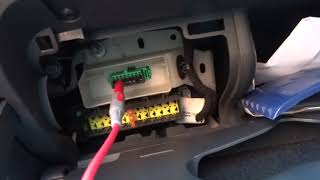
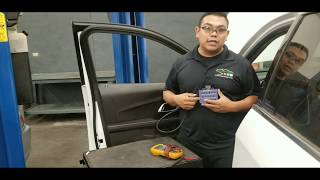
- Poor Ground Connection (Common) — Modules require a solid chassis ground. A loose or corroded ground strap causes the module to power off. On GM trucks, a corroded main ground strap directly causes power steering loss. 🎬 Watch: Expert tips for diagnosing GM network communication faults
- Poor Pin Tension or Fretting (Common) — Female terminal pins lose tension over time or develop 'fretting' (micro-vibration oxide buildup). This interrupts the signal even if the connector appears perfectly clean.
- Faulty Control Module (Common) — The silent module itself has failed due to thermal stress, vibration, or water damage. It stops communicating or internally shorts the entire network.
- Aftermarket Device Interference (Less Common) — Improperly installed remote starters, alarms, or dash cams introduce electrical noise or voltage drops onto the CAN bus, disrupting communication.
- Internal ABS Module Fluid Leak (Rare) — On specific vehicles (like older Hyundais), the ABS module develops internal seal failures. Brake fluid leaks into the electrical connector, shorting the communication lines.
Symptoms
- Multiple Warning Lights — ABS, Airbag, Power Steering, and Check Engine lights illuminate simultaneously because multiple modules lose data from the offline unit.
- Malfunctioning Features — The specific feature controlled by the offline module stops working (e.g., dead instrument cluster gauges or inoperative blind-spot monitoring).
- No-Start or Stalling — If the Powertrain Control Module (PCM) or Fuel Pump Control Module loses communication, the engine cranks but will not start, or stalls while driving.
- 'Limp Mode' Activation — The main computer restricts engine RPM and limits maximum speed to roughly 40 MPH to prevent drivetrain damage.
Diagnostic Flowchart
Tap your situation to follow the diagnostic path that matches what you're seeing on this code.
Common Fixes & Costs
- Repair Damaged Wiring or Connector — Parts: $10-$50, Labor: $250-$600, ~2.5 hr book time (Intermediate)
- Clean or Repair Ground Connection — Parts: $1-$10, Labor: $150-$250, ~1.5 hr book time (DIY)
- Replace Faulty Control Module — Parts: $250-$1200, Labor: $150-$400, ~2 hr book time (Professional)
- Module Repair Service — Parts: $150-$450, Labor: $150-$300, ~2 hr book time (Intermediate)
- Replace Main Wiring Harness — Parts: $800-$2500, Labor: $1200-$2500+, ~15 hr book time (Professional)
Used vs. New Parts: Buying Guide
When a used part is worth it: For older vehicles where a new module is a significant percentage of the car's value. Best for non-critical modules like door controllers.
Donor-vehicle mileage cap: roughly under 100000 miles for the part to have meaningful remaining life.
Donor quality checklist:
- Verify the part number matches EXACTLY.
- Purchase from a reputable seller with a return policy.
- Avoid parts from flood-damaged cars.
Decision logic:
- If The part is a critical safety module like ABS or Airbag → Buy new or professionally remanufactured parts with a warranty.
- If The module requires programming → Ensure your shop has the specific tools to program a used module, as some dealer tools refuse used parts.
- If Cost savings are less than $200 compared to a remanufactured unit → Choose the remanufactured part for its warranty.
Warranty tradeoff: Used parts have a 30-90 day warranty. Remanufactured modules offer 1-year to lifetime warranties. New OEM parts carry a 1-2 year warranty.
Worst-case if a used part fails: $300-800 if a used part fails, covering repeat diagnostic and labor costs.
What Happens If You Wait — Timeline
- 0-1 month: Intermittent fault occurs. A warning light appears and disappears. A 'history' U2169 code is stored with no major symptoms. (MPG impact: 0%% · Added cost: $0)
- 1-3 months: The fault becomes frequent. The warning light stays on permanently. The feature controlled by the module is consistently inoperative. (MPG impact: 0%% · Added cost: $0)
- 3-6 months: Wiring corrosion worsens. The intermittent short affects the entire network, causing unrelated warning lights to flicker. The vehicle occasionally enters 'limp mode'. (MPG impact: 0-5%% · Added cost: $150-$300)
- 6+ months: A hard network failure occurs. A short circuit brings down the entire CAN bus, leading to a no-start condition or failure of critical systems like power steering. (MPG impact: N/A% · Added cost: $500-$2000+)
Cost of Not Fixing It
- Immediate: Loss of function for the affected system (e.g., no ABS, no power steering), increasing accident risk. (Added cost: N/A)
- Weeks to Months: Stalling or no-start conditions. Intermittent shorts cause voltage spikes that damage healthy control modules. (Added cost: $500 - $2000+)
- Long-Term: Cascading failures across multiple electronic systems, making diagnosis progressively more difficult and expensive. (Added cost: $1000 - $4000+)
Diagnosis Steps
- Scan ALL Vehicle Modules for Codes
Use a bidirectional scanner to read codes from ALL modules. A basic code reader only sees engine codes. Identify exactly which module is offline.
Tools: Professional OBD-II Scanner (Bidirectional) (Beginner) - Check Battery and Charging System
Test the battery. A healthy resting battery reads 12.4-12.6V; alternator output must be 13.7-14.7V. Low voltage forces modules offline.
Tools: Multimeter or Battery Tester (Beginner) - Inspect Wiring and Grounds
Visually inspect the harness going to the offline module for chafing, water intrusion, or rodent damage. Clean the module's dedicated chassis ground to bare metal.
Tools: Flashlight, Wire Brush, Wrenches (Beginner) - Test CAN Bus Network Resistance
Disconnect the battery. Measure resistance between OBD-II pins 6 (CAN High) and 14 (CAN Low). A healthy network reads exactly 60 ohms. 120 ohms means an open circuit; near 0 ohms means a short.
Tools: Multimeter (Intermediate) - Check Module Power and Ground
Disconnect the suspect module. Verify proper battery voltage and a solid ground (less than 0.1V drop) on the correct connector pins using a wiring diagram.
Tools: Multimeter, Vehicle Wiring Diagram (Intermediate) - Isolate the Shorted Module
If network resistance is near 0 ohms, unplug modules one by one. When resistance returns to 60 ohms, the last unplugged module is shorting the network.
Tools: Multimeter, Trim Removal Tools (Advanced) - [PRO TIP] Check Pin Tension
Use terminal test probes to check 'pin drag' on the female connector terminals. A loose pin causes intermittent communication faults.
Tools: Terminal Test Probe Kit (Professional) - [PRO TIP] Test Network with Oscilloscope
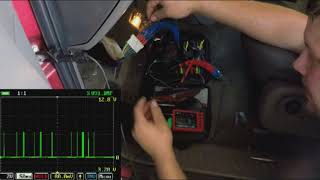
Connect to CAN-H and CAN-L. A healthy signal shows CAN-H rising to ~3.5V and CAN-L dropping to ~1.5V. Flat lines indicate hard shorts.
Tools: Automotive Oscilloscope, Probes (Professional)
When This Code Triggers (Freeze-Frame Conditions)
- Vehicle State: Key-On, Engine Off or Running (The fault is detected immediately at startup or while driving.)
- System Voltage: <10.5V or >15V (Sets during engine cranking with a weak battery or due to alternator voltage spikes.)
- Physical Event: N/A (Triggered by physical events like hitting a pothole or water intrusion disrupting a poor connection.)
- Network Status: Bus Off (A 'Bus Off' state occurs when a node shuts down due to excessive data errors.)
Related Codes
- U0100 — 'Lost Communication With ECM/PCM'. Having both codes strongly suggests a network-wide problem like a shorted CAN bus wire, not a single failed module.
- U0073 — 'Control Module Communication Bus A Off'. Indicates the entire network has shut down due to shorted wires or a module flooding the network with junk data.
- U0146 — 'Lost Communication With Gateway A'. The Gateway module acts as a router. This code means the central router or its connections have failed.
- U0121 — 'Lost Communication With ABS Module'. A faulty ABS module disrupts the entire CAN bus, causing other modules to set U2169.
Climate & Environmental Factors
- High Humidity / Coastal Regions: Salt-laden air accelerates the corrosion of wiring, connector pins, and ground points, increasing resistance.
- Cold Climates / Winter: Extreme cold causes materials to contract, loosening connections. Plastic housings become brittle and crack, allowing moisture to enter.
- Road Salt (Salt Belt Regions): Salt spray acts as an electrolyte, accelerating the decay of copper wires and terminals, creating a green crust that blocks signals.
How to Talk to a Mechanic About This Code
Say this: "I have a U2169 communication code and multiple warning lights. I'd like to schedule a diagnostic for a CAN bus network issue. Please start by identifying which module is offline and check its power, ground, and wiring integrity before recommending a module replacement."
This signals you understand U-codes are network problems, not necessarily bad parts. It directs the technician to follow a logical diagnostic process and prevents them from immediately quoting an expensive module replacement.
Avoid saying:
- 'My check engine light is on, can you look at it?'
- 'Just fix whatever is wrong.'
- 'My car is acting weird, I think it's the computer.'
Questions to ask before authorizing the repair:
- Which specific module was not communicating?
- Did you check for power and ground at the module's connector, and what were the readings?
- What was the CAN bus resistance at the OBD-II port? Was it 60 ohms?
- Can you show me the damaged wire or corroded connector?
- If a module needs to be replaced, does the new one require programming and is that included in the quote?
Where to Take It: Dealer vs Independent vs Chain
- Dealer:
Best for: Vehicles under warranty, Very new models (2023+), Known manufacturer-specific issues or TSBs, Complex German brands (BMW, Audi, Mercedes-Benz)
Downsides: Highest labor rates, often 50-100% more than independent shops., Defaults to replacing an entire assembly or harness rather than performing a detailed wiring repair. (Typical cost: +50% vs. baseline) - Independent Shop:
Excellent fit, but only if the shop has strong electrical diagnostic capabilities. A good independent diagnostician is more flexible and persistent than a dealer technician for finding wiring faults.
Best for: Out-of-warranty vehicles where cost is a factor., Diagnosing intermittent and complex electrical faults., Getting a second opinion on a dealership's quote.
Downsides: Quality varies greatly; seek out shops specializing in electrical/diagnostic work with ASE-certified technicians., Less experience with brand-new models or obscure manufacturer quirks. (Typical cost: +0% vs. baseline) - Chain Shop:
AVOID. This is a complex diagnostic task far outside the scope of a typical chain repair shop.
Best for: Simple, routine maintenance like oil changes, tires, and brake pads.
Downsides: Technicians are not equipped or trained for complex network diagnostics., High pressure to sell parts leads to misdiagnosis or unnecessary repairs. (Typical cost: -10% vs. baseline)
When to Walk Away From the Repair
If the estimated repair cost exceeds 50% of the car's private-party value, seriously consider selling or trading it in instead of repairing it.
- Car worth $5000, fix is $600: Fix it. This is a standard repair cost and well below the threshold.
- Car worth $4000, fix is $2200: Walk away. The repair cost is over 50% of the car's value. A new module and programming is a significant investment in an older vehicle.
- Car worth $8000, fix is $4000: Borderline. The cost is exactly 50% of the value. Get a second opinion before proceeding. If the rest of the car is in excellent condition, it might be worth it.
What Scan Tool You Need for This Code
Minimum: A scanner that reads 'enhanced' or 'full system' codes. It must communicate with all modules (ABS, BCM, TCM, Airbag, etc.), not just the engine computer.
A basic $20-$50 code reader only checks for engine codes ('P' codes). U2169 is a network code, and the key to diagnosis is finding which module is *not* responding. A basic reader cannot do this.
Budget: BlueDriver Pro (~$90) — Connects to your smartphone and reads/clears codes from all vehicle systems, allowing you to identify which module is offline. Provides live data with no subscription fees.
Mid-range: Innova 5610 / Foxwell NT530 (~$350) — Adds bidirectional control. This allows you to command modules directly, which is extremely helpful for confirming if a module is truly dead or just has a wiring issue.
Professional: Autel MaxiCOM MK808Z / Launch X431 CRP919EBT (~$450-600) — Provides full bidirectional control, advanced coding/programming for module replacement, and access to manufacturer-specific data. Essential for completing a module replacement yourself.
Rent vs buy: Most auto parts store loaner tools are basic code readers and will NOT be sufficient for diagnosing a U2169 code. You must buy a scanner with full-system capabilities.
How to Clear the Code After You Fix It
- Reconnect the battery.
- Use a professional OBD-II scan tool to clear the U2169 code from all modules.
- Perform a vehicle-specific drive cycle to confirm the fix.
Drive cycle (~20 minutes): Cold start, idle for 3 minutes, 15 minutes of mixed city/highway driving, then allow the vehicle to cool down.
Readiness monitors affected: Not directly applicable to emissions readiness monitors., Ensure the previously offline module communicates consistently.
Before emissions retest: drive at least 50 miles to fully set monitors.
Watch out for:
- Disconnecting the battery does not clear the code from most modules.
- If the corroded wire is not fixed, the code returns immediately.
Will This Fail Emissions / State Inspection?
Yes — this code typically fails an OBD-II emissions inspection.
- California: An illuminated Check Engine Light is an automatic failure. The vehicle must be driven to complete readiness monitors after repair.
- New York: The NYVIP3 inspection fails any vehicle with an illuminated Malfunction Indicator Lamp.
- Texas: An illuminated Check Engine Light results in an automatic failure. Too many 'Not Ready' monitors also cause a failure.
Most Commonly Affected Vehicles
- Chevrolet Silverado (2019-2022) — Prone to side detection system module issues due to broken wires in the rear harness, and ground strap corrosion causing power steering loss.
- GMC Sierra (2019-2022) — Experiences side detection module failures and electrical issues related to bad grounds or faulty wiring harnesses.
- Ford Focus (2007-2011) — Known for Body Control Module (BCM) failures causing widespread communication issues. Replacement BCMs require programming.
- Nissan Rogue (2021-2023) — TSB NTB23-042 addresses U2169 related to the Automatic Back Door Control Unit, requiring replacement.
- Hyundai Ioniq (2019-2022) — TSB 23-BR-001H addresses communication issues with the Electric Parking Brake (EPB) system by replacing the extension wiring harness.
- Pontiac G6 (2008-2010) — Sets U2169 for 'Lost Communication With Side Object Detection Module' due to wiring issues in the door or mirror.
- Cadillac Escalade (2007-2014) — Failures in modules like the ABS or BCM cause widespread communication issues and set various U-codes.
- Mitsubishi Outlander (2010-2016) — U2169 points to a communication circuit fault related to the instrument cluster, causing gauges to go blank.
Manufacturer-Specific Notes
- General Motors (GM): On 2019+ trucks, check the wiring harness near the rear bumper for side detection modules, and verify EBCM software updates related to recall 19V889000.
- Ford: A faulty ABS module sends disruptive signals onto the CAN bus. Disconnect the ABS module to see if communication is restored on the network.
- Chrysler/Dodge/Jeep: Highly sensitive to aftermarket electronic devices. Improperly installed remote starters tapped into the CAN bus are a primary cause of U2169.
- Nissan: For 2021-2023 Rogue models, TSB NTB23-042 requires replacement of the AUTO BACK DOOR ECU to resolve U2169.
- Hyundai: On 2019-2022 Ioniq models, TSB 23-BR-001H requires replacing the EPB extension wiring harness to fix communication faults.
Real Owner Stories
2007 Chevy Silverado with cascading electrical failures
Power door locks cycled randomly, gauges swept, engine lost power, and the truck intermittently refused to start.
What they tried:
- Dealer replaced the radio.
- Replaced the battery after finding a bad cell.
- Dealer replaced a MEGA Fuse and fuel pump module.
Outcome: The problems continued after multiple part replacements. The root cause was a systemic issue involving weak voltage and bad ground connections in the main harness.
Lesson: A cascade of bizarre electrical faults points to a systemic issue like a bad ground or wiring harness problem, not a single bad component.
2011 Ford Focus with dead dashboard
Turn signals failed to show on the dash, A/C cut out, and the car eventually refused to start.
What they tried:
- Checked for water intrusion in the Body Control Module (BCM).
- Programmed a new key.
- Replaced the BCM.
Outcome: After replacing the BCM, the dash remained dead. The superseded BCM part required an undocumented 25-amp fuse added to an empty slot (Fuse 88) to power the dash.
Lesson: When replacing modules, verify TSBs for superseded part numbers. New parts often require undocumented modifications, like adding a fuse.
2019 Audi A3 power steering failure after battery swap
Immediately after replacing the 12V battery, the power steering assist failed and multiple communication faults appeared.
What they tried:
- Reconnected the battery.
- Drove the vehicle to relearn systems.
- Scanned codes, showing the power steering module offline.
Outcome: A blown main fuse (Fuse SA3) for the electric power steering rack was found. The new battery registered low voltage initially, causing a power surge that blew the fuse.
Lesson: If a major system dies after a battery replacement, check the large-amperage fuses in the engine bay. Ensure new batteries are fully charged before installation.
How to Prevent This Code From Triggering
- Apply Dielectric Grease to Connectors (Whenever a connector is disconnected, or every 3-5 years for vulnerable areas.) — Dielectric grease blocks moisture and oxygen from metal pins, preventing corrosion that causes communication failures.
- Clean Battery Terminals (Annually) — Corrosion increases resistance and causes voltage drops, forcing sensitive modules offline. Clean terminals ensure a solid power supply.
- Wash the Undercarriage in Winter (Bi-weekly in 'Salt Belt' regions) — Road salt accelerates the decay of wiring harnesses and ground straps. Washing removes salt before it destroys wiring.
- Use Corrosion Inhibitor Sprays (Annually on exposed grounds) — Products like Fluid Film create a self-healing barrier that displaces moisture and stops existing corrosion on chassis grounds.
Frequently Asked Questions
Can a bad battery cause a U2169 code?
Yes. Modules require stable voltage to operate. Drops below 10.5V during startup force modules offline, triggering U2169. Always test the battery and alternator first.
What is the most common misdiagnosis for a U2169 code?
The most common mistake is immediately replacing the non-communicating module. Over 70% of the time, the issue is a corroded wire, poor ground, or loose connector pin. Always verify power, ground, and network integrity before condemning a module.
Can my aftermarket remote starter or stereo cause this code?
Yes. Improperly installed aftermarket electronics are a leading cause of network interference. If tapped into the CAN bus incorrectly, they disrupt signals and generate U-codes. Disconnect recent aftermarket installations first during diagnosis.
Is it expensive to fix a U2169 code?
Repair costs vary widely based on the root cause. A simple wiring repair costs $250 to $600, mostly in diagnostic labor. Replacing a critical module like a BCM costs $800 to over $2,000 including programming.
Can I fix a U2169 code myself?
Basic checks like testing the battery, inspecting fuses, and cleaning grounds are DIY-friendly. However, diagnosing the CAN bus requires wiring diagrams, a multimeter, and a bidirectional scanner. Advanced electrical faults require an oscilloscope and professional experience.
Will clearing the code make it go away?
Clearing the code with a scanner only works temporarily if the fault was a one-time voltage drop. If a hard fault exists, like a broken wire, the code returns immediately. You must fix the underlying physical issue.
What is a CAN bus?
The Controller Area Network (CAN bus) is your car's central nervous system. It consists of twisted wire pairs connecting all vehicle computers. This allows systems like the engine, transmission, and brakes to share data instantly.
Why do so many warning lights appear at once for one code?
Many systems rely on shared data to function properly. If the ABS module goes offline, the stability control system loses critical wheel speed data. It then triggers its own warning light because it can no longer operate safely.
What is the difference between a module failure and a network failure?
A module failure means a single computer died, but the wiring is intact. A network failure means the communication lines are broken or shorted. Network failures cause multiple unrelated systems to crash simultaneously.
Key Takeaways
- U2169 indicates a specific control module has dropped off the CAN bus network, triggering multiple unrelated warning lights simultaneously.
- Always test the battery first; voltage drops below 10.5V during startup are the leading cause of intermittent communication codes.
- Do not immediately replace the non-communicating module; over 70% of U2169 codes stem from corroded wiring, loose grounds, or poor connector pin tension.
- Diagnosis requires a bidirectional scanner capable of reading all vehicle systems to pinpoint exactly which module is offline before testing its 60-ohm network resistance.
Helpful Videos


The information in this article is provided for general reference and educational purposes only. Vehicle specifications, procedures, and part compatibility can vary by production date, trim level, and region. Always consult your vehicle's factory service manual and verify part numbers before purchasing or performing repairs. Safety-critical components such as airbags, seat belts, and braking systems should be installed by a qualified professional.
- 🎬 Helpful Videos
- What Does U2169 Mean?
- Can I Drive With U2169?
- Common Causes
- Symptoms
- Diagnostic Flowchart
- Common Fixes & Costs
- Used vs. New Parts: Buying Guide
- What Happens If You Wait — Timeline
- Cost of Not Fixing It
- Diagnosis Steps
- When This Code Triggers (Freeze-Frame Conditions)
- Related Codes
- Climate & Environmental Factors
- How to Talk to a Mechanic About This Code
- Where to Take It: Dealer vs Independent vs Chain
- When to Walk Away From the Repair
- What Scan Tool You Need for This Code
- How to Clear the Code After You Fix It
- Will This Fail Emissions / State Inspection?
- Most Commonly Affected Vehicles
- Manufacturer-Specific Notes
- Real Owner Stories
- 2007 Chevy Silverado with cascading electrical failures
- 2011 Ford Focus with dead dashboard
- 2019 Audi A3 power steering failure after battery swap
- How to Prevent This Code From Triggering
- Frequently Asked Questions
- Can a bad battery cause a U2169 code?
- What is the most common misdiagnosis for a U2169 code?
- Can my aftermarket remote starter or stereo cause this code?
- Is it expensive to fix a U2169 code?
- Can I fix a U2169 code myself?
- Will clearing the code make it go away?
- What is a CAN bus?
- Why do so many warning lights appear at once for one code?
- What is the difference between a module failure and a network failure?
- Key Takeaways
- 🎟️ Get 5% Off