

U1500 on 2009-2017 Volvo XC60: LIN Bus Communication Fault Causes and Fixes
Code U1500 on a 2009-2017 Volvo XC60 indicates a communication failure on a LIN bus sub-network. While the exact definition is not officially documented by Volvo, the most common causes are a faulty alternator voltage regulator or a failing alarm siren module. Diagnosis requires identifying which module has stopped communicating, often with a Volvo-specific scan tool like VIDA.
- U1500 means a component on a secondary communication network (LIN bus) has failed.
- The definition for U1500 on Volvo is not officially published, so diagnosis relies on general network principles and knowledge of common failure items.
- The most likely causes on a 2009-2017 XC60 are a faulty alternator/regulator or a failed alarm siren module.
- Symptoms can range from a check engine light to a dead battery or an 'Alarm System Service Required' message.
- Do not replace the battery without first diagnosing the source of the LIN bus fault, as a parasitic draw from a failed module is a common symptom.
What's Unique About the 2009-2017 Volvo XC60
While Volvo does not provide a public, specific definition for U1500, related Volvo codes (like ECM-B108700) point to LIN bus failures between the Engine Control Module (ECM) and the alternator or other sensors. On this XC60 platform (and its P3 platform mates), common LIN bus components known to fail and trigger this code are the alternator's voltage regulator and the alarm siren module (SCM). Unlike some other brands where this code points to a single, very common issue like an OnStar module, on a Volvo it requires a more systematic check of the potential LIN bus devices, with the alternator and siren being the primary suspects.
Symptoms You May Notice
- Check Engine Light is on
- "Alarm System Service Required" message in the instrument cluster
- Charging system warning light or "12V System Service Required" message
- Battery drains overnight or when parked
- Car alarm may sound randomly or not work at all
- Sunroof may become inoperative (it shares a network with the alarm siren)
- Features controlled by the failed module (e.g., climate control fans, heated seats) may not work.
- Replacing the battery. A failing LIN component (like the alternator or siren) can cause a parasitic draw that kills the battery. People often replace the battery first, only for it to die again because the underlying draw was not fixed.
Most Likely Causes
- Faulty Alternator / Voltage Regulator 🔴 High Probability Modern Volvos use a LIN-controlled 'smart' charging system. The voltage regulator, which communicates with the ECM over the LIN bus, is a common failure point. An internal fault in the regulator can disrupt the entire LIN network it's on, causing intermittent or total loss of communication. Aftermarket alternators are particularly noted for having less reliable regulators that fail prematurely.
How to confirm: Using a Volvo-specific scan tool like VIDA, check for communication errors with the Alternator Control Module (ACM). With the engine running, monitor battery voltage. A LIN fault will often cause the alternator to enter a 'fallback' mode, charging at a constant, non-ideal voltage (e.g., ~13.5V-13.8V) or not charging at all. A healthy system will vary voltage between approximately 12.7V and 15V depending on load and battery state. Disconnecting the single LIN wire at the alternator and seeing if other LIN-related codes change can also help isolate the issue.
Typical fix: Replace the alternator voltage regulator. This can sometimes be done with the alternator on the car, but often it is more practical to replace the entire alternator assembly, especially if the alternator is high-mileage. Volvo Technical Journal TJ 26897 specifically recommends replacing the regulator over the entire alternator for certain charging faults. 🎬 See how to troubleshoot a Volvo LIN bus alternator regulator
Est. part cost: $70-$230 for a regulator, $300-$750 for a complete alternator assembly. - Failed Alarm Siren Module (SCM) 🟡 Medium Probability The alarm siren module contains an internal, non-replaceable rechargeable battery. Over time, this battery fails and often leaks corrosive material onto the circuit board, destroying it and causing the module to fail. This failure disrupts LIN bus communication, leading to an "Alarm System Service Required" message, parasitic battery drain, and potentially a U1500 code.
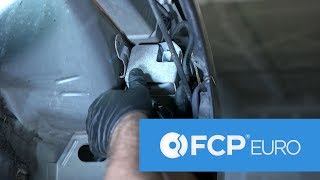
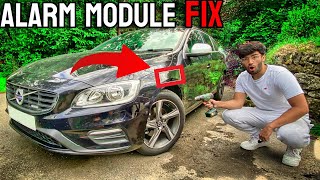
How to confirm: The primary symptom is the "Alarm System Service Required" message. A scan tool may show a specific code for the siren module (SCM), such as UEM-0004. You can try disconnecting the siren module, clearing codes, and seeing if the U1500 code disappears. The module is located in the front passenger-side wheel well, behind the fender liner, and requires drilling out a security bolt to remove. 🎬 Watch this step-by-step Volvo alarm siren module replacement video
Typical fix: Replace the alarm siren module. This requires drilling or cutting out a security shear bolt. Some owners on forums report success with just disconnecting the faulty module if they don't need the alarm functionality, though this may require a software update from a dealer to remove the warning message.
Est. part cost: $150-$250 for a new module. - Wiring or Connector Issue ⚪ Low Probability The single LIN bus wire can be vulnerable to chafing, corrosion, or breaks, especially in areas exposed to the elements or flexing, like behind the front bumper or near the alternator.
How to confirm: Visually inspect the wiring harness leading to the suspected faulty component (e.g., alternator, siren). Check for continuity and shorts to power or ground on the LIN wire using a multimeter. This requires a vehicle-specific wiring diagram.
Typical fix: Repair the damaged section of the wire or clean/replace the corroded connector.
Est. part cost: $5-$50 for wiring supplies.
Rare But Worth Checking
- Failed Climate Control Module (CCM) or Sensor: Water ingress from a leaking windshield seal can damage the CCM or its associated LIN bus components, causing communication failures. If you have symptoms related to the climate control system, this is a possibility.
- Faulty Engine Control Module (ECM): In rare cases, the LIN bus driver circuit within the master control module (often the ECM) can fail. This should only be considered after all other components on the network and the wiring have been proven to be good.
Diagnosis Steps
- Connect a Volvo-specific diagnostic tool (like VIDA) to read all fault codes from all modules. Note which module is reporting the U1500 code, as this is the 'master' module.
- Check for any other codes that point to a specific component (e.g., siren module code UEM-0004, alternator code ECM-B108700).
- If an "Alarm System Service Required" message is present, start by investigating the Siren Control Module (SCM). Access the module in the passenger wheel well, disconnect it, clear codes, and see if the U1500 code returns.
- If charging system warnings are present, investigate the alternator. With the engine running, use a multimeter to check charging voltage at the battery terminals. It should fluctuate, often between 12.7V and 15V. A steady, lower voltage (e.g., 13.5V) or no charge indicates a fallback mode due to a LIN communication failure.
- If the alternator is suspect, disconnect the single LIN wire from the alternator, clear codes, and re-scan. This will isolate it from the network.
- If no specific component is implicated, obtain a wiring diagram for the LIN bus associated with the master module that set the code.
- Inspect the LIN bus wiring for any visible damage, chafing, or corrosion at connectors.
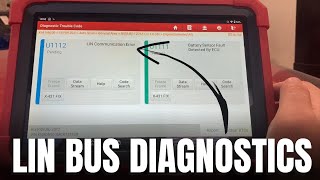
- Using an oscilloscope or multimeter, check the LIN bus for proper voltage signals. A healthy LIN bus should show a square wave toggling between near-battery voltage (recessive bit, >80% of Vbat) and near-ground voltage (dominant bit, <20% of Vbat). A short to ground or power will hold the voltage constant. 🎬 Watch how to perform LIN bus diagnostic testing
- Isolate components on the bus one by one by disconnecting them to see if normal communication is restored.
Parts You'll Likely Need
- Alternator Assembly
(OEM #36012382)— Often the internal LIN-communicating voltage regulator fails. Replacing the whole assembly is a common and reliable repair, especially on higher mileage vehicles. Aftermarket units have a reputation for premature failure.
Trusted brands: Bosch, Valeo, Genuine Volvo
OEM price range: $600-$750
Aftermarket price range: $300-$500 - Alarm Siren Module
(OEM #30659882 (or 30659883 for models with inclination sensor))— The internal battery fails and leaks, destroying the circuit board and taking down its LIN bus segment. This is a very common failure after 7-10 years.
Trusted brands: Genuine Volvo
OEM price range: $200-$250
Aftermarket price range: $150-$200
Related Codes That Often Appear With This One
- ECM-B108700 — This is a Volvo-specific code for 'LIN Bus A' communication failure, often pointing directly at the alternator or radiator sensor communication.
- CCM-B108788 — This is a Volvo-specific code for 'LIN Bus A - Bus off' set by the Climate Control Module, indicating a fault on the climate system's LIN network.
- UEM-0004 — This is a Volvo-specific code for the Siren/Internal battery of the alarm module, a very common cause of LIN bus issues on this platform.
Platform-Specific Known Issues
- SwedeSpeed Forum: A user with a 2010 XC60 reported the 'Alarm System Service Required' message and a dead battery. The fix was replacing the alarm siren module, which had a failed internal battery that leaked onto the circuit board. The user noted the difficulty of drilling out the security bolt during replacement.
- VolvoXC.com Forum: A user with a 2001 V70XC (P2 platform, but same siren issue) confirmed that a defective sire
Mechanic-Grade Diagnostic Values
- LIN Bus Signal Voltage (Oscilloscope) — expected: A square wave that toggles between a high (recessive) state and a low (dominant) state.. Failure: A flat line near 0V (short to ground), a flat line near battery voltage (short to power), or an absent/malformed waveform.
- Healthy 'Smart' Alternator Output Voltage (Multimeter at Battery) — expected: Fluctuates between ~12.7V and ~15.0V depending on battery state of charge, electrical load, and temperature.. Failure: A constant voltage (e.g., 13.5V - 13.8V) indicates the alternator is in 'fallback' or 'failsafe' mode due to a LIN communication loss. A voltage below 12.6V with the engine running indicates no charging.
- LIN Wire Voltage at Alternator Harness (Disconnected) — expected: Should be pulled high towards battery voltage by the master module's (ECM) internal pull-up resistor.. Failure: A low voltage (e.g., ~0.16V - 0.53V) with the harness disconnected from the alternator points towards a wiring short to ground or an internal fault in the ECM.
Scan Tool Commands That Help
- Volvo VIDA: Read out of all module DTCs, focusing on the ECM and CEM. — This is the first step to see which master module is logging the U1500 and if any slave modules (like SCM or ACM) are reporting specific internal faults (e.g., UEM-0004 for the siren).
- Volvo VIDA: Alternator Test / Activation — VIDA has a specific test procedure for the alternator that monitors communication and output based on varying battery temperatures and loads. This can confirm if the ECM is able to communicate with the Alternator Control Module (ACM) at all.
- Volvo VIDA: SCM (Siren Control Module) Activation — This bidirectional command attempts to trigger the alarm siren. If the command fails or the module does not respond, it strongly indicates a fault with the SCM or its wiring, a common cause for U1500.
Wiring & Ground Locations
- Alternator LIN Connector — A single-wire plug on the back of the alternator's voltage regulator.. This is the primary communication point for the charging system. Disconnecting it helps isolate the alternator from the LIN bus for testing. The wire is often purple or violet in color.
- SCM (Siren) Connector — Behind the passenger side front wheel well liner. The module is attached with a security bolt that must be drilled out.. This is the connection point for the second most common cause. Disconnecting it is a key diagnostic step if alarm-related symptoms are present.
- Main Engine Bay Ground Points — Located on the driver and passenger side strut towers.. Poor grounds can cause floating voltages and communication errors across multiple modules. While not a direct cause of a single LIN bus fault, ensuring these are clean and tight is a fundamental step in any electrical diagnosis.
Real Owner Repair Stories
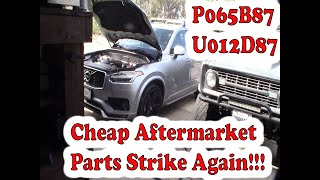
- YouTube user FintechRepairShop (2016 Volvo XC90 (SPA Platform, but same LIN principles as P3)) — Intermittent '12V System Service required' message. Charging voltage would get stuck at 13.8V (failsafe mode) instead of fluctuating up to 15V.
❌ Tried (didn't work) Replacing the voltage regulator with an aftermarket Amazon part was intermittent., A previous shop had installed a cheap aftermarket alternator which was also suspect.
✅ What actually fixed it The vehicle had a cheap aftermarket alternator AND a cheap aftermarket water pump, which shared the same LIN bus. Both were creating intermittent communication issues. Replacing both the alternator and water pump with OEM Volvo parts resolved the communication faults and restored normal charging. - Device Repair Guy Case Study (2013 Volvo XC90 3.2 (P3 Platform)) — Charging system warning ~30 seconds after start. Loss of communication with generator/alternator.
❌ Tried (didn't work) Replacing alternator with an incorrect 150A unit (caused undercharging)., Fitting a new genuine Bosch LIN regulator to the original alternator (fault returned, charging stuck in fallback mode at ~13.5V).
✅ What actually fixed it The root cause was a failed LIN driver circuit inside the Engine Control Module (ECM), which was damaged by a previous overcharge event from the original failed regulator. The LIN line was being held to ground internally by the faulty ECM. Repairing the ECM itself fixed the communication fault.
OEM Part Supersession History
30659413→30659882— Standard part revision and update.
Heads up: 30659882 is for vehicles without the inclination sensor. Part 30659883 is used for vehicles with the sensor. They are often interchangeable but may require a software configuration change if the wrong one is installed.30659758→31676009, then 31652388— Part revisions for later model years or different variants.
Heads up: These parts are for different chassis number ranges or option codes (e.g., 'Without level sensor'). Always verify the correct part number with a VIN.
Model Year Variations Within This Range
- 2015-2017: Some later models, particularly those with start/stop functionality, may use a Battery Monitoring Sensor (BMS) on the negative battery terminal. This sensor also communicates via a LIN bus and a fault with the BMS can cause charging system issues and related communication codes, though it's less common than the alternator or siren.
Diagnostic Flowchart
Other Known Issues on This Vehicle
Issues unrelated to this code that are worth knowing about as an owner of this generation:
- Excessive Oil Consumption (2015-2016 4-Cyl Drive-E) 🔴 High — Common on 2015-2016 models with the 4-cylinder Drive-E engine, often appearing after 60,000 miles. Caused by clogged piston oil control rings. (Ref: Volvo TSB TJ31233 (NHTSA ID 10121175) details the diagnosis and piston ring replacement procedure.)
- Aisin TF-80SC Transmission Valve Body Wear 🔴 High — Common on 6-speed automatic models, typically surfacing between 80,000-130,000 miles. Symptoms include shift flares, harsh shifts, and torque converter shudder. (Ref: No recall, but frequent fluid changes (every 30-50k miles) are recommended to prevent premature wear.)
- PCV System / Oil Trap Failure (3.2L and T6 Engines) 🟠 Medium — The PCV diaphragm can tear around 100,000 miles, causing a loud whistling or howling noise from the engine and creating excessive crankcase vacuum. (Ref: No TSB, but it is a common maintenance item. Part numbers include 31319642 or 31319643.)
- Powered Tailgate Strut/Motor Failure 🟡 Low — Fairly common for the power tailgate struts to fail, causing the tailgate to not open/close properly or make grinding noises. (Ref: A recall was issued for some model years due to the tailgate lifting arm potentially separating.)
- High Oil Consumption (5-Cyl Engines) 🟠 Medium — Some 2013-2016 5-cylinder engines can suffer from high oil consumption due to piston ring issues. (Ref: Volvo TSB TJ34588 covers the piston ring replacement for affected 5-cylinder engines.)
Used vs. New Parts: Buying Guide for This Vehicle
When a used part is the smart pick: A used OEM alternator from a low-mileage donor vehicle can be a cost-effective alternative to a new aftermarket unit, which are known to have unreliable voltage regulators. Other electronic modules like the Sunroof Module (SRM) are also good candidates for used parts.
Donor-vehicle mileage cap: roughly under 75000 miles for the part to have meaningful remaining life.
What to inspect on the donor part:
- For an alternator, check for smooth, quiet bearing rotation and inspect the slip rings (if visible) for deep grooves or excessive wear.
- Verify the part number on the used component matches the original exactly.
- Check the donor vehicle's history for any signs of flood or major electrical damage.
OEM-only on this vehicle (don't cheap out):
- Alternator Voltage Regulator: While the regulator is the common failure point, aftermarket regulators are notoriously unreliable for these LIN systems. If not buying a full OEM alternator, a Genuine Bosch or Volvo regulator is critical.
- Alarm Siren Module: Aftermarket sirens are available but may have quality control issues. Given the labor to access the part, using a Genuine Volvo unit (PN 30659882) is highly recommended to ensure longevity.
Aftermarket brands forum-validated for this vehicle:
- Bosch (for alternators/regulators)
Brands owners have reported issues with on this vehicle:
- Unbranded or 'white-box' alternators and voltage regulators from online marketplaces have a high rate of premature failure or communication issues on Volvo's LIN bus system.
Real Owner Stories
Aggregated from forums and TSBs cited above. Mileages and costs reflect what owners reported in those sources.
2010 Volvo XC60
Symptoms: The 'Alarm System Service Required' message appeared on the dash and the car suffered from a dead battery.
What fixed it: Replacing the alarm siren module; the internal battery had failed and leaked corrosive material onto the circuit board.
Source hint: SwedeSpeed Forum: A user with a 2010 XC60 reported the 'Alarm System Service Required' message and a dead battery.
2013 Volvo XC60
Symptoms: Owner was quoted $2200 for an alternator repair due to charging system issues.
What fixed it: Replacement of the alternator assembly using OEM parts to ensure LIN bus compatibility.
Cost: $300-$2200
Source hint: https://www.reddit.com/r/Volvo/comments/v17z35/2013_xc60_should_my_alternator_repair_really/
2010 Volvo XC60
Symptoms: Climate control problems potentially caused by water ingress.
What fixed it: Investigation of the Climate Control Module (CCM) for water leaking from the windshield, which can cause LIN bus faults.
Source hint: volvoforums.com/forum/volvo-xc60-51/xc60-2010-ccm-problems-caused-water-ingress-114
Related OBD-II Codes
Frequently Asked Questions
Why is my 2009-2017 XC60 sunroof not working at the same time as the 'Alarm System Service Required' message?
Should I replace the whole alternator on my XC60 if I have a LIN bus communication error?
Can a faulty alarm module cause my XC60 battery to drain overnight?
Is there a specific way to tell if my alternator is in 'fallback' mode?
Where is the module located that usually causes the 'Alarm System Service Required' message?
Why are aftermarket alternators discouraged for the XC60?
Helpful Videos
We Have This Part in Stock



The information in this article is provided for general reference and educational purposes only. Vehicle specifications, procedures, and part compatibility can vary by production date, trim level, and region. Always consult your vehicle's factory service manual and verify part numbers before purchasing or performing repairs. Safety-critical components such as airbags, seat belts, and braking systems should be installed by a qualified professional.
- Volvo XC60:
- 🎬 Helpful Videos
- 🛍️ Shop This Part
- What's Unique About the 2009-2017 Volvo XC60
- Symptoms You May Notice
- Most Likely Causes
- Rare But Worth Checking
- Diagnosis Steps
- Parts You'll Likely Need
- Related Codes That Often Appear With This One
- Platform-Specific Known Issues
- Mechanic-Grade Diagnostic Values
- Scan Tool Commands That Help
- Wiring & Ground Locations
- Real Owner Repair Stories
- OEM Part Supersession History
- Model Year Variations Within This Range
- Diagnostic Flowchart
- Other Known Issues on This Vehicle
- Used vs. New Parts: Buying Guide for This Vehicle
- Real Owner Stories
- 2010 Volvo XC60
- 2013 Volvo XC60
- 2010 Volvo XC60
- Related OBD-II Codes
- Frequently Asked Questions
- 🎟️ Get 5% Off