

U1500 on 2018-2025 Jeep Wrangler: Causes and Fixes for Network Faults
On a 2018-2025 Jeep Wrangler (JL), code U1500 is almost always caused by a failing auxiliary battery, part of the dual-battery system for the Engine Stop-Start (ESS). This creates voltage instability, causing communication errors across the vehicle's network. Replacing both the main and auxiliary batteries is the most common and effective fix, as the failure of one battery puts significant stress on the other.
- Code U1500 on a 2018-2025 Wrangler almost always points to a battery problem, not a complex module failure.
- The small auxiliary battery for the stop-start system is the most likely culprit. When it fails, it causes system-wide voltage problems.
- Always load test BOTH batteries. It is best practice to replace them as a pair to ensure stability.
- After replacing batteries, allow the vehicle's systems time to reset. Some functions may not return immediately.
- If batteries are confirmed good, the next most likely, though rarer, cause is a faulty CAN bus star connector behind the glove box.
What's Unique About the 2018-2025 Jeep Wrangler
The 2018+ Jeep Wrangler (JL generation) uses a dual-battery system to manage its electronics and the Engine Stop-Start (ESS) feature. This system, particularly the smaller auxiliary battery, is a well-documented weak point with a short service life. Unlike on other vehicles where U1500 might point to a specific failed sensor, on the JL Wrangler, it's most often a symptom of system-wide voltage instability caused by one or both of the batteries failing. This leads to a cascade of communication errors among the vehicle's many electronic modules, often referred to by owners as 'electrical gremlins' or a 'Christmas tree' of warning lights.
Generation note: The 2018-2025 range covers the Jeep Wrangler 'JL' generation. The 2018 model year was an overlap, with both the older 'JK' and new 'JL' being sold. The information here is specific to the JL model, as its dual-battery system is the primary cause of this code. The Jeep Gladiator (JT), which is built on the same platform, shares this entire electrical architecture and is prone to the exact same issues.
Symptoms You May Notice
- Check Engine Light
- "Stop/Start Unavailable - Service Stop/Start System" message
- Flashing dashboard lights or multiple warning lights appearing at once (ABS, Traction Control, etc.)
- Malfunctioning Uconnect screen (frozen, rebooting, or missing features)
- Climate controls not working or unresponsive
- No-start condition in some cases
- Erratic behavior from other electronic accessories (e.g., power windows, radio presets lost)
- "Service Shifter" warning message
- Loss of power steering assist at low speeds
- Replacing a single module (like the radio or climate control head unit) that is showing symptoms. The module is often fine; it's just not receiving proper power or communication due to the underlying battery issue.
- Assuming the issue is a software glitch and paying for a dealer reflash. While software updates can fix some issues, they will not fix a problem caused by a failing battery.
- Replacing only one of the two batteries. A bad auxiliary battery will quickly degrade a new main battery, and a bad main battery will overwork a new auxiliary battery, leading to a repeat failure.
Most Likely Causes
- Failing Auxiliary Battery 🔴 High Probability The auxiliary battery for the Engine Stop-Start (ESS) system is known for having a short service life, often failing within 2-4 years. Its failure destabilizes the vehicle's entire electrical system, as other modules are highly sensitive to voltage drops.
How to confirm: Perform a load test on the auxiliary battery. Many auto parts stores can do this for free. A voltage drop under load indicates failure. Accessing it requires either removing the main battery and fuse box from the top or, more commonly, peeling back the passenger-side front fender liner.
Typical fix: Replace the auxiliary battery. It is highly recommended to replace the main battery at the same time, as the failure of one often stresses and shortens the life of the other. Many owners also choose to bypass the auxiliary battery entirely.
Est. part cost: $100-$200 - Failing Main Battery 🟡 Medium Probability A failing main battery can cause the same voltage instability as a failing auxiliary battery. The complex electronics of the JL are very sensitive to correct voltage. The main battery is often weakened by a failing auxiliary battery, leading to a dual failure.
How to confirm: Perform a load test on the main battery. Check for a date code on the battery; they typically last 3-5 years. The Intelligent Battery Sensor (IBS) on the negative terminal monitors battery health, and a fault here can also cause issues.
Typical fix: Replace the main battery. It is best practice to replace both the main and auxiliary batteries together to ensure system stability.
Est. part cost: $200-$400 - Faulty CAN Bus Star Connector ⚪ Low Probability There are documented cases of the star connector (also called a CAN bus block or junction), a central hub for network wiring, having poor internal solder joints that crack over time. This causes intermittent communication loss, leading to a 'Christmas tree' of dash lights and multiple 'U' codes.
How to confirm: If batteries are confirmed good, inspect the star connector, located behind the glove box. Wiggling the wires going into the connector while the issue is present may temporarily resolve the symptoms, confirming a bad connection. Visual inspection of the internal circuit board may reveal cracked solder points.
Typical fix: Replace the star connector (Part No. 68321746AA). Some DIYers have successfully re-soldered the pins, but replacement is the recommended fix.
Est. part cost: $50-$100 - Loose or Corroded Battery Terminals ⚪ Low Probability Vibration from normal and off-road use can loosen battery connections. The auxiliary battery terminals, being harder to access, can be overlooked. Corrosion on the main battery's Intelligent Battery Sensor (IBS) can also send faulty data.
How to confirm: Visually inspect and physically check the tightness of all terminals on both the main and auxiliary batteries, including the connections at the fuse box and the IBS on the main negative terminal.
Typical fix: Clean the terminals with a wire brush and corrosion inhibitor spray, then tighten the connections securely.
Est. part cost: $0-$10
Rare But Worth Checking
- Faulty Intelligent Battery Sensor (IBS):
Diagnosis Steps
- Scan for all codes in all modules. Note any other 'U' (Network) or 'B' (Body) codes, especially those related to low voltage or lost communication.
- Begin with the simplest cause: Inspect the terminals on both the main and auxiliary batteries for corrosion and tightness. Clean and tighten as needed. Pay close attention to the Intelligent Battery Sensor (IBS) on the main negative terminal.
- Have both the main and auxiliary batteries professionally load-tested. Do not skip testing one if the other is bad. A failure in one battery often damages the other. This is the most critical diagnostic step.
- If both batteries test good, perform a full electrical system reset. Disconnect the negative terminal from the main battery (which includes the IBS) for at least 30 minutes to allow all modules to reset. Reconnect and allow the vehicle to sit for up to an hour to relearn.
- If issues persist, investigate the CAN Bus Star Connector. This is located behind the glove box. With the vehicle on, carefully wiggle the wiring harnesses connected to it. If the dashboard lights flicker or symptoms change, the connector is faulty.
- If a specific module is consistently flagged in scan data as 'lost,' and all the above steps check out, inspect the wiring and connectors for that specific module for damage or corrosion.
Parts You'll Likely Need
- Auxiliary Battery
(OEM #BE0H4245AA (Supersedes 68292352AB, 68292352AC))— This is the most frequent point of failure on the JL Wrangler's electrical system and the primary cause of code U1500.
Trusted brands: Mopar, Deka, East Penn
OEM price range: $150-$250
Aftermarket price range: $100-$200 - Main Battery (AGM)
(OEM #BBAH7900AA (H7 Group Size, 850 CCA for eTorque) or BBAH6800AA (H6 Group Size, 700 CCA for non-eTorque))— Often fails along with, or shortly after, the auxiliary battery. It's best practice to replace both at the same time.
Trusted brands: Mopar, Odyssey, NorthStar, Optima
OEM price range: $300-$450
Aftermarket price range: $200-$350 - CAN Bus Star Connector
(OEM #68321746AA)— A known weak point where internal solder joints can crack, causing intermittent network failures. If wiggling the connector resolves symptoms, it needs replacement.
Related Codes That Often Appear With This One
- U0140 — Lost Communication With Body Control Module. This can be logged by other modules when the BCM itself is acting up due to voltage instability.
- B210D — Battery Voltage Low. This code often appears alongside network codes and is a direct indicator of the root cause.
- U0415 — Invalid Data Received From ABS Control Module. This often appears when network-wide communication is disrupted by voltage issues.
Technical Service Bulletins (TSBs) & Recalls
- TSB 08-007-19: While not directly for U1500, this TSB addresses battery diagnostics and highlights the complexity of the charging system, reinforcing the importance of proper battery testing.
- TSB 08-023-19 REV. A: Addresses an issue where the instrument cluster may reset continuously at startup, a symptom that can overlap with U1500-related battery problems. The fix is a software flash.
- Star Online Publication S1408000384 Rev. C: A technical document for dealers explaining diagnostics for the Intelligent Battery Sensor (IBS) and noting that the IBS should not be replaced just for a new battery, but may need time to recalibrate.
Platform-Specific Known Issues
- The dual-battery system for the Engine Stop-Start (ESS) is a notorious weak point, with the auxiliary battery failing prematurely and causing widespread, difficult-to-diagnose electrical gremlins.
- After replacing the batteries, the vehicle's computer may require a significant amount of time (sometimes several hours or drive cycles) to fully reset and restore all functions like climate control and radio.
- Accessing the auxiliary battery is difficult. The official dealer method is to peel back the passenger-side fender liner, which takes about 15-30 minutes. Some owners go through the top by removing the main battery and fuse box, but this carries a risk of damaging electrical connectors.
Mechanic-Grade Diagnostic Values
- System Voltage (via EVIC display) - Healthy Batteries, Engine Running — expected: Varies based on load and battery state of charge due to the Intelligent Battery Sensor (IBS). Typically 12.5V-13.0V while cruising, and may jump to 13.8V-14.5V during deceleration or braking as the system recaptures energy.. Failure: A constant voltage of 13.8V or higher may indicate the system is working hard to keep failing batteries charged. Consistently low voltage below 12.5V while running can indicate a charging system or battery problem.
- CAN Bus Network Resistance — expected: With the battery disconnected, the resistance between CAN-C High and CAN-C Low pins at the OBD-II port should be approximately 60 ohms. Some owners have measured around 40 ohms, suggesting a third terminating resistor in the system, but a reading of ~60 ohms is the standard target.. Failure: A reading of 120 ohms indicates a break in the circuit or a problem with one of the two main terminating resistors. A reading near 0 ohms indicates a short between the CAN High and Low lines.
Scan Tool Commands That Help
- wiTECH (Dealer Tool), J-Scan, Appcar DiagFCA: Clear Faults / Clear DTCs — After a battery replacement, many communication codes will be stored in various modules. A comprehensive 'Clear All DTCs' command is needed to erase these history codes from modules like the BCM, ABS, and RF Hub.
- wiTECH (Dealer Tool), J-Scan, Appcar DiagFCA: IBS Reset / Battery Replacement Reset — After installing new batteries, the Intelligent Battery Sensor (IBS) needs to be reset to learn the new battery's state of charge and health. Failing to do this can lead to improper charging and persistent ESS-related warnings.
- wiTECH (Dealer Tool), J-Scan, Appcar DiagFCA: Live Data Monitoring (LIN Bus Status) — If batteries are good, an advanced scan tool can monitor the status of individual modules on the LIN bus. This can help identify a specific module (e.g., blind spot sensor, steering column control module) that is not communicating, which is a more advanced diagnostic step beyond the common battery issue.
Wiring & Ground Locations
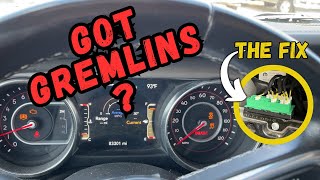
- CAN Bus Star Connectors (Junction Blocks) — Located behind the glove box. There are typically two: a green 20-pin connector and a white connector.. These connectors are central hubs for the CAN bus network. Poor internal solder joints are a known failure point, causing intermittent open circuits that lead to a cascade of U-codes. Wiggling the wires can often confirm a fault here.
- Power Distribution Center (PDC) Harness Connectors — Under the main fuse box in the engine bay. The entire PDC must be unbolted and lifted to access the large multi-pin connectors underneath.. When replacing batteries from the top, the PDC is removed. It is very easy to bend a pin on one of the large underlying connectors (e.g., F105 for ICS/HVAC) during reinstallation, causing a loss of communication or function for an entire subsystem.
- Transmission Harness Chafe Point — Along the wiring harness leading to the transmission module (TCM).. In at least one documented case, the CAN bus wires (Yellow for CAN Low, Violet/White for CAN High) chafed against a metal dowel or part of the chassis near the transmission, causing a short that took down the entire network and mimicked a star connector or battery failure.
Real Owner Repair Stories
- Reddit user /u/Maplecrush on /r/Jeep (Jeep Wrangler JL/JT) — Dashboard lights up like a Christmas tree, loss of power steering and speedometer on the highway.
❌ Tried (didn't work) Replacing the CAN bus star connector was the common advice.
✅ What actually fixed it The owner disassembled the original green star connector and found cracked solder joints on nearly every pin. They re-soldered all the pins on the connector's circuit board, which permanently fixed the issue without needing to buy a new part. - JLwranglerforums.com user 'The Last Cowboy' (2020 JL Willys) — After replacing both batteries, the HVAC control cluster had no power and a 'Service ESS' message appeared.
❌ Tried (didn't work) Replacing the N1-N7 fuse cluster., Trying a different HVAC cluster., Checking all fuses.
✅ What actually fixed it The owner removed the Power Distribution Center (PDC)/fuse box again and inspected the large harness connectors underneath. A pin at location F105 (for ICS/HVAC) was bent during the initial reinstallation. Straightening the bent pin restored all function. - YouTube channel 'Diagnose Communication Fault' (2021 Jeep Wrangler Rubicon) — After driving for 30 minutes, the vehicle would go haywire: wipers coming on, loss of power steering, multiple dash lights, 'no bus' message.
❌ Tried (didn't work) Initial suspicion was the common star connector failure.
✅ What actually fixed it Using a diagnostic technique of unplugging star connector branches one-by-one while the fault was active, the owner isolated the problem circuit to the transmission harness. Upon inspection, the CAN low (yellow) and CAN high (violet/white) wires had chafed through near the transmission, shorting the network. Repairing the damaged wires resolved all issues.
OEM Part Supersession History
68321746AA→68230877AA— The 20-way star connector (68321746AA) has been largely superseded in newer models by a 13-way connector (68230877AA).
Heads up: While the connectors are different sizes, some owners have successfully used the 13-way connector as a substitute if the 20-way is unavailable, as long as there are enough ports for the circuits in their specific vehicle. It is not a direct replacement if all 20 ways are needed.
Model Year Variations Within This Range
- 2024+: Starting in 2024, some reports indicate changes to the dual-battery system or the elimination of the auxiliary battery in certain trims, though this is not universally confirmed across all models and engines. This could change the diagnostic path for U-codes on the newest models, making them potentially less related to a secondary battery failure.
Diagnostic Flowchart
Other Known Issues on This Vehicle
Issues unrelated to this code that are worth knowing about as an owner of this generation:
- Steering Wander / Loose Steering Feel 🔴 High — Very common on 2018-2020 models, leading to a TSB. Less frequent on later models but still reported. (Ref: TSB 08-074-20 involves replacing the original aluminum steering gear with a revised steel unit and updating software to improve steering feel and reduce wander.)
- Front Track Bar Bracket Weld Failures 🔴 High — Affected a specific production run of 2018-2019 models, estimated at around 4% of 18,000 vehicles. (Ref: NHTSA Recall 18V-675000 (FCA recall U74) was issued for front track bar brackets that could separate from the frame due to improper welds, potentially causing a loss of steering.)
- The 'Death Wobble' 🔴 High — A persistent issue across many Wrangler generations, including the JL. It can be triggered by hitting a bump at highway speeds, causing violent shaking of the front end. (Ref: While the steering gear TSB (08-074-20) helps, it does not fully address the death wobble, which can also be caused by worn ball joints, tie rod ends, or an under-damped steering stabilizer.)
- Aluminum Body Panel Corrosion 🟠 Medium — Commonly reported on door hinges, hoods, and tailgates where steel fasteners contact the aluminum panels, causing galvanic corrosion. (Ref: Jeep has issued internal bulletins to dealers regarding corrosion repair procedures, but there is no formal recall.)
- Leaking Freedom Top or Soft Top Panels 🟡 Low — A common complaint among owners, often caused by misaligned panels, pinched seals, or missing foam pads from the factory. (Ref: Jeep issued a service bulletin for 2021-2025 models with leaks at the B-pillar due to missing foam pads.)
- 4xe High-Voltage Battery Fire Risk 🔴 High — Specific to the Wrangler 4xe Plug-in Hybrid model; multiple recalls have been issued. (Ref: Multiple recalls (e.g., NHTSA 23V-799) have been issued for the 4xe's high-voltage battery, which can fail internally and cause a fire, even when the vehicle is parked and off.)
Used vs. New Parts: Buying Guide for This Vehicle
When a used part is the smart pick: For this specific repair, used parts are generally not recommended for the primary causes. However, if the cause is a more obscure electronic module (like a Body Control Module or Radio Head Unit) that was misdiagnosed, a used part from a reputable salvage yard with a warranty can be a cost-effective option. A used CAN Bus Star Connector could also be a viable, low-cost part to try if a new one is unavailable.
Donor-vehicle mileage cap: roughly under 50000 miles for the part to have meaningful remaining life.
What to inspect on the donor part:
- For electronic modules, check for signs of water intrusion or corrosion on the case and pins.
- Verify the part number exactly matches the original part.
- Ask for the donor vehicle's VIN to check for compatibility and any history of electrical problems.
- Ensure the salvage yard offers at least a 30-day warranty for testing.
OEM-only on this vehicle (don't cheap out):
- Main Battery
- Auxiliary Battery
Aftermarket brands forum-validated for this vehicle:
- Odyssey, NorthStar, Optima (for main AGM batteries)
- Genesis Offroad, Cole-Hersee (for dual-battery system upgrades/isolators)
Brands owners have reported issues with on this vehicle:
- No-name, ultra-cheap batteries sold online. Given the vehicle's sensitivity to voltage, using a low-quality battery is a common way to have the problem return prematurely.
Real Owner Stories
Aggregated from forums and TSBs cited above. Mileages and costs reflect what owners reported in those sources.
2018-2025 Jeep Wrangler JL
Symptoms: Owner reported a 'Christmas tree' of dash lights and multiple 'U' codes appearing intermittently.
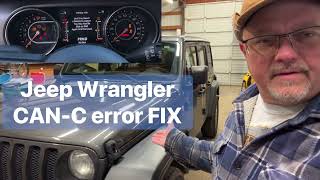
What fixed it: Replacing the CAN Bus Star Connector (Part No. 68321746AA) located behind the glove box.
Source hint: youtube.com: 'Jeep wrangler CAN-C canbus error FIX - replace STAR connector'
2020-2025 Jeep Gladiator (JT)
Symptoms: U1514-87 and U0415-00 errors appeared after a dead battery or disconnecting the Security Gateway Module (SGW).
What fixed it: Addressing battery health and ensuring proper network module connections.
Source hint: jeepgladiatorforum.com: 'U1514-87 and U0415-00 errors'
2018-2025 Jeep Wrangler JL
Symptoms: Stop/Start Unavailable message and electrical gremlins caused by a failing auxiliary battery.
What fixed it: Replacing the auxiliary battery via the passenger-side fender liner method.
Source hint: jlwranglerforums.com: 'Replacing the Auxiliary battery'
Related OBD-II Codes
Frequently Asked Questions
How do I access the auxiliary battery on my 2018-2025 Jeep Wrangler to check for U1500 issues?
Is there a specific TSB for the instrument cluster resetting on my Wrangler?
Can I just replace the main battery if my auxiliary battery is failing?
What part number do I need if the CAN Bus Star Connector is the cause of my dashboard 'Christmas tree' lights?
Why does my Wrangler still have missing climate control features after I replaced the batteries?
Is there a way to avoid future auxiliary battery failures entirely?
Helpful Videos

We Have This Part in Stock



The information in this article is provided for general reference and educational purposes only. Vehicle specifications, procedures, and part compatibility can vary by production date, trim level, and region. Always consult your vehicle's factory service manual and verify part numbers before purchasing or performing repairs. Safety-critical components such as airbags, seat belts, and braking systems should be installed by a qualified professional.
- Jeep Wrangler:
- 🎬 Helpful Videos
- 🛍️ Shop This Part
- What's Unique About the 2018-2025 Jeep Wrangler
- Symptoms You May Notice
- Most Likely Causes
- Rare But Worth Checking
- Diagnosis Steps
- Parts You'll Likely Need
- Related Codes That Often Appear With This One
- Technical Service Bulletins (TSBs) & Recalls
- Platform-Specific Known Issues
- Mechanic-Grade Diagnostic Values
- Scan Tool Commands That Help
- Wiring & Ground Locations
- Real Owner Repair Stories
- OEM Part Supersession History
- Model Year Variations Within This Range
- Diagnostic Flowchart
- Other Known Issues on This Vehicle
- Used vs. New Parts: Buying Guide for This Vehicle
- Real Owner Stories
- 2018-2025 Jeep Wrangler JL
- 2020-2025 Jeep Gladiator (JT)
- 2018-2025 Jeep Wrangler JL
- Related OBD-II Codes
- Frequently Asked Questions
- 🎟️ Get 5% Off