

U1424 on 2015-2017 Jeep Grand Cherokee: Causes of Implausible Engine Torque Signal
On a 2015-2017 Jeep Grand Cherokee, code U1424 is most often caused by a software glitch in the Powertrain Control Module (PCM) or Transmission Control Module (TCM). The primary fix is a software update from a Jeep dealer, as outlined in several Technical Service Bulletins (TSBs). Before replacing parts, check for available software updates, as this is the most common and cost-effective solution. In some cases, the code is triggered by a failing sensor or, more rarely, a mechanical timing issue
- U1424 is an 'Implausible Engine Torque Signal' code, meaning it's a data communication error between the engine and transmission controllers.
- The number one cause on this vehicle is outdated control module software. Always check for available PCM/TCM updates before replacing parts.
- This code is a classic example of 'don't shoot the messenger.' It rarely indicates a problem with the transmission itself, but rather with the data it's receiving.
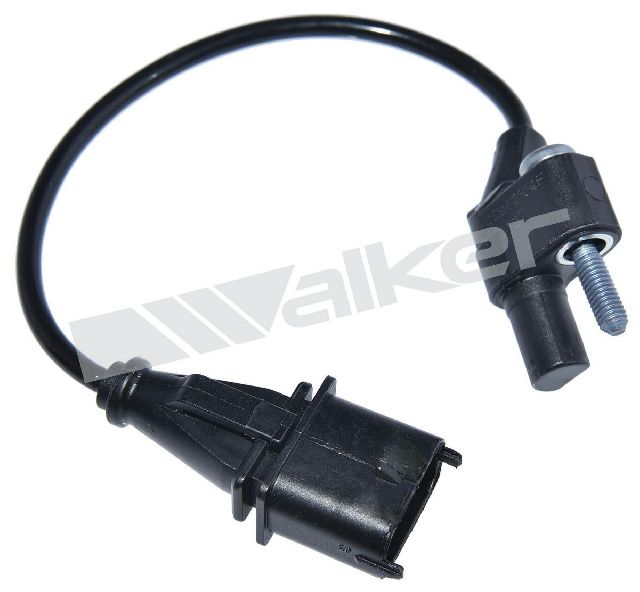
- If not a software issue, check for other engine codes. A fault in a related sensor (like brake booster, crank, or cam sensor) is the next most likely cause.
- A dealership or a shop with Jeep-specific diagnostic tools is often necessary to perform the software update fix.
What's Unique About the 2015-2017 Jeep GRAND CHEROKEE

For this generation of Jeep Grand Cherokee (WK2) and its platform mates like the Dodge Durango, the U1424 code is very frequently linked to software anomalies rather than a direct part failure. Chrysler/Jeep has issued multiple Technical Service Bulletins (TSBs) that involve reprogramming the PCM or TCM to correct the logic that falsely triggers this code. This is a key difference from other vehicles where a similar code might more directly point to a failing sensor or mechanical issue. The diagnostic path for these Jeeps must always begin with checking for software updates.
🎬 Watch: How a dealer performs ECM and TCM software updates.Diagnostic Flowchart

Tap your situation to follow the diagnostic path that matches what you're seeing on this vehicle.
Symptoms You May Notice
- Check Engine Light (Malfunction Indicator Lamp) is on
- Traction control light may be on
- Vehicle may get stuck in one gear (limp mode)
- Erratic or harsh transmission shifting
- Hesitation or lack of power during acceleration
- Vehicle may stall or have trouble starting
- Service Electronic Throttle Control message may appear
- Replacing the transmission or torque converter. Mechanics may see a transmission-related code and assume a major mechanical failure, but U1424 is an electronic signal problem, not an internal transmission fault. Always investigate software and sensor data first.
- Replacing camshaft phasers when the actual issue is a slipped tone ring on the camshaft itself, which requires replacing the whole camshaft.
Most Likely Causes

- Outdated Powertrain or Transmission Control Module Software 🔴 High Probability Multiple manufacturer TSBs have been issued to correct software logic that can falsely trigger this code. This is the most documented fix for 2015, 2016, and 2017 models.
How to confirm: A Jeep dealer or a well-equipped independent shop can use a scan tool like wiTECH to check the current software calibration ID against the latest version available from the manufacturer via DealerCONNECT/TechCONNECT.
Typical fix: Reprogramming (flashing) the PCM and/or TCM to the latest software version. TSB 18-095-15 addresses the TCM on 2015 models, while TSB 18-049-20 addresses the PCM on 2017 models.
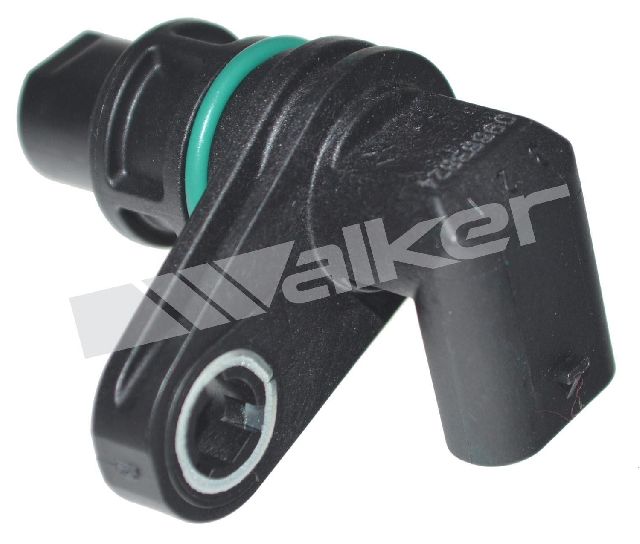
Est. part cost: $0 - Faulty Sensor Providing Incorrect Data 🟡 Medium Probability The engine torque calculation relies on many inputs. A failing sensor can corrupt this calculation. TSBs often list U1424 alongside sensor codes like P0556 (Brake Booster Pressure Sensor) and P0335 (Crankshaft Position Sensor), indicating a common link. A faulty camshaft sensor (P0340) can also be the primary cause.
How to confirm: Scan for other DTCs. If another code is present (e.g., for a crankshaft sensor, brake booster sensor, or throttle position sensor), that sensor is the likely culprit. Monitor live sensor data on a scan tool for erratic or out-of-range readings.
Typical fix: Replace the specific sensor that is failing. For example, if P0556 is present, the Brake Booster Pressure Sensor is the likely cause.
Est. part cost: $50-$200 - Mechanical Engine Issue Affecting Sensor Readings ⚪ Low Probability On the 3.6L and other VVT engines, mechanical timing issues, such as a slipped camshaft tone ring (reluctor wheel), can cause the camshaft/crankshaft position sensors to send data that conflicts with other engine parameters, leading to an implausible torque calculation.
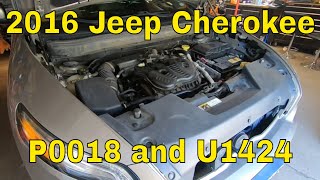
How to confirm: This is an advanced diagnosis. If codes like P0018 (Crankshaft/Camshaft Correlation) are present with U1424, a mechanical inspection of the timing components is necessary. A technician documented a case on a 2016 Cherokee where a slightly slipped tone ring on the exhaust camshaft was the root cause, which was confirmed after a dealer misdiagnosed it as a phaser issue.
Typical fix: Replacing the affected camshaft or other timing components like the reluctor wheel.
Est. part cost: $200-$600
Rare But Worth Checking
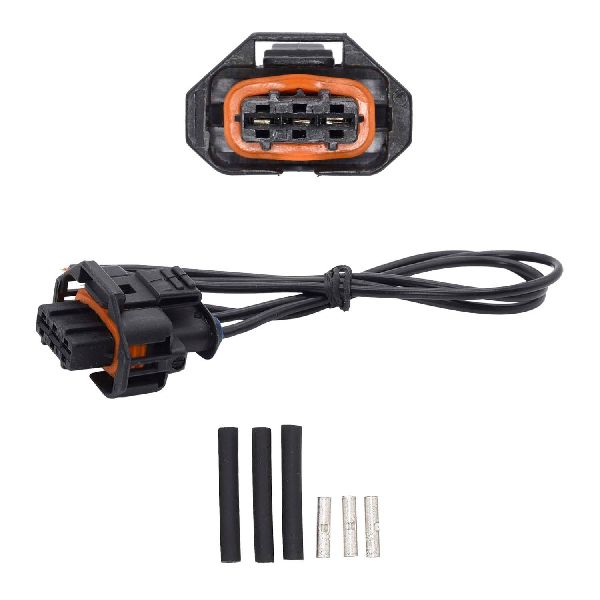
- Wiring or Connector Issue: A damaged wire or corroded connector in the CAN bus network between the PCM and TCM can corrupt the signal. This should be checked if software and sensors are confirmed to be good.
- Weak or Failing Battery: A weak battery can cause low voltage during startup, leading to communication glitches between modules and setting various codes, including U1424. This is a common suggestion in forums as a first check for multiple, seemingly unrelated electronic faults.
- Failing PCM or TCM: This is very rare. Control modules are robust. All other possibilities, especially software, sensors, and wiring, must be exhaustively ruled out before condemning a module.
Diagnosis Steps
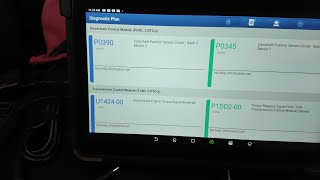
- Scan for all DTCs in all modules. Note any other codes present, as they are critical clues. Codes like P1DD2 are almost always paired with U1424.
- Check for Technical Service Bulletins (TSBs). Using the vehicle's VIN, have a dealer or use a subscription service to check for applicable TSBs. For this specific code and vehicle, there are multiple TSBs (e.g., #18-095-15 for 2015, #18-049-20 for 2017) that point to a required software update as the fix.
- Verify PCM/TCM Software Version. This is the most critical step. Have a dealer or qualified shop use a wiTECH scan tool to check if the module software is up-to-date. If an update is available, perform this step before any other repairs.
- Diagnose Accompanying Codes First. If other codes are present, diagnose them first as they are likely the root cause. For example, if P0340 (Camshaft Sensor) or P0556 (Brake Booster Sensor) is present, diagnose that sensor's circuit.
- Check Battery and Connections. Before diving into complex diagnostics, ensure the battery is fully charged and the terminals are clean and tight. A weak battery can cause numerous communication codes.
- Monitor Live Sensor Data. Use a scan tool to watch live data from sensors involved in torque calculation (throttle position, MAP, crank/cam sensors, brake sensor). Look for any readings that are erratic or illogical.
- Inspect Wiring. If no sensor faults are found, visually inspect the wiring harness and connectors between the PCM, TCM, and related sensors for damage, corrosion, or loose pins.
- Advanced Mechanical Checks. If timing-related codes (like P0018) are present, proceed with mechanical checks of the camshafts and tone rings as a potential, though less common, cause.
Parts You'll Likely Need
- PCM/TCM Software Update — This is a service, not a physical part, but it is the most common and manufacturer-recommended fix to resolve software logic errors that trigger the code.
OEM price range: $150-$250
Aftermarket price range: N/A - Brake Booster Pressure Sensor
(OEM #68329859AA (replaces 68361625AA))— This sensor is frequently implicated alongside U1424 in TSBs. Its failure provides incorrect data to the PCM's torque calculation.
Trusted brands: Mopar, Bosch
OEM price range: $70-$120
Aftermarket price range: $40-$80 - Crankshaft Reluctor Wheel
(OEM #68582742AA (for 3.0L Diesel))— In rare cases of mechanical failure on the 3.0L Diesel, the crankshaft tone wheel can fail, req
Related Codes That Often Appear With This One
- P1DD2 — Torque Request Signal From TCM Denied. This is the 'other side' of the conversation, where the TCM is actively rejecting the PCM's torque signal. It almost always appears with U1424.
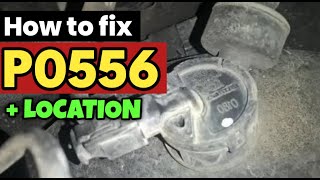
- P0556 — Brake Booster Pressure Sensor Performance. This sensor is a key input for torque management, and a fault here can directly cause the U1424 code. It is cited in TSB #18-049-20.
- P0335 / P0339 — Crankshaft Position Sensor Circuit / Intermittent. A faulty crank sensor provides fundamental engine speed data; if it's wrong, the torque signal will be implausible. It is cited in TSB #18-024-17 REV. A.
- P0018 — Crankshaft/Camshaft Correlation. This code points towards a mechanical timing issue, such as a slipped tone ring, which can be the underlying cause of the implausible torque signal.
- P2299 — Brake Pedal / Accelerator Pedal Incompatible. This indicates conflicting driver inputs, which can confuse the torque calculation. It is cited in TSBs #18-049-20 and #18-024-17 REV. C.
Technical Service Bulletins (TSBs) & Recalls
- 18-049-20: Supersedes older bulletins and addresses U1424 for 2017 MY Grand Cherokee and Durango (3.0L, 3.6L, 5.7L) as part of a PCM software update.
- 18-024-17 REV. C: Predecessor to 18-049-20, also notes U1424 for 2017 MY as part of a group of codes fixed by a software flash.
- 18-095-15: Specifically calls out U1424-00 on 2015 models (3.0L Diesel) and includes a fix in a PCM/TCM software update.
- 18-090-16: Addresses U1424 on 2016 models as part of a software update for various drivability symptoms.
- 18-081-19: Lists U1424-00 as a code fixed by a PCM flash on other Jeep models (Cherokee/Renegade), showing the pattern of software fixes for this code.
Platform-Specific Known Issues
- On 2015 models with the 3.0L Diesel, TSB #18-095-15 (later superseded by #18-019-16) specifically addresses U1424-00 found in the TCM memory and includes a fix within a PCM software update.
- For 2016-2017 models with 3.0L, 3.6L, or 5.7L engines, TSB #18-049-20 groups U1424 with other DTCs that are resolved by a PCM software update. This TSB specifically notes U1424 applies to the 2017 MY only.
- On 3.6L V6 engines, a slipped tone ring on a camshaft is a known, though uncommon, cause of U1424, often paired with P0018. This requires camshaft replacement, not just phaser replacement.
Mechanic-Grade Diagnostic Values
- CAN Bus Network Resistance — expected: ~60 Ohms. Failure: A reading of ~120 Ohms indicates an open circuit or one of the two terminating resistors is not being seen by the network. A reading significantly less than 60 Ohms can indicate a short between the CAN High and CAN Low wires.
- CAN Bus Voltage (Key On, Engine Off) — expected: CAN High (Pin 6 to Ground): 2.5V - 3.0V. CAN Low (Pin 14 to Ground): 2.5V - 2.0V.. Failure: Voltages outside these ranges indicate a potential short to power or ground on the network.
- 3.6L Pentastar Camshaft Position Sensor Power Supply — expected: ~5.0 Volts. Failure: Voltage significantly lower than 5.0V indicates a wiring or PCM issue.
- 3.6L Pentastar Camshaft Position Sensor Ground Circuit Resistance — expected: Less than 3 Ohms. Failure: Resistance higher than this indicates a poor ground connection, which can cause faulty sensor readings.
- Inductive Crankshaft Sensor Internal Resistance — expected: 200 - 1,000 Ohms. Failure: A reading of 0 Ohms indicates a short circuit within the sensor. A reading of M Ohms (infinite) indicates an open circuit.
Scan Tool Commands That Help
- wiTECH: Reprogram PCM / Reprogram TCM — This is the primary repair step if a TSB indicates a software update is available to fix the logic that falsely triggers U1424. Always check for software updates before replacing parts.
- wiTECH: Quick Learn — This procedure should be performed after reprogramming the TCM or replacing the transmission/valve body to reset and learn clutch adaptive values, ensuring proper shift quality.
- wiTECH: Network Diagnostics — To verify which modules are active and communicating on the bus. This can help identify a module that is offline and causing communication DTCs.
Wiring & Ground Locations
- CAN Bus Harness — Can run in various locations, but one documented case showed the harness being pinched and damaged under a floor panel near the ABS module.. The CAN bus wires (often white with a blue stripe and white with a green stripe) carry the engine torque signal between the PCM and TCM. Physical damage like pinching or chafing can corrupt this data, directly causing U1424.
- G102 / G103 (Typical Location) — Often located on the engine block, sometimes near the thermostat housing or motor mounts.. These grounds are commonly used for the PCM and various transmission sensors. A loose or corroded ground here can cause erratic sensor readings and communication issues, leading to implausible data codes like U1424.
- Engine Dipstick Tube Stud Ground — A ground point often found on the stud that secures the engine oil dipstick tube to the block.. This is noted as a 'SUPER IMPORTANT' ground on other Jeep models and often serves as a primary engine ground point. A poor connection here can cause a host of electrical issues.
Real Owner Repair Stories
- Reddit user Automatic_Spray_9795 (2015 Jeep Grand Cherokee) — Check engine light, traction control light, stuck in 2nd gear (limp mode). Codes U1424, P1DD2, U0100, P0394.
❌ Tried (didn't work) Replacing the Camshaft Position Sensor (Bank 2), Replacing the Crankshaft Position Sensor
✅ What actually fixed it A mechanical failure. The user reported the final fix was replacing the camshafts and lifters. The root cause was a bolt on the back of the head that had backed out, causing a drop in oil pressure which led to component failure. The engine ran perfectly with no noise, making diagnosis difficult. - YouTube channel Eagle Motors (Dodge Durango with 5.7L Hemi (platform-relevant)) — Check engine light, lack of power, unable to accelerate past 35-40 mph. Codes U1424, P1DD2, and P0340.
❌ Tried (didn't work) Initially fearing a transmission problem.
✅ What actually fixed it Diagnosing and fixing the other code first. The root cause was the P0340 (Camshaft Position Sensor Circuit). Replacing the faulty camshaft sensor for $25 resolved all codes, including U1424 and P1DD2. - YouTube video (Spanish) (2014 Jeep Grand Cherokee) — Transmission stuck in one gear, will not shift. Codes for U1424, P1DD2, and camshaft/crankshaft sensors.
❌ Tried (didn't work) The vehicle had already had the transmission replaced twice by other shops trying to fix the issue.
✅ What actually fixed it The mechanic ignored the transmission and focused on the engine codes. He swapped the cam sensors between banks, and the fault code moved with the sensor. Replacing the confirmed-bad camshaft sensor fixed the vehicle completely.
OEM Part Supersession History
68361625AA→68329859AA— Part revision or update by manufacturer.
Heads up: Online parts catalogs confusingly list this part number for both the Brake Booster Pressure Sensor and unrelated components like 'Headlamp Ballast' or 'Engine Controller Kit'. Verify the part by application and description, not just the part number, when ordering.68493358AA→68582742AA— Part revision or update by manufacturer.
Heads up: This is the Crankshaft Reluctor Wheel for the 3.0L V6 Turbo Diesel engine.
Model Year Variations Within This Range
- 2017 MY Only: Multiple TSBs (#18-049-20, #18-024-17 REV. C, #18-024-17 REV. A) specifically call out the U1424 code for the 2017 Model Year, linking it to software updates for the PCM. This suggests the logic causing the fault was most prevalent or identified in this specific year's software calibration.
- 2015 MY Only: TSB #18-095-15 specifically addresses U1424 on the 2015 model by reprogramming the Transmission Control Module (TCM), not the PCM. This indicates the fault logic for this year was located in the TCM's software.
Helpful Videos

Used OEM Parts in Stock


New Aftermarket Parts Available


The information in this article is provided for general reference and educational purposes only. Vehicle specifications, procedures, and part compatibility can vary by production date, trim level, and region. Always consult your vehicle's factory service manual and verify part numbers before purchasing or performing repairs. Safety-critical components such as airbags, seat belts, and braking systems should be installed by a qualified professional.
- Jeep GRAND CHEROKEE:
- 🎬 Helpful Videos
- 🛍️ Shop This Part
- What's Unique About the 2015-2017 Jeep GRAND CHEROKEE
- Diagnostic Flowchart
- Symptoms You May Notice
- Most Likely Causes
- Rare But Worth Checking
- Diagnosis Steps
- Parts You'll Likely Need
- Related Codes That Often Appear With This One
- Technical Service Bulletins (TSBs) & Recalls
- Platform-Specific Known Issues
- Mechanic-Grade Diagnostic Values
- Scan Tool Commands That Help
- Wiring & Ground Locations
- Real Owner Repair Stories
- OEM Part Supersession History
- Model Year Variations Within This Range
- 🎟️ Get 5% Off