

OBD-II Code U1409: Implausible Left Front Wheel Speed Signal
What U1409 means, why it triggers, and how to fix it
- Code U1409 flags an erratic or missing signal from the left front wheel speed sensor, instantly disabling your ABS and traction control.
- A failed $40-$100 wheel speed sensor causes 80% of U1409 codes, with damaged wiring harnesses being the second most frequent culprit.
- Expect 3 to 4 dashboard warning lights (ABS, Traction Control, 4WD) to illuminate simultaneously, especially on Jeep and Dodge vehicles.
- Use an OBD-II scanner with live ABS data capabilities to verify the left front wheel reads 0 MPH before spending money on replacement parts.
- Inspect the sensor wiring harness for chafing and the tone ring for metallic debris before replacing the sensor, saving you a $150 diagnostic fee.
What Does U1409 Mean?

Code U1409 means the vehicle's main computer receives a signal from the left front wheel speed sensor that contradicts the other three wheels. The computer constantly compares all four wheel speeds; when the left front signal is erratic, reads zero, or drops out while the vehicle is moving, it triggers this code and disables safety systems relying on that data.
Technical definition: Implausible Left Front Wheel Speed Signal Received. The Transmission Control Module (TCM) or ABS control module detects an incorrect, irrational, or missing digital signal from the left front wheel speed sensor via the CAN bus network.
Can I Drive With U1409?
Yes, But With Caution. Yes, but driving disables your Anti-lock Braking System (ABS), Electronic Stability Control (ESC), and Traction Control. Standard brakes function normally, but panic stops on wet or loose surfaces cause wheel lockup, increasing stopping distance and accident risk. Limit driving to short trips to a repair facility.
Common Causes

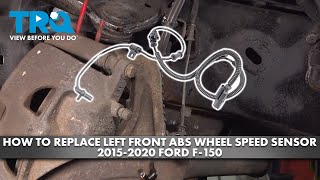
- Faulty Left Front Wheel Speed Sensor (Very Common) — The sensor degrades from constant exposure to heat, moisture, and road debris. This is the root cause in 80% of U1409 cases. 🎬 See how to replace a front wheel speed sensor.
- Damaged or Corroded Wiring Harness (Common) — The wiring harness flexes with steering and suspension movement. It chafes, stretches, or breaks internally. Connector pins corrode from water intrusion, blocking the signal.
- Damaged or Debris-Covered ABS Tone Ring (Common) — The tone ring cracks, loses teeth, or accumulates thick rust and metallic brake dust. This physical obstruction prevents the magnetic sensor from reading the wheel speed accurately.
- Failing Wheel Hub Bearing (Less Common) — A worn wheel bearing introduces excessive wobble. This alters the precise air gap between the sensor and the tone ring, generating an erratic signal. Usually accompanied by a grinding noise.
- Mismatched Tire Sizes or Severe Misalignment (Uncommon) — Running a significantly smaller spare tire or mixing tire sizes forces the left front wheel to rotate at a different speed than the others, triggering the implausibility code.
- Low Battery Voltage (Uncommon) — A weak battery or failing alternator causes transient voltage drops below 11V, disrupting CAN bus communication and triggering false U-codes.
- Faulty ABS Control Module (Rare) — The module itself fails to process the incoming signal. Consider this only after definitively proving the sensor, wiring, and tone ring are perfect.
Symptoms

- ABS Warning Light On — The amber ABS light illuminates permanently on the dashboard.
- Traction/Stability Control Light On — The ESC or traction control light illuminates simultaneously, as these systems require wheel speed data.
- 4WD or Service Transmission Light On — Jeep, Chrysler, and Dodge vehicles trigger 4WD 🎬 Watch: Diagnostic and repair walkthrough for Jeep and Dodge owners. and transmission warnings because those modules lose required speed data.
- ABS System Inoperative — Wheels lock up and skid during hard braking. The brake pedal feels different during panic stops.
- Erratic Transmission Shifting — The transmission shifts harshly, delays engagement, or holds gears too long due to missing speed parameters.
Diagnostic Flowchart

Tap your situation to follow the diagnostic path that matches what you're seeing on this code.
Common Fixes & Costs
- Replace Left Front Wheel Speed Sensor
— Parts: $40-$100, Labor: $100-$200, ~1.0 hr book time
(DIY)
Jeep Wrangler (JK, 2007-2018): OEM Mopar 68003281AF (Alt: {"brand": "Standard Motor Products", "part_number": "ALS1918", "price_comparison": "$45"})
Dodge Charger (AWD, 2015-2020): OEM Mopar 68199988AD (Alt: {"brand": "Duralast", "part_number": "SU16894", "price_comparison": "$79"}) - Repair or Replace Damaged Wiring Harness — Parts: $15-$60, Labor: $125-$300, ~1.5 hr book time (Intermediate)
- Clean Tone Ring and Sensor Mounting Surface — Parts: $5-$15, Labor: $80-$150, ~1.0 hr book time (DIY)
- Replace Wheel Hub Bearing Assembly
— Parts: $150-$350, Labor: $200-$450, ~2.5 hr book time
(Professional)
Chevrolet Silverado 1500 (2007-2013): OEM GM 84356642 (Alt: {"brand": "MOOG", "part_number": "515096", "price_comparison": "$245"}) - Replace ABS Control Module — Parts: $600-$1500, Labor: $150-$400, ~2.0 hr book time (Professional)
Used vs. New Parts: Buying Guide
When a used part is worth it: Buying a used wheel speed sensor never makes sense. It is a cheap wear item exposed to harsh elements. The labor to install it exceeds the part cost, making a used part a poor financial risk.
Donor-vehicle mileage cap: roughly under 20000 miles for the part to have meaningful remaining life.
Donor quality checklist:
- Only source from a low-mileage vehicle wrecked for non-suspension reasons.
- Reject parts from high-corrosion 'Rust Belt' areas.
- Match the OEM part number exactly.
Decision logic:
- If The part is a standalone wheel speed sensor → Buy a new OEM or premium aftermarket part. Used sensors fail prematurely.
- If The sensor integrates into the wheel hub assembly → Buy a new hub assembly. Used hubs carry the dual risk of a bad bearing and a bad sensor.
Warranty tradeoff: Used parts offer 30-day warranties. New aftermarket sensors include 1-year to lifetime warranties. New OEM parts carry 1-2 year warranties.
Worst-case if a used part fails: 100-200 (repeat labor to install a second sensor)
What Happens If You Wait — Timeline
- Immediate: Code U1409 sets. ABS, Traction Control, and Stability Control disable entirely. (MPG impact: 0% · Added cost: 0)
- 1-4 weeks: Driving without ABS normalizes. Chrysler/Dodge/Jeep vehicles experience harsh transmission shifts. (MPG impact: 1-2% · Added cost: 20-50 (wasted fuel))
- 1-6 months: Vehicle fails annual state safety inspections. Emergency braking maneuvers result in skidding. (MPG impact: 1-2% · Added cost: 50-150 (failed inspection fees))
- 6+ months: High risk of preventable accidents due to disabled safety systems. Harsh shifting accelerates transmission wear. (MPG impact: 1-2% · Added cost: 1000-5000 (accident damages or transmission repair))
Cost of Not Fixing It
- Immediate: ABS, traction control, and stability control disable entirely. Skidding and loss of steering control occur during emergency braking. (Added cost: 0)
- 0-3 months: Causes erratic transmission shifting and decreased fuel economy on vehicles where the TCM relies on wheel speed data. Fails state safety inspections. (Added cost: 50-150 (failed inspection fees and wasted fuel))
- 3+ months: Normalizes driving without critical safety systems. Increases wear on transmission components due to harsh shifting. (Added cost: 1000-5000 (accident-related damages or transmission wear))
Diagnosis Steps
- Confirm Code with Live Data Scanner
Connect an ABS-capable OBD-II scanner. Access the live data stream for wheel speeds. Drive slowly (5-10 mph) in a straight line. If the left front sensor reads 0 MPH or jumps erratically while the other three read a steady 5 mph, the fault is isolated to the left front circuit.
Tools: OBD-II Scanner with ABS Live Data (Beginner) - Visually Inspect Wiring and Connector
Raise and support the vehicle. Remove the left front wheel. Trace the sensor wire from the hub to the chassis. Look for chafing, cuts, or stretched sections near suspension joints. Disconnect the sensor and inspect the pins for green corrosion or water intrusion.
Tools: Jack, Jack Stands, Lug Wrench, Flashlight (Beginner) - Inspect Tone Ring and Sensor Tip
Examine the toothed tone ring on the axle or hub. Look for cracks, missing teeth, or heavy rust buildup. Remove the sensor (usually one 10mm bolt) and wipe metallic fuzz off the magnetic tip. Clean the tone ring with a wire brush and brake cleaner.
Tools: 10mm Socket, Ratchet, Wire Brush, Brake Cleaner (Intermediate) - Check for Wheel Bearing Play
Grasp the brake rotor or tire at the 12 and 6 o'clock positions. Push and pull firmly. Any noticeable clunking or movement indicates a failing wheel bearing, which alters the sensor air gap and causes the U1409 code.
Tools: Hands, Jack, Jack Stands (Intermediate) - Test Sensor Resistance (Passive 2-Wire Sensors)
Disconnect the sensor. Set a multimeter to Ohms. Probe the two sensor pins. A healthy passive sensor reads 800-2,500 Ohms. A reading of 'OL' (Open Line) or near zero confirms internal sensor failure.
Tools: Multimeter (Advanced) - Check Harness Voltage and Ground (Active 3-Wire Sensors)
Turn the ignition ON (engine off). Disconnect the sensor. Set multimeter to DC Volts. Probe the harness-side connector. You must find a 5V or 12V reference voltage on one pin and a solid ground on another. Missing voltage proves a wiring or module fault, not a bad sensor.
Tools: Multimeter (Advanced) - Check AC Voltage Output (Passive Sensors)
Set multimeter to AC Volts. Probe the connected sensor pins. Spin the wheel hub by hand at one revolution per second. It must generate at least 200mV (0.2V) AC. Readings below 100mV indicate a bad sensor or damaged tone ring.
Tools: Multimeter, Back-probe pins (Advanced)
When This Code Triggers (Freeze-Frame Conditions)
- Vehicle Speed: 15-55 mph (Sets once the vehicle exceeds 10-15 mph, the threshold where the computer reliably compares all four wheel speeds.)
- Brake Pedal Status: Off (Detects the fault during normal driving acceleration or cruising, independent of braking.)
- System Voltage: 12.5-14.5V (Sets during normal operating voltage. Drops below 11V trigger separate communication codes.)
- Time Since Engine Start: > 1 minute (Appears shortly after beginning a drive cycle when the ABS module completes its self-check.)
Related Codes
- C100A — Left Front Wheel Speed Sensor Circuit. Indicates a hard electrical fault (open or shorted wire). If present with U1409, diagnose the wiring harness and sensor resistance first.
- C1011 — Left Front Wheel Speed Sensor Erratic Performance. Points to a mechanical issue like a cracked tone ring, debris on the sensor, or a loose wheel bearing causing signal dropouts.
- U0415 — Invalid Data Received From ABS Control Module. A secondary code triggered by the TCM or PCM because it doesn't trust the ABS data due to the U1409 fault. Fix U1409 and U0415 disappears.
- U140A — Implausible Right Front Wheel Speed Signal. If both front wheel codes appear simultaneously, suspect mismatched tire sizes, severe alignment issues, or a central ABS module fault.
Climate & Environmental Factors
- Road Salt & Winter Climates: Salt accelerates corrosion on the tone ring and sensor mounting points. Rust expansion pushes the sensor away from the tone ring, altering the air gap and triggering the code.
- Off-Roading & Lift Kits: Suspension articulation stretches the sensor wiring harness. Mud and rocks snag the wire, causing internal breaks that are invisible from the outside.
- High Humidity: Moisture penetrates cracked wire insulation or unsealed connectors, causing green copper corrosion that blocks the low-voltage sensor signal.
How to Talk to a Mechanic About This Code
Say this: "My ABS light is on and my scanner shows code U1409 for the left front wheel speed sensor. Please verify the fault using live ABS data, and visually inspect the wiring harness and tone ring before replacing the sensor."
Directs the mechanic to perform a complete diagnostic rather than blindly firing the parts cannon. It prevents paying for a new sensor when the actual problem is a broken wire.
Avoid saying:
- 'Just replace the left front wheel speed sensor.'
- 'My ABS light is on, fix whatever is broken.'
- 'I read online that I need a new wheel bearing.'
Questions to ask before authorizing the repair:
- Did the live data show a zero reading or an erratic reading?
- Did you find any chafing or corrosion on the wiring harness?
- Is the tone ring intact and free of heavy rust?
- Is there any play in the wheel bearing?
- What is the warranty on the replacement sensor?
Where to Take It: Dealer vs Independent vs Chain
- Dealer:
Avoid unless under warranty. Independent shops handle this routine repair for much less.
Best for: Vehicles under factory warranty., Programming a replacement ABS control module.
Downsides: Charges $150-$200/hour for labor., Often recommends replacing the entire hub assembly when only a sensor is required. (Typical cost: +50% vs. baseline) - Independent Shop:
Best choice. Competent independent shops diagnose and fix U1409 quickly and affordably.
Best for: Out-of-warranty vehicles., Cost-effective sensor and wiring repairs.
Downsides: Diagnostic equipment quality varies by shop. (Typical cost: +0% vs. baseline) - Chain Shop:
Acceptable only if you are 100% certain the sensor is the sole issue. Avoid for initial diagnostics.
Best for: Simple sensor swaps when you have already diagnosed the issue yourself.
Downsides: High pressure to upsell unnecessary brake fluid flushes or calipers., Technicians often lack advanced diagnostic skills for wiring faults. (Typical cost: -10% vs. baseline)
When to Walk Away From the Repair
If the repair cost exceeds 40% of the vehicle's value, consider selling. However, U1409 is a cheap safety repair that rarely triggers this threshold.
- Car worth $10000, fix is $250: Fix it. This is a minor, necessary safety repair.
- Car worth $3000, fix is $600: Fix it. The repair is 20% of the value, but driving without ABS is dangerous and fails state inspections.
- Car worth $1500, fix is $800: Walk away. The repair (likely a full hub assembly at a shop) exceeds 50% of the vehicle's value.
What Scan Tool You Need for This Code
Minimum: An OBD-II scanner capable of reading ABS module codes and displaying LIVE DATA for individual wheel speeds.
Standard $20 engine code readers cannot communicate with the ABS module. Free auto parts store scans will show 'No Codes Found' even with the ABS light glaring. Live data is mandatory to watch the left front sensor's output in real-time.
Budget: Autel ML629 / BlueDriver Bluetooth Pro (~$80-120) — Reads ABS codes and displays live wheel speed data, providing everything needed for a confident DIY diagnosis.
Mid-range: Innova 5610 / Foxwell NT630 Plus (~$150-350) — Adds bidirectional controls, allowing you to command the ABS pump motor to cycle during advanced testing.
Professional: Autel MaxiCOM MK808S (~$400-500) — Professional-grade tool with fast live data graphing and ABS module programming capabilities. Overkill for a single U1409, but excellent for serious DIYers.
How to Clear the Code After You Fix It
- Use an OBD-II scan tool to clear the code from the ABS and TCM modules.
- Perform a 10-minute test drive exceeding 20 mph.
- Verify the ABS and traction control warning lights remain off.
Drive cycle (~10 minutes): Start the vehicle and drive for 10 minutes, ensuring speeds exceed 20 mph. The ABS system performs a self-test at this speed. If the repair succeeds, the warning lights extinguish. Some vehicles require a manual scan tool reset before the lights turn off.
Readiness monitors affected: None
Watch out for:
- Disconnecting the battery fails to clear this code; an ABS-capable scan tool is mandatory.
- If warning lights return instantly at 15 mph, the root cause remains unfixed.
- Forgetting to manually clear the code. Many systems lock the ABS light on until a scanner commands a reset.
Will This Fail Emissions / State Inspection?
Yes — this code typically fails an OBD-II emissions inspection.
- California: An active U1409 stored in the PCM/TCM causes an automatic OBD-II emissions failure.
- New York: An illuminated ABS warning light causes an automatic failure during the annual safety inspection.
- Texas: An illuminated ABS warning light fails the annual safety inspection.
- Virginia: The amber ABS light alone passes inspection, but an accompanying red 'BRAKE' light fails it.
Most Commonly Affected Vehicles
- Jeep Wrangler (JK) (2007-2018) — Extremely common. Lift kits alter suspension geometry, causing the sensor wire to rub against the axle U-joint and short out.
- Jeep Grand Cherokee (WK2) (2011-2021) — High failure rate for wheel speed sensors. Often triggers 4WD system warnings simultaneously.
- Dodge Charger / Challenger (2008-2020) — Shares the Chrysler platform. Sensor failures are routine maintenance items around 80,000 miles.
- Ford F-150 (2015-2021) — Triggers 'Service AdvanceTrac' messages. Often caused by sensor failure or a failing wheel bearing.
- Chevrolet Silverado 1500 (2007-2014) — The sensor is integrated into the wheel hub. Fixing this code usually requires replacing the entire $250 hub assembly.
Manufacturer-Specific Notes
- Jeep/Chrysler/Dodge: A single U1409 code illuminates the ABS, Traction Control, and 'SERV 4WD' lights simultaneously. Do not panic; replacing the $50 sensor resolves all warnings.
- Ford: Triggers a 'Service AdvanceTrac' and 'Hill Start Assist Not Available' message on the dash. The root cause remains the left front wheel speed sensor.
- General Motors: GM integrates the sensor and tone ring into a sealed wheel hub bearing assembly on many trucks. You cannot replace just the sensor; you must replace the entire hub.
Real Owner Stories
2012 Jeep Wrangler JKU with a lift kit
ABS and ESP/BAS lights illuminated 40 miles after installing a suspension lift kit. Codes U1409 and C100A appeared.
Outcome: Found the wheel speed sensor wire rubbing against the axle U-joint due to a bent mounting tab. The wire rubbed through, causing an open circuit. Replacing the $25 sensor harness and bending the tab back fixed the issue.
Lesson: If the code appears after suspension work, immediately inspect the sensor wiring for damage or improper routing.
2013 Jeep Wrangler in a rusty climate
ABS and traction control lights on. Owner suspected a bad sensor.
Outcome: Extracted the seized sensor and used a wire brush to thoroughly clean the rusty mounting hole before installing the new sensor. This restored the correct air gap and resolved the code.
Lesson: In rust-prone areas, cleaning the sensor mounting surface is mandatory. Rust buildup pushes the new sensor away from the tone ring, causing the code to return.
2013 Jeep Wrangler JKU with recurring codes
ABS lights on with codes U1409 and C1011. The owner replaced the left front sensor a year prior, but codes returned.
Outcome: Found significant wobble in the wheel bearing. Replacing the entire front left unit bearing assembly resolved the codes. The worn bearing caused the tone ring to wobble, creating an erratic signal.
Lesson: If a new sensor doesn't fix an 'erratic performance' code, the wheel bearing is failing and altering the sensor's air gap.
How to Prevent This Code From Triggering
- Apply dielectric grease to the sensor connector (Whenever disconnected) — Seals the electrical pins from moisture and road salt, preventing green corrosion that blocks the low-voltage signal.
- Inspect and secure sensor wiring routing (During tire rotations) — Prevents the wire from rubbing against the axle U-joint or brake rotor, the leading cause of harness failure on modified vehicles.
- Clean the sensor mounting surface (During brake rotor replacement) — Removes rust scale that pushes the sensor away from the tone ring, ensuring the critical magnetic air gap remains intact.
Frequently Asked Questions
Can I fix a U1409 code myself?
Yes, for many people this is a DIY-friendly repair. Replacing the wheel speed sensor requires basic hand tools and takes under an hour. The replacement part typically costs between $40 and $100.
Will clearing the code make the light go away?
No, clearing the code with a scanner only turns the light off temporarily. The code returns immediately once you drive over 15 mph and the computer detects the faulty signal again. You must fix the underlying hardware problem first.
My ABS light came on right after a brake job. Is that related?
Yes, it is highly likely. The wheel speed sensor or its wiring was likely disturbed, damaged, or left disconnected during the brake service. Inspect the left front wheel area immediately to verify the connection.
Why are my transmission and 4WD lights on too?
Transmission and 4x4 controllers require accurate wheel speed data to determine shift points and power distribution. When the left front signal drops out, these systems disable themselves as a safety precaution. Fixing the U1409 code restores all these systems simultaneously.
What is the most common misdiagnosis for U1409?
The most common mistake is replacing the wheel speed sensor without testing it or inspecting the wiring. A broken wire a few inches up the harness, a corroded connector, or a debris-covered tone ring causes the exact same code. Always perform a visual inspection first.
I replaced the sensor but the code came back. Now what?
If a new sensor fails to clear the code, the problem lies in the wiring, tone ring, or wheel bearing. Re-inspect the wiring harness for hidden breaks using a multimeter's continuity function. Check the wheel hub bearing for excessive play that alters the sensor's air gap.
How much does it cost to fix code U1409?
Replacing the wheel speed sensor at a shop costs between $150 and $300 for parts and labor. If the entire wheel hub bearing assembly requires replacement, expect to pay $400 to $800. DIY sensor replacement costs only $40 to $100 for the part.
What is a tone ring and where is it?
A tone ring is a notched metal ring that rotates with the wheel hub or CV axle. The magnetic wheel speed sensor reads these notches as they pass, generating a speed signal. If the ring cracks or fills with rust, the sensor outputs an erratic signal.
Key Takeaways
- Code U1409 flags an erratic or missing signal from the left front wheel speed sensor, instantly disabling your ABS and traction control.
- A failed $40-$100 wheel speed sensor causes 80% of U1409 codes, with damaged wiring harnesses being the second most frequent culprit.
- Expect 3 to 4 dashboard warning lights (ABS, Traction Control, 4WD) to illuminate simultaneously, especially on Jeep and Dodge vehicles.
- Use an OBD-II scanner with live ABS data capabilities to verify the left front wheel reads 0 MPH before spending money on replacement parts.
- Inspect the sensor wiring harness for chafing and the tone ring for metallic debris before replacing the sensor, saving you a $150 diagnostic fee.
Helpful Videos

The information in this article is provided for general reference and educational purposes only. Vehicle specifications, procedures, and part compatibility can vary by production date, trim level, and region. Always consult your vehicle's factory service manual and verify part numbers before purchasing or performing repairs. Safety-critical components such as airbags, seat belts, and braking systems should be installed by a qualified professional.
- 🎬 Helpful Videos
- What Does U1409 Mean?
- Can I Drive With U1409?
- Common Causes
- Symptoms
- Diagnostic Flowchart
- Common Fixes & Costs
- Used vs. New Parts: Buying Guide
- What Happens If You Wait — Timeline
- Cost of Not Fixing It
- Diagnosis Steps
- When This Code Triggers (Freeze-Frame Conditions)
- Related Codes
- Climate & Environmental Factors
- How to Talk to a Mechanic About This Code
- Where to Take It: Dealer vs Independent vs Chain
- When to Walk Away From the Repair
- What Scan Tool You Need for This Code
- How to Clear the Code After You Fix It
- Will This Fail Emissions / State Inspection?
- Most Commonly Affected Vehicles
- Manufacturer-Specific Notes
- Real Owner Stories
- 2012 Jeep Wrangler JKU with a lift kit
- 2013 Jeep Wrangler in a rusty climate
- 2013 Jeep Wrangler JKU with recurring codes
- How to Prevent This Code From Triggering
- Frequently Asked Questions
- Can I fix a U1409 code myself?
- Will clearing the code make the light go away?
- My ABS light came on right after a brake job. Is that related?
- Why are my transmission and 4WD lights on too?
- What is the most common misdiagnosis for U1409?
- I replaced the sensor but the code came back. Now what?
- How much does it cost to fix code U1409?
- What is a tone ring and where is it?
- Key Takeaways
- 🎟️ Get 5% Off