

OBD-II Code U1401: Implausible Data Signal Received
The Ultimate 2026 Guide to What U1401 Means, Why It Triggers, and How to Fix It
- U1401 triggers when a vehicle module receives mathematically impossible data, such as a wheel speed sensor reporting 100 mph while the engine is idling at 0 RPM.
- On Chrysler, Dodge, and Jeep vehicles, a faulty $50-$150 ABS wheel speed sensor is the primary culprit, instantly disabling traction control and ABS systems.
- If you own a 2014-2018 Ram or Jeep 3.0L EcoDiesel, pairing U1401 with code P0336 guarantees a failed crankshaft tone wheel, requiring a $1,500-$2,500 transmission-out repair.
- On Peugeot and Citroën models, U1401 isolates a failure in the alternator's single-wire LIN bus communication, requiring a direct oscilloscope test or alternator replacement.
- Always clean main chassis ground connections—like the notorious G401 ground on Ford F-150s—before spending $500+ replacing suspected control modules.
What Does U1401 Mean?

U1401 is a manufacturer-specific network communication code. It triggers when one vehicle computer (like the Transmission Control Module) receives a mathematically impossible signal from another module (like the ABS module). The receiving computer knows the data is corrupt. For example, the TCM might receive a vehicle speed signal of 60 mph from the ABS module while simultaneously receiving an engine speed signal of zero RPM from the ECM. This conflicting data sets U1401.
Technical definition: The formal SAE definition for U1401 is a manufacturer-controlled (U1XXX) network code. Its exact meaning varies by brand. Common definitions include 'Implausible Engine Speed Signal Received' (Chrysler/Dodge/Ram), 'Implausible Right Wheel Speed Signal Received' (Jeep), or 'Alternator LIN Network Fault' (Peugeot/Citroën). The code sets when a module detects a nonsensical data packet (CAN ID) from another module on the network.
Can I Drive With U1401?

Yes, But With Caution. Driving is possible but risky. It causes sudden limp mode, stalling, or disabled safety systems (ABS, traction control). On some Ford models, a related fault triggers a sudden downshift that momentarily locks the rear wheels. On EcoDiesel models, a stall leaves you stranded. Long-term driving with related faults forces rich or lean fuel conditions, destroying the catalytic converter—an $800-$2500 repair. Address the code promptly to avoid safety risks and secondary damage.
Common Causes

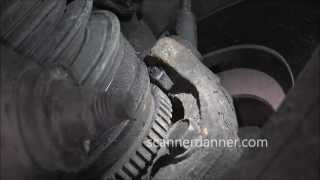
- Faulty Wheel Speed Sensor (Very Common) — Primarily affects Chrysler, Dodge, and Jeep vehicles. A single sensor fails and reports a speed that is impossible compared to the other three (e.g., 100 mph when others read 30 mph), triggering the code. This is the definitive cause when ABS and traction control lights illuminate simultaneously.
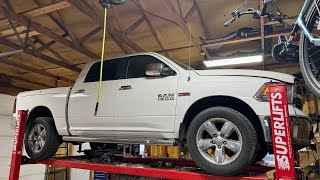
- Failed Crankshaft Tone Wheel (Ram/Jeep EcoDiesel) (Common) — A notorious issue specific to 2014-2018 Ram 1500 and Jeep Grand Cherokee models with the 3.0L EcoDiesel engine. The magnetic reluctor ring on the crankshaft delaminates or loses a magnet, sending an erratic signal to the crankshaft position sensor. This always sets U1401 alongside code P0336 and causes a crank-no-start or stalling condition. 🎬 Watch: Diagnosing a Ram EcoDiesel with codes P0336 and U1401.
- Damaged or Corroded Wiring Harness (Common) — Applies to all makes. Wires in the CAN bus network chafe, corrode, or melt from heat and vibration. This frequently occurs in wheel speed sensor harnesses, transmission harnesses rubbing on the chassis, or wires near hot exhaust components, scrambling communication between modules.
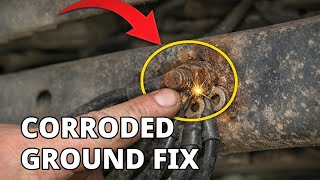
- Corroded or Loose Ground Connection (Common) — Control modules require a clean, tight ground connection to the vehicle's frame to communicate. Corrosion at a main ground point, like the G401 ground on 2015-2020 Ford F-150s located on the frame under the driver's door, disrupts network signals and triggers U1401 or related U-codes.
- Faulty Alternator or Alternator Regulator (Peugeot/Citroën) (Common) — Specific to Peugeot, Citroën, and select European makes. The alternator uses a single-wire communication line (LIN bus) to report its status to the engine computer. If the alternator's internal regulator fails, it corrupts this signal or stops communicating entirely, setting the U1401 code.
- Failing Totally Integrated Power Module (TIPM) (Less Common) — Applies mainly to Chrysler, Dodge, and Jeep vehicles. The TIPM acts as a central hub for power distribution and communication. Internal corrosion or relay failure creates widespread chaos on the CAN bus, leading to U1401 and a flood of other communication codes.
- Faulty Intelligent Battery Sensor (IBS) (Less Common) — On modern Fiat-Chrysler (FCA) vehicles, a U1401 code indicates a communication error with the Intelligent Battery Sensor mounted on the negative battery terminal. If it fails or its communication line is compromised, it sends implausible battery health data, triggering the code.
- Faulty Control Module (TCM/PCM/ABS) (Rare) — The module receiving the data (like the Transmission Control Module) or the module sending it fails internally. This is the absolute last resort after meticulously verifying all wiring, sensors, and ground connections.
Symptoms
- Check Engine Light is On — The most common and often the only symptom noticed during intermittent faults.
- ABS and Traction Control Lights On — A definitive indicator that the U1401 code stems from a faulty wheel speed sensor or a communication issue with the ABS module.
- Engine Stalls or Will Not Start — A critical symptom in Ram/Jeep EcoDiesel models with a failed tone wheel, where the engine cranks but refuses to fire. It also occurs on other vehicles if the communication fault involves critical engine timing data.
- Vehicle Enters 'Limp Mode' — The engine loses significant power, and acceleration is severely limited as the vehicle's computer forces a protective state to prevent mechanical damage.
- Erratic Gauge Behavior or Flickering Lights — The speedometer drops to zero while driving, or dashboard lights flicker randomly. This points to a general network communication failure, often linked to a bad TIPM or a major ground issue.
Diagnostic Flowchart
Tap your situation to follow the diagnostic path that matches what you're seeing on this code.
Common Fixes & Costs
- Replace a Faulty ABS Wheel Speed Sensor — Parts: $50-$190, Labor: $90-$130, ~1.5 hr book time (DIY)
- Clean or Repair Main Ground Connection — Parts: $1-$10, Labor: $50-$200, ~0.8 hr book time (DIY)
- Replace Crankshaft Tone Wheel (Ram EcoDiesel) — Parts: $40-$100, Labor: $1200-$2500, ~12 hr book time (Professional)
- Repair Damaged Wiring Harness — Parts: $10-$50, Labor: $200-$1200, ~4.5 hr book time (Professional)
- Repair or Replace TIPM — Parts: $250-$600, Labor: $100-$200, ~1 hr book time (Intermediate)
Used vs. New Parts: Buying Guide
When a used part is worth it: For a common fix like an ABS wheel speed sensor, buying used is never recommended. The low cost of a new aftermarket part combined with the high failure rate of used electronic sensors makes it a poor value. A used part only makes sense if it is a large, expensive, non-wear item like a complete wiring harness from a low-mileage vehicle.
Donor-vehicle mileage cap: roughly under 60000 miles for the part to have meaningful remaining life.
Donor quality checklist:
- For electronic sensors, new is always better due to the harsh environment they operate in.
- Match part numbers exactly; visual similarity does not guarantee compatibility.
- Avoid parts from vehicles in the rust belt, as corrosion is a primary cause of failure for sensors and wiring.
Decision logic:
- If The part is an electronic sensor like a wheel speed sensor → Buy a new aftermarket part from a reputable brand (e.g., Bosch, NTK) or an OEM part. The cost difference is minimal compared to the risk of a used part failing.
- If The vehicle is older (>150K miles) and the budget is extremely tight → A cheap aftermarket sensor is a viable option, but understand it has a shorter lifespan than a premium brand or OEM part.
- If The part is a control module like a TIPM → A professionally rebuilt unit with a warranty is a better value than a new OEM unit and far more reliable than a used one from a junkyard.
Warranty tradeoff: Used parts from a salvage yard typically offer a 30-90 day warranty. Aftermarket new sensors come with a 1-year to limited lifetime warranty. OEM parts carry a 12-month warranty.
Worst-case if a used part fails: $150-$300 if a used or cheap sensor fails shortly after installation, requiring repeat labor costs plus the price of another part.
What Happens If You Wait — Timeline
- 0-1 month: An intermittent ABS or Traction Control light appears, often triggered by specific events like sharp turns or bumps. The U1401 code is stored but may not trigger the Check Engine Light yet. No noticeable drivability issues. (MPG impact: 0%% · Added cost: $0)
- 1-3 months: The ABS/Traction Control lights are now on constantly. Safety systems are disabled, increasing stopping distances on slick surfaces and reducing stability. On some cars, erratic shifting begins as the TCM receives bad speed data. (MPG impact: 0-2%% · Added cost: $0-50 in wasted fuel, but high safety risk.)
- 3-6 months: For EcoDiesel models, a failing tone wheel progresses from an intermittent code to a crank-no-start condition, leaving you stranded. For wheel sensor issues, prolonged erratic shifting causes premature wear on transmission clutch packs. (MPG impact: 2-5% (due to inefficient shifting)% · Added cost: $500-$3500 (for potential transmission wear or a tow and diagnostic for the no-start condition).)
- 6+ months: Worst-case scenario: a communication failure related to a faulty alternator (on Peugeot) or TIPM (on Chrysler) is ignored. This leads to chronic under/overcharging of the battery, damaging it and other sensitive electronics, or causes a sudden stall while driving. (MPG impact: 5-10%% · Added cost: $1000-$4000+ (for replacing multiple modules, battery, and extensive diagnostics).)
Cost of Not Fixing It
- 0-1 month: Intermittent disabling of safety systems like ABS and traction control, increasing stopping distances and risk of skidding. Potential for unexpected stalling or limp mode. (Added cost: Negligible, but high safety risk.)
- 1-6 months: Continued driving with a faulty wheel speed sensor causes erratic transmission shifting, leading to premature wear on clutch packs. On EcoDiesel models, repeated stalling strains the starter and battery. (Added cost: $500-$3500 (for transmission repair or starter/battery replacement).)
- 6+ months: If the U1401 code relates to an underlying issue causing a rich or lean fuel mixture, it leads to overheating and failure of the catalytic converter. (Added cost: $1200-$2800 (for catalytic converter replacement).)
Diagnosis Steps

- Read All Fault Codes from All Modules
Use a high-quality OBD-II scanner capable of accessing all vehicle modules (Engine, Transmission, ABS, BCM). The U1401 code is a symptom; the other codes stored alongside it are the clues. A P0336 points to the EcoDiesel tone wheel, while a C-code like C102B pinpoints the exact failing wheel speed sensor.
Tools: Advanced OBD-II Scanner (Beginner) - Check for Technical Service Bulletins (TSBs)
Search online for your vehicle's make, model, year, and the U1401 code. Manufacturers release TSBs for known issues, such as the Ram EcoDiesel tone wheel, GM wiring connector corrosion, or software updates for Dodge/Jeep modules, saving hours of diagnostic time.
Tools: Internet access, Vehicle VIN (Beginner) - Analyze Live Sensor Data
If a wheel speed sensor is suspected, use your scanner to view the live data stream from all four sensors while driving slowly. The sensor that reads 0 mph, drops out, or shows a wildly different speed from the others is the culprit. Normal readings show all four sensors within 1-2 mph of each other.
Tools: Advanced OBD-II Scanner with Live Data (Intermediate) - Perform a Thorough Visual Inspection
Inspect for obvious damage. Check battery terminals for corrosion. Follow the wiring harness from the suspected component looking for chafing, melting, or breaks. On F-150s, inspect the G401 ground on the frame under the driver's door for rust. On GM trucks, check harnesses over the transmission for rubbing.
Tools: Flashlight, Wire Brush, Safety Glasses (Beginner) - Test Sensor and Wiring Circuits with a Multimeter
Using a multimeter and a vehicle-specific wiring diagram, check for correct voltage and ground at the connector of the suspected sensor. Unplug the sensor and the control module and check for continuity (no breaks) and for shorts (no connection to power or ground) in the wiring harness between them.
Tools: Multimeter, Vehicle-specific wiring diagram (Intermediate) - Perform a Voltage Drop Test on Power and Ground Circuits
This professional technique finds high resistance that a simple continuity test misses. With the circuit active, place one multimeter lead on the negative battery terminal and the other on the ground pin at the module's connector. A reading above 0.2 volts indicates a poor ground connection requiring repair.
Tools: Multimeter (Advanced) - Inspect the CAN Bus Network Resistance
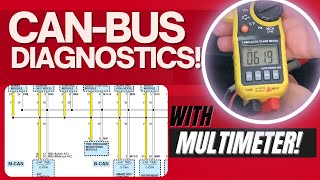
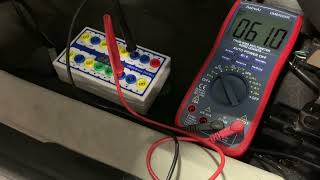
Disconnect the battery. At the OBD-II port, measure the resistance between Pin 6 (CAN High) and Pin 14 (CAN Low). A healthy network reads approximately 60 ohms. A reading of 120 ohms indicates a break in the circuit or a missing terminating resistor. A reading near 0 ohms indicates a short between the two CAN wires.
Tools: Multimeter, Breakout box (optional) (Advanced) - Scope Test the LIN Bus Circuit (Peugeot/Citroën)
For Peugeot/Citroën models with a U1401 alternator fault, this is the definitive test. Using an oscilloscope, back-probe the single LIN wire at the alternator connector. A healthy signal is a clean square wave switching between 1V and 80% of battery voltage. A flat line indicates a faulty alternator regulator.
Tools: Oscilloscope, Back-probe pins (Professional)
When This Code Triggers (Freeze-Frame Conditions)
- Engine Coolant Temp: 180-210°F (Vehicle is at full operating temperature.)
- RPM: 1200-2500 RPM (During steady-state cruise or light acceleration.)
- Vehicle Speed: 25-65 mph (The fault is detected during normal driving when conflicting speed signals become mathematically apparent to the computer.)
- System Voltage: 13.5-14.5V (Normal charging system voltage; the code sets during normal operation, not necessarily during low voltage events.)
Related Codes
- P0336 — Frequently appears with U1401 on Ram/Jeep EcoDiesel models. P0336 points to a crankshaft sensor performance issue, caused by the same failing tone wheel that triggers the implausible speed signal (U1401). If you have both codes, the tone wheel is the primary suspect.
- U0121 — Means 'Lost Communication With Anti-Lock Brake System (ABS) Module'. If you see U0121, the ABS module is completely offline. If you only see U1401, the ABS module is online but sending bad data. U0121 points strongly to a module power/ground issue.
- U0401 — Means 'Invalid Data Received From ECM/PCM'. This is a generic version of U1401. If you have U0401, data from the engine computer is illogical. Seeing both together strongly suggests a core network problem or a failing PCM.
- U1424 — A Chrysler/Jeep code for 'Implausible Engine Torque Signal Received'. Often set in the TCM when torque data from the ECM doesn't make sense. It is caused by software glitches, and a PCM software update is a common fix.
- C102B — A Chrysler-specific code for 'Right Rear Wheel Speed Sensor Signal Erratic'. U1401 tells you a module received an implausible speed, while C102B tells you exactly which sensor is sending the bad signal, making diagnosis much faster.
Climate & Environmental Factors
- Road Salt / High Humidity: Vehicles operated in the 'rust belt' or coastal areas are significantly more prone to U1401. Saltwater is an electrolyte that accelerates corrosion on wiring harnesses, connectors, and ground points, especially those low on the chassis like wheel speed sensor wiring. This corrosion creates unwanted resistance or shorts in the circuit, disrupting communication.
- Extreme Cold: In very cold temperatures, wiring harnesses become brittle and are more susceptible to cracking from vibration. Water that has seeped into connectors freezes and expands, pushing terminals apart or cracking the connector housing, leading to intermittent open circuits.
How to Talk to a Mechanic About This Code
Say this: "I have a U1401 code and I'd like to schedule a diagnostic. I know this is a network communication code. Can you please start by scanning all modules for any related codes, especially in the ABS and transmission systems, and then perform a visual inspection of the related wiring and grounds before suggesting any part replacements?"
This signals to the shop that you are an informed customer. It directs them to follow a logical diagnostic process (scan, inspect, test) rather than just replacing the most expensive part. It establishes that you expect a thorough diagnosis, not a guess.
Avoid saying:
- 'My check engine light is on, can you just fix it?'
- 'I think it's the computer, can you give me a price to replace it?'
- 'Just do whatever you think is best.'
Questions to ask before authorizing the repair:
- What other fault codes did you find in the other modules, like the ABS or Body Control Module?
- If you suspect a wheel speed sensor, can you show me the live data from all four sensors to confirm one is failing?
- If you are recommending a wiring repair, can you show me the damaged section?
- Before we replace an expensive module like the TIPM or ABS computer, what tests did you perform to confirm that all its power, ground, and communication wires are good?
Where to Take It: Dealer vs Independent vs Chain
- Dealer:
Best for: Vehicles under warranty., Complex, manufacturer-specific issues like the Ram EcoDiesel tone wheel failure., Repairs that require a vehicle-specific software update (a 'flash') after part replacement.
Downsides: Highest labor rates, often 1.5x to 2x more than independent shops., May recommend replacing a large assembly when a smaller component or wiring repair would suffice. (Typical cost: +50% vs. baseline) - Independent Shop:
Excellent fit. A reputable independent shop with strong electrical diagnostic skills is the best choice for most U1401 scenarios, offering a balance of expertise and value.
Best for: Out-of-warranty vehicles where cost is a major factor., Diagnosing and repairing common U1401 causes like wheel speed sensors and wiring issues., Finding a trusted, long-term mechanic for all vehicle needs.
Downsides: Diagnostic capabilities vary widely; ensure the shop has modern scan tools and experience with electrical issues. Look for ASE certifications., May not have access to the very latest TSBs or manufacturer-specific software. (Typical cost: +0% vs. baseline) - Chain Shop:
AVOID for initial diagnosis. A chain shop is ill-equipped for the complex troubleshooting U1401 often requires. Only use them if you have already diagnosed a simple sensor failure yourself and just need it installed.
Best for: Simple, confirmed repairs like replacing a single, easily accessible wheel speed sensor.
Downsides: Technician skill varies dramatically., Often lack the advanced diagnostic tools and training to troubleshoot complex network or wiring faults., High pressure to upsell services leads to unnecessary repairs. (Typical cost: -10% vs. baseline)
When to Walk Away From the Repair
If the estimated repair cost exceeds 50% of the car's private-party value, pause and carefully consider if the investment is worthwhile.
- Car worth $12000, fix is $2500: Fix it. A $2,500 repair for the EcoDiesel tone wheel on a truck worth $12,000 is well below the threshold and restores the vehicle's function.
- Car worth $3500, fix is $1800: Walk away. The repair cost is over 50% of the car's value. It's likely not a sound investment.
- Car worth $8000, fix is $350: Fix it. A $350 wheel speed sensor replacement is a minor cost compared to the vehicle's value and is a standard repair.
What Scan Tool You Need for This Code
Minimum: A scanner that can read codes from ALL vehicle modules (Engine, ABS, Transmission, BCM) and display live data streams. A basic engine-only code reader is not sufficient for U1401.
A basic $20 reader will not see the crucial codes stored in the ABS or transmission modules that pinpoint the problem (like a specific wheel sensor fault). It also cannot display the live wheel speed data, which is the most important diagnostic test for this code.
Budget: Kingbolen Ediag Elite / XTOOL A30D (~$80) — These Bluetooth dongle-style scanners connect to your phone and offer full-system scanning and live data viewing, including individual wheel speeds. This is the minimum required for a DIY diagnosis of U1401.
Mid-range: Foxwell NT630 Plus / Innova 5610 (~$250) — These handheld scanners add bidirectional controls. For U1401, this allows you to command the ABS pump to activate during a brake bleed, a key function after some ABS module repairs. They offer a more robust interface than phone apps.
Professional: Autel MaxiCOM MK808S / XTOOL D7 (~$450) — These are tablet-based tools with extensive bidirectional functions, service resets, and sometimes ECU coding capabilities. They provide professional-level data graphing and diagnostic speed, making it easier to spot intermittent glitches in sensor data.
Rent vs buy: Rent for free from an auto parts store if you just want to confirm the codes. However, to diagnose U1401 properly by watching live data while driving, you'll need to buy a scanner. A budget pick under $100 is a worthwhile investment for any modern car owner.
How to Clear the Code After You Fix It
- Fix the underlying mechanical or electrical fault.
- Use a quality OBD-II scan tool to clear all Diagnostic Trouble Codes (DTCs) from all modules.
- Perform a complete drive cycle to allow readiness monitors to run and confirm the fix.
Drive cycle (~30 minutes): A universal drive cycle involves a cold start (vehicle sits for 8+ hours), 2-3 minutes of idling, 15 minutes of mixed city/highway driving including steady speeds around 55 mph, and at least four 30-second idle periods. The goal is to allow the vehicle's computer to run its self-diagnostic tests.
Readiness monitors affected: Comprehensive Component Monitor, Misfire Monitor
Before emissions retest: drive at least 100 miles to fully set monitors.
Watch out for:
- Disconnecting the battery clears codes but resets all readiness monitors to 'Not Ready', causing an automatic emissions test failure.
- The code returns immediately if the root cause (e.g., bad sensor, damaged wire) is not properly repaired.
- Failing to perform a complete drive cycle leaves monitors 'Not Ready', preventing a successful emissions test.
Will This Fail Emissions / State Inspection?
Yes — this code typically fails an OBD-II emissions inspection.
- California: An illuminated Check Engine Light results in an automatic failure of the smog check. After repairs, a full drive cycle must be completed to set the readiness monitors before a re-test is possible.
- New York: An active Check Engine Light is an automatic failure for the emissions portion of the NYS inspection. Clearing the code without completing a drive cycle results in a failure due to 'Not Ready' monitors.
- Texas: In counties requiring emissions testing, an illuminated Check Engine Light is an automatic fail. For 2001 and newer vehicles, only one readiness monitor can be 'Not Ready' to pass.
Most Commonly Affected Vehicles

- Ram 1500 EcoDiesel (2014-2018) — Extremely prone to U1401 with P0336 due to crankshaft tone wheel delamination, causing a no-start condition.
- Jeep Grand Cherokee EcoDiesel (2014-2018) — Shares the same 3.0L EcoDiesel engine as the Ram 1500 and suffers from the identical tone wheel failure.
- Chevrolet/GMC Equinox, Terrain, Silverado, Tahoe (2007-2017) — Prone to network communication codes. Known issues include corroded harness connectors like the X411 block connector on Equinox/Terrain, and wiring harnesses chafing on transmission casings.
- Dodge Grand Caravan (2008-2020) — Experiences U1401 due to wiring harness issues or failures within the Totally Integrated Power Module (TIPM). For 2011-2015 models, check for PCM software updates.
- Chrysler Town & Country (2008-2016) — Shares the same platform as the Grand Caravan and is prone to identical TIPM failures and wiring problems that trigger communication codes.
- Jeep Wrangler (JK) (2007-2018) — Commonly sees U1401 related to failed wheel speed sensors or damaged sensor wiring. The harness is vulnerable to damage from off-road use or corrosion.
- Ford F-150 (2015-2020) — While U1401 is rare, related codes U0140 and U0401 are common. Causes include a corroded G401 ground connection under the driver's door, a damaged transmission harness, or a failed transmission molded lead frame.
- Nissan Rogue, Versa, Altima (2014-2020) — A U1000 code (generic CAN fault) is more common but has similar root causes. A weak battery, corroded battery terminals, or bad ground connections are the most frequent culprits.
Manufacturer-Specific Notes
- Chrysler/Dodge/Jeep/Ram: The code almost always points to an 'implausible' signal from a sensor. The most common culprits are wheel speed sensors or, on EcoDiesel models, the crankshaft tone wheel. Widespread electrical issues with this code often lead back to the TIPM. Always check for software updates (flashes) for the PCM.
- Ford/Lincoln/Mercury: Ford does not typically use U1401. The equivalent issue is coded as U0401 or U0140. These are commonly caused by corroded grounds (G401), damaged transmission harnesses, or a failed transmission lead frame on F-150s.
- Peugeot/Citroën: On these vehicles, U1401 is almost exclusively associated with a communication failure on the LIN bus for the alternator. This means the alternator is faulty, not charging correctly, or its internal regulator has failed. Diagnosis requires checking the LIN signal with an oscilloscope.
- General Motors (Chevrolet/GMC): GM often uses the related code U0140. TSBs point to specific known failure points, such as corroded harness connectors under the vehicle (e.g., Equinox/Terrain X411 connector) or chafed wires, as the root cause for network communication loss.
- Fiat/Alfa Romeo: On platforms from FCA, U1401 can indicate a fault in the in-car temperature sensor circuit. On others, it indicates a communication problem with the Intelligent Battery Sensor (IBS) located on the negative battery terminal.
Real Owner Stories
2015 Ram 1500 EcoDiesel at 140K miles
Truck would crank but refused to start. Check engine light was on, and the owner found codes U1401 and P0336.
What they tried:
- The owner suspected a fuel issue initially, but research pointed to a common EcoDiesel problem.
- A mechanic confirmed the diagnosis by dropping the transmission.
- The crankshaft tone wheel, a magnetic ring between the engine and transmission, had delaminated and was missing a piece.
Outcome: The tone wheel was replaced. The part itself was only about $41, but since the transmission has to be removed for access, the total repair cost was around $2,500. After the repair, the truck started immediately and ran correctly.
Lesson: On a 2014-2018 EcoDiesel, U1401 paired with P0336 is almost certainly a failed tone wheel. A software recall (W58) exists to prevent the engine from stalling, but it does not fix the underlying mechanical part which will eventually fail and cause a no-start condition.
2012 Dodge Grand Caravan with 115K miles
ABS and Traction Control lights came on, accompanied by code U1401. The speedometer was also behaving erratically, sometimes dropping to zero while driving.
What they tried:
- The owner first suspected a major electrical problem with the TIPM, a common issue on these vans.
- Before ordering an expensive module, they used a scanner with live data.
- While a friend drove the van slowly, the owner watched the wheel speed sensor data. Three wheels showed a matching speed, but the right rear sensor was reading 0 mph.
Outcome: Replaced the right rear wheel speed sensor. The part cost about $60 and took less than an hour to install. After replacement, the codes were cleared and did not return. The ABS/Traction lights went out, and the speedometer functioned normally.
Lesson: Don't immediately assume the worst-case scenario. A scanner that can read live data from all modules is a powerful diagnostic tool. For U1401 with ABS lights, checking the live wheel speed data is the fastest way to pinpoint a bad sensor before replacing expensive modules.
2015 Peugeot 508 1.6 e-HDI
The battery warning light was on, and a diagnostic scan showed code U1401: Alternator LIN network fault. The car started and ran, and a multimeter at the battery showed it was charging at nearly 14V.
What they tried:
- The owner bought a used alternator from a breaker's yard that looked identical.
- After installing the used part, the car was charging, but the U1401 code immediately returned.
- Further diagnosis on a similar vehicle showed that the LIN communication wire from a faulty alternator can have voltage present when it should be pulled to ground, corrupting the signal even if it appears to be charging.
Outcome: The used alternator was not compatible with the vehicle's specific LIN bus protocol, even though it was physically identical. The owner had to purchase a new, correct alternator for the specific vehicle VIN. In some cases, a software update from Peugeot can also resolve LIN communication issues without replacing the alternator.
Lesson: On Peugeot/Citroën vehicles, U1401 is almost always an alternator communication issue. Do not trust that a used part is compatible, even if it looks the same; modern smart alternators are highly specific to the vehicle's network. Always check for TSBs, as a software flash can sometimes be the correct fix.
How to Prevent This Code From Triggering
- Clean and Protect Ground Connections (Every 2-3 years or during brake service) — Corrosion on main ground points is a primary cause of network faults. Periodically disconnect main battery and engine-to-chassis grounds, clean them to bare metal with a wire brush, and apply a thin layer of dielectric grease before re-tightening to seal out moisture.
- Apply Dielectric Grease to Key Connectors (When servicing related components) — When replacing a wheel speed sensor or working near its harness, apply a small amount of dielectric grease to the connector pins. This prevents moisture intrusion and corrosion, which disrupts sensitive low-voltage signals and triggers communication codes.
- Inspect Wiring Harnesses for Chafing (During every oil change) — Many communication faults are caused by wiring harnesses rubbing against the frame or engine components. Take 5 minutes to visually inspect vulnerable areas, like the wheel speed sensor wires in the wheel wells and harnesses that cross over the transmission, for signs of wear.
- Perform Regular Battery Health Checks (Annually, especially before winter) — A weak or failing battery provides unstable voltage, which causes control modules to malfunction and generate spurious communication codes like U1401. Most auto parts stores test battery health for free, preventing complex and expensive misdiagnoses.
Frequently Asked Questions
Can a bad battery cause a U1401 code?
Yes, absolutely. A weak or failing battery causes low voltage across the vehicle's electrical system, leading to unpredictable module behavior and triggering communication codes like U1401. Always test the battery and check its connections before diving into complex wiring diagnostics.
What is a common misdiagnosis when dealing with U1401?
A very common mistake is replacing a control module (like the BCM, TCM, or ABS module) when the actual problem is a simple wiring or connection issue. A corroded ground, chafed wire, or a single bad pin in a connector is often the true cause. Always rule out the physical wiring and grounds before condemning an expensive computer.
I replaced the sensor but the code came back. What now?
If a new sensor doesn't fix the issue, the problem is in the wiring harness between the sensor and the control module, the connector pins, or the module itself. Inspect the wiring again, then perform electrical tests for continuity, shorts to power, and shorts to ground to isolate the fault.
Is it safe to clear the U1401 code and keep driving?
You can clear the code, but if there is an underlying hard fault, it returns quickly. If the code is intermittent, clearing it provides a temporary fix, but the root problem still exists and causes a stall, limp mode, or other safety issue at an inopportune time.
Why is the repair for the Ram EcoDiesel so expensive?
The failing part, the crankshaft tone wheel, costs less than $100. However, its location between the engine and the transmission means the entire transmission must be removed for access. This 10-15 hour labor job brings total costs to between $1,500 and $2,500.
My scanner shows U1401 but my car is a Honda/Toyota/Subaru. What does it mean?
U1401 is not a standard code for most Asian manufacturers like Honda, Toyota, or Subaru. If your scan tool displays this code on one of these brands, it is an error or a misinterpretation by the tool. Use a high-quality, manufacturer-specific scanner for the most accurate diagnosis, as the true code is likely a different 'U' or 'C' code.
What is the difference between U1401, U0140, and U0401?
U1401 means a module is online but sending 'Implausible Data' (e.g., a wheel speed of 200 mph). U0140 means 'Lost Communication with Body Control Module,' indicating the BCM is completely offline. U0401 means 'Invalid Data Received from ECM/PCM,' indicating data from the main engine computer is corrupt.
What is a LIN bus and why does it matter for my Peugeot?
A LIN (Local Interconnect Network) bus is a simple, single-wire communication network used for components that don't need the high speed of the main CAN bus. In many Peugeot and Citroën cars, the alternator uses a LIN bus to communicate its charging status to the ECU. A U1401 code on these cars means communication failed, pointing directly to a fault inside the alternator.
What is an Intelligent Battery Sensor (IBS) and can it cause U1401?
The IBS is a small module attached to your car's negative battery terminal that monitors voltage, temperature, and current flow. On Fiat-Chrysler vehicles, a failure in the IBS or its communication line triggers a U1401 code. The main computer receives implausible data about the battery's status, setting the fault.
Key Takeaways
- U1401 triggers when a vehicle module receives mathematically impossible data, such as a wheel speed sensor reporting 100 mph while the engine is idling at 0 RPM.
- On Chrysler, Dodge, and Jeep vehicles, a faulty $50-$150 ABS wheel speed sensor is the primary culprit, instantly disabling traction control and ABS systems.
- If you own a 2014-2018 Ram or Jeep 3.0L EcoDiesel, pairing U1401 with code P0336 guarantees a failed crankshaft tone wheel, requiring a $1,500-$2,500 transmission-out repair.
- On Peugeot and Citroën models, U1401 isolates a failure in the alternator's single-wire LIN bus communication, requiring a direct oscilloscope test or alternator replacement.
- Always clean main chassis ground connections—like the notorious G401 ground on Ford F-150s—before spending $500+ replacing suspected control modules.
Helpful Videos
![How To Test CAN BUS With A Multimeter [CAN Bus Resistance Check] Mechanic Mindset](https://img.youtube.com/vi/JPE42HSJxAk/mqdefault.jpg)

The information in this article is provided for general reference and educational purposes only. Vehicle specifications, procedures, and part compatibility can vary by production date, trim level, and region. Always consult your vehicle's factory service manual and verify part numbers before purchasing or performing repairs. Safety-critical components such as airbags, seat belts, and braking systems should be installed by a qualified professional.
- 🎬 Helpful Videos
- What Does U1401 Mean?
- Can I Drive With U1401?
- Common Causes
- Symptoms
- Diagnostic Flowchart
- Common Fixes & Costs
- Used vs. New Parts: Buying Guide
- What Happens If You Wait — Timeline
- Cost of Not Fixing It
- Diagnosis Steps
- When This Code Triggers (Freeze-Frame Conditions)
- Related Codes
- Climate & Environmental Factors
- How to Talk to a Mechanic About This Code
- Where to Take It: Dealer vs Independent vs Chain
- When to Walk Away From the Repair
- What Scan Tool You Need for This Code
- How to Clear the Code After You Fix It
- Will This Fail Emissions / State Inspection?
- Most Commonly Affected Vehicles
- Manufacturer-Specific Notes
- Real Owner Stories
- 2015 Ram 1500 EcoDiesel at 140K miles
- 2012 Dodge Grand Caravan with 115K miles
- 2015 Peugeot 508 1.6 e-HDI
- How to Prevent This Code From Triggering
- Frequently Asked Questions
- Can a bad battery cause a U1401 code?
- What is a common misdiagnosis when dealing with U1401?
- I replaced the sensor but the code came back. What now?
- Is it safe to clear the U1401 code and keep driving?
- Why is the repair for the Ram EcoDiesel so expensive?
- My scanner shows U1401 but my car is a Honda/Toyota/Subaru. What does it mean?
- What is the difference between U1401, U0140, and U0401?
- What is a LIN bus and why does it matter for my Peugeot?
- What is an Intelligent Battery Sensor (IBS) and can it cause U1401?
- Key Takeaways
- 🎟️ Get 5% Off