

OBD-II Code U1152: Lost Communication With HVAC Control Module
The Ultimate 2024 Guide to Diagnosing and Fixing U1152
- Code U1152 indicates a total communication failure between the HVAC control module and the vehicle's data network, instantly disabling all climate controls.
- Over 80% of U1152 codes on 2000s GM vehicles stem from a failed dashboard HVAC control panel or a shorted $40 blend door actuator.
- Driving with U1152 is mechanically safe, but the resulting loss of windshield defrosting capabilities creates a severe visibility hazard in cold or wet weather.
- Never replace the $300+ HVAC module without first testing the battery and unplugging blend door actuators to rule out a simple data line short.
What Does U1152 Mean?

U1152 is a network communication code indicating the main computer lost connection with the Heating, Ventilation, and Air Conditioning (HVAC) control module. This module translates your button presses into climate actions. Without communication, the system shuts down or defaults to blowing hot air through the defroster vents as a failsafe.
Technical definition: The SAE/OBD-II definition is "Lost Communication With HVAC Control Module." On networks like GM's Class 2 serial data circuit, modules broadcast a "Node Alive" message every two seconds. If the Body Control Module (BCM) misses this message from the HVAC module for five consecutive seconds, it flags the module as offline and sets code U1152.
Can I Drive With U1152?

Yes, But With Caution. Yes, but the risk is significant. The climate control system, including the window defroster, is inoperative. In cold, rainy, or humid weather, the inability to clear fog or ice from your windshield severely impairs visibility, making the vehicle unsafe and potentially illegal to operate.
Common Causes

- Faulty HVAC Control Module (Very Common) — The internal electronics of the dashboard climate control panel fail due to age, heat cycles, or component degradation, severing its connection to the vehicle's data network.
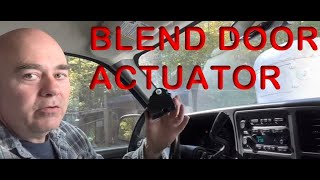
- Shorted Blend Door Actuator (Very Common) — The small electric motors controlling air temperature and direction short out internally. This electrical fault backfeeds into the communication line, knocking the HVAC module offline and triggering U1152.
- Wiring or Connector Issues (Common) — A damaged wire, loose pin, or corroded connector at the back of the HVAC module interrupts the data signal. This stems from previous dash repairs, vibrations, or moisture intrusion.
- HVAC Module Software Glitch (Common) — The HVAC module's software contains a bug causing intermittent communication drops. A hardware replacement is unnecessary; a dealer must apply a software update via a Technical Service Bulletin (TSB).
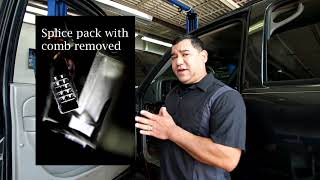
- Corroded Splice Pack / Junction Block (Less Common) — Many vehicles use splice packs to join data wires from multiple modules. Located in vulnerable areas like under carpets, these corrode from water leaks, disrupting the entire network segment.
- Weak Battery (Less Common) — System voltage below 12.0V during startup causes unpredictable communication glitches. The voltage drop prevents the HVAC module from initializing properly, setting a communication code.
- Network Interference from Other Modules (Rare) — Other modules (like the ABS or Radio) or cheap aftermarket accessories share the same data circuit. An internal short in these devices corrupts the entire data line, causing the HVAC module to lose communication.
Symptoms
- HVAC controls are dead or unresponsive — The buttons and knobs on your climate control panel do nothing, and the display is blank or flickering.
- Temperature stuck on full hot or full cold — You cannot adjust the temperature. The system defaults to full heat on the driver's side as a failsafe mode.
- A/C system does not work — The air conditioning compressor will not engage because the main computer cannot communicate with the HVAC module to verify the cooling request.
- Parasitic battery drain — A faulty HVAC module fails to 'sleep' when the car is off, creating a continuous power draw that drains the battery overnight.
- Blank radio or other module warnings — Because modules share data lines, a fault causing U1152 also causes the radio display to go blank or triggers ABS/Airbag warning lights.
- Check Engine Light is on — Persistent communication loss sets a hard code in the PCM or BCM, illuminating the Check Engine Light.
Diagnostic Flowchart
Tap your situation to follow the diagnostic path that matches what you're seeing on this code.
Common Fixes & Costs
- Replace HVAC Control Module — Parts: $150-$400, Labor: $120-$200, ~1 hr book time (Intermediate)
- Replace Blend Door Actuator(s) — Parts: $40-$100, Labor: $350-$800, ~4.5 hr book time (Advanced)
- Repair Wiring or Connector — Parts: $10-$50, Labor: $150-$400, ~2.5 hr book time (Professional)
- Update HVAC Module Software — Parts: $0, Labor: $125-$200, ~1.2 hr book time (Professional)
- Replace Battery — Parts: $150-$250, Labor: $25-$50, ~0.3 hr book time (DIY)
Used vs. New Parts: Buying Guide
When a used part is worth it: For vehicles over 15 years old where a new OEM part exceeds 10% of the car's value. A used plug-and-play module from a reputable salvage yard is cost-effective.
Donor-vehicle mileage cap: roughly under 100000 miles for the part to have meaningful remaining life.
Donor quality checklist:
- Verify the part number matches your original exactly to ensure software compatibility.
- Check the donor VIN to avoid flood-damaged vehicles.
- Source from a vehicle with lower mileage than your own.
Decision logic:
- If The part requires dealer programming to function (common on 2008+ vehicles) → Buy new. Used modules are often locked to the donor vehicle's VIN and cannot be reprogrammed.
- If The vehicle is less than 10 years old and the part is under $300 new → Buy new. The warranty and reliability outweigh the minimal savings of a used part.
- If The failure is a known wear item (like plastic gears in a blend door actuator) → Buy new. A used actuator has identical wear and will fail quickly.
Warranty tradeoff: Used parts carry a 30-90 day exchange warranty. New aftermarket parts offer 1-year to lifetime warranties.
Worst-case if a used part fails: $300-$1000 if a used actuator fails, requiring you to pay for 5-8 hours of dashboard removal labor twice.
What Happens If You Wait — Timeline
- 0-1 month: Intermittent HVAC issues appear. The A/C works one day and fails the next. Clearing the code temporarily restores function. (MPG impact: 0%% · Added cost: $0)
- 1-3 months: The fault becomes persistent. The system defaults to blowing hot air. A parasitic drain begins, causing slow starting or a dead battery after a few days. (MPG impact: 0%% · Added cost: $150-$250 (Premature battery replacement due to deep cycling).)
- 3-6 months: The HVAC system is permanently inoperative. The lack of a defroster becomes a critical safety issue. The internal short begins electrically stressing other modules. (MPG impact: 0%% · Added cost: $250 (Guaranteed battery replacement) + increased diagnostic labor.)
- 6+ months: Constant electrical noise permanently damages sensitive electronic modules (like the Radio or BCM) on the same network, leading to a cascade of failures. (MPG impact: 0%% · Added cost: $500-$2000 (Cost to replace the original part PLUS newly damaged modules).)
Cost of Not Fixing It
- Immediate: Total loss of climate control. The windshield defroster fails to function, creating a severe safety hazard in cold or humid weather due to zero visibility. (Added cost: $0)
- 1-3 months: A faulty HVAC module fails to enter sleep mode, creating a parasitic battery drain. This requires frequent jump starts and destroys the battery's internal cells. (Added cost: $150-$250 for a replacement battery.)
- 3+ months: The underlying electrical short damages other modules on the shared data bus, turning a single-module problem into a catastrophic network failure. (Added cost: $500-$2000 to diagnose and replace newly damaged modules.)
Diagnosis Steps

- Check for Other Codes
Use an OBD-II scanner capable of reading 'U' (Network) and 'B' (Body) codes from all modules. The presence of multiple 'U' codes (like U1000, U1064) proves a wider network problem exists, not just a single bad HVAC module.
Tools: Professional OBD-II Scanner (Beginner) - Test the Battery and Check Fuses
Verify the battery has at least 12.4 volts with the engine off. Inspect all fuses related to the HVAC system, Body Control Module (BCM), and Radio using the owner's manual.
Tools: Multimeter, Owner's Manual, Fuse Puller (Beginner) - Perform a Hard Reset
Disconnect the negative battery terminal for 30 minutes to force all modules to power down and reboot. Reconnect the battery and check if HVAC function returns. This clears temporary glitches but will not fix a hardware fault.
Tools: Wrench (for battery terminal) (Beginner) - Inspect HVAC Module Wiring
Remove dash trim to access the back of the HVAC control panel. Unplug the main connector and inspect for corrosion, moisture, or damaged pins. Wiggle the connector with the system on to check for a loose connection.
Tools: Trim removal tools, Flashlight (Intermediate) - Test for Power and Ground at the Module
Check for battery voltage (~12.6V) on the power pin and less than 0.1V on the ground pin at the HVAC module's connector. Missing power or ground indicates a wiring issue, meaning the module itself is likely fine.
Tools: Multimeter, Vehicle-specific wiring diagram (Advanced) - Isolate the Faulty Module
If multiple 'U' codes exist, disconnect other modules on the same data bus one by one (Radio, ABS, door modules). Clear codes after each unplug. If HVAC communication returns, the module you just unplugged is shorting the network.
Tools: Professional OBD-II Scanner, Trim removal tools (Advanced) - Check the Data Bus Voltage
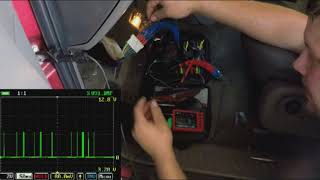
Probe the Serial Data wire at the HVAC module or DLC Pin 2. A healthy data line shows rapidly fluctuating voltage (e.g., 0V to 7V). A constant 0V means a short to ground; a constant 12V means a short to power. Stop DIY diagnosis and take the vehicle to an electrical specialist if the voltage is flatlined.
Tools: Multimeter, Vehicle-specific wiring diagram (Advanced) - Test Blend Door Actuator Resistance
Unplug suspected blend door actuators and measure resistance across the position sensor pins. The resistance must sweep smoothly as you manually move the arm. Sudden drops to zero confirm an internal short taking down the data line.
Tools: Multimeter, Wiring Diagram (Advanced) - Advanced Data Bus Analysis
Probe the data line with an oscilloscope to view the digital signal. A shorted actuator or faulty module corrupts this signal into a distorted waveform or a flat line, instantly confirming a physical network fault.
Tools: Oscilloscope, Wiring Diagram (Professional)
When This Code Triggers (Freeze-Frame Conditions)
- System Voltage: 11.5V - 14.5V (A low voltage reading (under 12.0V) points directly to a weak battery or charging system issue as the root cause of the communication glitch.)
- Module Status: Not Available / Error (Freeze frame logs which module (e.g., BCM) failed to receive a response from the HVAC module, confirming the exact point of network failure.)
- Engine State: Key On, Engine Off (The code sets during the initial 'roll call' of modules immediately after turning the key, showing 0 RPM and a cold engine temperature.)
- Time Since Key-On: < 5 seconds (If a monitoring module expects a 'State of Health' message and misses it within a 5-second window, it immediately logs U1152.)
Related Codes
- U1000 — A generic Class 2 communication failure code. Seeing U1000 alongside U1152 proves the issue is a main data bus wire or gateway module failure, not just the HVAC system.
- B0229 — Indicates a fault in the HVAC Recirculation Actuator circuit. The shorted actuator is the root cause, and U1152 is the symptom. Replacing the actuator fixes both codes.
- U1064 — Indicates a Loss of Communication with the Body Control Module (BCM). If the BCM is the gateway, this points to a BCM failure or a severed wire between the BCM and HVAC module.
- U1255 — A generic communication loss code. If multiple modules log this alongside U1152, identify which modules are offline to locate the specific broken segment of the wiring harness.
Climate & Environmental Factors
- High Humidity / Coastal Regions: Salt and moisture accelerate corrosion on electrical connectors and module circuit boards, creating high resistance that severs communication.
- Cold Climates with Road Salt: Salty snow melts from boots and seeps into carpets, corroding floor-mounted splice packs and taking down the entire data bus.
- Water Leaks: Leaks from windshield seals or sunroof drains drip directly onto under-dash modules, causing immediate electrical shorts and communication codes.
How to Talk to a Mechanic About This Code
Say this: "I have a U1152 communication code and my climate control is dead. Please authorize one hour of diagnostic time to scan all modules for other 'U' or 'B' codes and check the data bus voltage before recommending any part replacements."
This signals you understand network codes and prevents the shop from blindly quoting a new HVAC module. It forces a systematic diagnosis and sets a clear initial budget.
Avoid saying:
- 'My A/C is broken, can you fix it?'
- 'My check engine light is on, can you look at it?'
- 'Just replace the climate control panel.'
Questions to ask before authorizing the repair:
- Did you find any other codes in the BCM or radio?
- What was the voltage reading on the data line? Was it stable or fluctuating?
- If recommending a module replacement, have you confirmed it has good power and ground?
- If recommending a blend door actuator, is it because it shorted the data line?
- Will the replacement part require programming, and is that included in the quote?
Where to Take It: Dealer vs Independent vs Chain
- Dealer:
Recommended only if a software update is required or if initial diagnosis at an independent shop fails.
Best for: Vehicles under warranty., Repairs requiring a software update or module programming (common on 2008+ vehicles)., Complex, multi-module network failures.
Downsides: Highest labor rates., Quick to replace expensive modules rather than perform detailed wiring repairs. (Typical cost: +50% vs. baseline) - Independent Shop:
Best fit for most U1152 repairs. Choose a shop with strong reviews for electrical diagnostics.
Best for: Out-of-warranty vehicles, especially common GM trucks/SUVs., Shops specializing in electrical or diagnostic work.
Downsides: May lack the expensive tools to program a new module, requiring a second trip to the dealer. (Typical cost: +0% vs. baseline) - Chain Shop:
AVOID. They lack the skills and tools to correctly identify the root cause of a network fault.
Best for: Simple repairs like tires or oil changes.
Downsides: Technicians lack training for complex network diagnostics., High pressure to sell parts leads to misdiagnosis. (Typical cost: -10% vs. baseline)
When to Walk Away From the Repair
If the estimated repair cost exceeds 40% of the car's private-party value, seriously consider selling or trading in the vehicle.
- Car worth $4500, fix is $2200: Walk away. A repair costing 50% of the car's value is a poor investment.
- Car worth $12000, fix is $800: Fix it. The repair cost is well below the threshold and restores a critical safety function.
- Car worth $2000, fix is $1500: Walk away. The repair cost is 75% of the car's value.
What Scan Tool You Need for This Code
Minimum: A scanner capable of reading 'U' (network) and 'B' (body) codes from ALL vehicle modules (BCM, ABS, HVAC), not just the engine.
A basic $20 code reader only checks the engine computer and will not see the U1152 code or other critical network codes.
Budget: BlueDriver Pro Scan Tool (~$100) — Performs a full system scan to read codes from the BCM and provides freeze-frame data to confirm the presence of U1152.
Mid-range: Innova 5610 (~$330) — Offers bidirectional control to command HVAC actuators directly and performs the required HVAC relearn procedure after part replacement.
Professional: Autel MaxiCOM MK808 (~$500) — Provides dealer-level diagnostics, module programming, and topology mapping to visually identify offline modules.
Rent vs buy: For a one-time diagnosis, auto parts stores perform full system scans for free. If you plan to DIY the repair, buying a mid-range bidirectional tool is essential.
How to Clear the Code After You Fix It
- Perform the physical repair (replace module, fix wiring, etc.).
- Reconnect the battery.
- Use a professional-grade OBD-II scan tool to clear U1152 from all modules.
- Perform the HVAC actuator calibration procedure (often involves pulling the HVAC fuse for 20 seconds, reinstalling it, and letting the system run untouched for 2 minutes).
- Perform a complete drive cycle to reset system readiness monitors.
Drive cycle (~20 minutes): Start with a cold engine. Idle for 3 minutes with A/C and rear defroster on. Turn accessories off, accelerate at half throttle to 55 mph, and hold for 3 minutes. Coast down to 20 mph without braking. Accelerate to 60 mph, hold for 5 minutes, then coast to a stop.
Readiness monitors affected: Clearing the code or disconnecting the battery resets ALL emissions monitors to 'Incomplete'., You must perform a full drive cycle to achieve 'Complete' status before an emissions test.
Before emissions retest: drive at least 50 miles to fully set monitors.
Watch out for:
- Clearing the code without fixing the hardware fault causes the code to return immediately.
- Using a basic code reader only clears the ECU and leaves U1152 stored in the BCM.
- Failing to perform the actuator calibration procedure after replacement breaks the new actuator gears.
Will This Fail Emissions / State Inspection?
Yes — this code typically fails an OBD-II emissions inspection.
- California: A Check Engine Light from any code is an automatic failure. Most readiness monitors must be 'complete' to pass the smog check.
- New York: An active U1152 with the MIL on causes an immediate inspection failure.
- Texas: In the 17 counties requiring emissions testing, an illuminated Check Engine Light guarantees a failure.
Most Commonly Affected Vehicles
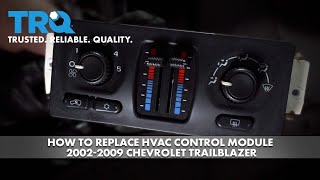
- Chevrolet Trailblazer (2002-2009) — Extremely common. Caused by a failed HVAC control head, a shorted blend door actuator, or a software glitch addressed by TSB 02-01-39-005.
- GMC Envoy (2002-2009) — Shares the GMT360 platform and identical electrical architecture with the Trailblazer, suffering the exact same failure points.
- Chevrolet Silverado (2003-2007) — U1152 is frequently accompanied by the driver's side blowing hot air, pinpointing a failed blend door actuator shorting the data line.
- GMC Sierra (2003-2007) — Mechanically identical to the Silverado, experiencing the same pattern of HVAC control module and actuator failures.
- Ford F-Series / Super Duty (1999-2007) — The instrument cluster acts as a network gateway. A failing cluster triggers communication codes for other modules, including U1152.
- Jeep Grand Cherokee (2005-2013) — Prone to HVAC control module failures and blend door actuator shorts that trigger communication codes on the CAN bus.
- BMW 3-Series / 5-Series (1998-2008) — CRITICAL: On these BMWs, U1152 is a manufacturer-specific code referring to an electronic throttle actuator fault, completely unrelated to the HVAC system.
Manufacturer-Specific Notes
- General Motors (Chevrolet, GMC, Cadillac): On 2000s trucks and SUVs, this code is overwhelmingly caused by a failed HVAC control unit, a shorted blend door actuator, or a software issue requiring a dealer reflash (TSB #02-01-39-005).
- Ford: On J1850 SCP data bus platforms, the Instrument Cluster acts as the network gateway. A failing cluster causes U1152. Chafed wiring harnesses near the parking brake pedal are also a known trouble spot.
- Chrysler / Dodge / Ram: A complete loss of communication results in totally dead controls. Diagnosis requires confirming 12V power, ground, and 2.5V CAN bus signals at the module connector before condemning the module.
- BMW: On older BMW models, U1152 relates to a self-test failure of the electronic throttle actuator. Diagnosing it as an HVAC problem is a complete misdiagnosis.
Real Owner Stories
2004 Chevy Silverado 2500HD with ~150K miles
A/C stopped working without a Check Engine Light. A scan tool revealed code U1152. Clearing the code temporarily restored A/C function before failing again.
What they tried:
- Clearing the code with a scan tool for a temporary fix.
Outcome: The intermittent loss of communication with the HVAC module was the root cause of the A/C failure, requiring a permanent hardware fix.
Lesson: Clearing a communication code is never a permanent fix. A returning code indicates a persistent hardware or wiring fault requiring proper diagnosis.
2007 Chevy Silverado with dual climate control
The driver's side vent blew extremely hot air while the passenger side remained cold, pointing to a blend door issue.
What they tried:
- Suspected a blend door actuator failure based on symptom research.
Outcome: Forum members confirmed a failing driver's side blend door actuator. On this model, the actuator is accessible under the dash without full removal, making it a manageable DIY repair.
Lesson: Symptom-specific issues, like one side blowing hot, pinpoint the exact failed component (the actuator) before even scanning for codes.
2005 Chevy Trailblazer with multiple 'U' codes
The vehicle was a no-start with U1152, U1000, and U1064 codes, indicating a widespread network failure.
What they tried:
- Performed a full system scan revealing a breakdown in the Class 2 communication network.
Outcome: The U1064 (Loss of communication with BCM) combined with U1152 proved the BCM or main data line was the source of the network collapse, not the HVAC module.
Lesson: A flood of 'U' codes means the problem is on the shared data network itself or the main gateway module. Stop diagnosing individual modules.
2003 GMC Envoy with a parasitic battery drain
The battery died overnight. The owner traced a 1.7-amp parasitic draw to the HVAC-B fuse.
What they tried:
- Performed a parasitic draw test, pulling fuses until the amp draw dropped.
- Unplugged the main HVAC module (draw remained).
- Unplugged the rear auxiliary HVAC module (draw disappeared).
Outcome: The rear HVAC control module failed to enter 'sleep' mode. Replacing the $39 rear module resolved the parasitic draw and the U1152 code.
Lesson: On vehicles with multiple climate zones, the fault often lies in a rear or auxiliary module. A systematic parasitic draw test is the definitive way to find the culprit.
How to Prevent This Code From Triggering
- Perform regular HVAC system checks. (Annually) — Regularly switching between all temperatures and vent modes prevents blend door actuator gears from seizing due to lack of motion.
- Avoid harsh or abrupt control inputs. (Daily habit) — Gently operating temperature controls reduces mechanical stress on the plastic gears inside blend door actuators, prolonging their life.
- Address cabin water leaks promptly. (As needed) — Water from leaking windshields or sunroofs seeps into carpets and corrodes under-dash connectors, directly causing communication failures.
- Use high-quality replacement parts. (During repairs) — Cheaper, low-quality electronic actuators are highly prone to premature failure and cause repeat network shorts.
- Replace cabin air filters regularly. (Every 15,000 miles) — A clogged filter restricts airflow, forcing the blower motor to work harder and adding unnecessary electrical strain to the HVAC system.
Frequently Asked Questions
What are common misdiagnosis pitfalls for U1152?
The most common mistake is replacing the expensive HVAC module without checking for a shorted blend door actuator. Another pitfall is overlooking a different failing module (like the radio) disrupting the shared data bus. Always scan all modules and test the network before buying parts.
Can a U1152 code cause my car not to start?
A faulty HVAC module will not cause a no-start condition. However, a network-wide communication failure or a shorted wire affecting the engine computer prevents the car from starting while simultaneously logging U1152.
Can I just clear the U1152 code?
Clearing the code works temporarily if the cause was a one-time low voltage glitch. If a hardware problem exists, the code returns immediately after the module fails its next check-in.
Why is my heat stuck on high with code U1152?
When the system loses communication, it defaults to sending hot air to the driver's side and defroster vents as a failsafe. This symptom strongly points to a failed blend door actuator or a dead HVAC control module.
Does a new HVAC control module need to be programmed?
For early-2000s GM vehicles, it is usually a plug-and-play replacement. On vehicles built after 2008, the new module must be programmed to the vehicle's VIN using dealer-level software.
Can a bad radio cause a U1152 code?
Yes. The radio shares the same data network as the HVAC system. An internal short circuit in a factory or cheap aftermarket radio disrupts the entire network, causing communication codes for other modules.
My scanner won't communicate with the car at all. Is this related to U1152?
Yes. The OBD-II port communicates over the same network. If a module severely shorts the data line to ground or power, it prevents scan tools from communicating with any module, indicating a major network failure.
Key Takeaways
- Code U1152 indicates a total communication failure between the HVAC control module and the vehicle's data network, instantly disabling all climate controls.
- Over 80% of U1152 codes on 2000s GM vehicles stem from a failed dashboard HVAC control panel or a shorted $40 blend door actuator.
- Driving with U1152 is mechanically safe, but the resulting loss of windshield defrosting capabilities creates a severe visibility hazard in cold or wet weather.
- Never replace the $300+ HVAC module without first testing the battery and unplugging blend door actuators to rule out a simple data line short.
Helpful Videos

The information in this article is provided for general reference and educational purposes only. Vehicle specifications, procedures, and part compatibility can vary by production date, trim level, and region. Always consult your vehicle's factory service manual and verify part numbers before purchasing or performing repairs. Safety-critical components such as airbags, seat belts, and braking systems should be installed by a qualified professional.
- 🎬 Helpful Videos
- What Does U1152 Mean?
- Can I Drive With U1152?
- Common Causes
- Symptoms
- Diagnostic Flowchart
- Common Fixes & Costs
- Used vs. New Parts: Buying Guide
- What Happens If You Wait — Timeline
- Cost of Not Fixing It
- Diagnosis Steps
- When This Code Triggers (Freeze-Frame Conditions)
- Related Codes
- Climate & Environmental Factors
- How to Talk to a Mechanic About This Code
- Where to Take It: Dealer vs Independent vs Chain
- When to Walk Away From the Repair
- What Scan Tool You Need for This Code
- How to Clear the Code After You Fix It
- Will This Fail Emissions / State Inspection?
- Most Commonly Affected Vehicles
- Manufacturer-Specific Notes
- Real Owner Stories
- 2004 Chevy Silverado 2500HD with ~150K miles
- 2007 Chevy Silverado with dual climate control
- 2005 Chevy Trailblazer with multiple 'U' codes
- 2003 GMC Envoy with a parasitic battery drain
- How to Prevent This Code From Triggering
- Frequently Asked Questions
- What are common misdiagnosis pitfalls for U1152?
- Can a U1152 code cause my car not to start?
- Can I just clear the U1152 code?
- Why is my heat stuck on high with code U1152?
- Does a new HVAC control module need to be programmed?
- Can a bad radio cause a U1152 code?
- My scanner won't communicate with the car at all. Is this related to U1152?
- Key Takeaways
- 🎟️ Get 5% Off