

OBD-II Code U1146: Lost Communication With External Memory
What U1146 means, why it triggers, and how to fix it
- Code U1146 in Chrysler, Dodge, and Jeep vehicles almost always points to a failed EEPROM memory chip inside the transmission, not a faulty Transmission Control Module (TCM).
- Do not authorize a $900+ TCM replacement until a mechanic verifies resistance is under 5.0 ohms on the three specific EEPROM communication wires (T313, T302, T327).
- A weak battery dropping system voltage below 9.0V during startup triggers this code; always test the battery and alternator before opening the transmission.
- Driving with a U1146 code forces the vehicle into a 5-10 MPH limp mode, which destroys the CVT belt and pulleys within 20 miles if not towed.
What Does U1146 Mean?

U1146 means your car's Transmission Control Module (TCM) lost its connection to a small, external memory chip called an EEPROM. Located inside the transmission, this chip stores critical hydraulic calibration data required for shifting. Without this data, the TCM cannot manage fluid pressure, instantly triggering the check engine light and forcing the vehicle into a protective limp mode.
Technical definition: The SAE/OBD-II definition is 'Lost Communication With External Memory'. The Transmission Control Module (TCM) failed to receive hydraulic calibration data from the Electrically Erasable Programmable Read-Only Memory (EEPROM) upon startup. The fault sets when communication drops for 5 seconds while the ignition is on and system voltage is between 9.0 and 16.0 volts.
Can I Drive With U1146?

No — Do Not Drive. Do not drive the vehicle. It will enter a severe 'limp mode,' limiting speed to 5-10 MPH and locking the transmission in a single gear. Driving at these speeds in traffic is a major safety hazard. Furthermore, forcing the transmission to operate without calibration data rapidly increases internal temperatures, turning a $300 electrical repair into a $4,000 complete transmission failure within miles. Tow the vehicle immediately.
Common Causes

- Faulty External EEPROM (EROM) (Very Common) — This small memory chip, located inside the transmission on the valve body, is the most frequent point of failure. Constant exposure to heat, vibration, and transmission fluid degrades the chip or its solder joints, especially in Chrysler, Dodge, and Jeep vehicles with CVT transmissions.
- Damaged Wiring or Connector Pins (Common) — Wires running between the external EEPROM and the main TCM frequently fray, short, or corrode. Additionally, the microscopic pins inside the transmission harness connector easily bend or lose tension, breaking the circuit.
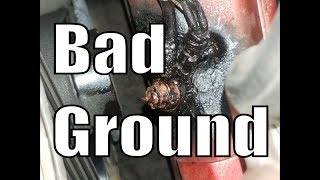
- Poor Ground Connections (Common) — The TCM requires a stable ground reference to communicate. A corroded or loose ground wire triggers a U1146 code even if all transmission components are perfectly functional. This is highly prevalent on Dodge Calibers due to severe subframe rust. 🎬 See how a bad ground causes multiple codes on Dodge vehicles.
- Low System Voltage (Common) — A weak battery or failing alternator drops system voltage below the 9.0 volts required for stable module communication during startup, instantly triggering this code.
- Software/Firmware Mismatch (Less Common) — If the transmission or TCM was recently replaced, the calibration software on the EEPROM may not match the vehicle's Powertrain Control Module (PCM). This requires reprogramming both modules together using a factory scan tool.
- Failing Transmission Control Module (TCM) (Rare) — The TCM itself occasionally fails, but this is heavily misdiagnosed. Mechanics frequently replace the expensive TCM when the actual issue is the cheaper EEPROM or a broken wire.
- Faulty Totally Integrated Power Module (TIPM) (Rare) — On Chrysler, Dodge, and Jeep vehicles, the TIPM (main fuse box) is prone to internal failure. A bad TIPM disrupts power to the TCM, causing U1146 alongside erratic electrical symptoms like random wiper or horn activation.
Symptoms

- Vehicle Enters 'Limp Mode' — The vehicle severely limits power and locks into a single gear, restricting top speed to 5-10 MPH to prevent mechanical damage.
- Check Engine Light is On — The Malfunction Indicator Lamp (MIL) illuminates immediately upon startup.
- All Dashboard Warning Lights Illuminate — Multiple warning lights (ABS, Traction Control, etc.) light up simultaneously, creating a 'Christmas tree' effect as the communication failure cascades across the vehicle's network.
- Harsh, Delayed, or No Shifting — The transmission shifts violently, hesitates, or refuses to shift out of first gear.
Diagnostic Flowchart
Tap your situation to follow the diagnostic path that matches what you're seeing on this code.
Common Fixes & Costs
- Replace External EEPROM (EROM) or Valve Body — Parts: $100-$800, Labor: $200-$500, ~3.0 hr book time (Advanced)
- Repair Damaged Wiring or Ground Connection — Parts: $10-$50, Labor: $150-$350, ~2.0 hr book time (Intermediate)
- Replace Battery or Alternator — Parts: $150-$400, Labor: $100-$250, ~1.0 hr book time (DIY)
- Replace Transmission Control Module (TCM) — Parts: $200-$900, Labor: $150-$300, ~1.5 hr book time (Professional)
- Repair or Replace Totally Integrated Power Module (TIPM) — Parts: $250-$800, Labor: $100-$250, ~1.5 hr book time (Professional)
Used vs. New Parts: Buying Guide
When a used part is worth it: A used valve body (which includes the EEPROM) from a low-mileage donor vehicle is the most cost-effective fix for older vehicles where a new $1,200 OEM part exceeds the car's value.
Donor-vehicle mileage cap: roughly under 60000 miles for the part to have meaningful remaining life.
Donor quality checklist:
- Ensure the donor vehicle was scrapped due to a collision, not a mechanical transmission failure.
- Match the valve body part number exactly to your VIN to avoid software incompatibility.
- Purchase from a salvage yard offering at least a 30-day warranty.
Decision logic:
- If The vehicle is over 10 years old and budget is tight → Install a used valve body assembly from a verified low-mileage donor.
- If You plan to keep the vehicle for 5+ more years → Invest in a professionally remanufactured valve body with a 1-year warranty.
- If You have access to a micro-soldering expert → Source a standalone EEPROM chip and solder it to the existing board for maximum savings.
Warranty tradeoff: Used parts carry a 30-day warranty, risking a repeat failure. Remanufactured valve bodies cost $300 more but include a 1-year warranty, protecting you from paying labor twice.
Worst-case if a used part fails: $800 (Cost of paying labor twice and buying a second replacement part if the used unit fails).
What Happens If You Wait — Timeline
- Immediate (First Startup): The TCM fails its startup check. The Check Engine Light illuminates, and the vehicle enters limp mode, limiting speed to 5-10 MPH. (MPG impact: 50%% · Added cost: $150 (Towing required))
- 1-5 miles of driving: Driving in limp mode forces incorrect hydraulic pressures. Internal temperatures spike, and accelerated wear begins on the clutches and valve body. (MPG impact: 50%% · Added cost: $1000 (Valve body scoring))
- 10-20 miles of driving: Extreme heat breaks down the CVT fluid. The metal push-belt begins to slip and gouge the internal pulleys, sending metal shavings throughout the system. (MPG impact: N/A (Vehicle undrivable)% · Added cost: $4000 (Complete transmission destruction))
Cost of Not Fixing It
- Immediate: The vehicle enters a 5-10 MPH limp mode, making it completely undrivable and a severe safety hazard in traffic. (Added cost: $100-$200 (Mandatory Towing))
- Short-Term (Days to Weeks): Attempting to drive in limp mode forces the transmission to operate at incorrect hydraulic pressures. This rapidly overheats the fluid and scores the valve body. (Added cost: $800-$1500 (Valve body replacement))
- Long-Term (Months): Sustained overheating and lack of lubrication causes the CVT belt to slip and shred, destroying the internal pulleys and requiring a complete transmission replacement. (Added cost: $3500-$5000 (Full transmission replacement))
Diagnosis Steps
- Read the Codes
Use an OBD-II scanner to confirm U1146. Look for related codes like P0700 (TCM fault) or P1679 (Calibration Not Learned), which confirm the TCM is online but missing its calibration data.
Tools: OBD-II Scanner (Beginner) - Check Battery and System Voltage
Measure battery voltage with the car off (12.6V) and running (13.7-14.7V). System voltage must remain between 9.0V and 16.0V during startup; anything lower will trigger communication faults.
Tools: Multimeter (Beginner) - Inspect External Wiring and Grounds
Visually inspect the wiring harness connecting to the transmission. Clean and tighten all chassis ground points, especially the main ground under the battery tray, ensuring bare-metal contact.
Tools: Flashlight, Socket Set, Wire Brush (Intermediate) - Test Specific EEPROM Circuits
Disconnect the TCM and transmission connectors. Measure the resistance of the (T313) Chip Select, (T302) Clock Select, and (T327) Data In/Out circuits end-to-end. Resistance must be under 5.0 ohms. An 'OL' reading confirms a broken wire.
Tools: Multimeter, Vehicle Wiring Diagram (Professional) - Perform a Pin-Drag Test
Use a correctly sized terminal pick to gently 'drag' through each female pin socket on the TCM connector. If a pin feels loose and lacks resistance, it is failing to make a solid connection and must be replaced.
Tools: Terminal Pick Set (Professional) - Analyze Scan Tool Live Data
Use a bi-directional scanner to monitor TCM voltage PIDs, ensuring the module receives stable power. Check 'Target secondary pressure' vs 'Actual secondary pressure'; deviations over 174 psi indicate internal hydraulic failure.
Tools: Professional Bi-Directional Scan Tool (Advanced) - Drop Pan and Test Internally
Drain the fluid and remove the transmission pan to access the valve body. Inspect the EEPROM and its micro-harness for damage. Perform continuity checks between the internal EEPROM connector and the main transmission case connector.
Tools: Socket set, drain pan, multimeter, new transmission fluid, new pan gasket (Advanced)
When This Code Triggers (Freeze-Frame Conditions)
- Fault Trigger: Ignition On (The U1146 code is a startup fault. The TCM attempts to communicate with the EEPROM as soon as the ignition is turned to the 'On' position. The code sets if communication fails for 5 seconds.)
- System Voltage: 9.0 - 16.0 Volts (If the freeze frame shows voltage below 9.0V, it confirms a weak battery or charging system issue is the primary cause of the communication failure.)
- Engine RPM: 0 RPM (If the freeze frame shows 0 RPM, it confirms the fault occurred during the initial electrical power-up sequence before the engine was even cranked.)
Related Codes
- P0700 — A generic informational code indicating the TCM has stored a fault. It always appears alongside U1146 to turn on the Check Engine Light, but does not point to a specific failure itself.
- P1679 — Means 'Calibration Not Learned'. It triggers directly because the U1146 communication loss prevents the TCM from downloading the required shift data from the EEPROM.
- U0101 — U0101 means the entire vehicle network lost contact with the TCM. U1146 means the TCM is online, but lost contact with its own internal memory chip.
- P2770, P0963, P0967 — These solenoid circuit codes appearing alongside U1146 indicate a massive systemic electrical failure, such as a severed main ground wire or a completely dead TIPM.
Climate & Environmental Factors
- High Humidity / Road Salt (Corrosion): Vehicles in the 'Salt Belt' are highly susceptible to chassis corrosion. The Dodge Caliber is notorious for severe front subframe rust, which destroys the main transmission ground point. This compromised ground causes erratic voltage drops, triggering U1146 even when the transmission is perfectly healthy.
- Extreme Cold: Extreme cold weakens marginal batteries, causing system voltage to drop below the 9.0V threshold during engine cranking. This voltage dip interrupts the TCM's startup communication sequence, instantly logging a U1146 code.
How to Talk to a Mechanic About This Code
Say this: "I have a U1146 code on my vehicle and it is in limp mode. Based on my research, this is usually an internal EEPROM failure, a wiring issue, or a bad ground, not a bad TCM. Can you start by testing the continuity of the three EEPROM communication wires and inspecting the main chassis ground?"
This proves you are an informed customer. It forces the shop to perform targeted, inexpensive electrical tests before quoting a highly profitable, unnecessary TCM or transmission replacement.
Avoid saying:
- 'My transmission is broken, fix whatever is wrong.' (Gives the shop a blank check for a $4,000 replacement.)
- 'The internet said I need a new computer.' (Leads them to replace the expensive TCM without testing the cheap wiring.)
Questions to ask before authorizing the repair:
- Did you perform a continuity test on the EEPROM wiring harness, and were the readings under 5.0 ohms?
- Did you check the TCM connector for loose or pushed-out pins?
- If replacing the valve body, does your quote include the required 'TCM Initialization' programming?
Where to Take It: Dealer vs Independent vs Chain
- Dealer:
Use only if under warranty or if you strictly need module programming. They are too expensive for the initial electrical diagnosis.
Best for: Vehicles under powertrain warranty., Performing the final 'TCM Initialization' if an independent shop lacks the software.
Downsides: Highest labor rates., Will almost always quote a full $1,500 valve body assembly rather than repairing a wire or replacing a chip. (Typical cost: +40% vs. baseline) - Independent Shop:
Best choice. A dedicated transmission or electrical shop will correctly identify the broken wire or bad EEPROM without upselling a full transmission.
Best for: Out-of-warranty vehicles., Shops specializing in automotive electrical diagnostics or transmission repair.
Downsides: May lack the $5,000 bi-directional scan tool required to program the TCM after replacing the EEPROM. (Typical cost: +0% vs. baseline) - Chain Shop:
AVOID. They will likely misdiagnose the issue or immediately recommend a complete transmission replacement.
Best for: Routine maintenance (oil, tires, brakes).
Downsides: Technicians lack the training and tools for complex CAN bus and internal transmission diagnostics. (Typical cost: -10% vs. baseline)
When to Walk Away From the Repair
If the repair cost exceeds 50% of the vehicle's private-party value, sell or trade the vehicle. For a U1146 code, this usually only applies if you ignored limp mode and destroyed the entire transmission.
- Car worth $4000, fix is $3500: Walk away. You drove in limp mode and destroyed the transmission. The repair is 87% of the car's value.
- Car worth $6000, fix is $900: Fix it. Replacing the valve body/EEPROM is only 15% of the vehicle's value and restores full functionality.
What Scan Tool You Need for This Code

Minimum: A scanner capable of reading manufacturer-specific Transmission Control Module (TCM) codes. Basic $20 engine readers will only show a generic P0700 code.
Basic readers cannot communicate with the TCM to retrieve the U1146 code, nor can they perform the mandatory 'TCM Initialization' required after replacing the EEPROM.
Budget: BlueDriver Pro (~$100) — Reads and clears the specific U1146 code from the TCM, but CANNOT perform the post-repair initialization.
Mid-range: Foxwell NT510 Elite (~$180) — The best DIY choice. Reads TCM codes, views live hydraulic pressure data, and performs the critical 'TCM Initialization' needed after replacing the valve body.
Professional: Autel MaxiCOM MK808S (~$450) — Provides full OEM-level bidirectional control, programming, and secure gateway access (AutoAuth) for newer Chrysler vehicles.
Rent vs buy: Buy the Foxwell NT510 if you plan to replace the valve body yourself. Auto parts store rental scanners cannot perform the required programming.
How to Clear the Code After You Fix It
- Perform the physical repair (replace EEPROM, fix wiring, or replace battery).
- Use a bi-directional scan tool to perform a 'TCM Initialization' if the EEPROM or valve body was replaced.
- Clear the U1146 and P0700 codes from the TCM and PCM.
- Perform a complete OBD-II drive cycle to reset readiness monitors.
Drive cycle (~30 minutes): Start with a cold engine. Idle for 3 minutes. Drive in stop-and-go city traffic for 10 minutes. Accelerate smoothly to 55 mph and hold a steady speed on the highway for 10 minutes. Coast to a stop without braking hard.
Readiness monitors affected: Comprehensive Component Monitor, Transmission Control Module Monitor
Before emissions retest: drive at least 50 miles to fully set monitors.
Watch out for:
- Failing to perform the 'TCM Initialization' after replacing the EEPROM will cause the code to return immediately, even with brand new parts.
- Attempting an emissions test immediately after clearing the code will result in an automatic failure due to 'Not Ready' monitors.
Will This Fail Emissions / State Inspection?
Yes — this code typically fails an OBD-II emissions inspection.
- California: An illuminated Check Engine Light is an automatic Smog Check failure. You must complete a full drive cycle after repairs to set all monitors to 'Ready'.
- New York: The NYVIP3 inspection fails any vehicle with an active U1146 code. For 2001+ vehicles, only one readiness monitor can be 'Not Ready' to pass.
- Texas: In emissions-testing counties, an active MIL is an automatic failure. You must clear the code and complete a drive cycle before re-testing.
Most Commonly Affected Vehicles
- Jeep Compass (2007-2017) — Extremely common on models with the Jatco CVT7 transmission due to internal EEPROM failure.
- Jeep Patriot (2007-2017) — Shares the exact same CVT and powertrain as the Compass, making it equally susceptible.
- Dodge Caliber (2007-2012) — Highly prone to this code due to both CVT EEPROM failures and severe subframe corrosion destroying ground points.
- Mitsubishi Outlander / Outlander Sport (2015-2024) — Uses a similar Jatco CVT-8 transmission. Often requires software updates to correct hydraulic calibration issues.
- Mitsubishi Lancer (2016-2017) — Subject to recalls and TSBs for transmission software updates to correct hesitation and communication faults.
- Chrysler Town & Country (2008-2016) — Triggers this code primarily due to failing TIPMs or damaged wiring harnesses.
Manufacturer-Specific Notes
- Chrysler/Dodge/Jeep: U1146 almost exclusively points to a failed EEPROM chip inside the Jatco CVT transmission. Mechanics frequently misdiagnose this as a bad TCM. Always test the EEPROM circuits before replacing external modules.
- Ford & Jaguar: On these vehicles, U1146 means 'Invalid or Missing Data for Vehicle Security'. It points to a fault in the anti-theft immobilizer network, and has absolutely nothing to do with the transmission.
- Mitsubishi: Look for recall SR-16-006 and TSB-22-23-001REV. These address CVT hesitation and shuddering via software updates, which often resolves underlying calibration communication issues.
Real Owner Stories
2008 Jeep Patriot quoted $3,500 for new transmission
Vehicle stuck in limp mode with codes P0700 and U1146. Dealership quoted $2,200 for a valve body/TCM or $3,500 for a full transmission.
Outcome: The independent shop correctly identified the internal EEPROM failure and replaced the valve body assembly for $900, saving the owner thousands.
Lesson: Never accept a full transmission replacement quote for a U1146 code without a second opinion. The fix is almost always a smaller electrical component.
2012 Jeep Compass fixed with EEPROM replacement
Dashboard lit up like a Christmas tree, vehicle in limp mode. Codes U1146 and P1679 present.
Outcome: Shop replaced the EEPROM on the side of the valve body and performed a 'TCM Initialization' with a scan tool, completely resolving the issue.
Lesson: Code P1679 confirms the EEPROM is the culprit. Replacing the chip and initializing the TCM is the definitive fix.
2007 Dodge Caliber with multiple electrical codes
Vehicle had U1146 alongside P2770, P0963, and P0967 (solenoid codes).
Outcome: Found severe subframe rust had completely severed the main transmission ground strap. Cleaning the mounting point and installing a new $15 ground strap cleared all codes.
Lesson: Multiple unrelated transmission codes point to a systemic power or ground failure. Always check grounds first, especially on Dodge Calibers.
How to Prevent This Code From Triggering
- Change CVT fluid and filters (Every 30,000-60,000 miles) — Clean fluid cools the sensitive internal EEPROM and valve body. Degraded fluid causes overheating, which melts the EEPROM's solder joints and triggers communication failures.
- Clean chassis ground connections (Every 2 years (Annually in Salt Belt regions)) — Removing ground bolts, wire-brushing the contacts to bare metal, and re-securing them prevents the voltage drops that trigger U1146 and other electrical gremlins.
- Apply dielectric grease to TCM connectors (During any under-hood electrical inspection) — Seals out moisture and prevents the microscopic connector pins from corroding and losing the tension required for stable data transmission.
Frequently Asked Questions
My mechanic says I need a new TCM, but I've heard that's often a misdiagnosis. What should I do?
This is a common, costly misdiagnosis. U1146 usually stems from the cheaper internal EEPROM chip or a wiring fault. Insist the shop tests the EEPROM circuits for continuity (under 5.0 ohms) before authorizing a TCM replacement.
Could a bad battery or ground wire really cause this transmission code?
Yes. The TCM requires a stable 9.0-16.0V supply to communicate with the EEPROM at startup. A weak battery or corroded ground introduces voltage drops that instantly trigger this code.
I just had my transmission replaced and now I have a U1146 code. What happened?
This indicates a software calibration mismatch. The replacement transmission's EEPROM data does not match your vehicle's Powertrain Control Module (PCM). A technician must use a factory-level scan tool to perform a 'TCM Initialization' to sync the modules.
What is an EEPROM and why does it fail?
EEPROM stands for Electrically Erasable Programmable Read-Only Memory. It is a small chip inside the transmission that stores critical hydraulic calibration data. Constant exposure to extreme heat, vibration, and transmission fluid eventually causes the chip or its solder joints to fail.
Why did all my dashboard warning lights turn on at once?
When the TCM loses its calibration data, it broadcasts an error over the vehicle's CAN bus network. This causes other modules, like ABS and traction control, to panic and illuminate their warning lights. Fixing the U1146 code resolves these secondary warnings.
Can a bad TIPM cause a U1146 code?
Yes, a failing Totally Integrated Power Module (TIPM) disrupts power to the TCM. If you experience U1146 alongside erratic wipers, horn, or fuel pump issues, the TIPM is the likely culprit. Replacing or rebuilding the TIPM restores proper communication.
Is replacing the EEPROM a DIY job?
Replacing the EEPROM requires draining the fluid, dropping the transmission pan, and working on the delicate valve body. If the chip requires micro-soldering, it demands specialized equipment and expertise. Tow the vehicle to a transmission specialist to avoid catastrophic damage.
Will clearing the code make it go away?
No. U1146 is a hard fault that triggers immediately upon startup when the TCM pings the EEPROM. Clearing the code only turns off the light until you cycle the ignition, at which point it instantly returns.
My mechanic quoted me thousands for a new transmission. Is that right?
A full $3,500+ transmission replacement is rarely necessary for a U1146 code. The root cause is usually a $100 EEPROM chip, a $800 valve body, or a broken wire. Always get a second opinion from a dedicated transmission shop before replacing the entire unit.
What is 'limp mode'?
Limp mode is a protective state where the computer restricts speed to 5-10 MPH and locks the transmission in a single gear. It prevents further mechanical damage when critical sensors fail. Driving in limp mode overheats the transmission and causes permanent damage.
Key Takeaways
- Code U1146 in Chrysler, Dodge, and Jeep vehicles almost always points to a failed EEPROM memory chip inside the transmission, not a faulty Transmission Control Module (TCM).
- Do not authorize a $900+ TCM replacement until a mechanic verifies resistance is under 5.0 ohms on the three specific EEPROM communication wires (T313, T302, T327).
- A weak battery dropping system voltage below 9.0V during startup triggers this code; always test the battery and alternator before opening the transmission.
- Driving with a U1146 code forces the vehicle into a 5-10 MPH limp mode, which destroys the CVT belt and pulleys within 20 miles if not towed.
Helpful Videos

The information in this article is provided for general reference and educational purposes only. Vehicle specifications, procedures, and part compatibility can vary by production date, trim level, and region. Always consult your vehicle's factory service manual and verify part numbers before purchasing or performing repairs. Safety-critical components such as airbags, seat belts, and braking systems should be installed by a qualified professional.
- 🎬 Helpful Videos
- What Does U1146 Mean?
- Can I Drive With U1146?
- Common Causes
- Symptoms
- Diagnostic Flowchart
- Common Fixes & Costs
- Used vs. New Parts: Buying Guide
- What Happens If You Wait — Timeline
- Cost of Not Fixing It
- Diagnosis Steps
- When This Code Triggers (Freeze-Frame Conditions)
- Related Codes
- Climate & Environmental Factors
- How to Talk to a Mechanic About This Code
- Where to Take It: Dealer vs Independent vs Chain
- When to Walk Away From the Repair
- What Scan Tool You Need for This Code
- How to Clear the Code After You Fix It
- Will This Fail Emissions / State Inspection?
- Most Commonly Affected Vehicles
- Manufacturer-Specific Notes
- Real Owner Stories
- 2008 Jeep Patriot quoted $3,500 for new transmission
- 2012 Jeep Compass fixed with EEPROM replacement
- 2007 Dodge Caliber with multiple electrical codes
- How to Prevent This Code From Triggering
- Frequently Asked Questions
- My mechanic says I need a new TCM, but I've heard that's often a misdiagnosis. What should I do?
- Could a bad battery or ground wire really cause this transmission code?
- I just had my transmission replaced and now I have a U1146 code. What happened?
- What is an EEPROM and why does it fail?
- Why did all my dashboard warning lights turn on at once?
- Can a bad TIPM cause a U1146 code?
- Is replacing the EEPROM a DIY job?
- Will clearing the code make it go away?
- My mechanic quoted me thousands for a new transmission. Is that right?
- What is 'limp mode'?
- Key Takeaways
- 🎟️ Get 5% Off