

U1141 on 2021 Dodge Charger: 'Lost ESP Torque Request' Causes and Fixes
On a 2021 Dodge Charger, code U1141 is almost always caused by a software glitch in the Powertrain Control Module (PCM). The fix is a software update from a Dodge dealer, as specified in Technical Service Bulletin (TSB) 18-012-22, which applies to vehicles built on or before October 14, 2021.
- U1141 on a 2021 Charger is a communication code, not a sensor failure.
- The first and most important step is to check with a Dodge dealer about TSB #18-012-22.
- The most probable solution is a simple software update, not an expensive part replacement.
- This code often appears with a large group of other 'U' codes due to the same software issue.
- Do not replace the ABS module or any other components until the software has been updated and wiring has been inspected.
What's Unique About the 2021-2021 Dodge CHARGER
For the 2021 Dodge Charger (and its platform mates, the Dodge Challenger and Chrysler 300), this code is rarely an isolated event. It is part of a well-documented software issue that causes numerous communication-loss codes to appear simultaneously. Chrysler issued Technical Service Bulletins (TSB 18-012-22 and 18-011-22) that address this specific cluster of codes with a software update for the Powertrain Control Module (PCM) on vehicles built on or before October 14, 2021. Therefore, the first diagnostic step is always to check if this software update has been performed.
Diagnostic Flowchart
Tap your situation to follow the diagnostic path that matches what you're seeing on this vehicle.
Symptoms You May Notice
- Malfunction Indicator Lamp (MIL) or Check Engine Light is on.
- ABS warning light is on.
- Traction Control/ESP warning light is on.
- Loss of cruise control functionality.
- Potential issues with transmission shifting, such as being stuck in a gear or rough shifting.
- Loss of Engine Start/Stop (ESS) functionality.
- Replacing the ABS/ESP module before checking for software updates. The TSB for this issue makes a software update the most likely fix, and an ABS module is an expensive part to replace unnecessarily.
Most Likely Causes
- Powertrain Control Module (PCM) Software Anomaly 🔴 High Probability This is a known issue documented by Dodge in TSB #18-012-22 and #18-011-22 for 2021 models built on or before October 14, 2021. The software glitch causes a flood of communication DTCs. 🎬 See how multiple communication errors often stem from one source.
How to confirm: Contact a Dodge dealership with the vehicle's VIN to see if TSB #18-012-22 or #18-011-22 is open for your vehicle. A dealer can also scan the vehicle with a wiTECH tool to check the current software calibration version.
Typical fix: Reprogramming the PCM with the latest available software. This must be done by a dealer or a qualified shop with a wiTECH scan tool. The labor time is estimated at 0.3 hours.
Est. part cost: $0 - CAN Bus Wiring Issue 🟡 Medium Probability Wiring harnesses can be susceptible to damage from chafing, corrosion, or improper routing, leading to intermittent communication loss. On some FCA platforms, the engine wiring harness can rub against the ECM/TCM bracket, upper control arm, or shock tower, causing shorts. A YouTube video shows a similar issue on a Dodge Nitro where CAN bus wires running too close to a metal pipe caused interference.
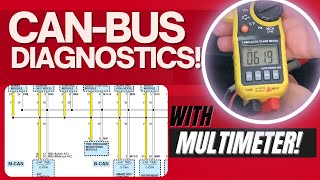
How to confirm: Visually inspect the wiring harness between the PCM and the ABS/ESP module. Check for any signs of damage, especially at points of contact with metal brackets or engine components. A multimeter can be used to check for proper resistance (typically 60 ohms) across the CAN High (Pin 6) and CAN Low (Pin 14) pins at the OBD-II port with the battery disconnected. 🎬 Watch: How to test CAN bus resistance with a multimeter.
Typical fix: Repairing the damaged section of the wiring harness. This may involve soldering, using quality heat-shrink tubing, and re-routing the harness away from chafe points with zip ties.
Est. part cost: $5-$50 - Faulty ABS/ESP Module ⚪ Low Probability
How to confirm: This should only be considered after software and wiring have been ruled out. A high-end scan tool can attempt to communicate directly with the module. If communication fails and the module has proper power and ground (check fuses first), it is likely faulty. On some Dodge vehicles, the ABS module power is supplied by a 30A fuse in the main fuse box.
Typical fix: Replace the ABS/ESP module and have it programmed to the vehicle. This programming is critical and usually requires dealer-level tools.
Est. part cost: $400-$1200 - Low Battery Voltage / Failing Alternator ⚪ Low Probability Modern vehicles with complex electronic modules are highly sensitive to system voltage. A weak battery or failing alternator can cause modules to drop off the network and generate a cascade of communication codes.
How to confirm: Test the battery voltage with a multimeter. A healthy battery should read approximately 12.6 volts with the engine off and above 13.5 volts with the engine running. A Reddit thread about a 2014 Charger with multiple communication codes pointed to a bad battery/alternator as a possible cause.
Typical fix: Replace the battery and/or alternator.
Est. part cost: $150-$700
Rare But Worth Checking
- Failing Powertrain Control Module (PCM): While the software is the most common PCM-related issue, an internal hardware failure of the module itself can cause similar communication faults. This is rare and should be the last item to consider after all other diagnostics have failed.
Diagnosis Steps
- Check with a Dodge dealer using your VIN to determine if TSB #18-012-22 or #18-011-22 is applicable and outstanding for your vehicle. This is the most important first step for any 2021 model built on or before October 14, 2021.
- If the TSB applies, have the dealer perform the PCM software update. The procedure requires a wiTECH scan tool and a stable battery voltage between 13.2 and 13.5 volts.
- If the TSB does not apply or the update has already been performed, scan all vehicle modules for other DTCs. Pay close attention to other 'U' codes which can help pinpoint the failing module or network segment.
- Test the battery and charging system. Ensure battery voltage is ~12.6V engine off and >13.5V engine running. Low voltage can cause random communication faults.
- Perform a thorough visual inspection of the wiring harness and connectors between the Powertrain Control Module (PCM) and the ABS/ESP module. Look for any signs of chafing, melting, corrosion, or physical damage, especially near the ECM/TCM bracket, control arms, and shock towers.
- If wiring appears intact, test the CAN bus network integrity. With the battery disconnected, measure the resistance between Pin 6 (CAN-H) and Pin 14 (CAN-L) on the OBD-II connector. A healthy network should read approximately 60 ohms. A reading of 120 ohms suggests a missing terminating resistor or a break in the circuit.
- If network resistance is correct, check for power and ground at the ABS module connector. A missing power supply, often from a blown fuse, will take the module offline.
- If all wiring, software, and power/grounds are confirmed to be good, the final step is to suspect a faulty module, most likely the ABS/ESP module or, rarely, the PCM. This requires advanced diagnostics to confirm.
Parts You'll Likely Need
- No Parts Needed - Software Update — The most common fix for this code on this specific vehicle is a PCM software reflash performed by a dealer, as per TSB 18-012-22.
OEM price range: $0
Aftermarket price range: $0 - ABS Control Module
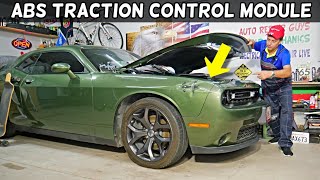
(OEM #68435852AF, 68258644AA, 68399772AF)— If software and wiring are ruled out, the ABS module (which contains the ESP controller) may have an internal fault preventing it from communicating. This is a less common cause. Part number varies by vehicle options. 🎬 Watch: How to locate the ABS module and pump.
Trusted brands: Mopar
OEM price range: $250-$600
Aftermarket price range: $400-$800
Related Codes That Often Appear With This One
- U0101 — Lost Communication With TCM. Part of the same software issue described in TSB 18-011-22.
- U110A — Lost Communication With SCM-CAN-C. Part of the same software issue described in TSB 18-012-22.
- U1110 — Lost Vehicle Speed Message. Part of the same software issue described in TSB 18-012-22.
- U1120 — Lost Wheel Distance Message. Part of the same software issue described in TSB 18-012-22.
- U1186 — Lost Communication With Adaptive Cruise Control Module. Part of the same software issue described in TSB 18-012-22.
- U11BC — Lost Brake Switch Message. Part of the same software issue described in TSB 18-012-22.
- U11C2 — Lost Transmission Message. Part of the same software issue described in TSB 18-012-22.
- U0416 — Implausible Data Received From ESP. Also listed in TSB 18-011-22 as part of the same software fault.
Technical Service Bulletins (TSBs) & Recalls
- Bulletin #18-012-22: The primary TSB for the 2021 Charger with 5.7L or 6.4L engines. Addresses U1141 and a host of other communication codes by reprogramming the PCM with updated software.
- Bulletin #18-011-22: A parallel TSB for the 2021 Dodge Challenger with the 3.6L V6 engine, covering the exact same list of communication code
Platform-Specific Known Issues
- A significant number of 2021 Dodge Chargers are affected by a software condition that can cause the Malfunction Indicator Lamp to illuminate and set multiple 'U' codes, including U1141. This is officially documented in Dodge's TSB #18-012-22 and #18-011-22, which provides a software update as the solution for vehicles built on or before October 14, 2021.
Mechanic-Grade Diagnostic Values
- CAN C Bus Voltage (Key On, Engine Off) — expected: CAN High (Pin 6 at DLC): ~2.6 Volts. CAN Low (Pin 14 at DLC): ~2.4 Volts.. Failure: Voltages that are stuck high (e.g., above 4.0V), stuck low, or equal to each other indicate a short or open in the harness.
- CAN Bus Network Resistance (Battery Disconnected) — expected: ~60 Ohms between Pin 6 and Pin 14 of the OBD-II port.. Failure: A reading of 120 Ohms indicates one of the two terminating resistors (usually in the PCM and ABS module) is offline or there's a break in the circuit. A reading near 0 Ohms indicates a short between the CAN High and CAN Low wires.
- ABS Module Power Supply (at module connector) — expected: Battery voltage (~12.6V) at the main power pins of the ABS module connector with the key on.. Failure: No voltage indicates a blown fuse (check underhood fuse box) or an open wire between the fuse box and the module.
- ABS Module Ground (at module connector) — expected: Near 0 Ohms of resistance between the ground pins on the ABS module connector and a known good chassis ground.. Failure: High or infinite resistance (OL) indicates a broken or corroded ground wire or a bad ground point connection.
Scan Tool Commands That Help
- wiTECH (Dealer Tool): ABS Initialization / Proxi Alignment — This is required after replacing the ABS module to write the vehicle's VIN and configuration data to the new module. It ensures the new module can communicate correctly with other systems like the PCM and BCM.
- wiTECH (Dealer Tool): Brake Pedal Calibration / Longitudinal G-Sensor Calibration — After flashing or replacing the ABS module, these routines must be run to recalibrate the sensors used by the ESP system. Failure to do so can result in incorrect operation and further fault codes.
- AlfaOBD (Advanced Aftermarket): ABS Initialization — Similar to the wiTECH function, AlfaOBD can be used to program a new or used ABS module to the vehicle, a critical step after replacement.
- wiTECH / AlfaOBD: Network Review / Topology — To get a high-level view of the vehicle's communication network. Modules that are not communicating or have faults will be highlighted (often in red), helping to quickly identify the source of a network-wide problem.
Wiring & Ground Locations
- ABS Module / Pump Assembly — Located in the engine bay on the driver's side, near the windshield washer fluid reservoir.. This is the physical location of the ESP module. All power, ground, and communication wires for the system terminate here, making its connector a primary test point.
- STAR Connector (CAN Bus Junction) — On many Dodge platforms, these are located behind the driver's side dash, sometimes accessible after removing the light switch panel. They look like small blocks with multiple pairs of twisted wires plugged in. The CAN C (powertrain) connector is often green.. This is a central junction for the CAN C bus. A technician can disconnect individual branches of the network here to isolate a module that might be causing a network-wide fault without having to access each module individually.
- Vehicle System Interface Module (VSIM) — For Charger Pursuit models, this is located under the left side of the instrument panel.. This module integrates aftermarket police equipment with the vehicle's CAN C data bus. Improperly installed equipment connected to this module can cause communication faults on the network.
OEM Part Supersession History
68435852AA, 68435852AB, 68435852AC, 68435852AD, 68435852AE→68435852AF— Standard part revision and improvement over model years.
Heads up: While the part number applies to multiple years, programming via wiTECH or AlfaOBD is required for the module to function with the specific vehicle's VIN and options.
Model Year Variations Within This Range
- 2021: The most significant variation is the build date. Vehicles built on or before October 14, 2021, are subject to TSB 18-012-22, which calls for a PCM software update as the primary fix. For vehicles built after this date, the TSB does not apply, and diagnosis should focus on traditional causes like wiring or module failure.
Helpful Videos

We Have This Part in Stock



The information in this article is provided for general reference and educational purposes only. Vehicle specifications, procedures, and part compatibility can vary by production date, trim level, and region. Always consult your vehicle's factory service manual and verify part numbers before purchasing or performing repairs. Safety-critical components such as airbags, seat belts, and braking systems should be installed by a qualified professional.
- Dodge CHARGER:
- 🎬 Helpful Videos
- 🛍️ Shop This Part
- What's Unique About the 2021-2021 Dodge CHARGER
- Diagnostic Flowchart
- Symptoms You May Notice
- Most Likely Causes
- Rare But Worth Checking
- Diagnosis Steps
- Parts You'll Likely Need
- Related Codes That Often Appear With This One
- Technical Service Bulletins (TSBs) & Recalls
- Platform-Specific Known Issues
- Mechanic-Grade Diagnostic Values
- Scan Tool Commands That Help
- Wiring & Ground Locations
- OEM Part Supersession History
- Model Year Variations Within This Range
- 🎟️ Get 5% Off