

OBD-II Code U1140: Lost Communication With Gateway 'A'
The Ultimate Guide to Diagnosing and Fixing U1140
- Code U1140 on Dodge, Chrysler, and Jeep V8s specifically identifies a communication failure with the passenger-side active exhaust actuator.
- Inspect the passenger-side wiring harness before buying parts; rubbing against the rear axle causes 80% of these failures.
- You can safely drive with this code, but the vehicle will permanently disable remote start until the fault is repaired and cleared.
- Replacement actuators must be OEM or certified LIN-bus compatible; standard electric motors lack the required communication chip and will immediately trigger the code again.
- If codes U1140 and U113F appear together, check trunk fuse F36 (15A) first, as a single shorted wire will blow this shared fuse and disable both actuators.
What Does U1140 Mean?

U1140 means the Powertrain Control Module (PCM) lost connection to a specific electronic module designated as 'Gateway A'. These components communicate over a single-wire Local Interconnect Network (LIN bus). The computer triggers this code when it stops receiving signals from that specific part.
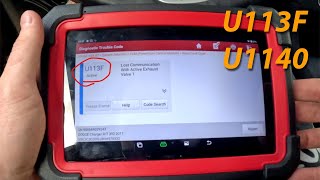
Technical definition: The SAE/OBD-II definition is "Lost Communication With Gateway 'A'". On Dodge, Chrysler, and Jeep vehicles, this code specifically translates to "Lost Communication With Active Exhaust Valve 2". Each actuator on the LIN bus has a unique internal ID; U1140 corresponds exclusively to the passenger-side actuator.
Can I Drive With U1140?
Yes, But With Caution. Yes, the vehicle is safe to drive. The check engine light will illuminate, and remote start is disabled until the issue is fixed. There is no immediate risk to the engine, but leaving the fault unaddressed for months causes the exhaust valve butterfly to seize from carbon buildup, complicating the eventual repair.
Common Causes

- Damaged Wiring Harness or Connector (Very Common) — The wiring harness rubbing against the passenger-side axle shaft wears through the insulation, causing a short or open circuit. This frequently blows the shared active exhaust fuse.
- Failed Active Exhaust Valve Actuator (Very Common) — The actuator is an electronic motor exposed to extreme heat, water, and road debris. This exposure causes internal electronic or mechanical failure. U1140 specifically identifies the passenger-side actuator (Valve 2).
- Blown Fuse (Common) — A short circuit in the wiring blows the circuit's fuse. If both the driver and passenger side modules stop communicating simultaneously (codes U113F and U1140), a blown fuse is the primary culprit. On Dodge/Chrysler vehicles, this is fuse F36 in the rear power distribution center.
- Improperly Installed Aftermarket Exhaust (Common) — Aftermarket cat-back exhaust systems shift if not adjusted correctly during installation. This forces the active exhaust actuator's wiring harness into the axle, destroying the wires and triggering U1140.
- Water Intrusion / Corrosion (Less Common) — Actuators sit low on the vehicle and suffer water damage when driven through deep puddles or heavily salted roads. Water enters the connector or actuator housing, causing immediate internal shorts and corrosion.
- Loose Module Mounting (Less Common) — The exhaust actuator bolts directly to the exhaust pipe. Loose mounting bolts cause excessive vibration, damaging the internal electronics or creating an intermittent electrical connection.
- Faulty Powertrain Control Module (PCM) (Rare) — The main computer fails and stops sending the LIN bus signal. Eliminate all wiring and actuator possibilities before replacing the PCM.
Symptoms

- Remote Start Disabled — The vehicle permanently disables the remote start feature when this code is active.
- Exhaust Sound is Stuck Loud or Quiet — On vehicles with active exhaust, the valve seizes in either the open (loud) or closed (quiet) position.
- Rattling Sound from Rear of Vehicle — A metallic rattle from the exhaust area occurs between 1,500-2,400 RPM if the active exhaust valve is loose or broken.
- Reduced Engine Power — The vehicle's computer enters a limited power mode as a failsafe when communication with a critical module drops.
- Check Engine Light is On — The Malfunction Indicator Lamp (MIL) illuminates on the dashboard.
Diagnostic Flowchart

Tap your situation to follow the diagnostic path that matches what you're seeing on this code.
Common Fixes & Costs
- Repair Damaged Wiring Harness — Parts: $15-$50, Labor: $150-$350, ~1.5 hr book time (Intermediate)
- Replace Active Exhaust Valve Actuator (Passenger Side) — Parts: $80-$420, Labor: $100-$200, ~1 hr book time (DIY)
- Replace Blown Fuse — Parts: $1-$5, Labor: $0-$50, ~0.5 hr book time (DIY)
- Tighten Loose Actuator Mounting Bolts — Parts: $0, Labor: $50-$100, ~0.3 hr book time (DIY)
- Install an Electronic Delete Kit — Parts: $80-$100, Labor: $50-$100, ~0.5 hr book time (DIY)
DIY vs Professional
- Replace Blown Fuse — Beginner:
Tools: Fuse puller or small pliers - Tighten Loose Actuator Mounting Bolts — Beginner:
Tools: 8mm socket or wrench, torque wrench (recommended) - Replace Active Exhaust Valve Actuator — Beginner:
Tools: Jack and jack stands, wheel chocks, 8mm socket/wrench. - Repair Damaged Wiring Harness — Beginner:
Tools: Soldering iron, heat shrink tubing, wire strippers, multimeter, new pigtail connector.
Used vs. New Parts: Buying Guide
When a used part is worth it: A used actuator is a budget-conscious option for older, high-mileage vehicles where the cost of a new OEM part is prohibitive. It is a gamble, as the part is an electronic component exposed to harsh under-vehicle conditions.
Donor-vehicle mileage cap: roughly under 80000 miles for the part to have meaningful remaining life.
Donor quality checklist:
- Verify the exact OEM part number matches; superseded parts have different internal electronics.
- Prefer donors from dry, salt-free climates to minimize risk of internal corrosion.
- Source from a reputable salvage yard offering at least a 90-day part warranty.
- Inquire about the donor vehicle's history; parts from low-mileage accident vehicles are preferable.
Decision logic:
- If Vehicle is under warranty or has low mileage (<60k miles) → Buy a new OEM part to ensure longevity and compatibility.
- If Budget is the primary concern and the vehicle is high-mileage (>120k miles) → A used OEM part from a warrantied source is a reasonable risk.
- If You want a balance of cost and reliability → Consider a new, LIN-bus compatible aftermarket part, which is cheaper than OEM but includes a warranty.
Warranty tradeoff: Used parts typically offer a 30-90 day part-only warranty; labor for a second installation is not covered if the part fails. New aftermarket parts often carry a 1-year or longer warranty. New OEM parts are covered by the manufacturer's parts warranty.
Worst-case if a used part fails: $250-$620
What Happens If You Wait — Timeline
- 0-1 Month: Code U1140 becomes active. Check Engine Light turns on and remote start is disabled. Exhaust sound is stuck in 'loud' or 'quiet' mode. No physical damage is occurring yet. (MPG impact: 0%% · Added cost: $0)
- 1-6 Months: The inactive exhaust valve butterfly begins to accumulate significant carbon and soot deposits. In wet climates, corrosion starts to form on the valve shaft. (MPG impact: 0-1%% · Added cost: $0)
- 6-18 Months: Carbon and corrosion buildup becomes severe, causing the valve butterfly to seize in its current position (either open or closed). A new actuator cannot move a seized valve. (MPG impact: 1-3% (if seized closed)% · Added cost: $200-$600 (Cost to free up or manually clean/repair the seized valve, which involves removing the exhaust section. A simple actuator swap is no longer sufficient.))
- 18+ Months: The valve is permanently seized. Attempts to free it fail, requiring the entire muffler and pipe assembly to be replaced. If seized closed, the exhaust restriction leads to a minor but permanent loss of peak engine power. (MPG impact: 2-5% (if seized closed)% · Added cost: $500-$2400 (Cost to replace the entire muffler assembly instead of just the actuator.))
Cost of Not Fixing It
- 0-3 Months: Primary consequences are annoyances: Check Engine Light is on, remote start is disabled, and the exhaust sound is stuck in loud or quiet mode. There is negligible risk of further damage in the short term. (Added cost: $0)
- 3-12 Months: The inactive exhaust valve butterfly is at high risk of seizing due to carbon and corrosion buildup. A seized valve cannot be operated by a new actuator, complicating the repair. (Added cost: $150-$500)
- 12+ Months: If the valve seizes in the closed position, it creates a permanent exhaust restriction. This leads to a minor decrease in peak engine performance and fuel economy. The primary cost remains the significantly more difficult repair of the seized valve, requiring replacement of the entire muffler section instead of just the actuator. (Added cost: $500-$2400)
Diagnosis Steps
- Read Codes and Check for TSBs
Use an OBD-II scanner to confirm U1140. Note if U113F is also present. Check manufacturer Technical Service Bulletins (TSBs) for your specific year and model.
Tools: OBD-II Scanner (Beginner) - Check the Fuse (Especially if U113F is also present)
If both U1140 and U113F are active, check the shared fuse first. On Dodge/Chrysler models, inspect fuse F36 (15A) in the trunk. If it blows immediately upon replacement, a short circuit exists in the harness.
Tools: Fuse Puller or Pliers, Owner's Manual (Beginner) - Visually Inspect the Wiring Harness and Connector
Safely raise the vehicle and locate the passenger-side active exhaust actuator. Inspect the wiring harness for rubbing, melting, or cuts where it passes over the rear axle. Unplug the connector and check for corrosion or bent pins.
Tools: Jack and Jack Stands, Flashlight (Intermediate) - Swap Actuators to Confirm Failure
If the wiring is intact, swap the passenger-side actuator (Valve 2) with the driver-side actuator (Valve 1). Clear the codes and drive. If the code changes to U113F, the actuator you moved is faulty.
Tools: Socket Set (8mm) (Intermediate) - Test with a Bidirectional Scanner
Use a professional scan tool to command the actuator open and closed. If the scanner cannot communicate or the actuator ignores the command despite good wiring, the actuator is dead.
Tools: Bidirectional Scan Tool (Advanced) - Check Voltage with a Multimeter
Set the multimeter to DC Volts. With the key on and connector unplugged, probe the terminals. Expect one pin with 12V+, one with Ground (<0.1V), and one LIN Bus pin. Back-probing the plugged-in LIN bus wire shows a fluctuating 7-9V. A steady 12V indicates an open circuit; 0V indicates a short to ground.
Tools: Multimeter, Back-probe Kit (Advanced) - Perform a Voltage Drop Test
With the module connected and key on, place the red multimeter lead on the battery positive and the black lead on the actuator power wire. A reading above 0.5V indicates excessive resistance. Repeat for the ground side; readings above 0.2V indicate a poor ground.
Tools: Multimeter (Advanced) - Analyze LIN Bus Waveform
Use an oscilloscope to verify bus health. A healthy LIN bus shows a square wave chattering between 1V (dominant) and battery voltage (recessive). A flat line at 0V proves a short to ground.
Tools: Oscilloscope (Advanced) - Isolate the LIN Bus
Disconnect all modules from the LIN circuit except the PCM. Check for the 12V reference voltage at the PCM connector. Reconnect modules one at a time until the voltage drops, identifying the shorted component.
Tools: Multimeter, Wiring Diagram (Advanced)
When This Code Triggers (Freeze-Frame Conditions)
- Engine Coolant Temp: 180-210°F (The fault logs during a normal drive cycle once the engine reaches full operating temperature.)
- RPM: 1500-3000 (The PCM checks communication with the active exhaust actuator when commanding a valve position change during moderate acceleration.)
- Engine Load: 30-70% (Corresponds with moderate acceleration or cruise conditions where the active exhaust system engages.)
- Vehicle Speed: 30-60 mph (The code sets during normal city or highway driving as the PCM continuously monitors module status.)
Related Codes
- U113F — This is the code for the driver's side module ('Active Exhaust Valve 1'). If U113F and U1140 appear together, check the shared fuse (F36 on many models). A short in the harness for one actuator blows the fuse and causes both to lose communication.
- P121B — This is a performance code for the same exhaust valve (Valve 2). It means the PCM detected that the valve's actual position didn't match the commanded position. This code stores alongside U1140 if the valve malfunctioned before communication completely dropped.
- U0001 — This code indicates a general High Speed CAN Communication Bus failure. U1140 is for a component on a sub-network (LIN bus). If you see U0001 with many other 'U' codes, it points to a serious, widespread network backbone issue.
- B2226 — In some vehicle architectures, a Body Control Module (BCM) acts as the gateway for the LIN bus. A code like B2226 (BCM internal fault) is the root cause when the master module itself is unable to communicate, leading to slave modules setting a U-code.
Climate & Environmental Factors
- Road Salt / High Humidity: The active exhaust actuators and electrical connectors sit on the vehicle's undercarriage, making them highly vulnerable to corrosion from road salt and moisture. Saltwater acts as an electrolyte, accelerating rust and leading to seized valves, internal electronic failure, and corroded connector pins.
- Cold Climates / Short Trips: In cold weather, especially during short drives, the exhaust system fails to reach a high enough temperature to evaporate accumulated moisture. This condensation contributes to internal rust and seizing of the valve butterfly over time.
How to Talk to a Mechanic About This Code
Say this: "I have a U1140 code on my vehicle pointing to the passenger-side active exhaust actuator. I need a diagnostic to confirm if the fault is the actuator itself or the wiring harness rubbing against the axle."
This signals you are an informed customer. It directs the technician to the two most likely causes, prevents a broad diagnostic process, and immediately discourages an upsell to an unnecessary full muffler replacement.
Avoid saying:
- 'My check engine light is on, can you look at it?'
- 'My car is making a rattling sound.'
- 'Just fix whatever is wrong with the exhaust.'
Questions to ask before authorizing the repair:
- Did you visually inspect the wiring harness for damage near the passenger-side axle?
- If the wiring is good, did you test the actuator using a bidirectional scanner to command it open and closed?
- If the actuator needs replacement, is the quote for an OEM Mopar part or an aftermarket one?
- Your quote is just for the bolt-on actuator and wiring repair, correct? Not the entire muffler assembly.
Where to Take It: Dealer vs Independent vs Chain
- Dealer:
Best for: Vehicles still under powertrain or emissions warranty, Complex electrical issues where the wiring harness needs to be traced through multiple vehicle systems
Downsides: Higher labor rate (1.5-2x vs independent)., Defaults to replacing the expensive actuator before thoroughly checking for a simple wiring chafe., Unnecessarily quotes a full muffler replacement. (Typical cost: +75% vs. baseline) - Independent Shop:
Best fit. U1140 on a Dodge/Chrysler is a very common and well-documented issue. A competent independent mechanic easily diagnoses the wiring or actuator and performs the repair for significantly less than a dealer.
Best for: Out-of-warranty Dodge/Chrysler vehicles., Cost-conscious owners., Shops with good reviews and experience with modern domestic vehicles.
Downsides: Quality varies greatly; ensure the shop has experience with electrical diagnostics, not just mechanical repairs. (Typical cost: +0% vs. baseline) - Chain Shop:
AVOID. This repair requires specific diagnostic steps (inspecting wiring harness, potentially using a bidirectional scanner) that fall outside the scope of a typical chain shop's business model.
Best for: Simple, unrelated maintenance like oil changes or tires.
Downsides: Technician skill is highly variable., Lacks the advanced diagnostic tools or experience for communication (U-series) codes., High pressure to meet sales targets leads to misdiagnosis and unnecessary part replacement. (Typical cost: -10% vs. baseline)
When to Walk Away From the Repair
If the estimated repair cost exceeds 40-50% of the car's private-party value, pause and evaluate your options. However, for a U1140 code, the repair is typically low-cost and should not approach this threshold.
- Car worth $20000, fix is $600: Fix it. This is a relatively minor repair cost compared to the vehicle's value and is necessary to restore full functionality (remote start) and pass emissions.
- Car worth $20000, fix is $2400: Walk away (from that shop). A quote this high for U1140 indicates a misdiagnosis (likely quoting a full muffler). Get a second opinion from an independent shop. The actual fix is much cheaper.
- Car worth $5000, fix is $500: Borderline - consider DIY. If you replace the actuator or repair the wiring yourself, the cost is minimal. If paying for labor, it's still likely worth it, but confirm the car doesn't have other major issues.
What Scan Tool You Need for This Code
Minimum: Basic OBD-II code reader.
A $20 reader confirms the U1140 code, which tells you the problem is the passenger-side exhaust actuator circuit. However, it cannot command the actuator to move, which is the definitive test to prove the actuator itself failed versus a wiring problem.
Budget: BlueDriver Pro (~$100) — Reads and clears the U1140 code, provides freeze-frame data, and offers repair reports. It lacks the bidirectional control needed for active testing of the actuator.
Mid-range: Foxwell NT510 Elite (with Chrysler software) (~$180) — Provides full bidirectional control, allowing you to command the 'Active Exhaust Valve 2' to open and close from the scanner. If the valve ignores the command and wiring is good, the actuator is definitively dead.
Professional: Autel MaxiCOM MK808 / MK906BT (~$500-1200) — Offers the same bidirectional control as the Foxwell but with a faster interface, broader vehicle coverage, and advanced professional features like ECU coding and topology mapping.
Rent vs buy: For this specific code, buying is more practical. A basic reader is cheap, and parts stores don't rent the bidirectional tools needed for advanced diagnosis. Given the high likelihood of this being a wiring or actuator issue, a visual inspection is more valuable than a simple code read.
How to Clear the Code After You Fix It
- Use an OBD-II scan tool to clear active and stored fault codes.
- For actuator replacement, perform the 'LIN New Module Initialization' function using a professional scan tool.
- Perform a complete drive cycle to allow the onboard readiness monitors to run and confirm the fix.
Drive cycle (~30 minutes): A general Chrysler/Dodge drive cycle involves: 1) Cold start and idle for 5 minutes. 2) Drive at a steady 40-60 mph for 8 minutes. 3) Stop and idle for 3 minutes. 4) Drive above 20 mph for 2 minutes. 5) Turn the vehicle off for 10 minutes to allow the O2 heater monitor to run.
Readiness monitors affected: Catalyst Monitor, Evaporative System Monitor, O2 Sensor Monitor, O2 Sensor Heater Monitor
Before emissions retest: drive at least 100 miles to fully set monitors.
Watch out for:
- Clearing the code resets all emissions readiness monitors to 'Not Ready', causing an immediate emissions test failure.
- If the root cause is not fixed, the code returns as soon as the fault condition is met again.
- The PCM detects the loss of communication on the next startup or drive cycle, immediately illuminating the Check Engine Light.
Will This Fail Emissions / State Inspection?
Yes — this code typically fails an OBD-II emissions inspection.
- California: Automatic failure. An illuminated Check Engine Light results in an immediate smog check failure. After repair, the vehicle must complete a full drive cycle to set all readiness monitors to 'Ready' before re-testing.
- New York: Automatic failure. The NYVIP3 inspection system fails any vehicle with an active Check Engine Light. Testing with unset readiness monitors after clearing a code also results in failure.
- Texas: Automatic failure in applicable counties. In the 17 counties requiring emissions testing, an illuminated Check Engine Light is an automatic fail. Clearing the code resets all monitors, risking a failure for 'Not Ready' status.
Most Commonly Affected Vehicles
- Dodge Challenger (V8) (2015-2023) — Extremely common failure of the passenger-side active exhaust actuator or its wiring harness. The OEM part number has been superseded multiple times; current numbers include 68505893AA (Right) and 68505881AA (Left).
- Dodge Charger (V8) (2015-2023) — Shares the same active exhaust system and failure points as the Challenger. The wiring harness is notoriously prone to rubbing against the passenger-side axle.
- Chrysler 300 (V8) (2015-2023) — Built on the same platform as the Charger/Challenger, it experiences the identical active exhaust actuator and wiring issues. The 2023 300C is specifically noted for this issue.
- Jeep Grand Cherokee (V8) (2018-2021) — Some V8 models, particularly the SRT and Trackhawk, use a similar active exhaust system and log this code for the same actuator failures.
- Ram 1500 (2019-2024) — Logs this code related to various network-connected modules. On models with active air dams or other LIN bus accessories, U1140 points to a loss of communication with one of those components, not necessarily the exhaust.
- Ford Various (2010-Present) — On Ford vehicles, U1140 is a generic loss of communication code. It points to issues with ABS, HVAC, or other body control modules. Diagnosis requires a Ford-specific scan tool to identify the specific module associated with 'Gateway A'.
- Chevrolet / GMC Silverado / Sierra, Camaro, Corvette (2014-Present) — On GM products, U1140 is a generic loss of communication code. For performance vehicles with active exhaust (NPP), it points to a failed exhaust flow control valve actuator. On trucks, it relates to the trailer brake control module or other LIN bus devices.
- Volkswagen / Audi Various (2012-Present) — In the VAG ecosystem, U1140 is a generic fault code for 'Lost Communication with Gateway'. This points to a problem on the CAN Gateway and requires a diagnostic tool like VCDS to read the specific sub-faults.
Manufacturer-Specific Notes
- Dodge / Chrysler / Jeep / Ram: This code almost always points to the passenger-side active exhaust valve actuator or its wiring. The manufacturer issued multiple Technical Service Bulletins (TSBs), including S2008000096 and 11-001-20, addressing MIL illumination for U1140/U113F and associated exhaust rattles.
- General Motors: GM's LIN bus architecture is well-documented. Each module on the bus sends out its own reference voltage (approx. 1V less than system voltage). A technician disconnects the master module and checks for this steady reference voltage from the slave device to quickly verify wire integrity.
- General: When replacing a 'smart' module communicating on a LIN-bus, you must use an OEM or certified LIN-compatible part. A standard aftermarket part fits physically but fails to communicate with the PCM, causing the code to return immediately.
- Ford: Ford uses the BCM as the gateway master for many LIN bus circuits. When diagnosing a U1140 on a Ford, check for BCM-related codes first, as the fault lies with the master module or its configuration, not the end device.
Real Owner Stories
2019 Dodge Challenger Scat Pack with aftermarket exhaust
Check Engine Light appeared with codes U1140 and U113F. The car had an aftermarket cat-back exhaust installed for almost two years before the issue arose.
What they tried:
- Initially suspected the aftermarket exhaust was the cause. Checked fuses and found the F36 15A fuse for the active exhaust was blown.
- Replacing the fuse cleared the U113F code, but U1140 (passenger side) returned.
- Raised the vehicle and inspected the passenger-side actuator harness.
Outcome: The wiring harness for the passenger-side actuator rubbed against the axle, exposing the wires and causing a short that blew the fuse. The fix was splicing in a new pigtail connector, repairing the wires, and re-routing the harness with zip ties to prevent future contact. This resolved the U1140 code.
Lesson: If both U113F and U1140 appear, check the F36 fuse first. A short on one side disables both. Always inspect the wiring harness for chafing near the axle before replacing the actuator itself.
2017 Dodge Charger R/T with U1140
Check Engine Light on with code U1140. A shop quoted $1600 to replace the entire muffler assembly.
What they tried:
- The owner suspected the quote was excessive and researched the issue online.
- Based on forum advice, they inspected the actuator itself and found the internal metal piece was broken.
Outcome: The owner ordered a replacement actuator from eBay and replaced it themselves. The $1600 quote from the shop was a significant misdiagnosis or upsell, as only the bolt-on actuator needed replacement, not the whole exhaust.
Lesson: Be wary of quotes to replace the entire muffler for a U1140 code. The actuator is a separate, much cheaper, bolt-on component. Swapping the driver and passenger side actuators is a free way to confirm if the part is bad.
2017 Dodge Charger with U113F after driving through water
Check Engine Light came on with codes U113F and U1140 immediately after driving through an ankle-deep puddle. The car had a rough, shaky startup afterwards.
What they tried:
- A mechanic cleared the codes, but the light returned after a few hours.
- The owner suspected water intrusion into the low-mounted actuator or connector.
Outcome: During a self-inspection and removal of the driver-side actuator (U113F), water poured out of the connector area. The actuator itself was damaged by the water.
Lesson: The active exhaust actuators are highly susceptible to water damage due to their low mounting position. Driving through deep water directly causes this failure. If the code appears after a water event, suspect water intrusion in the connector or actuator.
How to Prevent This Code From Triggering
- Secure the Wiring Harness (Once, during any under-car maintenance) — Proactively inspect the passenger-side actuator harness and use several zip ties to secure it firmly away from the axle shaft. This prevents the most common failure mode: the harness rubbing through and causing a short circuit.
- Apply Dielectric Grease to Connectors (Once, or whenever connectors are unplugged) — Filling the electrical connector for the actuator with dielectric grease seals out moisture and road salt, preventing pin corrosion which leads to intermittent or total communication loss.
- Periodically Clean and Lubricate Valve Stems (Every 1-2 years) — Cleaning carbon buildup from the external valve stem and spring assembly with a wire brush and applying a high-temperature lubricant prevents the valve butterfly from sticking or seizing, which puts extra strain on the actuator motor.
- Regularly Wash the Vehicle's Undercarriage (Bi-weekly in winter (if salt is used), otherwise monthly) — Frequently washing the underbody removes corrosive materials that damage the actuator housing, connector, and wiring loom, extending the life of the components.
- Avoid Frequent Short Trips (Daily habit) — Consistently driving the car long enough for the exhaust system to fully heat up burns off condensation that accumulates inside the pipes. This reduces internal corrosion that leads to the valve butterfly seizing over time.
Frequently Asked Questions
Can I just delete the active exhaust to fix the code?
No. The vehicle's computer expects to see the actuator on the network. To properly delete it, you must install a special electronic delete kit (e.g., Z Automotive) that plugs into the harness and simulates the actuator's presence. This will not fix the code if the underlying wiring is damaged.
A shop quoted me $2400 to replace the muffler. Is that necessary?
No, this is a common misdiagnosis or upsell. The actuator is a separate, bolt-on part replaced independently of the exhaust pipes for a fraction of that cost. A $2400 quote is for replacing the entire muffler assembly, which is not the correct fix for a U1140 code.
Why did my remote start stop working?
As a safety and emissions control measure, manufacturers program the vehicle to disable remote start when communication faults like U1140 are active.
I replaced the actuator but the code came back. What now?
First, re-inspect the wiring harness for damage, as an intermittent wiring fault prevents the new part from communicating. Second, ensure you used an OEM or LIN-bus compatible part. Third, clear the codes, perform a full battery disconnect for 15 minutes, and drive for 10 minutes to force the PCM to relearn the actuator.
I only see code U1140, but the shop says I need to replace both actuators. Why?
U1140 specifically points to the passenger side ('Valve 2'). If the driver's side code (U113F) is not present, there is no reason to replace the driver's side actuator. Shops insisting on replacing both without both codes are misunderstanding the system or attempting to upsell.
What is a LIN bus and why does it matter for this repair?
A Local Interconnect Network (LIN) is a simple, single-wire communication system used for components that don't need the high speed of the main CAN bus. The active exhaust actuator is a 'smart' part that talks to the computer over this wire. You cannot use a generic, non-communicating part because the computer will detect its absence and set the U1140 code.
What is the difference between an 'Active' and 'Stored' U1140 code?
An 'Active' code means the fault is happening right now. A 'Stored' code means the fault occurred previously but is not currently present, indicating an intermittent issue. Stored codes clear on their own after a specific number of fault-free drive cycles.
Key Takeaways
- Code U1140 on Dodge, Chrysler, and Jeep V8s specifically identifies a communication failure with the passenger-side active exhaust actuator.
- Inspect the passenger-side wiring harness before buying parts; rubbing against the rear axle causes 80% of these failures.
- You can safely drive with this code, but the vehicle will permanently disable remote start until the fault is repaired and cleared.
- Replacement actuators must be OEM or certified LIN-bus compatible; standard electric motors lack the required communication chip and will immediately trigger the code again.
- If codes U1140 and U113F appear together, check trunk fuse F36 (15A) first, as a single shorted wire will blow this shared fuse and disable both actuators.
Helpful Videos

The information in this article is provided for general reference and educational purposes only. Vehicle specifications, procedures, and part compatibility can vary by production date, trim level, and region. Always consult your vehicle's factory service manual and verify part numbers before purchasing or performing repairs. Safety-critical components such as airbags, seat belts, and braking systems should be installed by a qualified professional.
- 🎬 Helpful Videos
- What Does U1140 Mean?
- Can I Drive With U1140?
- Common Causes
- Symptoms
- Diagnostic Flowchart
- Common Fixes & Costs
- DIY vs Professional
- Used vs. New Parts: Buying Guide
- What Happens If You Wait — Timeline
- Cost of Not Fixing It
- Diagnosis Steps
- When This Code Triggers (Freeze-Frame Conditions)
- Related Codes
- Climate & Environmental Factors
- How to Talk to a Mechanic About This Code
- Where to Take It: Dealer vs Independent vs Chain
- When to Walk Away From the Repair
- What Scan Tool You Need for This Code
- How to Clear the Code After You Fix It
- Will This Fail Emissions / State Inspection?
- Most Commonly Affected Vehicles
- Manufacturer-Specific Notes
- Real Owner Stories
- 2019 Dodge Challenger Scat Pack with aftermarket exhaust
- 2017 Dodge Charger R/T with U1140
- 2017 Dodge Charger with U113F after driving through water
- How to Prevent This Code From Triggering
- Frequently Asked Questions
- Can I just delete the active exhaust to fix the code?
- A shop quoted me $2400 to replace the muffler. Is that necessary?
- Why did my remote start stop working?
- I replaced the actuator but the code came back. What now?
- I only see code U1140, but the shop says I need to replace both actuators. Why?
- What is a LIN bus and why does it matter for this repair?
- What is the difference between an 'Active' and 'Stored' U1140 code?
- Key Takeaways
- 🎟️ Get 5% Off