

U1120 on 2021 Dodge Charger: Causes and Fixes for 'Lost Wheel Distance Message'
On a 2021 Dodge Charger, code U1120 means 'Lost Wheel Distance Message,' indicating a communication failure with the ABS module. This is often caused by a faulty ABS module, damaged wiring, or a poor connection, and will disable safety systems like ABS and traction control. Professional diagnosis is recommended as it requires specialized tools to check the CAN bus network.
- U1120 is a network communication code, not a simple sensor fault. It means the 'Lost Wheel Distance Message' from the ABS module is not being received.
- This fault will disable safety systems like ABS, Traction Control, and Stability Control.
- The most common causes are a failed ABS module or damaged wiring/connector to the module.
- Diagnosis is complex and requires tools that can read CAN bus communication; professional service is strongly recommended.
- Always check for other 'U' codes. A cluster of them (like U1110 and U0121) confirms a network problem centered around the ABS system.
What's Unique About the 2021-2021 Dodge CHARGER

On the modern Dodge Charger (LD platform) and its relatives like the Chrysler 300 and Dodge Challenger, numerous vehicle systems are deeply integrated and rely on shared data from the CAN bus network. A single communication failure like U1120 🎬 Watch: A quick breakdown of what the U1120 code means. can cause a cascade of warning lights and system shutdowns, including ABS, traction control, stability control, and even a no-crank condition. Unlike a simple sensor fault, this code points to a more complex network or module issue that requires a systematic diagnostic approach, often starting with checking for communication with the ABS module itself.
Diagnostic Flowchart
Tap your situation to follow the diagnostic path that matches what you're seeing on this vehicle.
Symptoms You May Notice
- ABS warning light is on.
- Traction Control (ESC/BAS) warning light is on.
- Check Engine Light is on.
- Brake warning light is on.
- Cruise control is inoperative.
- Speedometer does not work or is inaccurate.
- Odometer is inoperative.
- Vehicle may enter 'limp mode' with reduced power.
- In some cases, a no-start or no-crank condition, especially if the ABS module failure pulls down the entire CAN network.
- Blower fan for climate control may stop working.
- Replacing wheel speed sensors. While a faulty wheel speed sensor can cause ABS issues, the U1120 code specifically points to a loss of the entire calculated message from the module, not just bad input from one sensor. Diagnosing other ABS-related codes first is recommended.
Most Likely Causes

- Faulty ABS Control Module 🔴 High Probability The ABS module on this platform is a known point of failure, often due to internal electronic faults or failed solder joints that prevent it from communicating on the CAN network. This can be an intermittent failure at first.
How to confirm: Using a high-end scan tool, attempt to communicate directly with the ABS module. If communication fails (the module appears 'red' or 'offline' in a network topology view) and power/ground circuits are verified as good, the module is likely faulty. Unplugging the module may restore communication with other modules or even allow the car to start if it was causing a no-crank.
Typical fix: Replace the ABS control module and perform the necessary initialization and programming procedures (like VIN programming and a 'Proxy Alignment') with a compatible scan tool. Alternatively, the original module can be sent to a specialist for repair and rebuilding, which avoids programming issues.
Est. part cost: $400-$1200 - Damaged Wiring or Corroded Connector 🟡 Medium Probability Wiring harnesses, particularly in the driver-side front wheel well area, are susceptible to damage from road debris, moisture, and chafing against chassis components. The main connector at the ABS module itself can also suffer from corrosion, bent, or disintegrated pins, sometimes to the point of complete failure.
How to confirm: Visually inspect the wiring harness and connector going to the ABS module for any signs of physical damage, corrosion, or bent pins. In severe cases, the connector may fall apart upon removal. Check for continuity and resistance on the CAN C bus wires (often a twisted pair of wires) between the ABS module and the gateway or Star Connector.
Typical fix: Repair the damaged section of the wiring harness or replace the connector pigtail. In a documented case on a Dodge Ram, road debris pierced the wheel well liner and broke wires at the connector, causing U1110 and U1120.
Est. part cost: $20-$200 - Low Battery Voltage or Poor Connection ⚪ Low Probability Sensitive electronic modules on Chrysler/Dodge vehicles are known to malfunction and set communication codes when system voltage is low or unstable. This can happen due to a weak battery or a poor ground connection.
How to confirm: Test the battery's state of charge and health. Ensure battery terminals and main ground connections are clean and tight. A simple reset by disconnecting the battery may temporarily clear the code, but it will likely return if the underlying voltage issue isn't fixed.
Typical fix: Charge or replace the battery and clean all primary power and ground connections.
Est. part cost: $150-$350 - Missing or Blown Fuse ⚪ Low Probability While not common, a blown fuse for the ABS module will cut power and prevent it from communicating, triggering this code.
How to confirm: Check the vehicle's fuse box (Totally Integrated Power Module or TIPM) for the fuse that powers the ABS module. On similar year Chargers, fuses F5 (40A) and F6 (30A) in the front fuse box are for the stability/ABS system. In one documented case on a similar platform, a blown fuse for the ABS module was the sole cause of a U0121 no-communication code.
Typical fix: Replace the blown or missing fuse. If the fuse blows again, there is a short circuit in the power wire to the ABS module that must be diagnosed.
Est. part cost: $1-$10
Rare But Worth Checking
- Faulty Powertrain Control Module (PCM): While less common, the receiving module (PCM) can fail in a way that it cannot process the incoming message, even if the message is being sent correctly by the ABS module. This is usually diagnosed after all other possibilities, including the ABS module and wiring, are eliminated.
- PCM Software Glitch: TSB #18-012-22 indicates that for 2021 Chargers with the 3.6L engine built on or before October 14, 2021, a PCM software update may be required to fix a condition where numerous communication DTCs, including U1120, are set. A dealer can verify if this update is applicable and perform the flash.
Diagnosis Steps
- Connect a high-end bidirectional scan tool and perform a full vehicle scan. Note all modules that are reporting communication loss codes.
- Check the network topology view on the scan tool. A red or offline ABS module is a strong indicator of the problem area.
- Attempt to communicate directly with the ABS module. If there is no communication, proceed to check its power and ground circuits.
- Check the fuses for the ABS/Stability Control module in the main fuse box under the hood. Specifically, check fuses F5 and F6.
- Using a multimeter, verify that the ABS module connector has proper battery voltage and a solid ground connection. A possible ground location is designated G105.
- If power and ground are good, visually and physically inspect the ABS module connector and wiring harness for physical damage, corrosion, or bent/broken pins. The connector itself can disintegrate.
- Test the CAN bus wiring. With the battery disconnected, check for resistance between the CAN High and CAN Low wires at the diagnostic port or module connector. Resistance should be approximately 60 ohms if the network is intact. If it's 120 ohms, there's a break in the circuit or a terminating module is unplugged/faulty.
- As a test, try unplugging the ABS module connector and see if the vehicle starts or if communication is restored with other modules. If so, the ABS module is very likely faulty and pulling the network down.
- If wiring, power, and ground are all confirmed to be good, the ABS module is the most likely cause of the failure.
- If the ABS module is communicating but the code persists, check for applicable software updates like TSB #18-012-22, especially on 3.6L models. If no updates are available, the fault may lie within the module's internal logic or with the receiving module (e.g., PCM).
Parts You'll Likely Need
- ABS Control Module
(OEM #68435852AF, 68258644AA, 68399772AF, P68290444AA)— This module is the most common point of failure for this code. It calculates and sends the wheel distance message, and internal failure will stop this communication. Part numbers vary significantly by trim and options (e.g., adaptive cruise control).
Trusted brands: Mopar
OEM price range: $180-$900
Aftermarket price range: $200-$800 (Remanufactured) - ABS Module Connector Pigtail — If the connector itself is damaged by corrosion, heat, or physical impact, it must be replaced to ensure a solid connection to the new module. In some cases, the entire engine harness may be recommended by the dealer.
Trusted brands: Mopar, Dorman
OEM price range: $50-$150
Aftermarket price range: $30-$80
Related Codes That Often Appear With This One
- U1110 — This code means 'Lost Vehicle Speed Message,' which is also generated by the ABS module. It frequently appears with U1120 as both messages are lost simultaneously when the module goes offline.
- U0121 — This code means 'Lost Communication With Anti-Lock Brake System Module.' It is a more general code indicating the ABS module is offline and is a strong indicator that the ABS module itself, its power/ground, or its wiring is the root cause.
- U110A — Lost Communication With SCM-CAN-C. The provided TSB #1801222 lists this code alongside U1120, indicating a broader network communication issue that can be related to a PCM software update.
- U1141 — Lost ESP Torque Request Message. Also listed in TSB #1801222, this points to a failure in the stability control system communication, which is housed in the ABS module.
Technical Service Bulletins (TSBs) & Recalls
- 1801222: This TSB for 2021 Dodge Chargers lists U1120 - Lost Wheel Distance Message among a group of potential communication fault codes that may be addressed by a PCM software update, confirming its definition for this vehicle.
Platform-Specific Known Issues
- A known issue on some Dodge/Chrysler vehicles involves the CAN bus wiring harness chafing against hot or sharp components, like coolant pipes behind the engine, leading to short circuits.
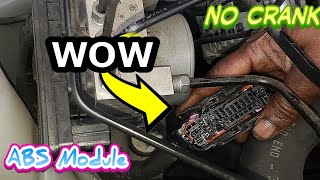
- Corrosion and bent/disintegrated pins at the main ABS module connector have been documented, sometimes causing a no-start condition by disrupting the entire CAN network. A mechanic on YouTube demonstrated this failure on a Dodge Challenger where the connector fell apart upon removal.
- Road debris can penetrate the plastic wheel well liner and physically damage the wiring harness or connector leading to the ABS module.
Mechanic-Grade Diagnostic Values
- CAN Bus Network Resistance — expected: ~60 Ω (Ohms). Failure: A reading of ~120 Ω indicates an open circuit or one of the two terminating resistors is offline. A reading significantly lower than 60 Ω suggests a short between the CAN high and low wires.
- CAN Bus Short to Ground — expected: No continuity (Open Line / OL). Failure: Any continuity reading between either the CAN High or CAN Low line and a known good chassis ground indicates a short to ground.
- CAN Bus Short to Voltage — expected: 0 Volts. Failure: Any voltage reading between either the CAN High or CAN Low line and a known good chassis ground (with the network asleep) indicates a short to a power source.
Scan Tool Commands That Help

- wiTECH, AlfaOBD, Appcar DiagFCA: Proxy Alignment (or Proxi Configuration) — This procedure is required after replacing a CAN bus module, such as the ABS module. It synchronizes the vehicle's configuration across all modules on the network. Failure to perform a proxy alignment will often result in a flashing odometer and persistent communication codes.
- wiTECH: Flash Powertrain Control Module (PCM) — Used to apply software updates from the manufacturer. For this specific code, TSB #18-012-22 directs technicians to reprogram the PCM with the latest software on certain 2021 Chargers to resolve a list of communication DTCs, including U1120.
- High-End Bidirectional Scanner: Network Topology View — This provides a visual map of all vehicle modules and their communication status. It is one of the first and most effective ways to quickly identify which module is offline (often shown in red), pointing directly to the source of a 'Lost Communication' code.
Wiring & Ground Locations

- Star Connector / Gateway Connector — On 2020 and newer Chargers, it is located on the passenger side, under the glove box area. It's a block with multiple green connectors plugged into it.. This is the central hub for the CAN C and IHS bus networks. A technician can disconnect individual modules from the network at this single point to isolate which one is pulling the bus down and causing communication failures.
- ABS Module Fuses — In the fuse box under the front hood. For 2015-2021 models, these are typically identified as FUSE #5 (40A) and FUSE #6 (30A).. These fuses provide the main power to the ABS module. If either is blown or missing, the module will be completely offline and cannot communicate, directly causing U1120 and U0121 codes.
- ABS Module Location — Under the hood on the driver's side, near the windshield washer reservoir. It is identifiable by the multiple rigid brake lines running into the valve block and the attached electronic module.. This is the physical location for visual inspection of the module, its connector, and the surrounding wiring harness for damage or corrosion.
- G105 (Ground) — A forum post for a similar platform identifies a ground point near the driver's side front of the vehicle as G105, suggesting it serves the ABS module.. A poor ground connection at this point would prevent the ABS module from operating correctly and could cause communication codes. Verifying this ground is clean and tight is a key diagnostic step.
Real Owner Repair Stories
- YouTube channel 'Online Mechanic Tips' (Dodge/Chrysler vehicle (specific model not stated, but platform is consistent)) — No crank, no start. Multiple communication codes including U0129, U11BC, U1110, and U1120. Scan tool showed the ABS module was offline ('red' in topology).
❌ Tried (didn't work) Owner had already replaced the battery.
✅ What actually fixed it The technician unplugged the ABS module connector and found it had completely disintegrated. The plastic was brittle, and pins were bent and corroded. The root cause was a failed connector, which was pulling the entire CAN bus network down. Replacing the connector pigtail was the required fix. - YouTube channel 'Back40 Bandit' (Dodge Ram 1500 HEMI) — ABS light on, codes U1110 and U1120 present.
❌ Tried (didn't work) Initial code scan and visual checks.
✅ What actually fixed it A close inspection of the driver's side front wheel well revealed that road debris had pierced the plastic liner and struck the ABS module's wiring harness connector, breaking some of the wires. The physical damage to the harness was the direct cause of the lost communication. Repairing the broken wires resolved the codes.
OEM Part Supersession History
68435852AA, 68435852AB, 68435852AC, 68435852AD, 68435852AE→68435852AF— Part revisions for improved reliability or manufacturing changes.
Heads up: While the latest part (AF) is generally backward compatible for the specified vehicles, it is critical to verify the correct part number for the vehicle's specific options (e.g., with or without adaptive cruise control) as different hardware is used.
Model Year Variations Within This Range
- 2021: Per TSB #18-012-22, vehicles built on or before October 14, 2021, equipped with the 3.6L engine, may have a PCM software vulnerability that can cause a wide range of communication codes, including U1120. Vehicles built after this date or with different engines would not be subject to this specific software fix.
Helpful Videos


We Have This Part in Stock



The information in this article is provided for general reference and educational purposes only. Vehicle specifications, procedures, and part compatibility can vary by production date, trim level, and region. Always consult your vehicle's factory service manual and verify part numbers before purchasing or performing repairs. Safety-critical components such as airbags, seat belts, and braking systems should be installed by a qualified professional.
- Dodge CHARGER:
- 🎬 Helpful Videos
- 🛍️ Shop This Part
- What's Unique About the 2021-2021 Dodge CHARGER
- Diagnostic Flowchart
- Symptoms You May Notice
- Most Likely Causes
- Rare But Worth Checking
- Diagnosis Steps
- Parts You'll Likely Need
- Related Codes That Often Appear With This One
- Technical Service Bulletins (TSBs) & Recalls
- Platform-Specific Known Issues
- Mechanic-Grade Diagnostic Values
- Scan Tool Commands That Help
- Wiring & Ground Locations
- Real Owner Repair Stories
- OEM Part Supersession History
- Model Year Variations Within This Range
- 🎟️ Get 5% Off