

OBD-II Code U1116: Lost Communication With A Vehicle Module
What U1116 means, why it triggers, and how to fix it
- On 2011-2019 Hyundai and Kia hybrids or EVs, U1116 almost exclusively points to a failed Electric Water Pump (EWP) requiring a $600-$1,300 replacement.
- Driving a hybrid with U1116 forces the vehicle into a reduced-power limp mode to prevent a catastrophic $3,000+ hybrid inverter meltdown.
- On Ford vehicles using the older J1850 network, a weak 12V battery dropping below 12.4V triggers this code by disrupting electrical energy management data.
- On Citroën C5 (X7) models, U1116 specifically flags a hydropneumatic suspension ECU (BHI) failure, often fixed by cleaning corroded connector pins.
- Never replace the module named in the scan tool definition without first verifying its power, ground, and 60-ohm CAN bus resistance.
What Does U1116 Mean?

U1116 is a network communication code indicating a specific computer module in your car is not talking to the other modules. Your car contains dozens of computers (modules) controlling the engine, hybrid system, airbags, and accessories. They communicate over a network like a CAN bus. This code triggers when one module goes silent, halting the exchange of critical data.
Technical definition: The SAE/OBD-II definition for U1116 varies strictly by manufacturer. For Hyundai/Kia, it means 'Lost Communication With Motor Electronics Coolant Pump'. For Ford, it means 'SCP (J1850) Invalid or Missing Data for Electrical Energy Management'. For Chrysler, it indicates 'Window Washer Motor 1 Control Circuit High'. For Citroën, it flags 'Suspension ECU data not valid fault'. In all cases, it signifies a failure on the vehicle's communication network where expected data from a specific module is missing.
Can I Drive With U1116?
Yes, But With Caution. You can drive, but with significant caution and for a limited time. On Hyundai/Kia hybrids, a failed water pump forces the vehicle into a reduced-power 'limp mode' to prevent hybrid inverter overheating. Continuing to drive risks permanent inverter damage, a repair costing over $3,000. The gasoline engine runs continuously. In other vehicles, losing communication with a critical module disables power steering, causes stalling, or prevents restarting, posing a direct safety risk.
Common Causes

- Faulty Electric Water Pump (EWP) in Hybrid/EV Models (Very Common) — On Hyundai and Kia hybrid and electric vehicles, this is the primary cause. The electric water pump cooling the hybrid components fails internally when coolant leaks into the electronics, permanently severing its network connection.
- Wiring Harness or Connector Damage (Common) — Communication networks rely on physical wires. Chafed insulation, corroded connector pins, loose grounds, or rodent damage break the circuit. This physical disconnect is a leading cause for all U-codes across all manufacturers.
- Faulty Control Module (Common) — The specific module named in the manufacturer's definition (like the EWP or Citroën's BHI) or a central gateway module like Chrysler's Totally Integrated Power Module (TIPM) has suffered an internal hardware failure and died.
- Low Battery Voltage or Faulty Alternator (Less Common) — Communication networks require stable 12V power. A dying battery or failing alternator drops system voltage below operating thresholds, causing random communication dropouts and triggering a flood of U-codes, especially on Ford J1850 systems. 🎬 Watch how a failing alternator triggers charging system warnings on Fords.
- Blown Control Module Fuse (Less Common) — Each module relies on one or more fuses. A blown fuse completely cuts power to the module, instantly taking it offline. Always check both main maxi-fuses and smaller secondary electronics fuses.
- Improperly Installed Aftermarket Accessories (Less Common) — Aftermarket stereos, remote starters, or alarms spliced incorrectly into the CAN bus inject electrical noise or flood the network with garbage data, crashing communication between factory modules.
- Software Glitch or Failed Initialization (Rare) — A software bug within a module halts communication. This occurs after an interrupted over-the-air update or if a newly replaced module was not properly programmed and initialized to the vehicle's security network.
Symptoms

- Check Engine Light or Hybrid System Warning Light — An illuminated warning light on the dashboard, such as the Check Engine Light, a wrench symbol, or a specific 'Hybrid System Warning' message.
- Vehicle Enters Reduced Power 'Limp Mode' — Affected hybrid/EV models display 'Hybrid System Warning! Safely stop and Do Not Drive' and severely limit speed to prevent inverter overheating. Conventional vehicles do this if a critical powertrain module drops offline.
- Gasoline Engine Stays On (in Hybrids) — When the hybrid cooling pump fails, the vehicle forces the gasoline engine to run continuously and disables EV mode to prevent electrical component meltdown.
- Vehicle Won't Start or Shuts Down While Driving — If a critical module like the Powertrain Control Module (PCM) or Body Control Module (BCM) loses communication, the vehicle shuts down in motion or refuses to crank.
- Malfunctioning Features — Specific features tied to the offline module stop working. For example, the radio dies, power steering gets heavy, or on Citroën C5s, the hydropneumatic suspension refuses to raise or lower.
- Lost Communication with a Specific Module (scan-tool only — no driver-felt sign) — A professional scan tool reveals a specific module (e.g., 'Motor Electronics Coolant Pump') is completely unresponsive to diagnostic pings.
Diagnostic Flowchart
Tap your situation to follow the diagnostic path that matches what you're seeing on this code.
Common Fixes & Costs
- Replace the Electric Water Pump (EWP) — Parts: $300 - $900, Labor: $300 - $600, ~2.5 hr book time (Intermediate)
- Repair or Replace Damaged Wiring/Connectors — Parts: $10 - $50, Labor: $150 - $500, ~3.5 hr book time (Professional)
- Replace a Faulty Control Module (e.g., TIPM, BCM, BHI) — Parts: $300 - $1000, Labor: $150 - $400, ~2 hr book time (Professional)
- Replace a Blown Fuse — Parts: $1 - $5, Labor: $0 - $50, ~0.1 hr book time (DIY)
- Module Software Update / Re-flash — Parts: $0, Labor: $150 - $250, ~1 hr book time (Professional)
Used vs. New Parts: Buying Guide
When a used part is worth it: For the common Hyundai/Kia Electric Water Pump (EWP), buying a used part is strongly discouraged. These pumps fail due to internal coolant leakage, a wear-and-tear issue. A used pump has an unknown history and will likely fail soon after installation.
Donor-vehicle mileage cap: roughly under 40000 miles for the part to have meaningful remaining life.
Donor quality checklist:
- Verify the exact part number matches; there are many variations.
- Avoid parts with any signs of coolant crust (pink or blue residue) or corrosion on the electrical connector.
- Prefer donors from dry climates to minimize the risk of corrosion.
Decision logic:
- If The part is a critical electronic component like an EWP or control module. → Buy a new OEM or high-quality aftermarket part. The risk of premature failure and repeated labor costs with a used part is too high.
- If Vehicle is over 10 years old and the new part cost exceeds 25% of the vehicle's value. → A low-mileage used part from a reputable salvage yard with a warranty is a reasonable gamble.
- If The failure is a known wear item (like an EWP). → Strongly favor new. A used part has the same wear and is close to failure itself.
Warranty tradeoff: Used parts typically offer a 30-90 day warranty covering only the part, not the labor. New aftermarket parts offer a 1-year to limited lifetime warranty. New OEM parts carry a 1-year manufacturer warranty if installed by a dealer.
Worst-case if a used part fails: $500 - $1200 (If a used EWP fails, you pay for the replacement part and 2-3 hours of labor a second time.)
What Happens If You Wait — Timeline
- 0-1 month: Code U1116 sets. On Hyundai/Kia hybrids, the 'Hybrid System Warning' light appears, and the vehicle enters 'limp mode'. The gas engine runs constantly to protect the hybrid system. No permanent damage has occurred yet. (MPG impact: 25-40% (decrease, due to gas engine running constantly)% · Added cost: $0)
- 1-3 months: Continued driving with a failed EWP causes the hybrid inverter to repeatedly overheat. Thermal stress weakens internal solder joints and power transistors. Limp mode events become more frequent. (MPG impact: 25-40% (decrease)% · Added cost: $150-$300 (for diagnostic costs as symptoms worsen))
- 3-6 months: The hybrid inverter fails permanently due to cumulative thermal damage. The vehicle shuts down while driving, refuses to start, and displays a constant 'Hybrid System Failure' message. (MPG impact: 100% (vehicle becomes undriveable)% · Added cost: $2,500 - $4,000+)
- 6+ months: Catastrophic failure of the hybrid inverter is complete. This failure cascades, damaging components within the high-voltage battery pack. The initial $1,000 EWP repair escalates into a $10,000+ total system replacement. (MPG impact: 100% (vehicle is inoperative)% · Added cost: $4,000 - $10,136+)
Cost of Not Fixing It
- Immediate: On Hyundai/Kia hybrids, the vehicle enters 'limp mode,' severely limiting power and speed. On other vehicles, critical features like power steering disable, or the vehicle refuses to start. (Added cost: 0)
- 0-1 month: Continued driving with a failed hybrid electric water pump causes the hybrid inverter to repeatedly overheat, weakening internal components and causing intermittent performance issues. (Added cost: $200 - $500 (for diagnostic costs as new symptoms appear))
- 1-6 months: Permanent failure of the hybrid inverter due to repeated overheating renders the hybrid system inoperative. On conventional cars, a critical module offline leads to a no-start condition requiring a tow. (Added cost: $2500 - $4000+ (for inverter replacement and labor))
Diagnosis Steps

- Read All Trouble Codes from All Modules
Use a professional-level OBD-II scanner to access all vehicle modules (ABS, BCM, Hybrid Controller). Record all codes. Identify which modules report 'Lost Communication' and which modules are completely unresponsive to the scanner.
Tools: Professional OBD-II Scanner (Beginner) - Check the Battery and Charging System
Ensure the battery is fully charged. Use a multimeter to verify battery voltage is ~12.6V with the engine off and alternator output is 13.7-14.7V with the engine running. Low voltage causes network-wide communication errors.
Tools: Multimeter (Beginner) - Perform a Visual Inspection
Inspect the module suspected of failing. Look for corroded battery terminals, loose ground straps, and damaged wiring harnesses. On Hyundai/Kia hybrids, check the Electric Water Pump connector for pink or blue coolant crust.
Tools: Flashlight (Beginner) - Check Fuses
Locate the fuse boxes using your owner's manual. Find and inspect the fuses providing power to the non-communicating module. Check both main power fuses and secondary electronics fuses.
Tools: Fuse puller or needle-nose pliers (Intermediate) - Check for Power and Ground at the Module
If fuses are good, verify power and ground reach the module. Unplug the module's connector. Use a multimeter to test for battery voltage at the power pins and near 0 ohms resistance to chassis ground at the ground pins.
Tools: Multimeter, vehicle-specific wiring diagram (Advanced) - Test the CAN Bus Network Wires (Resistance)
Disconnect the battery. At the OBD-II port, measure resistance between CAN-H (Pin 6) and CAN-L (Pin 14). A healthy network reads 60 ohms. A reading of 120 ohms indicates an open circuit; near 0 ohms indicates a short circuit.
Tools: Multimeter, vehicle-specific wiring diagram (Advanced) - ADVANCED: Test CAN Bus Voltages
Reconnect the battery and turn the ignition ON (engine off). Check voltages at the OBD-II port. A healthy, idle bus shows ~2.5V on both CAN High (Pin 6) and CAN Low (Pin 14). Voltages outside this range indicate a short to power or ground.
Tools: Multimeter (Advanced) - PRO TIP: Isolate and Test Terminating Resistors
If your CAN bus resistance is 120 ohms, one terminating module is offline. Identify the two terminating modules using a wiring diagram. Disconnect one and recheck resistance. If it stays at 120 ohms, the fault lies in the other half of the circuit.
Tools: Multimeter, vehicle-specific wiring diagram (Professional) - PRO TIP: Perform a Network Voltage Drop Test
To ensure the module has sufficient power under load, back-probe the power and ground wires with the module plugged in and ignition on. A voltage drop exceeding 0.5 volts indicates high circuit resistance requiring repair.
Tools: Multimeter (with back-probe pins), wiring diagram (Professional) - PRO TIP: Analyze CAN Signal with an Oscilloscope
Use an oscilloscope to view the CAN High and CAN Low signals. A healthy signal shows clean, sharp square waves that are mirror images. Distorted or noisy waveforms indicate a short, a faulty transceiver, or external interference.
Tools: Automotive Oscilloscope, wiring diagram (Professional)
When This Code Triggers (Freeze-Frame Conditions)
- Module Voltage: 13.5 - 14.5V (Engine running, fault logged during normal operation.)
- Engine Coolant Temp: 185-210°F (85-99°C) (Vehicle at normal operating temperature when the communication loss was detected.)
- Vehicle Speed: 0 - 65 mph (Communication faults occur at any speed, from key-on to highway driving.)
- Engine RPM: 700 - 2500 RPM (The fault logs at idle or during steady-state cruise.)
Related Codes
- U1118 — On Hyundai/Kia EVs, U1116 refers to the 'Motor Electronics Coolant Pump', while U1118 refers to the 'Battery Coolant Pump'. TSB SA394 dictates replacing the specific pump named, or both if both codes are present.
- P0A93 — Means 'Inverter 'A' Cooling System Performance'. U1116 is the cause (lost communication with the pump), and P0A93 is the effect (inverter overheating). Seeing them together guarantees a failed EWP on a hybrid.
- U0100 — Generic code for 'Lost Communication With ECM/PCM'. Paired with U1116, it points to a widespread network problem like a main CAN bus backbone failure or a power/ground issue affecting multiple modules.
- U0140 — Means 'Lost Communication With Body Control Module (BCM)'. The BCM acts as the central gateway. If U0140 is present with U1116, the BCM itself or its power supply is the primary suspect.
Climate & Environmental Factors
- High Humidity and Moisture: Moisture is the primary catalyst for connector corrosion. Water ingress into non-sealed connectors oxidizes metal pins, increasing resistance and disrupting communication signals.
- Road Salt: Saline spray from winter roads is highly corrosive to electrical connectors, wiring, and ground points located on the undercarriage, accelerating degradation far beyond simple moisture.
- Extreme Temperatures: Repeated hot and cold cycles cause plastic connector housings and wire insulation to become brittle and crack, creating entry points for moisture and loosening metal contacts.
How to Talk to a Mechanic About This Code
Say this: "I have a U1116 communication code and I'd like to schedule a diagnostic. I need you to identify the specific module that is offline and test its power, ground, and network wiring before recommending a module replacement. Please authorize one hour of diagnostic time to start."
This signals you understand U1116 is a network fault, not necessarily a bad part. It directs the technician to find the root cause (wiring, power, or the module itself) and prevents them from replacing the most likely part without confirmation.
Avoid saying:
- 'My check engine light is on, can you look at it?'
- 'Just fix the U1116 code.'
- 'My car is in limp mode, just replace the water pump.' (On a Hyundai/Kia)
Questions to ask before authorizing the repair:
- Did you verify good power and ground at the module's connector?
- What were the results of the CAN bus resistance and voltage tests?
- Can you show me the damaged wiring or the failed test result condemning this part?
- Does the new module require programming, and is that included in the quote?
- Will the old parts be returned to me?
Where to Take It: Dealer vs Independent vs Chain
- Dealer:
Recommended, especially for warranty work or if module programming is required. They have access to up-to-date service information and specific tools.
Best for: Vehicles under warranty or covered by a specific TSB/service campaign (like Hyundai/Kia EWP or Chrysler TIPM)., Complex electrical issues on European brands (BMW, Citroën)., Repairs requiring module programming with proprietary software.
Downsides: Highest labor rates., Defaults to expensive module replacement without exhausting wiring diagnostics. (Typical cost: +50% vs. baseline) - Independent Shop:
Good fit, IF you find a well-equipped shop with strong electrical diagnostic skills. Ask if they have experience with CAN bus troubleshooting.
Best for: Out-of-warranty vehicles where the cause is a known issue (e.g., Hyundai EWP)., Diagnosing common wiring or connector failures.
Downsides: Diagnostic capabilities vary greatly. Must find a shop specializing in electrical or your specific brand., Lacks expensive, manufacturer-specific programming tools. (Typical cost: +0% vs. baseline) - Chain Shop:
AVOID for diagnosing a U1116 code. They are not equipped for complex electrical work.
Best for: Checking and replacing the battery if suspected to be the cause of multiple U-codes.
Downsides: Technicians are not equipped or trained for complex network diagnostics., High pressure to sell parts leads to misdiagnosis (e.g., selling an alternator when the issue is a bad ground). (Typical cost: -10% vs. baseline)
When to Walk Away From the Repair
If the estimated repair cost exceeds 50% of the car's private-party value, seriously consider selling or trading in the vehicle instead of repairing it.
- Car worth $6000, fix is $1100: Fix it. The repair cost for a common issue like an EWP replacement is well below the 50% threshold.
- Car worth $5000, fix is $3500: Walk away. If continued driving has damaged the hybrid inverter, the repair cost is over 50% of the car's value.
- Car worth $2000, fix is $1200: Borderline. The cost is at the 50% threshold. Consider the car's overall condition and any other needed repairs before proceeding.
What Scan Tool You Need for This Code

Minimum: A scanner that reads codes from ALL vehicle modules (ABS, SRS, BCM, Hybrid Controller), not just the engine computer (ECU).
A $20 generic code reader only talks to the engine computer. U1116 is a network code set by other modules. Without a full system scan, you cannot identify which module is offline, making diagnosis impossible.
Budget: BlueDriver Pro (~$100) — Performs a full system scan to read codes from all modules. It shows which module reports the U1116 and if other modules lost communication with it, which is the essential first step.
Mid-range: Foxwell NT510 Elite / NT530 (~$200) — Provides full system scanning and adds bidirectional controls. This allows you to command a specific module (like a pump) to turn on, testing if the module is functional before replacing it.
Professional: Autel MaxiCOM MK808 / ThinkCar 689BT (~$400-600) — Offers extensive bidirectional controls across most vehicle systems. You can perform active tests, view live data streams from the network, and perform service functions necessary after a repair.
Rent vs buy: For a one-time U1116 diagnosis, renting is impractical as parts stores only rent basic code readers. You must buy a budget pick capable of an all-system scan. For serious DIY work, invest in a mid-range tool with bidirectional controls.
How to Clear the Code After You Fix It
- Reconnect battery if disconnected for repair.
- Use a professional-level OBD-II scan tool to clear the U1116 code from all modules.
- Perform a complete OBD-II drive cycle to allow readiness monitors to run.
Drive cycle (~30 minutes): Start with a cold engine (sit for 8+ hours). Idle for 2-3 minutes with electrical loads on (A/C, defroster). Drive for 15 minutes in mixed city/stop-and-go conditions. Drive for 10-15 minutes at a steady highway speed (55-60 mph). Allow the vehicle to cool down completely.
Readiness monitors affected: Comprehensive Component Monitor, Misfire Monitor
Before emissions retest: drive at least 100 miles to fully set monitors.
Watch out for:
- Disconnecting the battery does not clear the code from all modules and resets all readiness monitors to 'Not Ready'.
- The code returns immediately if the root cause (e.g., bad wiring, faulty pump) is not fixed.
- Using a basic code reader that only clears codes from the engine control unit (ECU) fails to clear the fault from the module logging the U1116 code.
Will This Fail Emissions / State Inspection?
Yes — this code typically fails an OBD-II emissions inspection.
- California: An illuminated Check Engine Light results in an automatic failure. After repair, the vehicle must complete a drive cycle to set readiness monitors before re-testing.
- New York: A vehicle fails inspection if the Malfunction Indicator Lamp is on. After clearing the code, readiness monitors must be set. For 2001+ vehicles, only one monitor is allowed to be 'Not Ready'.
- Texas: In emissions-testing counties, an illuminated Check Engine Light is an automatic failure. After repair, the vehicle must complete a drive cycle, as too many 'Not Ready' monitors results in failure.
Most Commonly Affected Vehicles
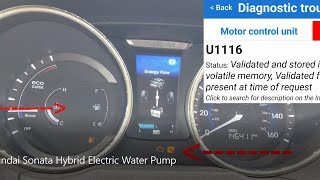
- Hyundai Sonata Hybrid (2011-2015) — Prone to Electric Water Pump (EWP) failure. TSB 12-HA-003 confirms U1116, often paired with P0A93, points directly to a failed EWP.
- Kia Niro (HEV, PHEV, EV) (2018-2019) — Subject to service action SA394 for a faulty Electric Water Pump (EWP) that leaks and causes communication failure.
- Hyundai Ioniq (HEV, PHEV, EV) (2019) — Affected by service campaign T4G (TSB 19-01-036H) for coolant leaking into the Electric Water Pump (EWP), leading to code U1116.
- Ford F-150 (2004-2018) — U1116 relates to 'Invalid or Missing Data for Electrical Energy Management' on the J1850 SCP network, triggered heavily by failing batteries or charging issues.
- Citroën C5 (X7) (2008-2017) — Logs U1116 as a 'Suspension ECU data not valid fault' when the integrated hydraulic control unit (BHI) fails or has a connection issue.
- Peugeot Various Models (e.g., 3008, 508, 208) (2010-2023) — U1116 indicates a communication fault with various ECUs, sometimes defined as a fault with the Vehicle Security Calculator.
- Chrysler/Dodge/Jeep Various Models (e.g., 200, Grand Cherokee, Ram 1500) (2007-2016) — Experiences failures of the Totally Integrated Power Module (TIPM), acting as a central communication hub and causing various U-codes when it fails.
- Mitsubishi i-MiEV (2012-2017) — Per TSB-17-54-003, U1116 appears as a normal, non-fault code during a full system scan and should be ignored if no symptoms are present.
Manufacturer-Specific Notes
- Hyundai / Kia: This code is famously linked to a failing Electric Water Pump (EWP) on hybrid and EV models. Coolant leaks into the pump's electronics, causing communication loss. Check TSBs SA394 and 19-01-036H for warranty extensions.
- Citroën / Peugeot: On vehicles with hydropneumatic suspension, U1116 is a classic indicator of a problem with the suspension ECU (BHI), its wiring, or its power supply, appearing as 'Suspension ECU data not valid'.
- Ford: The definition 'SCP (J1850) Invalid or Missing Data for Electrical Energy Management' points to a fault on an older communication protocol, heavily triggered by a failing battery or charging system.
- Chrysler / Dodge / Jeep: U1116 has completely different definitions, such as 'WINDOW WASHER MOTOR 1 CONTROL CIRCUIT HIGH', pointing to an issue controlled by the TIPM. Spurious U-codes are often fixed by a PCM software update.
- Mitsubishi: On the i-MiEV, U1116 appears as a normal, non-fault code during a full system scan with a dealer-level tool. TSB-17-54-003 advises ignoring it if no symptoms are present.
- BMW: Defined as 'Lost Communication With Vehicle Mode Status Check SumError', pointing to a data verification problem during startup between the engine computer (DME) and other modules.
Real Owner Stories
2012 Hyundai Sonata Hybrid with multiple warning lights
Wrench light and blinking 'Ready' light appeared after 15 minutes of driving. The gas engine stayed on constantly, and the car jerked when stopping.
Outcome: Owner replaced the Electric Water Pump. The repair required removing a few bolts and the headlight for access. This resolved all symptoms and cleared the codes permanently.
Lesson: On a Hyundai/Kia hybrid, test the EWP theory by unplugging the pump when the car is cold to see if it perfectly replicates your warm-engine symptoms.
2009 Citroën C5 X7 with 'Suspension Fault' message
Dash displayed 'Suspension Fault' and the hydropneumatic suspension refused to raise or lower, locking the car at its current ride height.
Outcome: The issue was traced to corroded wiring connections at the BHI module. Cleaning the pins and securing the connectors restored communication without needing a new BHI.
Lesson: For Citroën suspension faults with U1116, inspect and clean the wiring connectors at the BHI before condemning the expensive module.
2018-2019 Kia Niro EV with intermittent charging failures
Intermittent Level 2 charging failures. OBD2 scan revealed U1116. An IR thermometer showed high temperatures (135°F) at the under-hood coolant pump during charging.
Outcome: The vehicle required the repair outlined in service action SA394, replacing the EWP assembly and its electrical connector due to internal coolant intrusion.
Lesson: U1116 on a Kia Niro strongly points to an EWP failure covered by a service campaign. Check with a dealer about TSB SA394 before paying for independent diagnosis.
C5 Corvette with a flood of 'U' communication codes
Pulled codes U1016, U1064, and U1116 after noticing a previous battery acid leak near the battery tray.
Outcome: A weak battery and poor ground connections caused unstable voltage, disrupting the entire network. Cleaning the battery terminals and the main chassis ground under the battery resolved all intermittent communication faults.
Lesson: Multiple 'U' codes across different modules indicate a systemic power issue, not multiple failed computers. Always verify battery health and chassis grounds first.
How to Prevent This Code From Triggering
- Apply dielectric grease to critical electrical connectors. (Whenever a connector is disconnected for service.) — Dielectric grease blocks moisture and oxygen from reaching metal pins. This prevents corrosion, which creates high resistance and destroys low-voltage CAN bus signals.
- Perform regular hybrid/EV coolant system service. (Every 30,000 to 60,000 miles, per manufacturer schedule.) — Hybrid power electronics have a dedicated cooling system. Degraded coolant loses its anti-corrosive properties, accelerating internal seal failure in the electric water pump and causing the U1116 short circuit.
- Maintain battery and charging system health. (Annually.) — Communication modules require stable voltage. A weak battery causes voltage drops during cranking that corrupt data packets and trigger a flood of 'U' codes.
- Protect wiring harnesses from physical damage. (During any under-hood or under-vehicle service.) — CAN bus wires are a twisted pair. Incorrect routing allows them to chafe against sharp metal or hot exhaust, eventually shorting out the entire network.
Frequently Asked Questions
Can I fix a U1116 code myself?
Yes, if the cause is a blown fuse or a bad battery. However, most causes require advanced diagnostic skills and bidirectional scan tools. Replacing the Hyundai/Kia electric water pump is possible for an experienced DIYer but requires a scan tool for the mandatory coolant bleeding procedure.
How much does it cost to fix code U1116?
Costs range from $5 for a fuse to over $1,000 for module replacement. Diagnosing a wiring issue typically costs $150-$500 in labor. Replacing a Hyundai/Kia electric water pump at a dealer ranges from $600 to $1,300 for parts and labor.
What is the difference between U1116 and U1118 on a Kia Niro?
These codes specify different coolant pumps on Kia and Hyundai EVs/hybrids. U1116 points to the 'Motor Electronics Coolant Pump,' while U1118 points to the 'Battery Coolant Pump.' Service bulletin SA394 dictates replacing the specific pump named by the code, or both if both codes are present.
Can a bad battery cause a U1116 code?
Yes. Communication modules require a stable 12V supply to operate correctly. A weak battery or failing alternator causes voltage drops during cranking, leading to communication dropouts and U-codes, particularly on Ford vehicles.
What are common misdiagnosis mistakes for U1116?
The biggest mistake is immediately replacing the module named in the code definition. The actual fault is usually in the power, ground, or communication wiring leading to that module. Always verify the circuit integrity before condemning the computer.
My car has code U1116 but no symptoms. What should I do?
On certain models like the Mitsubishi i-MiEV, U1116 logs during a deep scan without an actual fault. Record the code, clear it, and drive the vehicle. If it does not return and no symptoms appear, ignore it as an intermittent glitch.
Will clearing the code make it go away?
Clearing the code turns off the warning light temporarily. However, the code returns immediately once the vehicle runs its self-diagnostics if the underlying physical or software problem remains unfixed.
Is U1116 covered under warranty?
If your vehicle is within the bumper-to-bumper or powertrain warranty period, the repair is covered. Hyundai and Kia issued specific service campaigns and warranty extensions for the EWP issue on certain models. Provide your VIN to a dealer to check for active extended coverage.
What is a CAN bus?
The Controller Area Network (CAN) is the primary communication network in modern vehicles. It acts as the car's nervous system, allowing dozens of computers to exchange real-time data over a shared pair of twisted wires.
What is a terminating resistor and why is my CAN bus 60 ohms?
A CAN bus network uses a 120-ohm resistor at each physical end to prevent data signal reflection. When measuring the entire network's resistance, these two 120-ohm resistors sit in parallel. The parallel resistance formula ((120*120)/(120+120)) equals exactly 60 ohms for a healthy network.
Key Takeaways
- On 2011-2019 Hyundai and Kia hybrids or EVs, U1116 almost exclusively points to a failed Electric Water Pump (EWP) requiring a $600-$1,300 replacement.
- Driving a hybrid with U1116 forces the vehicle into a reduced-power limp mode to prevent a catastrophic $3,000+ hybrid inverter meltdown.
- On Ford vehicles using the older J1850 network, a weak 12V battery dropping below 12.4V triggers this code by disrupting electrical energy management data.
- On Citroën C5 (X7) models, U1116 specifically flags a hydropneumatic suspension ECU (BHI) failure, often fixed by cleaning corroded connector pins.
- Never replace the module named in the scan tool definition without first verifying its power, ground, and 60-ohm CAN bus resistance.
Helpful Videos

The information in this article is provided for general reference and educational purposes only. Vehicle specifications, procedures, and part compatibility can vary by production date, trim level, and region. Always consult your vehicle's factory service manual and verify part numbers before purchasing or performing repairs. Safety-critical components such as airbags, seat belts, and braking systems should be installed by a qualified professional.
- 🎬 Helpful Videos
- What Does U1116 Mean?
- Can I Drive With U1116?
- Common Causes
- Symptoms
- Diagnostic Flowchart
- Common Fixes & Costs
- Used vs. New Parts: Buying Guide
- What Happens If You Wait — Timeline
- Cost of Not Fixing It
- Diagnosis Steps
- When This Code Triggers (Freeze-Frame Conditions)
- Related Codes
- Climate & Environmental Factors
- How to Talk to a Mechanic About This Code
- Where to Take It: Dealer vs Independent vs Chain
- When to Walk Away From the Repair
- What Scan Tool You Need for This Code
- How to Clear the Code After You Fix It
- Will This Fail Emissions / State Inspection?
- Most Commonly Affected Vehicles
- Manufacturer-Specific Notes
- Real Owner Stories
- 2012 Hyundai Sonata Hybrid with multiple warning lights
- 2009 Citroën C5 X7 with 'Suspension Fault' message
- 2018-2019 Kia Niro EV with intermittent charging failures
- C5 Corvette with a flood of 'U' communication codes
- How to Prevent This Code From Triggering
- Frequently Asked Questions
- Can I fix a U1116 code myself?
- How much does it cost to fix code U1116?
- What is the difference between U1116 and U1118 on a Kia Niro?
- Can a bad battery cause a U1116 code?
- What are common misdiagnosis mistakes for U1116?
- My car has code U1116 but no symptoms. What should I do?
- Will clearing the code make it go away?
- Is U1116 covered under warranty?
- What is a CAN bus?
- What is a terminating resistor and why is my CAN bus 60 ohms?
- Key Takeaways
- 🎟️ Get 5% Off