

U1110 on 2021 Dodge Challenger: 'Lost Vehicle Speed Message' Causes and Fixes
On a 2021 Dodge Challenger, code U1110 indicates a 'Lost Vehicle Speed Message' and is most often caused by a software glitch in the Powertrain Control Module (PCM). A dealership software update, covered by TSB #18-011-22, is the most common fix for vehicles built on or before October 14, 2021.
- Code U1110 on a 2021 Challenger means the Powertrain Control Module (PCM) has lost the vehicle speed signal from the ABS module.
- The most common cause is a software bug. Check if your vehicle needs the software update outlined in TSB #1801122 before replacing any parts.
- Symptoms include ABS/Traction lights, a dead speedometer, and the transmission being stuck in gear.
- Diagnosis and repair are not DIY-friendly, as they require dealership-level scan tools for network testing and software flashing.
- Do not immediately replace the ABS module or wheel speed sensors; have the PCM software checked first to save time and money.
What's Unique About the 2021-2021 Dodge CHALLENGER
On modern Dodge platforms like the 2021 Challenger, network communication codes are frequently addressed by software updates rather than hardware replacement. For this specific vehicle and code, Dodge issued Technical Service Bulletin #18-011-22 that involves reprogramming the PCM to resolve a host of communication issues, including U1110. This indicates the problem is a known software bug for vehicles built before mid-October 2021, not a random component failure.
Diagnostic Flowchart
Tap your situation to follow the diagnostic path that matches what you're seeing on this vehicle.
Symptoms You May Notice
- Check Engine Light illuminated
- ABS and/or Traction Control (ESP/BAS) warning lights on
- Speedometer not working or displaying '---'
- Transmission may not shift properly or may be stuck in one gear (often 3rd gear)
- Cruise control may be inoperative
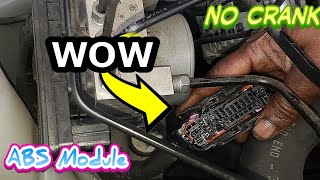
- Vehicle may exhibit a no-crank, no-start condition if the ABS module failure is severe enough to bring down the entire CAN-C network. 🎬 Watch: Diagnosing a no-start caused by ABS communication failure.
- Replacing wheel speed sensors without confirming they are faulty with a dedicated ABS code.
- Replacing the PCM when only a software update is needed, especially on vehicles covered by TSB 18-011-22.
- Replacing the ABS module without first checking for power, ground, and CAN bus wiring integrity at the module's connector.
Most Likely Causes
- Powertrain Control Module (PCM) Software Glitch 🔴 High Probability Dodge released TSB #18-011-22 specifically to address this and other communication codes via a PCM software update for 2021 models with the 3.6L engine built on or before October 14, 2021.
How to confirm: A Dodge dealership or a properly equipped independent shop can check your vehicle's VIN and current PCM software calibration ID to see if the update from TSB #18-011-22 is applicable and has not yet been performed.
Typical fix: Reprogram the PCM with the latest available software using the wiTECH scan tool. 🎬 Watch: How to perform PCM programming with the wiTECH tool.
Est. part cost: $0-$250 (Cost varies; may be covered under warranty or as a customer satisfaction campaign) - Faulty Anti-Lock Brake (ABS) Module 🟡 Medium Probability The ABS module is responsible for processing wheel speed data and broadcasting the vehicle speed message on the CAN bus. A failure of the module itself—either internal electronics or the attached pump—can halt this communication.
How to confirm: Using a high-end scan tool, a technician will attempt to communicate directly with the ABS module. If the module is unresponsive (shows as 'offline' in network topology) and its power and ground connections are verified as good, the module is likely faulty.
Typical fix: Replace the ABS module and program the new unit to the vehicle. The system will also require a thorough brake bleed procedure. 🎬 See this walkthrough for replacing a faulty ABS module.
Est. part cost: $400-$800 - Wiring Harness or Connector Issue ⚪ Low Probability The CAN bus network relies on a twisted pair of wires. Damage, corrosion, or a loose connection at the PCM or ABS module can disrupt the signal. The ABS module connector is located in the driver's side front wheel well area, making it susceptible to damage from road debris or moisture.
How to confirm: Visually inspect the wiring harness and connectors going to the ABS module and PCM. A technician may also perform a CAN bus resistance test. With the battery disconnected, the resistance between Pin 6 (CAN-C High) and Pin 14 (CAN-C Low) at the OBD-II port should be approximately 60 ohms.
Typical fix: Repair the damaged section of the wiring harness or clean/replace the faulty connector.
Est. part cost: $50-$400
Rare But Worth Checking
- Faulty Wheel Speed Sensor: While a bad wheel speed sensor typically sets its own specific C-code (e.g., C0031), it can sometimes provide erratic or implausible data that confuses the ABS module, indirectly leading to a U1110 code being broadcast.
- Low Battery Voltage or Poor Grounds: Insufficient system voltage can cause unpredictable communication errors between modules. It's a simple and important first check, as modern electronics are highly sensitive to voltage fluctuations.
Diagnosis Steps
- Connect a professional OBD-II scanner (ideally a wiTECH for full functionality) and check for all stored Diagnostic Trouble Codes (DTCs) in all modules. Note any other codes, especially U0121 or U1120.
- Check for applicable Technical Service Bulletins (TSBs). Specifically, for 3.6L models built on or before 10/14/2021, check if TSB #18-011-22 applies to your vehicle's VIN.
- If the TSB applies and has not been performed, have a dealership or qualified shop perform the PCM software update. This is the most likely solution and should be the first step.
- If the TSB does not apply or does not fix the issue, test the battery and charging system to ensure system voltage is stable and above 12.4V with the engine off.
- Using the scan tool, attempt to communicate with the ABS module. Check for any DTCs stored within the ABS module itself and view the network topology to see if the ABS module is 'online'.
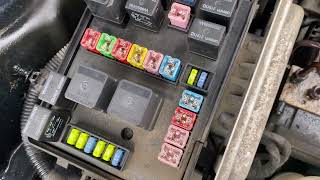
- If communication with the ABS module is not possible, inspect the fuses for the ABS system in the front power distribution center.
- Inspect the wiring and connector at the ABS module (located on the driver's side, near the firewall/shock tower) for any signs of physical damage, corrosion, or loose pins.
- If wiring appears intact, perform a CAN bus integrity test (see Diagnostic Deep Dive).
- If the CAN bus wiring tests good, use a multimeter to test the power and ground circuits at the ABS module connector. If power and ground are present but the module won't communicate, the ABS module has likely failed.
Parts You'll Likely Need
- Anti-Lock Brake (ABS) Module/Pump Assembly
(OEM #68399772AG, 68258644AA (Examples, verify with VIN))— If a software update doesn't fix the issue and the module has good power, ground, and CAN wiring, the module itself is the next most likely point of failure, as it's responsible for sending the speed signal.
Trusted brands: Mopar
OEM price range: $450-$900
Aftermarket price range: $300-$600
Related Codes That Often Appear With This One
- U0121 — This code means 'Lost Communication With ABS Module' and often appears with U1110 because if the PCM can't communicate with the ABS module at all, it certainly can't receive the speed message from it.
- U1120 — 'Lost Wheel Distance Message'. This is another piece of data sent by the ABS module, so its loss often points to the same root cause as U1110. It is listed in the same TSB.
- U0101, U0402, U1141, U1186 — These are various other communication codes listed in TSB #18-011-22, indicating a broader software-related communication problem that the PCM update is designed to fix.
Technical Service Bulletins (TSBs) & Recalls
- 18-011-22: Flash: Powertrain Control Module (PCM) Updates, which addresses U1110 - Lost Vehicle Speed Message among other communication DTCs for 3.6L models.
Platform-Specific Known Issues
- A known software issue prompted Dodge to release Technical Service Bulletin #18-011-22 (NHTSA ID: 10222994) on January 20, 2022. This TSB involves reprogramming the Powertrain Control Module (PCM) to fix a list of communication codes, including U1110 - Lost Vehicle Speed Message. It applies specifically to 2021 Challenger and Charger models with the 3.6L engine built on or before October 14, 2021.
Mechanic-Grade Diagnostic Values
- CAN Bus C Network Resistance — expected: ~60 Ω. Failure: A reading of ~120 Ω indicates one of the two terminating resistors is offline or there's a break in the bus. A reading of 0 Ω or a very low value indicates a short between the CAN High and Low wires. An Open Line (OL) reading indicates a break in both wires.
- CAN Bus C Voltage (Key On, Engine Off) — expected: CAN High (e.g., Pin 6) should be ~2.5V and CAN Low (e.g., Pin 14) should be ~2.5V (recessive state).. Failure: Voltages that are stuck high (e.g., 5V or 12V), stuck low (0V), or equal to each other at an incorrect voltage (e.g., both at 2.6V) indicate a bus fault, short, or a module pulling the bus down.
- ABS Module Power Supply Voltage — expected: Greater than 11-12V. Failure: Voltage below 11V can cause the module to drop offline and set communication codes. No voltage indicates a blown fuse or an open in the power supply wire.
- ABS Module Ground Circuit Continuity — expected: Less than 1.0 Ω. Failure: High resistance or an Open Line (OL) reading indicates a poor or broken ground connection, which can prevent the module from operating correctly.
Hidden / Shadow Codes Worth Checking
- C2200: Anti-Lock Brake Module Internal. While not a 'hidden' code, this fault is often stored within the ABS module itself and is a definitive indicator that the module has an internal failure. It frequently accompanies network-wide U-codes like U0121 and U1110 when the ABS module is the root cause. (see via A professional scan tool capable of reading codes from the ABS module, not just the PCM.)
Scan Tool Commands That Help
- wiTECH: Reprogram Module / Flash ECU — Used to perform the software update on the PCM as specified in TSB #18-011-22. Can also be used to update ABS module software if a newer calibration is available.
- wiTECH / high-end aftermarket (e.g., Autel): ABS Initialization — This function is critical after replacing the ABS module. It writes the vehicle's VIN to the new module and integrates it with the vehicle's security and network systems, clearing VIN mismatch codes like C2200.
- wiTECH: Proxi Alignment Procedure — This procedure, found under the Body Control Module (BCM) functions, synchronizes the configuration of all modules on the network. It is often required after flashing or replacing a major module like the ABS or PCM.
- wiTECH: View Network Topology — This is a primary diagnostic step to get a visual map of all modules on the CAN bus and see which ones are communicating ('online') and which are not ('offline'). If the ABS module is offline, it confirms a communication breakdown.
Wiring & Ground Locations
- ABS Module / Pump Assembly — In the engine compartment on the driver's side, typically located near the firewall and next to the windshield washer fluid reservoir.. This is the source of the vehicle speed message. All power, ground, and CAN bus connections at its main connector (sometimes labeled C135) are critical for its operation.
- CAN Bus Star Connector (Junction Block) — Chrysler vehicles often use star connectors (or junction blocks) to connect multiple modules to a single bus. On a Challenger, these are typically located behind the dash, for example, near the instrument cluster or behind the headlight switch panel.. This is a central hub for CAN bus wiring. While not a common failure, an internal fault (like a failing capacitor) in the star connector itself can bring down the entire network, causing widespread communication codes including U1110.
- Main Chassis/Engine Ground — Key grounds are located from the battery negative terminal to the chassis and from the chassis to the engine block.. A loose or corroded main ground can cause floating voltages and unpredictable electronic behavior across all modules, leading to random communication faults. Verifying these grounds are clean and tight is a fundamental diagnostic step.
Real Owner Repair Stories
- YouTube channel 'Rob The Mechanic' (Chrysler/Dodge/Jeep/Ram vehicle (platform generic)) — Intermittent loss of communication with multiple modules across an entire network, occurring consistently after driving for a specific distance (33 miles).
❌ Tried (didn't work) Unplugging individual modules one-by-one from the star connector did not restore communication.
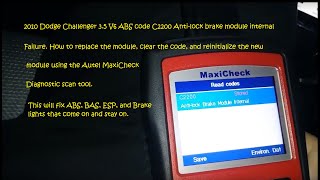
✅ What actually fixed it The star connector (CAN bus junction block) itself had an internal capacitor that was failing under load. Replacing the star connector resolved the issue. - YouTube channel 'ThatCarguyNate' (2010 Dodge Challenger SE 3.5L V6) — ABS, ESP, BAS, and Brake warning lights on. Stored code C2200 (ABS Module Internal Failure), which often accompanies communication codes.
❌ Tried (didn't work) Clearing codes was unsuccessful as they returned immediately.
✅ What actually fixed it The electronic portion of the ABS module was replaced (four T20 Torx screws). After installation, an Autel scan tool was used to perform the 'ABS Initialization' function to pair the new module to the car's VIN.
When the Usual Fixes Don't Work
- While the Pass 2 data correctly identifies the TSB software update as the most common fix, if that does not apply or fails to resolve the issue, diagnosis must proceed to the physical layer. The existence of a failing star connector, as documented in a real-world repair, shows that even when modules and wiring seem to check out, the network's central connection point can be the root cause. This highlights the need for advanced electrical diagnosis beyond just checking for codes or performing software updates.
OEM Part Supersession History
68399772AA, 68399772AB, 68399772AC, 68399772AD, 68399772AE, 68399772AF→68399772AG— Part has been revised multiple times by the manufacturer to improve reliability or address known failure modes.
Model Year Variations Within This Range
- 2021: The primary fix for U1110 on 3.6L models, a PCM software update (TSB 18-011-22), is only applicable to vehicles built on or before October 14, 2021. Vehicles built after this date should already have the updated software, and the cause of the code is more likely to be hardware-related (ABS module, wiring).
Helpful Videos
We Have This Part in Stock


The information in this article is provided for general reference and educational purposes only. Vehicle specifications, procedures, and part compatibility can vary by production date, trim level, and region. Always consult your vehicle's factory service manual and verify part numbers before purchasing or performing repairs. Safety-critical components such as airbags, seat belts, and braking systems should be installed by a qualified professional.
- Dodge CHALLENGER:
- 🎬 Helpful Videos
- 🛍️ Shop This Part
- What's Unique About the 2021-2021 Dodge CHALLENGER
- Diagnostic Flowchart
- Symptoms You May Notice
- Most Likely Causes
- Rare But Worth Checking
- Diagnosis Steps
- Parts You'll Likely Need
- Related Codes That Often Appear With This One
- Technical Service Bulletins (TSBs) & Recalls
- Platform-Specific Known Issues
- Mechanic-Grade Diagnostic Values
- Hidden / Shadow Codes Worth Checking
- Scan Tool Commands That Help
- Wiring & Ground Locations
- Real Owner Repair Stories
- When the Usual Fixes Don't Work
- OEM Part Supersession History
- Model Year Variations Within This Range
- 🎟️ Get 5% Off