

U1110 on 2021 Chrysler 300: 'Lost Vehicle Speed Message' Causes and Fixes
On a 2021 Chrysler 300, code U1110 means a control module has lost the vehicle speed signal, which usually comes from the ABS module. This often points to a faulty ABS module, a damaged wiring harness, or a bad wheel speed sensor. Expect multiple warning lights like ABS and traction control, and the speedometer may fail.
- U1110 means the vehicle speed signal is lost, which disables safety systems like ABS and traction control.
- The most likely cause is a faulty ABS module, followed by damaged wiring to the module.
- This code often appears with other communication codes (U1120, U0121), reinforcing the likelihood of an ABS system fault.
- Diagnosis requires a scan tool that can read manufacturer-specific codes from all modules, not just a basic engine code reader.
- Do not drive the vehicle extensively with these warning lights on, as key safety features are inactive.
What's Unique About the 2021-2021 Chrysler 300

On modern Chrysler platforms like the 300 (and its platform-mate, the Dodge Charger), various electronic modules are tightly integrated via the CAN bus. A single fault, particularly in the ABS system, can create a cascade of communication error codes. The provided NHTSA TSB #1801322 lists U1110 alongside other 'Lost Communication' codes, which strongly suggests that a central component, like the ABS module, is the likely source of the network disruption rather than multiple separate failures. The ABS module is a critical node on the CAN C bus, responsible for broadcasting essential data to the PCM, TCM, and instrument cluster.
Diagnostic Flowchart

Tap your situation to follow the diagnostic path that matches what you're seeing on this vehicle.
Symptoms You May Notice
- ABS warning light is on.
- Traction Control (ESC/BAS) warning light is on.
- Check Engine Light may be on.
- Speedometer works erratically or not at all.
- Transmission may not shift properly or may enter a limp mode.
- Brake warning light may be illuminated.
- Vehicle may not crank or start in severe cases where the ABS module failure brings down the entire CAN network.
- Replacing a wheel speed sensor when the actual fault is in the ABS module or wiring. A scan tool showing a wheel speed sensor code alongside a U1110 often points to the module itself being unable to process the sensor's signal.
- Replacing the PCM when the ABS module is the actual source of the network fault. The U1110 code is logged by the PCM, but it's reporting a problem with a message it's *receiving*, not a problem with itself.
Most Likely Causes

- Faulty ABS Control Module 🔴 High Probability The ABS module acts as the central hub for vehicle speed data and is a terminating resistor for the CAN C bus. Internal electronic failure is a common issue that can disrupt its ability to send signals over the CAN bus, triggering multiple communication codes. When it fails, it can go completely offline, causing the PCM and other modules to log communication loss codes.
How to confirm: Use a high-level scan tool to view the network topology. An offline ABS module will often show as 'red' or non-responsive. Attempt to communicate directly with the ABS module. If it's offline or reports internal fault codes (like C2200), it is the likely culprit.
Typical fix: Replace the ABS control module. A new module will require programming to the vehicle's VIN and configuration. In some cases, the hydraulic unit is replaced with the module.
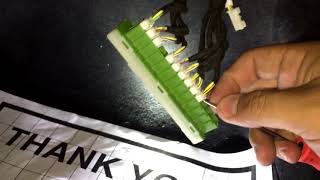
Est. part cost: $300-$750 - Damaged Wiring or Connectors 🟡 Medium Probability Wiring harnesses, especially the main connector at the ABS module, are exposed to heat, vibration, and moisture. This can lead to corrosion, broken wires, or pushed-out pins, causing a loss of power, ground, or CAN bus signal. There are documented cases of the connector itself disintegrating from corrosion.
How to confirm: Visually inspect the wiring harness and the large multi-pin connector at the ABS module for any signs of green/white corrosion, physical damage, or bent/broken pins. Disconnect the battery and connector, then check for continuity on power and ground wires and measure the resistance between the CAN High and CAN Low wires (should be ~120 ohms looking into the harness if the other terminating resistor is at the other end).
Typical fix: Repair the damaged section of the wiring harness or replace the connector pigtail if available. In severe cases of corrosion, the entire engine harness may be recommended for replacement.
Est. part cost: $30-$300 - Faulty Wheel Speed Sensor ⚪ Low Probability While a single faulty wheel speed sensor can cause ABS issues, it's less likely to cause a total loss of communication code like U1110 unless it creates an electrical short that affects the entire module's operation. Typically, a bad sensor will set a specific sensor-related code (e.g., C0031-C0038).
How to confirm: Use a scan tool to monitor live data from all four wheel speed sensors while driving. If one sensor reads incorrectly or not at all, it is suspect. This should be done after confirming the ABS module is online and communicating.
Typical fix: Replace the faulty wheel speed sensor.
Est. part cost: $40-$120
Rare But Worth Checking
- Failing Powertrain Control Module (PCM): While rare, the PCM is the module that typically sets the U1110 code because it's the one *expecting* the speed signal. If the PCM has an internal fault, it might falsely report a communication loss. This should only be considered after all other possibilities are exhausted and the ABS module is confirmed to be communicating correctly.
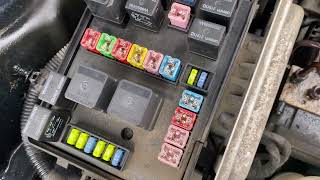
- Blown Fuse for ABS Module: A simple blown fuse can cut power to the ABS module, making it go offline and triggering communication codes from other modules. Always check the fuses first. In one documented case on a similar platform, a missing 30-amp fuse for the ABS module was the root cause for U0121, U1110, and U1120.
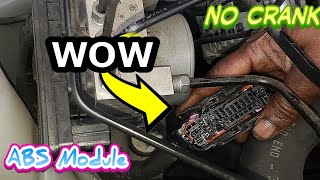
- Corroded/Damaged ABS Module Connector: A YouTube video on a Dodge Challenger with a no-crank condition and U1110/U1120 codes found the cause to be a completely disintegrated ABS module connector. The corrosion and broken pins were pulling the entire CAN bus network down, preventing the car from starting. This is more than just damaged wiring; it's a catastrophic failure of the connector itself. 🎬 See how a failed module can cause a no-start condition.
Diagnosis Steps
- Connect a full-system diagnostic scanner (e.g., wiTECH) capable of reading ABS and network codes. Do not rely on a basic OBD-II reader.
- Scan all modules for stored trouble codes. Note all 'U' (network) codes present, especially U0121, U1110, and U1120.
- Check all fuses related to the ABS module in the engine bay fuse box (TIPM). A missing or blown fuse can take the whole module offline.
- Attempt to communicate directly with the ABS module using the scan tool. If it's 'offline' or won't respond, the module, its power/ground, or the connector is the primary suspect.
- If the module is offline, disconnect the battery. Unplug the ABS module connector and inspect it thoroughly for corrosion, moisture, or damaged pins.
- With the connector unplugged, check for battery voltage and good ground at the appropriate pins on the harness side of the connector.
- Test the CAN bus integrity. With the battery still disconnected, measure the resistance between the two CAN bus pins at the ABS connector. You should read approximately 120 Ohms. Then, measure resistance between the CAN pins at the OBD-II port (pins 6 and 14); a healthy network should read approximately 60 Ohms.
- If wiring, power, and ground are confirmed good but the module remains offline, the ABS module has likely failed internally and requires replacement.
Parts You'll Likely Need
- ABS Control Module
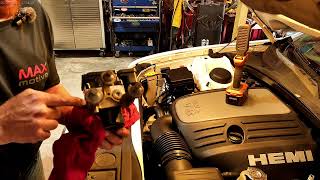
(OEM #68341606AC, 68341609AD (Part numbers can vary based on RWD/AWD and other options, always verify with VIN))— This module is the most common point of failure when U1110 is present with other communication codes. It processes and sends the vehicle speed signal to the rest of the car. 🎬 Watch a step-by-step walkthrough of the ABS module replacement process.
Trusted brands: Mopar
OEM price range: $300-$750
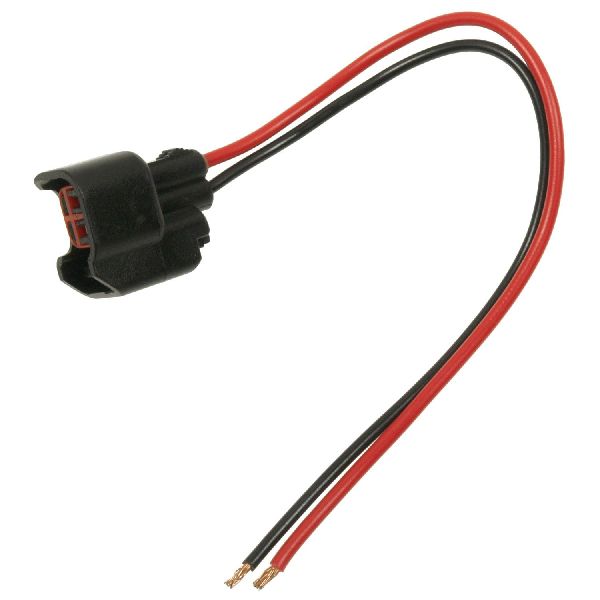
Aftermarket price range: $250-$500 (often remanufactured) - ABS Module Connector Pigtail — In cases of heavy corrosion or physical damage, the connector itself must be replaced. Splicing in a new pigtail is often necessary.
Trusted brands: Mopar, Dorman
OEM price range: $50-$150
Aftermarket price range: $30-$80 - Wheel Speed Sensor — A less common cause, but a failed sensor can sometimes disrupt the ABS module's operation. It's a more likely fix if you have a specific wheel speed sensor code along with the U1110.
Related Codes That Often Appear With This One
- U1120 — This code means 'Lost Wheel Distance Message' and is also sent by the ABS module. It almost always appears with U1110 as they are related data points broadcast in the same CAN message.
- U0121 — This code means 'Lost Communication With Anti-Lock Brake System Module'. It is a more direct indicator that the ABS module is offline and is the root cause of the U1110 code. If you see U0121, the ABS module is almost certainly the problem.
- U110A — Mentioned in TSB #1801322, this is another communication loss code ('Lost Communication With SCM-CAN-C'), indicating a wider network problem likely originating from a single module failure.
Technical Service Bulletins (TSBs) & Recalls
- 1801322: Mentions U1110 - Lost Vehicle Speed Message in a list of potential electronic stability control-related diagnostic trouble codes that may be addressed by a PCM software update. However, the presence of multiple 'U' codes often points to a hardware failure that a flash will not fix.
Platform-Specific Known Issues
- TSB #1801322 - PCM Updates: TSB #1801322 notes that on 2021 models, code U1110 can appear with a cluster of other communication codes (U0594, U110A, U1120, U1141, U1186), pointing towards a broader network communication failure. While the TSB is for a PCM software update, the presence of these codes together strongly indicates a hardware fault on the CAN C bus, often the ABS module itself.
- Owner Experience: Disintegrated ABS Connector: A well-documented YouTube video by 'Online Mechanic Tips' on a platform-mate Dodge Challenger showed a no-crank condition caused by codes U1110 and U1120. The root cause was found to be a severely corroded and disintegrated ABS module connector, which was shorting out the CAN bus and preventing multiple modules from communicating, including the module needed to authorize starting the engine.
Mechanic-Grade Diagnostic Values
- CAN C Bus Resistance (at DLC pins 6 & 14, battery disconnected) — expected: ~60 Ohms. Failure: Significantly higher (open circuit) or lower (shorted circuit, e.g., ~40 Ohms could indicate a third resistor or module fault). Note: Some Chrysler sources suggest not testing at the DLC and instead testing at the TIPM or Star Connector.
- CAN C Bus Voltage (Key On, Engine Off) — expected: CAN High (Pin 6): Toggles 2.5V to 3.5V; CAN Low (Pin 14): Toggles 2.5V to 1.5V. Both idle around 2.5V.. Failure: Voltages stuck high, low, or at 0V indicate a short to power, ground, or an open circuit.
- ABS Module Power Supply — expected: Battery voltage (12V+) at the appropriate power pin on the module connector with ignition on.. Failure: Voltage below 11V or 0V indicates a wiring issue or blown fuse.
- ABS Module Ground — expected: Near 0 Ohms resistance between the ground pin on the module connector and a clean chassis ground.. Failure: High resistance or an open circuit (OL) indicates a bad ground connection.
Scan Tool Commands That Help

- wiTECH: Network Topology View — This is the first step to visually identify which modules are offline. An ABS module that is the source of the U1110 will often show as 'red' or non-communicating.
- wiTECH: ABS Initialization / Proxi Alignment Procedure — After replacing the ABS module, this function is required to program the new module with the vehicle's VIN and configuration data. Failure to perform this can result in the new module not working correctly.
- wiTECH: Brake Pedal Calibration / Longitudinal G-Sensor Calibration — These are post-flash routines that must be run after reprogramming or replacing the ABS module to ensure the stability control system functions correctly.
- wiTECH or advanced aftermarket scanner: Clear All DTCs — After a module is reprogrammed or replaced, the wiTECH application will present all resulting DTCs from the procedure and allow them to be cleared. This is a necessary final step.
Wiring & Ground Locations
- ABS Module Connector — On the ABS hydraulic unit, located in the engine bay. On some models like the Dodge Charger, the windshield washer reservoir may need to be removed for access.. This is the primary point of failure for wiring issues. Corrosion, moisture intrusion, or pushed-out pins at this connector can sever power, ground, or CAN communication to the module, causing it to go offline.
- CAN C Star Connector (Diagnostic CAN-C Connector) — Often located behind the instrument cluster or in the passenger side kick panel area. It serves as a junction point for the CAN C bus wires.. A fault within the star connector itself, such as a failing internal capacitor or resistor, can bring down the entire network, causing widespread communication codes including U1110. It's also a useful point for isolating sections of the network during diagnosis.
- ABS Module Fuses — In the engine compartment fuse box (Totally Integrated Power Module - TIPM). On similar platforms, these have been identified as fuses F17 and F21 or F34.. The ABS module has dedicated power fuses. A blown or even missing fuse will cause the module to be completely offline, triggering U1110 and U0121 in other modules.
Real Owner Repair Stories
- YouTube channel 'JT the Car Guy' (Dodge Challenger (similar platform)) — No crank, no start, multiple ABS and communication codes including U1110 and U1120. ABS module showing as 'offline' in the scan tool network topology.
❌ Tried (didn't work) Customer had already replaced the battery.
✅ What actually fixed it The ABS module connector itself had catastrophically failed due to corrosion. The plastic had disintegrated and the pins were bent and corroded, pulling the entire CAN C network down. The fix required replacing the connector pigtail, which was a major wiring repair. - YouTube channel 'Dodge Avenger U0121... Diag/FIX!' (2014 Dodge Avenger (similar CAN architecture)) — ABS lights on, codes U0121, U1110, U1120. ABS module offline.
❌ Tried (didn't work) Visual inspection of the ABS connector showed no obvious damage.
✅ What actually fixed it The 30-amp fuse (Fuse 34 in this case) for the ABS module was missing from the fuse box. Installing the correct fuse restored power to the module and cleared all communication codes. - YouTube channel 'Gage Fixes Everything' (Dodge Grand Caravan / Chrysler Town & Country (similar ABS module)) — ABS, ESP, BAS, and traction control lights on. Code C2200 (internal ABS module failure) present.
❌ Tried (didn't work) Cleaning battery terminals and resetting codes provided only a temporary fix.
✅ What actually fixed it The ABS control module was replaced. The video notes that if a brand new Mopar module is used, it may self-learn and the lights will go off after about 100 miles of driving. If a used module is installed, it must be reflashed by a dealer.
OEM Part Supersession History
68341606AA, 68341606AB→68341606AC— Standard part revision and update by the manufacturer.
Helpful Videos

Used OEM Parts in Stock

New Aftermarket Parts Available


The information in this article is provided for general reference and educational purposes only. Vehicle specifications, procedures, and part compatibility can vary by production date, trim level, and region. Always consult your vehicle's factory service manual and verify part numbers before purchasing or performing repairs. Safety-critical components such as airbags, seat belts, and braking systems should be installed by a qualified professional.
- Chrysler 300:
- 🎬 Helpful Videos
- 🛍️ Shop This Part
- What's Unique About the 2021-2021 Chrysler 300
- Diagnostic Flowchart
- Symptoms You May Notice
- Most Likely Causes
- Rare But Worth Checking
- Diagnosis Steps
- Parts You'll Likely Need
- Related Codes That Often Appear With This One
- Technical Service Bulletins (TSBs) & Recalls
- Platform-Specific Known Issues
- Mechanic-Grade Diagnostic Values
- Scan Tool Commands That Help
- Wiring & Ground Locations
- Real Owner Repair Stories
- OEM Part Supersession History
- 🎟️ Get 5% Off