

OBD-II Code U1040: Lost Communication with ABS Module
What U1040 means, why it triggers, and how to fix it
- Code U1040 triggers when the Anti-lock Brake System (ABS) module fails to send its required 'State of Health' signal for 2 to 5 seconds.
- Check the ABS module's main chassis ground and fuses first, as simple electrical connection failures cause the majority of U1040 codes.
- Driving with a U1040 code increases emergency stopping distances by up to 45 feet from highway speeds due to disabled ABS and traction control.
- On early 2000s GM vehicles, a U1040 code frequently causes a complete no-start condition by shorting the shared Class 2 data line.
What Does U1040 Mean?

Your car's main computer lost its connection to the Anti-lock Brake System (ABS) module. These modules constantly communicate over a data network. When the ABS module stops sending its 'State of Health' signal for 2 to 5 seconds, other modules on the network store this code.
Technical definition: The formal SAE definition is 'Lost Communication With Antilock Brake System (ABS) Control Module'. Another electronic module (like the Engine Control Module) expected a message from the ABS module but did not receive it within a 2-5 second timeframe. This code is common on older GM vehicles using the Class 2 protocol; its modern CAN bus equivalent is U0121.
Can I Drive With U1040?
Yes, But With Caution. Yes, but with extreme caution. Standard hydraulic brakes still function, but the Anti-lock Braking System (ABS), traction control, and stability control are disabled. This increases the risk of wheel lock-up and skidding during hard braking or on slippery surfaces, increasing stopping distances by up to 10%. A non-ABS stop from highway speeds takes an extra 45 feet compared to a car with functional ABS. Limit driving to reaching a repair shop.
Common Causes

- Bad ground connection for the ABS module (Very Common) — The ABS module requires a solid connection to the vehicle's metal frame to function. A rusty, loose, or corroded ground wire interrupts the module's power supply and disables communication. 🎬 Watch: How to clean corroded ABS ground connections.
- Poor electrical connection or damaged wiring (Very Common) — Connectors exposed to the elements corrode, and wires chafe or break from rubbing against other parts. This severs the power, ground, or communication signal to the ABS module.
- Blown fuse for the ABS module (Common) — A blown fuse cuts power directly to the ABS module, forcing it offline and immediately triggering the U1040 code.
- Low or unstable battery voltage (Common) — Modern vehicles require stable voltage. A weak battery, failing alternator, or corroded terminals cause temporary voltage drops that disrupt module communication.
- Faulty ABS control module (Less Common) — The electronic module fails internally due to cracked solder joints or component degradation. It either sends garbage data onto the network or stops communicating entirely.
- Another module pulling down the data bus (Uncommon) — On shared networks (like Nissan's LIN bus), a completely different component like a faulty alternator or active grille shutter fails and shorts the entire communication line. 🎬 See how a faulty alternator or grille shutter triggers U1040.
- Interference from aftermarket accessories (Uncommon) — Improperly installed aftermarket stereos, amplifiers, or lighting interfere with the vehicle's data network. On Harley-Davidson motorcycles, a new head unit's data wire frequently disrupts the bus.
- Faulty ignition switch (Uncommon) — In older GM models, a failing ignition switch causes a momentary loss of power to various modules during startup, leading to a cascade of communication codes.
Symptoms

- ABS, Traction, and Brake warning lights illuminated — The ABS, traction control, and general brake warning lights illuminate simultaneously on the dashboard, indicating the entire safety system is offline.
- Vehicle won't start or has extended crank — On GM models where the ABS module acts as a critical network gateway, a loss of communication prevents the engine from cranking or starting.
- Erratic behavior from other systems — On GM vehicles using the Class 2 data bus, a faulty ABS module disrupts the entire network, causing the climate control, radio, or instrument cluster gauges to fail intermittently.
- ABS pump motor runs continuously — An internally shorted ABS module forces the ABS pump motor to run constantly, even when the car is off, creating a buzzing noise and draining the battery.
Diagnostic Flowchart

Tap your situation to follow the diagnostic path that matches what you're seeing on this code.
Common Fixes & Costs
- Cleaning or Repairing ABS Module Ground — Parts: $5-$15, Labor: $100-$150, ~1.0 hr book time (DIY)
- Replacing a Blown Fuse — Parts: $2-$10, Labor: $0-$50, ~0.5 hr book time (DIY)
- Repairing Damaged Wiring or Connectors — Parts: $10-$50, Labor: $150-$450, ~2.5 hr book time (Intermediate)
- Repairing/Rebuilding the ABS Control Module — Parts: $150-$400, Labor: $150-$300, ~1.5 hr book time (Professional)
- Replacing the ABS Control Module
— Parts: $400-$1500, Labor: $200-$400, ~2.0 hr book time
(Professional)
2006 Chevrolet Trailblazer / GMC Envoy: OEM
2005 Cadillac SRX: OEM
Used vs. New Parts: Buying Guide
When a used part is worth it: A used ABS module is a budget option for older vehicles where a new part is cost-prohibitive. It requires a mechanic with a professional scan tool to program the used module to your vehicle's VIN.
Donor-vehicle mileage cap: roughly under 100000 miles for the part to have meaningful remaining life.
Donor quality checklist:
- Verify the exact part number matches your original module.
- Obtain a 30-90 day warranty from the seller.
- Avoid parts from flood or heavily corroded vehicles.
- Ignore claims of 'pre-programmed' modules; programming must be done on the vehicle.
Decision logic:
- If You want a plug-and-play solution with no programming required → Send your original module to be rebuilt. This balances cost and convenience.
- If The vehicle is newer and the budget allows → Buy a new OEM part for the most reliable long-term solution.
- If The budget is extremely tight and a shop agrees to program it → Buy a used part, but factor in $150-$300 for programming labor.
Warranty tradeoff: Used parts have a 30-90 day warranty. Rebuild services often provide a lifetime warranty on the repair. OEM new parts carry a 1-2 year warranty.
Worst-case if a used part fails: $400-$800 if a used part fails, requiring repeat labor for installation, programming, and a replacement part.
What Happens If You Wait — Timeline
- Immediately: ABS and Traction Control lights illuminate. A U1040 code is stored. The ABS, traction control, and stability control systems are disabled. (MPG impact: 0%% · Added cost: $0, but immediate loss of critical safety systems.)
- 1-2 weeks: On GM vehicles, the fault causes intermittent electronic glitches (radio, climate control) or a no-start condition, requiring a tow. (MPG impact: 0%% · Added cost: $100-$300 for a tow if the vehicle fails to start.)
- 1-3 months: An internally shorted module causes a parasitic battery drain, killing the battery overnight. The vehicle fails state OBD-II inspections. (MPG impact: 0%% · Added cost: $150-$300 for a new battery, plus diagnostic costs for the parasitic drain.)
- 3+ months: If the module fault causes the ABS pump to run continuously, the pump motor burns out, requiring a full hydraulic unit replacement. (MPG impact: 0%% · Added cost: $800-$1500 to replace the burnt-out ABS pump motor.)
Cost of Not Fixing It
- Immediately: Loss of ABS, traction control, and stability control, significantly increasing the risk of skidding in emergency braking. Potential for a no-start condition. (Added cost: $100-$300 for a tow if the vehicle fails to start.)
- 1-3 months: If the ABS pump motor runs continuously due to a module fault, it drains the battery and eventually burns itself out. (Added cost: $500-$1000 to replace a burnt-out ABS pump motor, plus $200 for a ruined battery.)
- 6+ months: Continued electrical shorts damage other modules on the same data network, complicating diagnosis and increasing repair costs. (Added cost: $1000+ if other electronic modules require replacement.)
Diagnosis Steps
- Inspect ABS Fuses
Locate the fuse box using your owner's manual. Find all fuses labeled for the ABS, EBCM, or Brakes. Visually inspect them and test for continuity. Replace any blown fuses.
Tools: Owner's Manual, Multimeter, Fuse Puller (Beginner) - Check the Battery and Charging System
Ensure the battery is fully charged (above 12.4V with engine off) and terminals are clean. Start the engine and verify the alternator charges at 13.5V-14.5V. Low voltage disrupts communication.
Tools: Digital Multimeter (Beginner) - Check the ABS Module Ground
Find the main ground wire for the ABS module (often on the frame rail below the driver's door on GM trucks). Unbolt the ground, clean the terminal and frame to bare metal, and re-secure tightly.
Tools: Wrenches/Sockets, Wire Brush (Intermediate) - Visually Inspect Wiring and Connectors
Unplug the main electrical connector at the ABS module. Inspect closely for corrosion, moisture, or bent pins. Follow the wiring harness to check for chafing, breaks, or heat damage.
Tools: Flashlight, Inspection Mirror (Intermediate) - Perform a Full Network Scan
Use a professional scan tool to scan all modules. Note which other modules report a loss of communication with the ABS. If multiple modules flag the ABS, the problem is the ABS module or its wiring.
Tools: Professional OBD-II Scan Tool (Intermediate) - Verify Power and Ground at the Module Connector
Using a wiring diagram, identify the power and ground pins on the ABS connector. With the key on, test for battery voltage at the power pins and low resistance (less than 1 ohm) at the ground pins.
Tools: Digital Multimeter, Vehicle-Specific Wiring Diagram (Advanced) - Check Data Line Voltage and Resistance
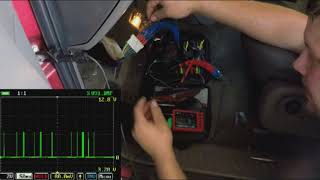
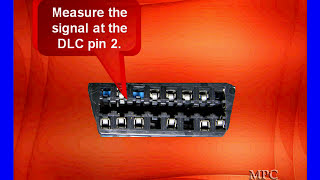
On a GM Class 2 system, the data line (Pin 2 at the OBD-II port) fluctuates around 0-7V. If stuck at 12V or 0V, a module is shorted. On CAN bus systems, resistance between Pins 6 and 14 should be 60 ohms. 120 ohms indicates a broken wire.
Tools: Digital Multimeter, Vehicle-Specific Wiring Diagram (Advanced) - Isolate the Faulty Module (Splice Pack Method)
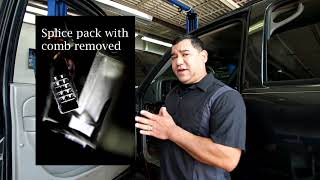
On GM vehicles, communication wires meet at a 'splice pack'. Unplug this pack and remove the connecting comb. Test each line individually with a multimeter to pinpoint which module is shorting the network.
Tools: Multimeter, Trim Removal Tools, Wiring Diagram (Professional)
When This Code Triggers (Freeze-Frame Conditions)
- Fault Trigger: Communication Timeout (Sets when the ABS module fails to send a 'State of Health' message for 2-5 seconds.)
- Vehicle Speed: 0 MPH (Logs immediately at key-on or during startup before the vehicle moves, indicating a hard electrical fault.)
- Battery Voltage: 9V - 11.5V (Triggers during engine cranking when system voltage momentarily dips below the module's operating threshold.)
- Engine Coolant Temp: Variable (Thermal cycling (hot/cold) expands and contracts failing solder joints within the module, causing intermittent communication loss.)
Related Codes
- U0121 — The modern CAN bus equivalent of U1040. U1040 is specific to older GM vehicles using the Class 2 protocol, while U0121 indicates the exact same ABS communication loss on 2008+ vehicles.
- U1000 — A general communication failure code. If U1040 and U1000 appear together, it strongly points to a network-wide problem rather than an isolated ABS module failure.
- U1064 — Indicates a loss of communication with the Body Control Module (BCM). Appearing with U1040 suggests a shared wiring fault, splice pack issue, or power/ground problem affecting multiple modules.
- C0265 — Points to an internal relay failure inside the Electronic Brake Control Module (EBCM). Seeing this alongside U1040 confirms the ABS module itself requires replacement or rebuilding.
Climate & Environmental Factors
- Road Salt / High Humidity: Salt and moisture accelerate corrosion of the ABS module's electrical connector and the main ground connection on the vehicle's frame, increasing electrical resistance and causing communication loss.
- Extreme Cold/Heat Cycles: Thermal cycling causes microscopic cracks in the solder joints on the ABS module's internal circuit board, leading to intermittent connections that fail when the module is hot or cold.
How to Talk to a Mechanic About This Code
Say this: "I have an ABS light on and my scanner shows a U1040 code, indicating a loss of communication with the ABS module. I'd like to book a diagnostic appointment. Please start by checking the fuses, the main ground connection, and testing for power and ground at the connector before quoting a module replacement."
This signals you understand the most common and cheapest causes for this code. It directs the shop to perform a proper electrical diagnosis first, preventing an immediate and potentially unnecessary ABS module replacement quote.
Avoid saying:
- 'My ABS light is on, can you fix it?'
- 'Just replace the ABS module.'
- 'I have a U1040, just fix whatever is wrong.'
Questions to ask before authorizing the repair:
- Did you test for battery voltage and a good ground at the ABS module's main connector?
- Was the main ground connection on the frame inspected for corrosion?
- If recommending a module replacement, what tests ruled out a wiring issue or a data network problem?
- Does the quoted price for a new module include programming it to my vehicle?
Where to Take It: Dealer vs Independent vs Chain
- Dealer:
A strong, but expensive, choice. They are best equipped to handle programming and manufacturer-specific diagnostic trees.
Best for: Vehicles under warranty., Complex, manufacturer-specific issues like the GM no-start or Nissan alternator quirk., When you want a guaranteed fix with OEM parts and programming.
Downsides: Highest labor rates and parts costs., Defaults to replacing entire assemblies rather than repairing wires. (Typical cost: +50% vs. baseline) - Independent Shop:
Best overall fit, provided you find a reputable shop with good reviews for electrical diagnostics. They are more likely to attempt a cost-effective wiring repair first.
Best for: Out-of-warranty vehicles where cost is a factor., Diagnosing common electrical faults like bad grounds or broken wires., Vehicles with well-documented issues like the GM truck frame ground.
Downsides: Diagnostic skill varies greatly; a shop without strong electrical experience will struggle., May lack the dealer-level scan tools required for programming replacement modules. (Typical cost: +0% vs. baseline) - Chain Shop:
Avoid for this code. The risk of a misdiagnosis is extremely high.
Best for: Simple jobs like battery replacement.
Downsides: Not recommended for complex electrical or network diagnostics., Technicians lack the specialized training and equipment for this fault, leading to misdiagnosis. (Typical cost: -10% vs. baseline)
When to Walk Away From the Repair
If the estimated repair cost exceeds 50% of the car's private-party value, seriously consider selling or trading it in rather than fixing it.
- Car worth $4000, fix is $2200: Walk away. The repair cost is over 50% of the car's value.
- Car worth $12000, fix is $1500: Fix it. The repair cost is well below the threshold and restores a critical safety system.
- Car worth $3000, fix is $200: Fix it. A $200 repair for a wiring or ground issue is a great investment to keep a running vehicle on the road.
What Scan Tool You Need for This Code
Minimum: A scanner that reads manufacturer-specific 'U' codes and accesses the ABS module. Basic engine-only code readers will not see this code.
A $20 reader from a parts store only checks generic engine codes ('P' codes) and reports 'No Codes Found', even with the ABS light on.
Budget: BlueDriver Pro Scan Tool (~$100) — Reads and clears ABS codes for most major brands, shows live data, and provides repair reports.
Mid-range: Foxwell NT510 Elite (~$180) — Provides full-system diagnostics and bi-directional controls to perform active tests on the ABS system.
Professional: Autel MaxiCOM MK808 / MK900 series (~$500-800) — Offers full bidirectional control, OE-level diagnostics, and performs special service functions like the automated ABS bleed procedure.
Rent vs buy: Free rental tools at auto parts stores are basic readers and will NOT read ABS codes. Buying a capable scanner is a worthwhile investment.
How to Clear the Code After You Fix It
- Fix the underlying electrical or module fault.
- Reconnect the battery if disconnected.
- Use an OBD-II scan tool to clear the U1040 code from all modules.
- Perform the manufacturer-specific drive cycle to reset emissions monitors.
Drive cycle (~30 minutes): 1. Cold Start: Engine coolant temp below 122°F. 2. Idle for 3 minutes with A/C and rear defroster on. 3. Accelerate to 55 MPH at half-throttle and hold for 5 minutes. 4. Coast down to 20 MPH without braking. 5. Accelerate to 60 MPH at 3/4 throttle and hold for 5 minutes. 6. Stop and allow the vehicle to cool.
Readiness monitors affected: Catalyst monitor, Evaporative System (EVAP) monitor, Oxygen (O2) Sensor monitor, EGR System monitor
Before emissions retest: drive at least 50 miles to fully set monitors.
Watch out for:
- Disconnecting the battery resets readiness monitors to 'Not Ready', causing an automatic emissions failure.
- The code returns immediately on the next key cycle if the root cause is not fixed.
Will This Fail Emissions / State Inspection?
Yes — this code typically fails an OBD-II emissions inspection.
- California: Automatic fail. Any diagnostic trouble code that illuminates a malfunction indicator lamp or prevents OBD readiness monitors from completing results in failure.
- New York: Likely pass, but law may change. Currently, an illuminated ABS light is advisory. However, if the code illuminates the main Check Engine Light, it is an automatic failure.
- Texas: Automatic fail in emissions counties. The presence of a U1040 code during the OBD-II scan causes an automatic failure in counties requiring emissions testing.
Most Commonly Affected Vehicles
- Cadillac SRX (2004-2009) — Prone to this code causing a no-start condition or stuck key. GM TSB PIC5460B points to intermittent faults in the Class 2 data wire or power/ground feeds to the EBCM.
- Chevrolet Trailblazer (2002-2009) — Frequently caused by corrosion at the under-vehicle EBCM connector or a poor ground connection on the frame rail beneath the driver's door due to road salt exposure.
- GMC Envoy (2002-2009) — Shares the Trailblazer platform and common issues. Diagnosing via the splice pack is a required professional technique for these vehicles.
- Pontiac Grand Am / Aztek (2000-2005) — Experiences this code due to intermittent power or ground issues related to the ignition switch or chafed wiring harnesses in the engine bay.
- Buick Regal / LeSabre / Century (2000-2005) — Issues with the Class 2 data line originate from a failing EBCM that shorts the network or from corroded wiring.
- Nissan Rogue, Altima, Qashqai (2015-2019) — U1040 is often a misleading code here. The true culprit is a faulty alternator or active grill shutter pulling down the shared LIN communication bus, not a bad ABS module.
- Ford F-150, Fusion (2008-2015) — Known for internal ABS controller module failures requiring full module replacement after confirming power and ground are intact.
- Harley-Davidson Touring Models (2010-2019) — Triggered by aftermarket accessories, like stereos or amplifiers, that are improperly wired and interfere with the bike's data communication network.
Manufacturer-Specific Notes
- General Motors (GM): A faulty ABS module interrupts the Class 2 data line, preventing the car from starting or causing the climate control to act erratically. TSB PIC5460B addresses this specific no-start condition.
- Nissan: The U1040 code is a red herring caused by a failure of the alternator or active grille shutter sharing the LIN data bus. Unplugging the alternator restores communication, isolating the true fault.
- Saturn: U1040 appears on vehicles not equipped with ABS if the main computer (PCM) was replaced with one from a donor car that had ABS, causing the computer to search for a non-existent module.
- Harley-Davidson: An improperly installed aftermarket stereo head unit interferes with the serial data bus, causing a persistent U1040 code. Disconnecting the data wire from the accessory resolves the code.
Real Owner Stories
2007 Chevy Trailblazer, mileage unknown
ABS and Brake lights were on, and climate control was not working. Scan tool could not communicate with any modules with the key in the 'On' position, showing code U1040.
What they tried:
- Checked data line voltage at the diagnostic port, which showed over 10 volts instead of the correct 0-7V signal.
- Located the Class 2 splice pack under the dash to test individual module communication lines.
- Removed the connecting comb and tested each pin, finding one outputting the incorrect high voltage.
- Traced that specific wire back to the Electronic Brake Control Module (EBCM).
Outcome: Unplugging the main connector at the EBCM caused the data line voltage to return to normal, restoring communication with all other modules. This confirmed an internal fault in the EBCM was shorting the network. The fix was replacing the EBCM.
Lesson: On older GM vehicles, a single faulty module takes down the entire communication network. Using the splice pack to isolate modules is a mandatory professional diagnostic technique.
2017 Nissan Rogue SV, 35K miles
Battery light came on, but the car ran fine. A shop confirmed the alternator was charging but logged communication fault codes U1040 and U1044.
What they tried:
- The shop recommended replacing the alternator, but the owner declined since it was still charging.
- The owner continued driving, leading to a dead battery and parasitic drain problems.
Outcome: The root cause on these Nissan models is a failure in the alternator's internal communication circuit. Even though it produces a charge, it disrupts the LIN bus shared with the ABS, causing communication codes. The fix is replacing the alternator.
Lesson: Don't dismiss a communication code just because the primary function of a part seems okay. Communication failure is a sign of impending total failure.
2013 Harley-Davidson Ultra Limited
After installing an aftermarket Rockford PMX head unit, the bike would start and stall, cruise control failed, and it constantly logged code U1040.
What they tried:
- Replaced the ECM and the ABS module, but the problem persisted.
- Disconnected the serial data wire from the new aftermarket head unit.
Outcome: Disconnecting the data wire from the aftermarket stereo immediately solved the stalling and cruise control issues. The aftermarket accessory was interfering with the bike's data bus.
Lesson: If a U1040 code appears immediately after installing aftermarket electronics, disconnect the new accessory first before replacing expensive OEM modules.
How to Prevent This Code From Triggering
- Apply dielectric grease to key electrical connectors (Once, or whenever connectors are disconnected) — Dielectric grease seals out moisture and salt, preventing corrosion on the pins of critical connectors like the main ABS module harness.
- Clean and protect the main ABS ground point (Every 5 years or during brake service in rust-prone areas) — Periodically unbolting the chassis ground, cleaning it to bare metal, and applying a corrosion inhibitor ensures the module maintains a solid ground path.
- Regularly wash the vehicle's undercarriage (Monthly during winter in 'Salt Belt' regions) — Rinsing away corrosive road salt reduces the rate of corrosion on the vehicle frame and exposed wiring harnesses.
- Inspect and secure wiring harnesses (During oil changes or other maintenance) — Securing loose wiring harnesses with zip ties prevents chafing against sharp metal edges or high-heat sources.
Frequently Asked Questions
Can I fix a U1040 code myself?
Maybe. Simple fixes like replacing a fuse or cleaning a ground connection are very DIY-friendly. However, diagnosing wiring problems or replacing the ABS module requires special tools and programming expertise.
How much does it cost to fix a U1040 code?
The cost ranges from $5 for a fuse to over $1,500 for a new module. Repairing wiring costs $150-$450 in labor, while rebuilding your existing module costs $150-$400. A full replacement runs $600 to $1,500 including parts, labor, and programming.
Will clearing the code fix the problem?
No. Clearing the code only turns off the warning lights temporarily. The code returns on the next key cycle as soon as the computer detects the communication loss again.
What's a common misdiagnosis for U1040?
A common mistake is immediately replacing the ABS module without checking the wiring. The actual cause is usually a simple power, ground, or wiring issue. On Nissan vehicles, a faulty alternator triggers this code, misleading mechanics into replacing the ABS module.
My brakes feel fine. Is the U1040 code a serious problem?
Yes, it is a serious safety issue because your ABS and stability control are disabled. Your normal hydraulic brakes still stop the car, but you lose the crucial safety feature that prevents wheel lock-up. This significantly increases the risk of skidding during an emergency stop.
Can a bad ABS module drain my battery?
Yes. An internally shorted ABS module fails to shut down properly when the car is turned off. This causes the ABS pump to run continuously or creates a parasitic draw that drains the battery overnight.
What is a 'Class 2' or 'LIN bus' data line?
These are communication networks vehicles use to let computers talk to each other. Class 2 is an older GM protocol operating on a 0-7 volt signal, while LIN is a simpler network used for alternators. If one module on these single-wire lines fails, it disrupts communication for the entire network.
Key Takeaways
- Code U1040 triggers when the Anti-lock Brake System (ABS) module fails to send its required 'State of Health' signal for 2 to 5 seconds.
- Check the ABS module's main chassis ground and fuses first, as simple electrical connection failures cause the majority of U1040 codes.
- Driving with a U1040 code increases emergency stopping distances by up to 45 feet from highway speeds due to disabled ABS and traction control.
- On early 2000s GM vehicles, a U1040 code frequently causes a complete no-start condition by shorting the shared Class 2 data line.
Helpful Videos



The information in this article is provided for general reference and educational purposes only. Vehicle specifications, procedures, and part compatibility can vary by production date, trim level, and region. Always consult your vehicle's factory service manual and verify part numbers before purchasing or performing repairs. Safety-critical components such as airbags, seat belts, and braking systems should be installed by a qualified professional.
- 🎬 Helpful Videos
- What Does U1040 Mean?
- Can I Drive With U1040?
- Common Causes
- Symptoms
- Diagnostic Flowchart
- Common Fixes & Costs
- Used vs. New Parts: Buying Guide
- What Happens If You Wait — Timeline
- Cost of Not Fixing It
- Diagnosis Steps
- When This Code Triggers (Freeze-Frame Conditions)
- Related Codes
- Climate & Environmental Factors
- How to Talk to a Mechanic About This Code
- Where to Take It: Dealer vs Independent vs Chain
- When to Walk Away From the Repair
- What Scan Tool You Need for This Code
- How to Clear the Code After You Fix It
- Will This Fail Emissions / State Inspection?
- Most Commonly Affected Vehicles
- Manufacturer-Specific Notes
- Real Owner Stories
- 2007 Chevy Trailblazer, mileage unknown
- 2017 Nissan Rogue SV, 35K miles
- 2013 Harley-Davidson Ultra Limited
- How to Prevent This Code From Triggering
- Frequently Asked Questions
- Can I fix a U1040 code myself?
- How much does it cost to fix a U1040 code?
- Will clearing the code fix the problem?
- What's a common misdiagnosis for U1040?
- My brakes feel fine. Is the U1040 code a serious problem?
- Can a bad ABS module drain my battery?
- What is a 'Class 2' or 'LIN bus' data line?
- Key Takeaways
- 🎟️ Get 5% Off