

OBD-II Code U1030: Lost Communication / Data Bus Malfunction
What U1030 means, why it triggers, and how to fix it
- U1030 indicates a network communication failure, meaning one of your vehicle's modules failed to receive a required message within a 5-second window.
- On 2010-2015 Volkswagen models, a failed radiator identification sensor causes the vast majority of U1030 codes and costs about $70 to fix yourself.
- Always test the battery to ensure it produces at least 12.4 volts before spending $300 or more replacing suspected control modules.
- Use a full-system OBD-II scanner to read all modules; a basic $20 engine code reader will miss the specific module causing the network fault.
What Does U1030 Mean?

U1030 is a network communication code indicating a vehicle computer (module) detected invalid or missing data from another module on the CAN bus. The code sets when a control module fails to receive an expected message within a 5-second window. It means a module has stopped transmitting or is sending corrupted data.
Technical definition: The SAE/ISO definition for U1030 is 'Lost Communication with [Module]' or 'Local Data Bus Electrical Malfunction'. The primary computer logs this code when a required data packet from a secondary module is not received within the programmed timeframe.
Can I Drive With U1030?
Yes, But With Caution. You can drive with a U1030 code, but address it promptly. It often only triggers a Check Engine Light, but causes poor engine performance, erratic gauges, or HVAC malfunctions depending on the affected module. Do not drive if critical systems like ABS or stability control are disabled. Ignoring a limp mode condition causes secondary damage, like a melted catalytic converter, adding $800-$2500 to repair costs.
Common Causes

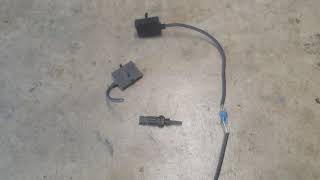
- Faulty Radiator Identification Sensor (VW Models) (Very Common) — Extremely common on Volkswagen models (GTI, Jetta) with PZEV emissions systems. The G611 sensor fails and stops confirming the correct radiator is installed, triggering U1030 alongside U102E or U102F. 🎬 Watch: How to fix the VW radiator sensor issue.
- Damaged or Corroded CAN Bus Wiring (Common) — The communication network relies on a pair of twisted wires. If these wires fray, short together, or corrode from water intrusion, modules cannot communicate. This is highly prevalent in regions using road salt.
- Poor Electrical Grounds (Common) — Computer modules require a solid ground connection to the chassis. A loose or corroded ground strap causes voltage fluctuations that disrupt communication. This is a frequent issue on GM trucks and Ford models.
- Low Battery Voltage (Common) — Modern vehicle computers are highly sensitive to voltage drops. A weak battery (under 12.4V) or failing alternator causes modules to temporarily shut down and drop off the network.
- Aftermarket Component Interference (Common) — Improperly installed remote starters, alarms, or stereos tapped into the CAN bus introduce signal noise or draw excessive power, corrupting network data.
- Failing Control Module (Less Common) — A specific computer, like the Engine Control Module (ECM) or ABS module, fails internally. When it stops communicating, other modules report its absence via a U-code.
- Faulty Intelligent Power Distribution Module (Nissan) (Uncommon) — On Nissan Titans and Armadas, the IPDM fails due to internal circuitry issues, causing stalling, no-start conditions, and U1030 codes.
- HVAC Control Module or LIN Bus Fault (Audi) (Uncommon) — On certain Audi models, U1030 is triggered by a fault in the climate control module, pointing to an electrical issue on the LIN bus sub-network.
Symptoms

- Illuminated Check Engine Light — The most common and often the only symptom noticed by the driver.
- Erratic Engine Behavior or Limp Mode — The engine idles roughly, hesitates, or enters a low-power limp mode if powertrain communication is lost.
- Multiple Warning Lights — ABS, traction control, or airbag lights illuminate simultaneously as multiple systems lose network data.
- Reduced Fuel Economy — Gas mileage drops significantly if the fault forces the engine into a rich-fuel default map.
- No-Start or Stalling Condition — The engine fails to crank or stalls while driving if the ECM loses communication with the power distribution module (common on Nissans).
- HVAC System Malfunction — The blower motor stops working or gets stuck on a single setting if the climate control network fails.
Diagnostic Flowchart

Tap your situation to follow the diagnostic path that matches what you're seeing on this code.
Common Fixes & Costs
- Replace Radiator Identification Sensor (VW)
— Parts: $70-$220, Labor: $100-$300, ~2 hr book time
(Intermediate)
DIY Alternative for VW: OEM
Volkswagen GTI/Jetta (CBFA): OEM - Clean Grounds and Repair Wiring
— Parts: $5-$50, Labor: $150-$600, ~2.5 hr book time
(Intermediate)
Chevrolet Silverado (2007-2013): OEM - Replace Intelligent Power Distribution Module (Nissan)
— Parts: $230-$400, Labor: $100-$200, ~0.8 hr book time
(Intermediate)
Nissan Titan/Armada (2006-2010): OEM - Replace Failed Control Module (BCM/ECM/ABS)
— Parts: $300-$1500, Labor: $150-$500, ~2.5 hr book time
(Professional)
Ford F-150 (2013, 3.5L): OEM - ECU Reprogramming / Software Update — Parts: $0, Labor: $100-$300, ~1.5 hr book time (Professional)
- Professional Electrical Diagnosis — Parts: $0, Labor: $125-$250, ~1.5 hr book time (Professional)
DIY vs Professional
- Replace Radiator Identification Sensor (VW) — Beginner: No
Tools: Soldering iron, wire strippers, heat shrink tubing, basic hand tools. - Clean Grounds and Repair Wiring — Beginner: Yes
Tools: Socket set, wire brush, sandpaper, dielectric grease, multimeter. - Replace Intelligent Power Distribution Module (Nissan) — Beginner: Yes
Tools: Basic hand tools. - Replace a Failed Control Module — Beginner: No
Tools: Socket set, OEM programming software.
Used vs. New Parts: Buying Guide
When a used part is worth it: For electronic modules like a PCM or Nissan IPDM, a used part from a reputable salvage yard is cost-effective for older vehicles, provided the part numbers match exactly.
Donor-vehicle mileage cap: roughly under 100000 miles for the part to have meaningful remaining life.
Donor quality checklist:
- Match the part number EXACTLY. Superseded versions are often not interchangeable.
- Verify the donor vehicle was not scrapped for flood damage.
- Choose parts from vehicles in dry climates to minimize hidden corrosion.
- Ensure the seller offers at least a 90-day warranty.
Decision logic:
- If The part requires programming (e.g., Ford PCM) → Favor a new part or a specialized 'repair and return' service to avoid programming headaches.
- If The part is known to be plug-and-play (e.g., early Nissan IPDM) → A used part is a reasonable choice if the part number matches perfectly.
- If The vehicle is less than 10 years old and the budget allows → Buy a new OEM part for the best reliability and warranty.
Warranty tradeoff: Used parts typically come with a 30-90 day part-only warranty. New aftermarket parts offer 1-year warranties. New OEM parts offer the best warranty but at the highest cost.
Worst-case if a used part fails: $500-$1500 if a used module fails, requiring repeat labor for removal, installation, and programming.
What Happens If You Wait — Timeline
- 0-1 month: Check Engine Light illuminates. Vehicle fails OBD-II emissions tests. Intermittent electronic glitches may occur. (MPG impact: 0-5%% · Added cost: $0)
- 1-4 months: If the fault triggers limp mode, engine power is reduced. Fuel economy worsens as the engine runs a rich fuel map. (MPG impact: 10-20%% · Added cost: $50-$150 in wasted fuel)
- 4-12 months: Continued driving with a rich fuel mixture overheats and melts the catalytic converter. Stalling events become frequent. (MPG impact: 20-30%+% · Added cost: $1000-$2500)
- 12+ months: A completely failed module or severe wiring short leaves the vehicle stranded with a no-start condition. (MPG impact: N/A% · Added cost: $200-$500)
Cost of Not Fixing It
- 0-1 month: Annoying Check Engine Light and an automatic emissions test failure. Minor drop in fuel economy if the engine runs in limp mode. (Added cost: Negligible)
- 1-6 months: If the communication fault causes the engine to run consistently rich, it overheats and destroys the catalytic converter. (Added cost: $1000-$3000)
- 6+ months: Continued operation with a severe communication fault leads to unpredictable stalling or no-start conditions, requiring a tow. (Added cost: $200-$500)
Diagnosis Steps
- Read All Trouble Codes from All Modules
Use a full-system OBD-II scanner to access the ECM, BCM, TCM, and ABS. Reading only generic engine codes misses the root cause. Codes appearing alongside U1030 identify which specific module is failing.
Tools: ['Full-System OBD-II Scanner'] (Basic) - Check Battery and Charging System
Verify the battery reads above 12.4 volts with the engine off and 13.5-14.5 volts with the engine running. A weak battery causes random communication faults and must be ruled out first.
Tools: ['Digital Multimeter'] (Basic) - Perform a Visual Inspection
Check for corroded battery terminals, loose ground straps on the engine and chassis, and visible damage to wiring harnesses near hot exhaust or aftermarket electronics.
Tools: ['Flashlight'] (Basic) - Test the CAN Bus Resistance
With the battery disconnected, measure resistance between Pin 6 (CAN High) and Pin 14 (CAN Low) on the OBD-II port. A healthy network reads 60 ohms. 120 ohms indicates a broken circuit or unplugged module; 0 ohms indicates a short.
Tools: ['Digital Multimeter'] (Intermediate) - Inspect Network Wiring and Connectors
Locate the suspected failing module. Unplug its connector and inspect for corrosion, bent pins, or water damage. Trace the harness looking for chafing.
Tools: ['Flashlight', 'Pick Tool'] (Intermediate) - Check CAN Bus Voltage
With the battery connected and key ON (engine OFF), check DC voltage at the OBD-II port. Pin 6 should read 2.5-3.5V; Pin 14 should read 1.5-2.5V. Fluctuating or stuck voltages indicate a short.
Tools: ['Digital Multimeter'] (Intermediate) - Isolate the Faulty Module
If CAN bus resistance is incorrect, unplug modules one by one until the reading returns to 60 ohms. This pinpoints the exact module or wiring section causing the network failure.
Tools: ['Digital Multimeter', 'Vehicle Wiring Diagram'] (Advanced) - Monitor Live Data PIDs
Using a professional scan tool, monitor data from suspected modules. If a module reports blank data (e.g., missing wheel speed sensor data from the ABS), it confirms a module-level failure.
Tools: ['Professional Bi-Directional Scan Tool'] (Advanced) - Use an Oscilloscope for Signal Analysis
Connect an oscilloscope to CAN High and CAN Low to view the digital square wave. Signal noise or a flat line definitively identifies electrical shorts or interference that a multimeter misses.
Tools: ['Automotive Oscilloscope', 'Back-probe Pins'] (Advanced) - Fuel Pressure Test (for No-Start)
If U1030 is accompanied by a crank-no-start (common on Nissans), verify fuel pressure at the rail. Zero pressure suggests the module powering the fuel pump (like the IPDM) is offline.
Tools: ['Fuel Pressure Gauge'] (Advanced)
When This Code Triggers (Freeze-Frame Conditions)
- Engine Coolant Temp: 180-210°F (82-99°C) (Vehicle is at full operating temperature.)
- RPM: 1500-2500 RPM (Steady-state cruise or light acceleration.)
- Vehicle Speed: 45-65 mph (Often occurs during highway driving.)
- Battery Voltage: 13.5-14.5 Volts (Normal charging system operation; the fault is not typically due to low system voltage at the exact moment it logs.)
Related Codes
- U102E / U102F — On VWs, these mean 'Lost Communication with Radiator Fan Identification Sensor'. Seeing them with U1030 points directly to the radiator sensor circuit.
- U0100 — Means 'Lost Communication With ECM/PCM'. U0100 is set by a secondary module that can't hear the engine computer, whereas U1030 is often set by the engine computer when it can't hear a secondary module.
- P0299 — Turbocharger Underboost. If the ECM sets U1030 and enters limp mode, it limits turbo boost, triggering P0299 as a secondary symptom.
- U0001 — High Speed CAN Communication Bus. Indicates a general failure of the entire high-speed network (like a dead short), rather than invalid data from a specific module.
Climate & Environmental Factors
- Hot Weather: On Volkswagen models, heat increases electrical resistance within the failing G611 radiator sensor, pushing it outside operational parameters and triggering the code.
- High Humidity / Road Salt: Salt and moisture accelerate corrosion on exposed copper wires, connector pins, and chassis ground points, directly causing communication failures.
How to Talk to a Mechanic About This Code
Say this: "I have a U1030 communication code. I need a technician to perform a full-system scan to see which modules are reporting errors. Please check the battery, main ground connections, and CAN bus wiring before recommending any module replacements."
Signals you understand U1030 is a network problem requiring methodical diagnosis. It guides the shop to check basics first, preventing premature and expensive module replacements.
Avoid saying:
- 'Just fix whatever's wrong'
- 'My check engine light is on, can you look at it?'
- 'Whatever you recommend'
Questions to ask before authorizing the repair:
- Did you get a list of codes from all the vehicle's modules?
- Did you test the CAN bus resistance between pins 6 and 14?
- If recommending a module replacement, did you verify its power and ground connections?
- Does the replacement module require programming, and is that cost included?
Where to Take It: Dealer vs Independent vs Chain
- Dealer:
Best for: Vehicles under warranty, Complex, brand-specific electrical issues, Repairs requiring manufacturer software updates
Downsides: Highest labor rates and parts costs., Defaults to replacing entire assemblies (like the VW radiator) instead of component-level fixes. (Typical cost: +50% vs. baseline) - Independent Shop:
A good choice if you select a top-tier independent shop specializing in electrical diagnostics. Ask if they have an all-system scan tool.
Best for: Out-of-warranty vehicles., Common, well-documented U1030 causes like bad grounds or Nissan IPDM failures.
Downsides: General mechanics may lack specific tools for network diagnosis., May not have access to dealer-level software for module programming. (Typical cost: +0% vs. baseline) - Chain Shop:
AVOID for diagnosis. They are highly likely to misdiagnose a network fault and recommend expensive, incorrect repairs.
Best for: Confirming the issue is a simple-to-replace battery.
Downsides: Business model is not designed for complex electrical diagnostics., High risk of misdiagnosis and unnecessary parts replacement. (Typical cost: -10% vs. baseline)
When to Walk Away From the Repair
If estimated repair cost exceeds 40-50% of the car's KBB private-party value, consider trading it in or selling it as-is.
- Car worth $4000, fix is $2000: Borderline — get a 2nd opinion before authorizing
- Car worth $12000, fix is $1800: Fix it — well below threshold
- Car worth $2500, fix is $1500: Walk away — list for sale or scrap
What Scan Tool You Need for This Code
Minimum: A scanner that performs an 'All-System Scan' to read codes from every module (ECM, BCM, ABS, TCM).
A basic $20 code reader only shows the U1030 code from the Engine Control Module. It won't tell you which secondary module is offline, leaving you guessing at the cause.
Budget: BlueDriver Pro Scan Tool (~$100) — Connects to your smartphone and reads manufacturer-specific codes from all major modules, providing the necessary clues to find the failing system.
Mid-range: Autel MaxiCOM MK808 / MX808 (~$350) — Provides a dedicated tablet interface for full-system diagnostics and shows live data from all modules to verify if a suspect module is transmitting.
Professional: Autel MaxiSys MS906BT / MK906BT (~$900-1200) — Offers full bidirectional control, advanced topology mapping to visualize the network, and OEM-level diagnostic functions for programming.
Rent vs buy: For a one-time diagnosis, try a 'Loan-A-Tool' program. BEWARE: many free rental scanners are basic code readers and cannot perform the required all-system scan. Buy a tool if you diagnose vehicles more than once a year.
How to Clear the Code After You Fix It
- Reconnect the battery if it was disconnected for the repair.
- Use an OBD-II scan tool to perform a 'Clear All Codes' function to reset the Check Engine Light and emissions monitors.
- Perform a complete OBD-II drive cycle to allow the vehicle's computers to re-run self-tests.
Drive cycle (~30 minutes): A generic drive cycle includes a cold start, 3 minutes of idling, steady highway driving at 55-60 mph for 15 minutes, followed by stop-and-go city driving for 10 minutes.
Readiness monitors affected: Catalyst (CAT) Monitor, Evaporative System (EVAP) Monitor, Oxygen (O2) Sensor Monitor, Oxygen Sensor Heater Monitor
Before emissions retest: drive at least 100 miles to fully set monitors.
Watch out for:
- Disconnecting the battery does not reliably clear codes and resets readiness monitors to 'Not Ready'.
- The code returns immediately if the root electrical cause is not fixed.
- Failing to complete a full drive cycle results in an emissions test failure due to 'Not Ready' monitors.
Will This Fail Emissions / State Inspection?
Yes — this code typically fails an OBD-II emissions inspection.
- California: An active U1030 code is an automatic failure. After repair, all readiness monitors must be 'Ready' to pass the re-test.
- New York: Any active diagnostic trouble code that illuminates the Malfunction Indicator Lamp (MIL) results in a test failure.
- Texas: A vehicle fails the OBD inspection if the Check Engine Light is commanded on for any fault, including U1030.
Most Commonly Affected Vehicles
- Volkswagen GTI / Golf (Mk6) (2010-2014) — Extremely prone to U1030 due to failure of the G611 radiator identification sensor on PZEV models (CBFA engine). Often appears with U102E/U102F.
- Volkswagen Jetta (2011-2015) — Shares the same PZEV emissions system and faulty radiator sensor design as the Mk6 GTI.
- Ford F-150 (2010-2018) — U1030 appears with other U-codes during a loss of communication with the PCM, frequently caused by bad grounds or a corroded wiring harness.
- Chevrolet / GMC Silverado / Sierra (2007-2013) — Known for poor main engine-to-chassis grounds. Corroded grounds cause a host of communication codes, including U1030.
- Ford C-MAX (2013-2015) — TSB 15-0129 addresses a U1030 code set in the Battery Energy Control Module (BECM) after reprogramming. The fix is a software update.
- Audi Q7 (2016-2019) — U1030 in the Climatronic module indicates an electrical malfunction on the LIN bus, causing the A/C to stop working.
- Nissan Titan / Armada (2004-2015) — Communication issues and stalling are traced to a failing Intelligent Power Distribution Module (IPDM). Early 'white-housing' IPDMs are a common failure point.
- Mazda 3 (2007-2012) — Communication codes are triggered by an internal failure of the ABS/DSC module, which stops communicating on the CAN bus.
Manufacturer-Specific Notes
- Volkswagen: Dealers replace the entire radiator for over $700 to fix the U1030 sensor issue. A popular DIY fix splices in a Mercedes-Benz sensor (A2219055600) for under $100.
- General Motors (GM): A rash of U-codes on trucks and SUVs is almost always traced back to a corroded main ground connection at the engine block or frame.
- Ford: TSB 15-0129 for 2013-2015 C-MAX models requires a Programmable Module Installation (PMI) on the BECM to resolve U1030 software glitches.
- Nissan: Early 'white-housing' IPDMs are highly prone to internal failure, causing no-starts and U-codes. They were superseded by a more reliable 'black-housing' version.
Real Owner Stories
2013 VW GTI (CBFA Engine) - Intermittent CEL
Check Engine Light appeared intermittently during hot weather (90°F+). Scan tool showed codes U1030, U102E, and U102F. No noticeable driving issues.
What they tried:
- Cleared codes, but they returned.
- Attempted the DIY fix of splicing in a Mercedes-Benz radiator sensor (A2219055600).
Outcome: The DIY Mercedes sensor splice, costing $70 in parts, successfully cleared the codes and passed emissions.
Lesson: On a PZEV VW, U1030 with U102E/F points directly to the radiator ID sensor. The DIY splice is highly effective and saves hundreds over a dealer radiator replacement.
2007 Nissan Titan - Crank No-Start & Stalling
Vehicle lost power while driving, chugged, and then would only crank but not start. Battery and brake lights flashed, but no codes were stored initially.
What they tried:
- Replaced Cam Position Sensors.
- Swapped the ECM relay.
- Suspected the fuel pump.
Outcome: The root cause was a faulty Intelligent Power Distribution Module (IPDM). Replacing the IPDM resolved the no-start and stalling conditions.
Lesson: On older Nissan trucks, a sudden no-start or stalling condition is highly suspicious of an IPDM failure. Investigate the IPDM before replacing the ECM or fuel pump.
Ford F-150 - Multiple Warning Lights
Owner experienced multiple U-codes including U1030, along with ABS and Traction Control lights. The truck drove normally.
What they tried:
- Checked battery and alternator.
- Visually inspected wiring harnesses.
- A shop suggested replacing the ABS module for $1000.
Outcome: The problem was a corroded main chassis ground connection under the driver's side door. Cleaning the ground point resolved all codes for less than $10.
Lesson: A flurry of communication codes across different modules points to a foundational electrical issue. Always clean major power and ground connections before replacing expensive modules.
How to Prevent This Code From Triggering
- Clean Battery Terminals and Chassis Grounds (Annually or every 15,000 miles) — Corrosion creates resistance, leading to voltage drops and electrical noise that disrupt module communication.
- Apply Dielectric Grease to Exposed Connectors (Whenever a connector is unplugged) — Seals electrical connectors against moisture intrusion and corrosion, which are primary causes of communication faults.
- Perform Regular Undercarriage Washes (Monthly in winter) — Removes corrosive road salt before it damages CAN bus wiring and ground points.
- Inspect Wiring Harnesses for Damage (During every oil change) — Identifies chafing against sharp metal or hot exhaust before it causes a short circuit.
- Test Battery Health (Annually in Autumn) — Identifies a weak battery before cold weather causes voltage drops that trigger communication codes.
Frequently Asked Questions
What are the most common misdiagnosis mistakes with a U1030 code?
The biggest mistake is replacing an expensive control module without testing the battery and grounds first. Another common error is using a basic code reader that only checks the engine computer. You must use a full-system scanner to identify which specific module is offline.
Can an aftermarket part cause a U1030 code?
Yes. Poorly installed remote starters, alarms, and stereos frequently disrupt network communication. If spliced incorrectly into the CAN bus, they corrupt data signals and trigger U-codes.
Can I just clear the U1030 code and keep driving?
You can clear it, but the code will return if the underlying electrical fault remains. While it may not immediately affect drivability on some cars, ignoring it masks a failing component.
Will a U1030 code cause me to fail an emissions test?
Yes. A U1030 code illuminates the Check Engine Light, resulting in an automatic failure for OBD-II emissions tests. You must repair the fault and complete a drive cycle to pass.
Why does this code appear more often in hot weather?
On affected Volkswagen models, heat increases electrical resistance inside the failing radiator identification sensor. This pushes the sensor outside its normal operating range, triggering the U1030 fault.
I replaced the VW radiator sensor but the code came back. What now?
Double-check your wiring splices to ensure they are secure and weatherproof. Some aftermarket sensors are defective out of the box. If the sensor and splices are good, the wiring harness between the sensor and the ECM is likely damaged.
What is a CAN bus?
The Controller Area Network (CAN) bus is the primary communication network connecting your car's computers. It consists of two twisted wires that transmit data between modules like the engine, transmission, and brakes.
Is it expensive to fix a U1030 code?
Costs range from $0 for a simple ground cleaning to over $1,000 for a new control module. A proper diagnosis costs $125-$250. The common VW radiator sensor DIY fix costs under $100, while the dealer repair exceeds $700.
Key Takeaways
- U1030 indicates a network communication failure, meaning one of your vehicle's modules failed to receive a required message within a 5-second window.
- On 2010-2015 Volkswagen models, a failed radiator identification sensor causes the vast majority of U1030 codes and costs about $70 to fix yourself.
- Always test the battery to ensure it produces at least 12.4 volts before spending $300 or more replacing suspected control modules.
- Use a full-system OBD-II scanner to read all modules; a basic $20 engine code reader will miss the specific module causing the network fault.
Helpful Videos

![How To Test CAN BUS With A Multimeter [CAN Bus Resistance Check] Mechanic Mindset](https://img.youtube.com/vi/JPE42HSJxAk/mqdefault.jpg)

The information in this article is provided for general reference and educational purposes only. Vehicle specifications, procedures, and part compatibility can vary by production date, trim level, and region. Always consult your vehicle's factory service manual and verify part numbers before purchasing or performing repairs. Safety-critical components such as airbags, seat belts, and braking systems should be installed by a qualified professional.
- 🎬 Helpful Videos
- What Does U1030 Mean?
- Can I Drive With U1030?
- Common Causes
- Symptoms
- Diagnostic Flowchart
- Common Fixes & Costs
- DIY vs Professional
- Used vs. New Parts: Buying Guide
- What Happens If You Wait — Timeline
- Cost of Not Fixing It
- Diagnosis Steps
- When This Code Triggers (Freeze-Frame Conditions)
- Related Codes
- Climate & Environmental Factors
- How to Talk to a Mechanic About This Code
- Where to Take It: Dealer vs Independent vs Chain
- When to Walk Away From the Repair
- What Scan Tool You Need for This Code
- How to Clear the Code After You Fix It
- Will This Fail Emissions / State Inspection?
- Most Commonly Affected Vehicles
- Manufacturer-Specific Notes
- Real Owner Stories
- 2013 VW GTI (CBFA Engine) - Intermittent CEL
- 2007 Nissan Titan - Crank No-Start & Stalling
- Ford F-150 - Multiple Warning Lights
- How to Prevent This Code From Triggering
- Frequently Asked Questions
- What are the most common misdiagnosis mistakes with a U1030 code?
- Can an aftermarket part cause a U1030 code?
- Can I just clear the U1030 code and keep driving?
- Will a U1030 code cause me to fail an emissions test?
- Why does this code appear more often in hot weather?
- I replaced the VW radiator sensor but the code came back. What now?
- What is a CAN bus?
- Is it expensive to fix a U1030 code?
- Key Takeaways
- 🎟️ Get 5% Off