

U1002 on 2005-2012 Nissan Pathfinder: CAN Communication Failure Causes and Fixes
U1002 on a 2005-2012 Pathfinder indicates a CAN communication network failure. The most common causes are poor ground connections, especially on the engine or chassis, or a failing Transmission Control Module (TCM), often destroyed by a radiator failure known as 'SMOD' in 2005-2010 models. Always start by cleaning all major ground points before suspecting expensive modules.
- U1002 is a network communication code; do not replace the module that logged the fault without further diagnosis.
- Always start by checking, cleaning, and tightening all major ground connections on the engine and chassis.
- If transmission symptoms are present, check the transmission fluid for coolant contamination, which points to a failed radiator and a likely damaged TCM.
- Diagnosing this code without a professional scan tool that can show which modules are offline is very difficult.
- A healthy CAN bus should have approximately 60 ohms of resistance across pins 6 and 14 of the OBD-II port (with the battery disconnected).
What's Unique About the 2005-2012 Nissan PATHFINDER

On the R51 generation Pathfinder, CAN communication codes like U1002 are frequently linked to two well-known issues: poor ground connections and Transmission Control Module (TCM) failure. Nissans of this era are known for having ground points that are susceptible to corrosion, which can disrupt sensitive module communications. Additionally, the automatic transmission in 2005-2010 models can suffer from a failed internal radiator cooler, which contaminates the transmission fluid with coolant (a failure known as the 'Strawberry Milkshake of Death' or SMOD) and can destroy the valve body and the integrated TCM, leading to a host of communication and shifting problems.
Diagnostic Flowchart

Tap your situation to follow the diagnostic path that matches what you're seeing on this vehicle.
Symptoms You May Notice

- Check Engine Light is on
- Vehicle may not start or may stall while driving
- Erratic or flashing dashboard lights, including ABS, VDC, 4WD, and battery lights
- Transmission may enter 'limp mode' with harsh shifting or get stuck in one gear
- Gauges (speedometer, tachometer) may stop working intermittently
- Cooling fans may run constantly or at incorrect times
- Crank, but no start condition
- Replacing the module that stored the code. The module reporting a U1002 is usually the messenger, not the cause. The problem is that it's not hearing from another module on the network.
Most Likely Causes

- Poor or Corroded Ground Connections 🔴 High Probability Nissan vehicles from this period are known for issues with ground wire corrosion, particularly the main battery-to-engine ground and smaller braided straps from the engine to the firewall. This creates high resistance and disrupts module communication.
How to confirm: Visually inspect and test the main ground points: the negative battery cable to the engine block, braided straps from the engine to the firewall (a common failure point is a strap on the passenger-side exhaust manifold heat shield), and various chassis grounds. Clean any corrosion and ensure all connections are tight.
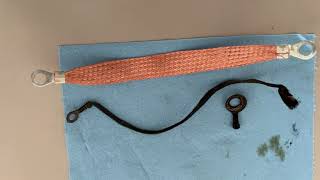
Typical fix: Remove, clean all contact surfaces with a wire brush until they are shiny, and securely re-fasten the ground wires/straps. Apply a dielectric grease to prevent future corrosion. Replace any frayed or broken straps. 🎬 Watch: How to find and replace your corroded ground straps.
Est. part cost: $10-$30 for new straps if needed. - Faulty Transmission Control Module (TCM) due to SMOD 🔴 High Probability On 2005-2010 models, the radiator has an integrated transmission cooler that is prone to internal failure. This allows engine coolant to mix with the transmission fluid, creating the 'Strawberry Milkshake of Death' (SMOD). This contaminated fluid destroys the electronics of the TCM, which is located inside the transmission's valve body.
How to confirm: Check the transmission fluid dipstick and radiator coolant for a pink, milky appearance. A professional scan tool will show the TCM as offline. A blown 10A fuse for the TCM is also a strong indicator.
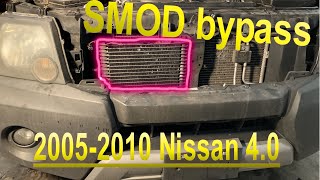
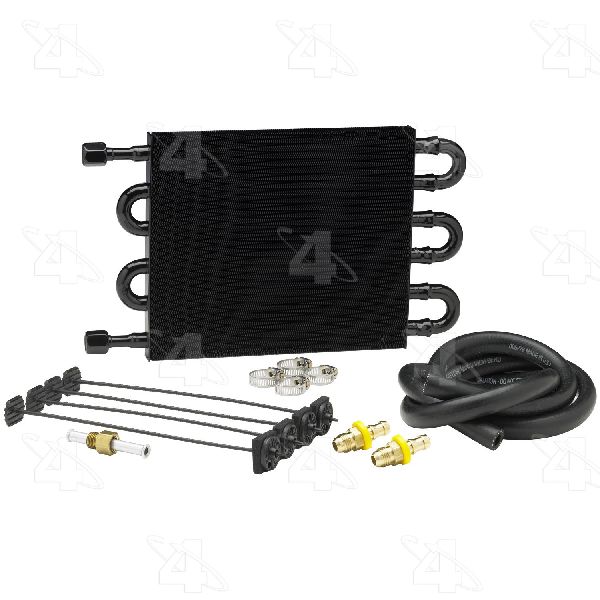
Typical fix: The TCM must be replaced, which is part of the valve body assembly. The radiator must also be replaced with an updated part, and the transmission and cooler lines must be thoroughly flushed. Many owners proactively install an external transmission cooler to bypass the radiator's internal cooler.
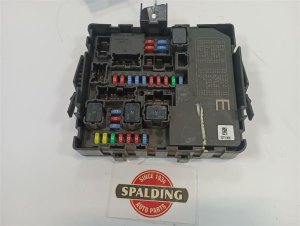
Est. part cost: $400-$800 for a remanufactured valve body/TCM assembly. - Faulty IPDM (Intelligent Power Distribution Module) 🟡 Medium Probability The IPDM is a 'smart' fuse and relay box that powers many other modules. Internal failures, often of the non-serviceable ECM relay on the circuit board, can cut power to a module, causing it to drop off the CAN network.
How to confirm: If a specific module is offline, use a multimeter to check for power at its main connector, tracing it back to the IPDM relay or fuse. An IPDM self-test can sometimes identify issues. A common diagnostic step is to temporarily swap the ECM relay with an identical one (like the fog lamp relay) to see if the vehicle starts.
Typical fix: Replacement of the IPDM e/r (engine room). While some relays are swappable for diagnosis, Nissan generally advises against replacing individual relays, recommending a full IPDM replacement.
Est. part cost: $250-$500 - Damaged CAN Bus Wiring ⚪ Low Probability Wiring can be damaged by chafing, previous repairs, or rodent activity.
How to confirm: With the battery disconnected, measure the resistance between Pin 6 (CAN-H) and Pin 14 (CAN-L) at the OBD-II port. A healthy network should read approximately 60 ohms. A reading of 120 ohms indicates a break in the circuit or that one of the two terminating resistors is offline. A reading near 0 ohms indicates a short between the CAN lines.
Typical fix: Locate the open or short in the harness and repair the damaged wires.
Est. part cost: $10-$50 for wiring repair supplies.
Rare But Worth Checking
- Low Battery Voltage: A weak or failing battery can cause modules to drop off the network during startup, setting communication codes. Always test the battery and charging system before diving into complex diagnostics.
- Faulty ABS Control Module: The ABS module is another key node on the network. If it fails, it can disrupt communication and trigger codes in other modules.
- Faulty Body Control Module (BCM): The BCM is often a terminating module in the CAN network. A failure can take down the entire network. Symptoms may also include issues with keys, locks, and interior electronics.
Diagnosis Steps
- Check and charge the battery. Ensure battery voltage is above 12.4V. Low voltage can cause random communication faults.
- Perform a full vehicle scan with a professional-grade scanner to see which modules are reporting the U1002 code and, more importantly, which modules are not communicating at all.
- For 2005-2010 models, immediately inspect for SMOD. Check the transmission fluid on the dipstick and the coolant in the radiator overflow for any signs of cross-contamination (pink, milky fluid).
- Inspect all major power and ground connections. Pay close attention to the main battery ground cable to the engine/transmission, the braided strap from the passenger side exhaust heat shield to the firewall, and other chassis grounds. Clean any corrosion found.
- With the battery disconnected, measure the resistance between Pin 6 (CAN-H) and Pin 14 (CAN-L) at the OBD-II port. The reading should be ~60 ohms. If it's 120 ohms, one of the two terminating resistors (often in the ECM and IPDM/BCM) is not connected or has failed. If it's near 0 ohms, there is a short between the CAN lines.
- If a specific module is identified as offline, check for power and ground directly at that module's connector. If power/ground is good, the module itself is the likely culprit. If not, trace the wiring back to the source (usually the IPDM).
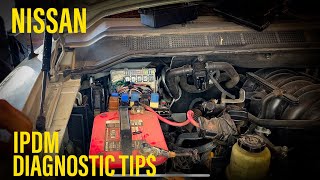
- If a crank-no-start condition exists, consider a faulty IPDM. Try swapping the ECM relay inside the IPDM with an identical relay (e.g., fog light relay) as a quick diagnostic test. 🎬 Watch: Expert tips for diagnosing and testing your Nissan IPDM.
Parts You'll Likely Need
- Ground Straps — Corroded or broken ground straps are a very common cause of communication issues on this platform.
Trusted brands: Nissan OE, Dorman
OEM price range: $20-$40
Aftermarket price range: $5-$15 - Transmission Valve Body with TCM
(OEM #RE5R05A / 0260550002)— This is the required part if the TCM has failed, often due to coolant contamination (SMOD). The TCM is integrated into the valve body and must be programmed to the vehicle's VIN.
Trusted brands: Hitachi (OEM), Rostra, Street Smart Transmission, Nissan OE (Remanufactured)
OEM price range: $700-$1000
Aftermarket price range: $400-$700 - IPDM E/R (Intelligent Power Distribution Module Engine Room) — Internal failure of the non-serviceable ECM relay or other circuits within the IPDM can cause a no-start or stalling, triggering CAN codes. The original factory part was often white, with the updated replacement part being black.
Trusted brands: Nissan OE
OEM price range: $250-$500
Aftermarket price range: $150-$300
Related Codes That Often Appear With This One
- U1000 — Both are general CAN communication failure codes. U1002 has a stricter timing requirement to set, but they point to the same underlying network problem.
- U1001 — This is a CAN communication code specifically related to the ECM. It often appears with U1002 if the ECM is the module that is offline or causing the network disruption.
- P07xx codes (e.g., P0717) — These are transmission-related codes. If they appear with U1002, it strongly suggests the Transmission Control Module (TCM) is the source of the communication failure, often due to SMOD.
Technical Service Bulletins (TSBs) & Recalls
- NTB10-066A: CAN Communication Codes - Diagnostic Tips & Guidelines. Explains that U1002 is a stricter version of U1000 and that the reporting module is usually not the faulty part.
- NTB13-027C: CAN Communication - Network Diagnostic Flow Chart. Provides diagnostic trees and helpful tips for troubleshooting CAN network issues, including checking for low voltage and the function of the IPDM.
Platform-Specific Known Issues
- Strawberry Milkshake of Death (SMOD): Affects 2005-2010 models with automatic transmissions. The internal transmission cooler within the stock radiator fails, mixing coolant and transmission fluid. This mixture destroys the transmission's valve body and the integrated Transmission Control Module (TCM), causing U1002 and other transmission codes. Prevention involves replacing the radiator with an updated model or installing an external transmission cooler.
- Ground Wire Corrosion: The R51 platform is known for having inadequate or corrosion-prone ground connections, especially the main battery ground and the smaller braided straps connecting the engine/exhaust to the chassis. These poor grounds create electrical noise and voltage drops that disrupt CAN bus communication.
Mechanic-Grade Diagnostic Values
- CAN Bus Network Resistance — expected: ~60 Ohms. Failure: A reading of ~120 Ohms indicates an open circuit or a missing terminating resistor. A reading near 0 Ohms indicates a short between the CAN-H and CAN-L lines.
- CAN Bus Terminating Resistor Resistance — expected: ~120 Ohms. Failure: A significantly different reading when measuring directly at a terminating module (like the ECM or BCM) indicates a faulty internal resistor.
- Battery Voltage — expected: Above 12.4V (Key On, Engine Off). Failure: Voltage below 10V can cause various modules to stop communicating, leading to U-codes.
Scan Tool Commands That Help
- Nissan CONSULT-III / CONSULT-III plus: CAN Diagnosis Support Monitor — This function is the primary diagnostic tool for CAN codes. It polls all modules on the network and displays a map of which ones are communicating and which are not, quickly identifying the source of the dropout.
- Manual Procedure (No Scan Tool): IPDM E/R Self-Diagnostic Test — To quickly verify if the IPDM is capable of powering up various components it controls (wipers, lights, A/C clutch, fans). A failure during the self-test points towards a faulty IPDM. The test is initiated by turning the ignition on, pressing the driver's door switch 10 times within 10-20 seconds, turning the ignition off, and then on again. A horn chirp confirms the test has started.
Wiring & Ground Locations
- E72 — A short, braided ground strap located on the passenger side, connecting the exhaust manifold heat shield to the firewall flange, above the valve cover.. This is a very common failure point. The strap frays or corrodes, creating a poor ground reference for critical engine sensors and disrupting module communication.
- Muffler Grounding Strap — A strap connecting the exhaust system to the vehicle frame, typically near the muffler.. While less critical than engine grounds, a broken exhaust ground can introduce electrical noise that may interfere with sensitive sensor readings, potentially contributing to network communication errors in rare cases. It is often found broken due to rust.
- Main Battery Ground — The primary negative cable from the battery terminal to the engine block or transmission case.. Corrosion or looseness at this primary point affects the entire vehicle's electrical system and is a fundamental check for any electrical or communication fault.
- Transfer Case Ground — A short wire from a 10mm stud on the passenger side of the transfer case tail housing to the frame cross-member.. A poor connection here specifically affects the 4WD control system. If the 4WD module is the one dropping off the CAN bus, this ground is a primary suspect.
Real Owner Repair Stories
- YouTube user comment section (2010 Suzuki Equator (Nissan Frontier platform twin)) — Sudden stalling while driving, or a crank-but-no-start condition. Sometimes would start after waiting a few minutes or hours. Also experienced sputtering and rough idling.
❌ Tried (didn't work) Waiting for the vehicle to start on its own.
✅ What actually fixed it Replacement of the entire IPDM (Intelligent Power Distribution Module) fuse box. The owner noted this is a known issue with Nissans of this era. - Reddit r/MechanicAdvice (2007 Nissan (model not specified, but platform shared)) — Car suddenly lost power, started chugging, brake and battery lights flashed. Then resulted in a crank-no-start condition.
❌ Tried (didn't work) Replacing cam position sensors, swapping the ECM relay.
✅ What actually fixed it The owner suspected a faulty IPDM, specifically the known-problematic white-colored original modules. The final fix was confirmed to be the IPDM's internal fuel pump relay.
OEM Part Supersession History
Various (White Case)→Various (Black Case)— The original IPDM units, typically housed in a white-colored plastic case, were prone to internal relay failures, especially the ECM relay. Nissan superseded these with more reliable units housed in a black case.
Heads up: While a used IPDM may physically fit, it must be the correct part number for the vehicle's specific options. However, they do not typically require programming.RE5R05A / 0260550002→Multiple revisions exist (e.g., 31705-90X01, ETC91-171N)— Revisions were made over the part's lifecycle. When replacing, it is critical to match the part number from the original valve body or ensure the replacement is programmed to the vehicle's VIN.
Heads up: A TCM from another vehicle, even if the same part number, will not work without being flashed with the correct VIN and calibration file for the specific vehicle it is being installed in.
Model Year Variations Within This Range
- 2005-2010: These model years are equipped with the RE5R05A automatic transmission that is susceptible to the SMOD (Strawberry Milkshake of Death) failure due to an integrated radiator/transmission cooler design flaw. This is a primary cause of TCM failure and U1002 codes on these specific years.
- 2008: The Pathfinder received a mid-cycle refresh for the 2008 model year, which included minor exterior styling changes and the introduction of an optional 5.6L V8 engine. While the core CAN architecture remained similar, some wiring and module locations may differ slightly from earlier 2005-2007 models.
- 2011-2012: For the 2011 model year, Nissan reportedly began using an updated radiator design that resolved the SMOD issue. Therefore, on 2011-2012 models, while a TCM failure is still possible, it is much less likely to be caused by coolant contamination.
Helpful Videos
Used OEM Parts in Stock



New Aftermarket Parts Available


The information in this article is provided for general reference and educational purposes only. Vehicle specifications, procedures, and part compatibility can vary by production date, trim level, and region. Always consult your vehicle's factory service manual and verify part numbers before purchasing or performing repairs. Safety-critical components such as airbags, seat belts, and braking systems should be installed by a qualified professional.
- Nissan PATHFINDER:
- 🎬 Helpful Videos
- 🛍️ Shop This Part
- What's Unique About the 2005-2012 Nissan PATHFINDER
- Diagnostic Flowchart
- Symptoms You May Notice
- Most Likely Causes
- Rare But Worth Checking
- Diagnosis Steps
- Parts You'll Likely Need
- Related Codes That Often Appear With This One
- Technical Service Bulletins (TSBs) & Recalls
- Platform-Specific Known Issues
- Mechanic-Grade Diagnostic Values
- Scan Tool Commands That Help
- Wiring & Ground Locations
- Real Owner Repair Stories
- OEM Part Supersession History
- Model Year Variations Within This Range
- 🎟️ Get 5% Off