

U1002 on 2009-2014 Nissan Murano: CAN Communication Fault Causes and Fixes
U1002 on a 2009-2014 Nissan Murano indicates a CAN network communication failure. This is most often caused by poor electrical grounds, a weak battery, or a wiring issue, not a failed control module. Start by cleaning battery terminals and all major ground connections, especially the main chassis and transmission grounds, before suspecting expensive parts like the ABS module.
- U1002 is a network communication code, not a specific component failure. Do not replace the module that stored the code without further diagnosis.
- Always start with the basics: test the battery and thoroughly clean all main power and ground connections in the engine bay.
- Symptoms can be widespread and seem unrelated, including warning lights (VDC, SLIP, ABS), transmission problems, and no-start conditions.
- Diagnosis is complex and best left to a professional with a Nissan-specific scan tool to avoid wasting money on incorrect parts.
- A faulty ABS module is a known potential cause on this platform that can bring down the entire communication network.
What's Unique About the 2009-2014 Nissan MURANO
For the second-generation Murano (Z51), like many Nissans of this era, the U1002 code often points to foundational electrical issues rather than a single failed module. These vehicles are susceptible to problems with the Intelligent Power Distribution Module (IPDM), which is a 'smart' fuse box that can disrupt the network if it fails. Additionally, poor ground connections and corrosion in wiring harnesses are common culprits that can cause intermittent and frustrating communication dropouts between modules. A particularly common failure point is the ABS actuator/module, which can fail internally and disrupt the entire CAN network.
Diagnostic Flowchart
Tap your situation to follow the diagnostic path that matches what you're seeing on this vehicle.
Symptoms You May Notice
- Multiple warning lights on the dashboard, such as VDC OFF, SLIP, and ABS.
- Erratic or improper transmission shifting.
- Intermittent no-start or crank-no-start condition.
- Gauges on the instrument cluster behaving erratically or not working.
- Loss of function in systems like ABS or Vehicle Dynamic Control.
- Engine stalling at low speeds.
- Flickering headlights or other erratic electrical behavior.
- Replacing the control module that stored the U1002 code. TSB NTB10-066A states that when a module reports a U1000-series code, it is typically operating normally and the fault is external to that module.
Most Likely Causes
- Poor Battery Voltage or Ground Connections 🔴 High Probability Nissan TSBs frequently advise checking power and grounds first for any CAN communication issues. Low voltage (below 10V) can cause modules to stop communicating. Engine bay corrosion can degrade the effectiveness of essential ground straps over time, particularly the main battery-to-chassis ground and the transmission-to-frame ground.
How to confirm: Test the battery to ensure it's fully charged (above 12.4V) and healthy. Visually inspect battery terminals for corrosion and clean them. Locate, remove, and clean the main chassis ground (from the negative battery terminal, often under the battery tray) and the engine/transmission ground straps to ensure a clean, tight connection.
Typical fix: Clean battery terminals and ground connection points with a wire brush. If a ground strap is heavily corroded, frayed, or broken, it must be replaced.
Est. part cost: $10-$50 - Faulty ABS Actuator / Control Module 🟡 Medium Probability The ABS module is a critical node on the CAN network. An internal failure, sometimes triggered by an event like hitting a pothole, can cause it to stop communicating or flood the network with bad data, bringing down other systems. This is a known and expensive issue on the Z51 Murano.
How to confirm: Use an advanced scan tool to check for specific codes pointing to the ABS module (like U0121 or C-codes). A common diagnostic step is to disconnect the ABS module; if communication with other modules is restored (and the CAN bus resistance returns to ~120 ohms from ~60 ohms), the ABS module is the culprit.
Typical fix: Replace the ABS actuator and control unit assembly. 🎬 Watch: A pro tip for replacing the ABS module faster. This requires bleeding the brake system and often needs programming/calibration with a Nissan-specific scan tool. Repair services for the original module are also an option.
Est. part cost: $350-$1900 - Damaged or Corroded CAN Bus Wiring/Connectors 🟡 Medium Probability Wiring harnesses in the engine bay are exposed to heat, moisture, and vibration, which can lead to chafed wires or corroded connector pins over time, disrupting network signals. Areas where the harness routes near engine components or the firewall are common chafe points.
How to confirm: Perform a detailed visual inspection of wiring harnesses, especially those connected to the ECM, TCM, and ABS module. Look for any signs of physical damage, chafing against other components, or green/white corrosion inside connectors. Wiggling the harness while the vehicle is running may trigger the fault.
Typical fix: Repair damaged wires using solder and heat shrink. Clean corroded connector pins with electrical contact cleaner. If a connector is severely damaged, it may need to be replaced.
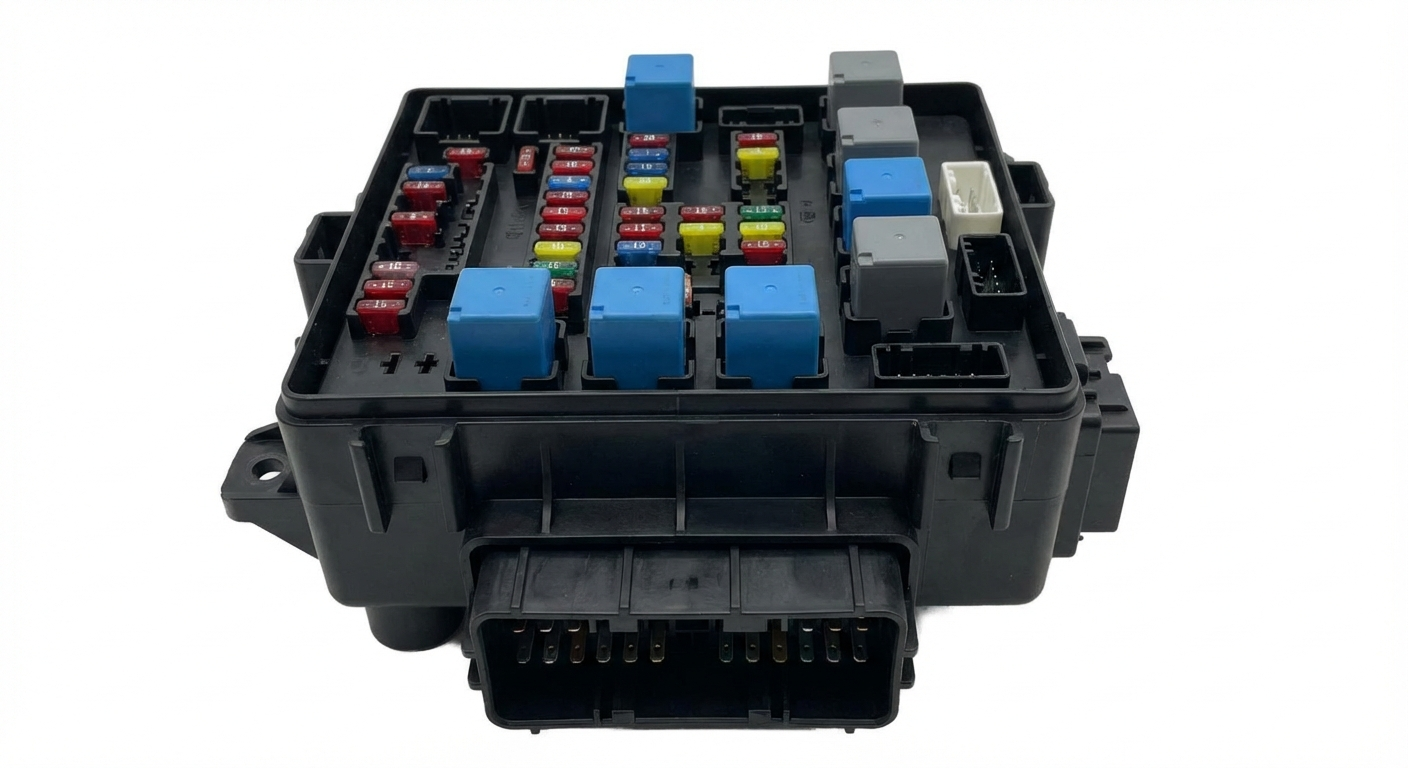
Est. part cost: $5-$100 - Faulty Intelligent Power Distribution Module (IPDM) ⚪ Low Probability The IPDM is a 'smart' fuse box with internal, non-serviceable relays that power other modules. A failure within the IPDM, such as the internal ECM relay, can cut power to a critical module, causing a network-wide communication failure and a U1002 code.
How to confirm: If the vehicle has a crank-no-start condition along with the U1002 code, the IPDM is a strong suspect. Some Nissans have a built-in IPDM self-test that cycles components 🎬 See how to run a Nissan IPDM auto active test. like wipers and lights. A technician can also test for power output from the IPDM to the affected modules using a wiring diagram.
Typical fix: Replace the IPDM assembly. The new unit must be the correct part number for the vehicle's trim and options.
Est. part cost: $200-$500
Rare But Worth Checking
- Failing Control Module (ECM/TCM): While possible, the module that *stores* the U1002 code is usually working correctly and reporting that it cannot hear from another module. Do not replace the ECM or TCM unless it has been definitively proven to be the source of the network failure through isolation testing.
- Aftermarket Electronics: Improperly installed remote starters, alarms, or stereos that are tapped into the CAN bus wiring can disrupt communication and cause a flood of U-codes.
Diagnosis Steps
- Check Battery and Fuses: Ensure the battery voltage is above 12.4V. A weak battery is a primary cause of communication codes. Inspect all fuses related to major control modules (ECM, TCM, BCM, ABS) in the IPDM and interior fuse box.
- Perform a Full System Scan: Use a Nissan-compatible scan tool to pull codes from ALL modules. Note which modules are communicating and which are not. This is critical information for identifying the source of the dropout.
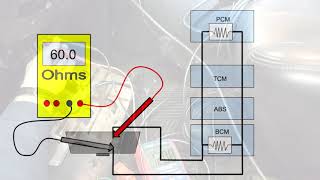
- Check CAN Bus Resistance: Disconnect the negative battery terminal. At the DLC (Data Link Connector, under the driver's dash), measure the resistance between Pin 6 (CAN High) and Pin 14 (CAN Low). 🎬 Watch: How to perform a CAN bus resistance check. A healthy network should read approximately 60 ohms. If it reads 120 ohms, there is an open circuit or a terminating resistor (often in the ECM or IPDM) is offline. If it's near 0 ohms, the CAN lines are shorted together.
- Visual Inspection: Thoroughly inspect the wiring harnesses for any signs of chafing, breaks, or corrosion, paying close attention to connectors at the ECM, TCM, and ABS modules. Check the transmission ground strap for corrosion or looseness.
- Isolate Modules: If a specific module is suspected (e.g., the ABS module from a U0121 code), disconnect it and re-check CAN resistance. If the resistance changes (e.g., from 60 to 120 ohms) and communication is restored with other modules, the disconnected module is likely faulty.
- Check Power and Grounds at the Offline Module: If a module is not communicating, use a multimeter and wiring diagram to confirm it is receiving proper power and has a solid ground connection before condemning the module itself.
Parts You'll Likely Need
- ABS Actuator and Electric Unit
(OEM #47660-1AA6C (2009-2011), 47660-1V41C (2011-2014))— An internal failure in the ABS module is a common cause of U1002 on this platform, taking the entire CAN network down. - Ground Straps — The main battery-to-chassis and transmission-to-chassis ground straps are prone to corrosion, which creates high resistance and causes widespread electrical and communication faults.
- Intelligent Power Distribution Module (IPDM) — Internal relay failure in the IPDM can cut power to essential modules like the ECM, causing a network failure and a no-start condition.
Related Codes That Often Appear With This One
- U1000 — U1000 is a general CAN communication failure code. U1002 is a more specific version with a stricter timing requirement, and they often appear together.
- U0121 — This code specifically indicates 'Lost Communication With Anti-Lock Brake System (ABS) Control Module'. If the ABS module is the cause of the network failure, this code will often be present with U1002.
- U0101 — This code means 'Lost Communication with TCM'. If the Transmission Control Module is the one that has dropped off the network, you will likely see this code alongside U1002.
Technical Service Bulletins (TSBs) & Recalls
- NTB10-066A
- NTB13-027a
Platform-Specific Known Issues
- There are documented recalls for the ABS actuator on some 2009-2010 Murano models, which could potentially relate to CAN communication failures. A dealer can check if a specific VIN is affected.
Mechanic-Grade Diagnostic Values
- CAN Bus Resistance — expected: ~60 Ω between Pin 6 (CAN-H) and Pin 14 (CAN-L) at the DLC with battery disconnected.. Failure: 120 Ω indicates an open circuit or missing terminating resistor. ~0 Ω indicates a short between CAN lines. ~40-45 Ω may indicate a third, unintended resistor on the network or a faulty module.
- CAN Bus Voltage (Key On, Engine Off) — expected: Using a multimeter: CAN-H (Pin 6) to ground should be ~2.5-3.0V. CAN-L (Pin 14) to ground should be ~2.0-2.5V. An oscilloscope is required to see the actual square wave signal.. Failure: Voltages that are stuck high, low, or at 0V indicate a short to power, short to ground, or an open circuit.
- Ground Circuit Voltage Drop — expected: As close to 0V as possible when measured between the negative battery post and the module's ground pin or chassis ground point.. Failure: Even a small reading like 200mV (0.2V) indicates high resistance that can disrupt module communication.
- ABS Module Power Supply (at module connector) — expected: Battery voltage should be present at specific power input pins with the key on.. Failure: No voltage indicates a problem with the fuse, relay (IPDM), or wiring leading to the module. For a similar 2006 Murano, power should be at pins 1 and 32 of connector E24.
Scan Tool Commands That Help
- Nissan CONSULT: CAN Diagnosis Support Monitor — This is an automated function that tests the entire CAN system, identifying which modules are communicating and which are not, much faster than manual checks.
- Nissan CONSULT: Simultaneous Data Monitor — To observe data from multiple control units at the same time. This helps identify how one module's failure affects others on the network in real-time.
- Manual Procedure: IPDM Auto Active Test — To verify the basic functionality of the Intelligent Power Distribution Module (IPDM). With the key off and doors closed, press and release the driver's door switch 10 times, then turn the key to ON. The horn should chirp and components like wipers and lights will cycle, confirming the IPDM's internal relays are working.
Wiring & Ground Locations
- Main Battery Ground — Typically a multi-point cable from the negative battery terminal. One point connects to the chassis/inner fender, often under or near the battery tray.. This is the primary return path for the entire electrical system. Corrosion here creates high resistance, lowering system voltage and causing modules to drop off the CAN network.
- Transmission Ground Strap — A braided strap connecting the transmission case to the vehicle's frame or subframe.. This is the main ground for the TCM and other engine-mounted components. It is highly exposed to road salt and moisture, making it a very common failure point that directly causes communication codes.
- Engine Compartment Grounds (E21, F83, F84) — Service diagrams show ground distribution points at the left rear of the engine compartment (E21) and the front of the engine (F83, F84).. The ABS actuator and ECM share ground points in the engine compartment. A failure at one of these junctions can affect multiple critical modules.
- ABS Module Connector (E24) — On the ABS actuator assembly, located in the engine bay.. This is the main connector for the ABS module. Verifying power, ground, and CAN signals at this connector is essential to determine if a fault is in the module or the wiring leading to it.
Real Owner Repair Stories
- Reddit user on r/Cartalk (2007 Nissan Murano (First Gen, but highly relevant)) — Car would shut off while driving.
❌ Tried (didn't work) Checking fuses (all were good)., Checking ground under battery tray (looked okay visually).
✅ What actually fixed it The owner found a burnt wire at the positive battery terminal connection leading into the main fuse box (fusible link holder). They cut back the wire past the corrosion, re-crimped the connection, and the problem was resolved. This indicates a high-resistance connection was causing system-wide voltage instability. - Mechanic response on 2CarPros (2018 Nissan Rogue (Later model, but same failure pattern)) — U0121 and U1002, no start with key but would start with remote start.
❌ Tried (didn't work) N/A, was a diagnostic inquiry.
✅ What actually fixed it A mechanic noted that the symptoms strongly point to a faulty ABS actuator. They stated, 'When I worked at Nissan, we replaced tons of these. Unfortunately, they are over $1,600.00, just for the part.' This story confirms the ABS module is a very common and expensive point of failure for this type of CAN fault on Nissans.
"I Checked Everything" — The Actual Cause
- The electrical equivalent of a 'smoke test clean' scenario is when the CAN bus resistance measures a perfect 60 ohms, yet the fault persists. This often points to a fault that only appears under specific conditions. A wire can have continuity and pass a simple resistance check but may be internally broken, making contact only intermittently. Wiggling the harness while monitoring the network can expose this. Furthermore, a corroded wire may show continuity but be unable to carry the necessary current under load. A better test is to use a test light to apply a load to the circuit; if the light doesn't illuminate brightly, the wire has high resistance despite having continuity.
Model Year Variations Within This Range
- 2009-2011 vs 2011-2014: The OEM part number for the ABS Actuator and Electric Unit changes. For 2009-2011 models, a common part number is 47660-1AA6C. For 2011-2014 models, it is 47660-1V41C. Using the incorrect part for the model year can lead to incompatibility.
Helpful Videos
![How To Test CAN BUS With A Multimeter [CAN Bus Resistance Check] Mechanic Mindset](https://img.youtube.com/vi/JPE42HSJxAk/mqdefault.jpg)
We Have This Part in Stock





The information in this article is provided for general reference and educational purposes only. Vehicle specifications, procedures, and part compatibility can vary by production date, trim level, and region. Always consult your vehicle's factory service manual and verify part numbers before purchasing or performing repairs. Safety-critical components such as airbags, seat belts, and braking systems should be installed by a qualified professional.
- Nissan MURANO:
- 🎬 Helpful Videos
- 🛍️ Shop This Part
- What's Unique About the 2009-2014 Nissan MURANO
- Diagnostic Flowchart
- Symptoms You May Notice
- Most Likely Causes
- Rare But Worth Checking
- Diagnosis Steps
- Parts You'll Likely Need
- Related Codes That Often Appear With This One
- Technical Service Bulletins (TSBs) & Recalls
- Platform-Specific Known Issues
- Mechanic-Grade Diagnostic Values
- Scan Tool Commands That Help
- Wiring & Ground Locations
- Real Owner Repair Stories
- "I Checked Everything" — The Actual Cause
- Model Year Variations Within This Range
- 🎟️ Get 5% Off