

U1002 on 2005-2012 Infiniti QX56: CAN Communication Failure Causes and Fixes
U1002 on an Infiniti QX56 indicates a CAN communication network failure. This is often caused by a weak battery, corroded ground wires (especially the main battery ground), or a faulty control module like the IPDM or ABS actuator. Diagnosis is complex and usually requires professional tools; it is not a simple part replacement fix.
- U1002 is a serious network communication code, not a simple sensor failure.
- Always start diagnosis by checking the battery, its connections, and main chassis/engine grounds. These are the most common and cheapest fixes.
- Do not replace expensive modules like the ECM or TCM without performing a full CAN bus diagnostic to confirm they are the root cause.
- Due to the complexity and need for special tools, professional diagnosis is highly recommended to avoid costly misdiagnosis.
What's Unique About the 2005-2012 Infiniti QX56
The 2005-2010 (JA60) and 2011-2012 (Y62) QX56 are packed with electronic modules that are all interconnected. A failure in one can create a domino effect, making diagnosis tricky. Unlike a simple sensor code, U1002 points to a system-wide problem. Owners often find the root cause to be something simple like a corroded battery ground cable or a failing battery, which can cause modules to drop off the network intermittently. However, it can also be a more complex issue like a damaged wiring harness, a failing ABS actuator, or a faulty Intelligent Power Distribution Module (IPDM), which is a known failure point on these vehicles and their Nissan Armada platform-mates.
Diagnostic Flowchart
Tap your situation to follow the diagnostic path that matches what you're seeing on this vehicle.
Generation note: The 2005-2012 range covers two generations: the first (JA60, 2005-2010) and the early second (Y62, 2011-2012). While the underlying CAN bus principles are the same, specific module locations, ground points, and wiring harness routing differ. The TSB ITB10-029A applies to all 2005-2015 Infiniti vehicles, covering both generations. Common causes like battery and ground issues are prevalent on both. The first generation (JA60) is particularly known for IPDM failures. The Y62 generation (2011+) adds a VVEL control module to the CAN network, which can be another potential point of failure.
Symptoms You May Notice
- Check Engine Light is on
- VDC (Vehicle Dynamic Control) and SLIP lights are on
- ABS light is on
- No-start or intermittent no-crank condition 🎬 Watch: Diagnosing a no-start caused by ECM communication loss.
- Engine stalls while driving, sometimes after hitting a bump
- Gauges on the instrument cluster behaving erratically or not working
- Transmission shifting harshly or not shifting
- Inability of a standard OBD-II scanner to communicate with the ECM/TCM
- Flickering or dimming headlights
- Clicking or buzzing sounds from the IPDM area
- Replacing a single module (like the ECM or TCM) without confirming it is the source of the network failure. The code often points to a network-wide issue, not a specific part.
- Overlooking a simple, corroded ground wire and proceeding to replace expensive modules. Cleaning ground points is a critical first step.
Most Likely Causes
- Low Battery Voltage or Poor Battery Connection 🔴 High Probability Complex electronics are sensitive to voltage drops. A weak battery can cause random modules to fail to initialize, triggering communication codes.
How to confirm: Test the battery voltage with a multimeter. It should be ~12.6V with the engine off and 13.5V-14.5V while running. Inspect terminals and main ground cables for corrosion or looseness. A voltage drop test on the ground side can confirm a bad connection.
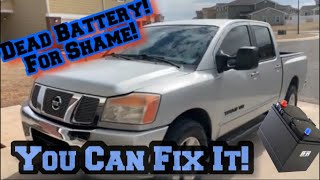
Typical fix: Charge or replace the battery. Thoroughly clean the battery terminals 🎬 Watch: How to properly replace a dead battery and terminals. and all major power and ground connections with a wire brush.
Est. part cost: $150-$350 - Corroded or Loose Ground Wires 🔴 High Probability The main battery ground cable and other chassis ground points are highly susceptible to corrosion, creating high resistance and causing intermittent communication dropouts. This is a very common fix for U-codes on these trucks.
How to confirm: Visually inspect the main negative battery cable where it bolts to the chassis and engine block. Look for any signs of corrosion, looseness, or fraying. Perform a voltage drop test on the ground circuit; any significant voltage reading indicates a problem.
Typical fix: Remove, thoroughly clean with a wire brush, and securely re-fasten all ground connections. If the cable is heavily corroded, it must be replaced.
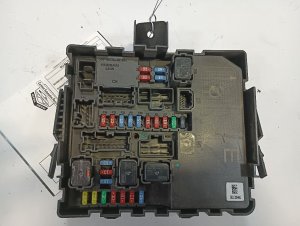
Est. part cost: $20-$120 - Faulty Intelligent Power Distribution Module (IPDM) 🟡 Medium Probability The IPDM contains integrated relays (like the ECM and fuel pump relays) that can fail, causing stalling, no-start, and communication issues. Early models with white-colored IPDM housings are particularly known for failure. 🎬 See how to replace the ECM relay inside the IPDM.
How to confirm: An advanced scan tool can show if the IPDM is offline. A self-test can be initiated by turning the ignition ON and opening/closing the driver's door 10 times within 20 seconds; the IPDM will then cycle various components like wipers and lights.
Typical fix: Replace the IPDM. On many models, this is a plug-and-play part, but it's crucial to match the part number from the old unit. The updated OEM part is often black instead of the original white.
Est. part cost: $200-$700 - Faulty ABS Actuator and Electric Unit 🟡 Medium Probability The ABS control unit is a critical node on the CAN bus. Internal failure of this module can disrupt the entire network, setting a U1002 code in other modules.
How to confirm: This requires an advanced scan tool to see if the ABS module is not responding or is reporting internal errors. A technician may disconnect the ABS module to see if communication is restored to the rest of the network.
Typical fix: Replace the ABS actuator/control unit assembly. This is an expensive part and typically requires professional installation and brake system bleeding.
Est. part cost: $800-$2000+ - Damaged CAN Bus Wiring Harness ⚪ Low Probability Wiring can be damaged by chafing against chassis components, previous improper repairs, or rodent damage.
How to confirm: Visually inspect the wiring harness for damage. With the battery disconnected, check for 60 ohms of resistance across the CAN-H and CAN-L pins at the DLC. Deviations indicate an open or short in the wiring.
Typical fix: Repair the damaged section of the wiring harness. This is labor-intensive.
Est. part cost: $10-$100
Rare But Worth Checking
- Improperly Installed Aftermarket Electronics: Aftermarket alarms, remote starters, or audio systems that are improperly tapped into the CAN bus can introduce interference and cause communication codes like U1002.
Diagnosis Steps
- Read all stored DTCs from all modules using an advanced scan tool (like CONSULT-III plus). Note which modules are not communicating or are reporting the U1002 code.
- Check battery health. Ensure voltage is above 12.4V (engine off) and that the charging system is working correctly (13.5V-14.5V).
- CRITICAL STEP: Inspect and clean all main ground connections. Disconnect the negative battery cable. Remove the bolt securing it to the chassis and the other end at the engine block. Use a wire brush to clean the cable ends, the bolt, and the mounting surfaces on the frame/engine until they are shiny metal. Re-secure tightly.
- Visually inspect all accessible wiring harnesses for signs of physical damage, chafing, or corrosion, particularly around the IPDM and ABS actuator.
- If possible, check for aftermarket devices tapped into the vehicle's wiring and disconnect them to see if the fault clears.
- With the battery disconnected, measure the resistance between Pin 6 (CAN-H) and Pin 14 (CAN-L) at the Data Link Connector (DLC). A healthy network should read approximately 60 ohms.
- If resistance is 120 ohms, it indicates an open circuit or a missing terminating resistor (often in the ECM or IPDM/BCM). If it's 0 ohms, there is a short between the CAN lines.
- If wiring and resistance are good, the issue likely lies with a single faulty module (IPDM and ABS actuator are common culprits). This requires professional diagnosis, often by disconnecting modules one by one to isolate the one causing the network to crash.
Parts You'll Likely Need
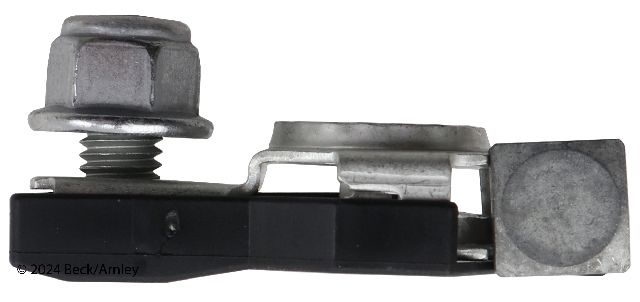
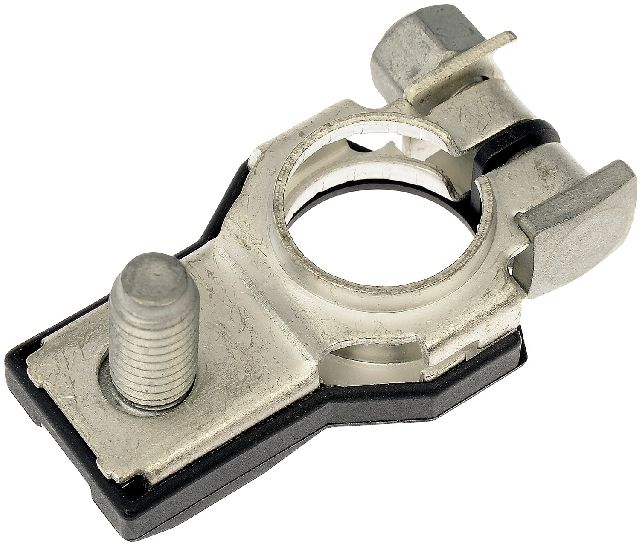
- Battery Ground Cable
(OEM #24080-1LA0A)— The main ground cable is a frequent point of corrosion, leading to intermittent voltage drops that disrupt module communication. Cleaning is often sufficient, but replacement is needed for severe corrosion.
Trusted brands: Infiniti OE
OEM price range: $100-$150
Aftermarket price range: $50-$90 - Battery — The complex electronics in the QX56 are highly sensitive to low voltage, which can cause modules to drop off the network during startup.
Trusted brands: Interstate, DieHard, Duralast
OEM price range: $250-$400
Aftermarket price range: $150-$300 - Intelligent Power Distribution Module (IPDM)
(OEM #284B7-1LA0A (2011-2012 Y62))— This module contains non-serviceable internal relays that are a known failure point, especially on the JA60 generation, leading to no-start conditions and network-wide communication faults.
Trusted brands: Infiniti OE
OEM price range: $400-$700
Aftermarket price range: $200-$500
Related Codes That Often Appear With This One
- U1000 — Both are CAN communication failure codes. U1002 is a more specific or stringent version of the U1000 fault, according to Infiniti TSB ITB10-029A.
- U1001 — This is also a CAN communication code, often related to the ECM.
- U0100 — A generic code for 'Lost Communication With ECM/PCM,' which is functionally very similar to the manufacturer-specific U-codes and points to the same diagnostic path.
- C1130 — This code for 'Engine Signal 1' often appears alongside CAN communication codes when the ABS module loses its connection with the ECM.
Technical Service Bulletins (TSBs) & Recalls
- ITB10-029A: SERVICE INFORMATION Related to communication codes U1000, U1001, U1002, U1010. This TSB provides the official diagnostic procedure for CAN communication faults, emphasizing checking basics like voltage and resistance before replacing modules.
Platform-Specific Known Issues
- Main Battery Ground Cable Corrosion: The most widely reported fix for U1002 on the QX56 and its platform mates is not a faulty module, but a corroded main battery ground cable. The connection point on the chassis/frame is highly prone to rust and corrosion, creating high resistance that disrupts CAN communication. A thorough cleaning with a wire brush or cable replacement often resolves the code.
- IPDM Failure (Stalling/No-Start): The Intelligent Power Distribution Module, especially the earlier white-colored units on the JA60 platform, is a known weak point. Internal relay failure can lead to sudden engine stalling or a no-start condition, accompanied by a host of CAN codes including U1002.
Mechanic-Grade Diagnostic Values
- CAN Bus Network Resistance — expected: ~60 Ω. Failure: A reading of ~120 Ω indicates an open circuit or a missing terminating resistor. A reading of 0 Ω indicates a short between CAN-H and CAN-L. A reading of ~40-45 Ω may indicate a third, unintended terminating resistor on the network.
- CAN Bus Voltage (Key On, Engine Off) — expected: Both CAN-H and CAN-L should idle at ~2.5V. During data transmission, CAN-H should pulse to ~3.5V and CAN-L should pulse to ~1.5V.. Failure: Voltages that are stuck high or low, or do not mirror each other around the 2.5V axis, indicate a short to power/ground or a faulty module transceiver.
- Battery Voltage (Key Off) — expected: ~12.6V or higher. Failure: Voltage below 12.4V indicates a discharged battery. Infiniti TSBs note that modules can begin to drop off the network below 10V.
Hidden / Shadow Codes Worth Checking
- U1002 vs U1000: While not a hidden code, Infiniti TSB ITB13-006C clarifies that U1002 is not identical to U1000. U1002 indicates a missing CAN communication that has a 'tighter timing spec' to set the DTC, meaning the communication loss was detected under more stringent or time-sensitive conditions than a U1000. (see via Visible with any standard OBD-II scanner, but the specific meaning is defined by Infiniti service literature.)
Scan Tool Commands That Help
- Infiniti CONSULT-III plus: CAN Diagnosis Support Monitor — This is the primary function to use when diagnosing a U1002 code. It provides a network topology view and shows which specific control units are 'OK', have a 'PAST' issue, or are currently not communicating ('NG'), guiding the technician to the source of the network failure.
- Manual Procedure (No Scan Tool): IPDM E/R Auto Active Test — To quickly verify the basic functionality of the IPDM and its ability to communicate with the BCM. If the test initiates (horn chirps once), it confirms the CAN line between the BCM and IPDM is likely intact. The test is started by turning the ignition ON and pressing the driver's door switch 10 times within 20 seconds.
- Advanced Scan Tool: Steering Angle Sensor Reset/Calibration — If VDC/SLIP lights are on, especially after an alignment or suspension work. An uncalibrated steering angle sensor can flood the network with conflicting data, causing other modules to report communication errors.
Wiring & Ground Locations
- CAN Bus at DLC — Data Link Connector (OBD-II port) under the driver's side dashboard. Pin 6 is CAN-H, Pin 14 is CAN-L.. This is the primary access point for testing the entire CAN bus resistance and voltage.
- IPDM E/R — JA60 (2005-2010): Right rear corner of the engine compartment. Y62 (2011-2012): In the engine compartment near the battery.. The IPDM is a common failure point and a terminating module on the CAN bus. Checking for power, ground, and CAN signals at this module is a key diagnostic step.
- JA60 (2006) Engine Grounds — Key ground points include E9 (right side of engine compt), E24 (left front of engine compt), and E119.. Corrosion or looseness at these main engine and chassis grounds is a primary cause of intermittent communication faults.
- Y62 (2012) Engine Grounds — Key ground points include E202 (right side of engine), E38 (right front of engine compt), and E43 (left front of engine compt).. Like the earlier generation, poor grounds are a top cause of U-codes. Locations differ from the JA60.
Real Owner Repair Stories
- Victor Martinez YouTube Channel (2011 Infiniti QX56 (Y62)) — No crank, no start, U1000 code (lost communication with PCM).
❌ Tried (didn't work) Checking fuses initially, checking for 5V reference at sensors (it was absent).
✅ What actually fixed it The PCM (ECM) was internally shorted. As soon as the main connector to the PCM was plugged in, it would instantly blow the 30A fuse that supplied its power. Replacing the PCM resolved the issue. - Homie Hektor YouTube Channel (2008 Infiniti QX56 (JA60)) — VDC OFF and SLIP lights on, code C1143 (Steering Angle Sensor Circuit).
❌ Tried (didn't work) The vehicle had a wheel alignment which caused the steering angle to be off, triggering the lights.
✅ What actually fixed it The steering angle sensor itself was not faulty. The problem was resolved by performing a 'Steering Angle Sensor Reset' using a scan tool to recalibrate its neutral position after the wheel alignment was corrected. This cleared the VDC/SLIP lights.
"I Checked Everything" — The Actual Cause
- The equivalent for a CAN code is 'resistance test is 60 ohms, but the network is still down.' A perfect 60-ohm reading only confirms the two terminating resistors and the main bus wiring are intact. It does NOT confirm that individual modules have proper power and ground, nor does it rule out an internal module fault (like a bad transceiver) that doesn't short the bus, or electrical noise interfering with the signal. Diagnosis must proceed to checking power/ground at non-communicating modules and using an oscilloscope to check signal quality.
When the Usual Fixes Don't Work
- While checking the battery and grounds is the correct first step and solves many U1002 issues, it is not a guaranteed fix. In a documented case on a 2011 QX56, the vehicle had a no-start and U1000/U1002 codes, but the root cause was not a ground or power supply issue. Instead, the Engine Control Module (ECM) itself was internally shorted, causing its dedicated 30-amp fuse to blow the moment the module was connected. This demonstrates that if the common, simple fixes do not work, the next step must be to isolate and test individual modules for internal faults.
OEM Part Supersession History
White-cased IPDM (various PNs)→Black-cased IPDM (various PNs)— The original white-cased IPDMs on the JA60 platform were known for internal relay failures. The updated black-cased units are generally more reliable.
Heads up: Part numbers must be matched exactly when replacing, as internal logic can differ even if the unit fits physically.
Model Year Variations Within This Range
- 2005-2010 (JA60): The IPDM is located in the right rear of the engine bay and is a very common failure point. Ground points are specific to this chassis (e.g., E9, E24).
- 2011-2012 (Y62): The IPDM is located near the battery and has different part numbers (e.g., 284B7-1LA0A). This generation adds the VVEL control module to the CAN network, creating another potential point of failure. Ground points are also different from the first generation (e.g., E202, E38).
Helpful Videos
Used OEM Parts in Stock


New Aftermarket Parts Available

The information in this article is provided for general reference and educational purposes only. Vehicle specifications, procedures, and part compatibility can vary by production date, trim level, and region. Always consult your vehicle's factory service manual and verify part numbers before purchasing or performing repairs. Safety-critical components such as airbags, seat belts, and braking systems should be installed by a qualified professional.
- Infiniti QX56:
- 🎬 Helpful Videos
- 🛍️ Shop This Part
- What's Unique About the 2005-2012 Infiniti QX56
- Diagnostic Flowchart
- Symptoms You May Notice
- Most Likely Causes
- Rare But Worth Checking
- Diagnosis Steps
- Parts You'll Likely Need
- Related Codes That Often Appear With This One
- Technical Service Bulletins (TSBs) & Recalls
- Platform-Specific Known Issues
- Mechanic-Grade Diagnostic Values
- Hidden / Shadow Codes Worth Checking
- Scan Tool Commands That Help
- Wiring & Ground Locations
- Real Owner Repair Stories
- "I Checked Everything" — The Actual Cause
- When the Usual Fixes Don't Work
- OEM Part Supersession History
- Model Year Variations Within This Range
- 🎟️ Get 5% Off