

U1001 on 2005-2012 Nissan XTERRA: CAN Communication Failure Causes and Fixes
The U1001 code on a 2005-2012 Nissan Xterra indicates a CAN communication network failure. The most common causes are poor ground connections, a faulty Intelligent Power Distribution Module (IPDM), or damaged wiring. Start by cleaning all major ground points, especially those near the battery and engine block, before suspecting expensive modules.
- U1001 is a network code, not a sensor code. Do not replace parts like the ECM without extensive diagnosis.
- Always start with the simplest fixes: check battery health and thoroughly clean all major ground connections in the engine bay.
- The IPDM (Intelligent Power Distribution Module) is a known weak point on this vehicle and a likely cause if grounds are good.
- If you have a 2005-2010 model with transmission issues alongside the U1001 code, investigate for potential coolant contamination in the transmission fluid (SMOD).
- Due to the complexity, professional diagnosis with advanced tools is strongly recommended if the issue isn't a simple ground or battery problem.
What's Unique About the 2005-2012 Nissan XTERRA
The second-generation Nissan Xterra (2005-2012) shares its F-Alpha platform with the Frontier, Pathfinder, Titan, and Armada of the same era, making them all susceptible to similar electrical issues. A well-documented problem on this platform is the failure of the Intelligent Power Distribution Module (IPDM), which contains non-serviceable relays that can fail and cause a host of electrical gremlins, including CAN communication codes like U1001. Additionally, owners on forums like TheNewX.org and ClubFrontier.org frequently report that poor or corroded factory ground wires are a primary source of intermittent and hard-to-diagnose electrical faults.
Diagnostic Flowchart
Tap your situation to follow the diagnostic path that matches what you're seeing on this vehicle.
Generation note: The 2005-2012 year range covers the entire second generation (N50) of the Nissan XTERRA. The issues and fixes are generally consistent across this generation and its platform mates (Frontier, Pathfinder).
Symptoms You May Notice
- Engine cranks but will not start.
- Sudden engine stalling while driving.
- Multiple warning lights on the dashboard (Check Engine, ABS, VDC, Slip).
- Instrument cluster gauges behaving erratically or not working (e.g., speedometer at zero).
- Transmission stuck in one gear or not shifting properly ('fail-safe' mode).
- Cooling fans running constantly at high speed even when the engine is cold.
- Headlights, wipers, or other accessories not working or working intermittently.
- Security light stays on, preventing the engine from starting.
- Replacing the ECM or other control modules without first verifying all power, ground, and network connections. The TSB NTB10-066A specifically warns that the module reporting the code is usually not the one that has failed.
- Replacing the battery when the root cause is a faulty alternator or a parasitic drain from a failing module like the IPDM.
Most Likely Causes
- Poor or Corroded Ground Connections 🔴 High Probability Nissans of this era are known to be sensitive to ground issues. Corrosion builds up on main ground points, creating resistance and disrupting module communication. Common problem areas are the main battery ground, engine block grounds, and smaller grounds on the core support and behind the kick panels.
How to confirm: Visually inspect the main ground straps from the battery to the chassis, the engine block to the chassis, and smaller ground points in the engine bay. Look for rust, green/white corrosion, fraying, or looseness. Perform a voltage drop test on the ground circuit with a multimeter; any significant voltage reading indicates a bad ground.
Typical fix: Disconnect the battery. Unbolt, clean all contact points (wire terminal, bolt, and chassis) with a wire brush until they are shiny metal. Apply dielectric grease to prevent future corrosion and re-secure the ground connections tightly. In some cases, adding a supplementary ground wire ('Big 3' upgrade) can provide a more robust ground path.
Est. part cost: $0-$20 - Faulty Intelligent Power Distribution Module (IPDM) 🟡 Medium Probability The original white-colored IPDM units are known to have internal relay failures, particularly for the ECM and fuel pump, which can disrupt CAN communication and cause a crank/no-start symptom. The relays are integrated into the IPDM's circuit board and are not individually replaceable.
How to confirm: Perform the IPDM self-test: with the key out, open and close the driver's door, insert key and turn to ON (don't start), then press the driver's door jamb switch 10 times within 20 seconds. The IPDM will cycle various components (wipers, lights, horn). A failure to perform this test or specific component failures can point to a bad IPDM. However, the self-test does not check the ECM relay, so a no-start can still be a bad IPDM even with a successful self-test.
Typical fix: Replace the IPDM. Newer replacement units from Nissan are typically black and have an updated design. This is a plug-and-play part located in the engine bay near the battery. 🎬 Watch this walkthrough on how to remove the IPDM module.
Est. part cost: $150-$350 - Damaged CAN Bus Wiring 🟡 Medium Probability Wiring can become frayed, corroded, or damaged by rodents, especially in the engine bay harness or at connectors. A common failure point is the harness connector at the Transmission Control Module (TCM), where pins can get corroded or pushed out.
How to confirm: Visually inspect the wiring harnesses leading to the ECM, TCM, and IPDM for any signs of damage. A multimeter can be used to check for continuity and resistance between pins 6 (CAN-H) and 14 (CAN-L) at the OBD-II port. With the battery disconnected, a healthy network should read approximately 60 ohms. A reading of 120 ohms suggests a break in the circuit or a problem with one of the two terminating resistors (usually in the ECM and IPDM/BCM).
Typical fix: Repair the specific section of damaged wire. This may involve soldering in a new piece of wire and protecting it with heat shrink tubing. For connector issues, clean the pins with contact cleaner and ensure they are fully seated.
Est. part cost: $5-$50 - Low Battery Voltage or Faulty Alternator ⚪ Low Probability Like any modern vehicle, low system voltage from a weak battery or failing alternator can cause unpredictable behavior from electronic modules, leading to communication codes.
How to confirm: Test the battery voltage with a multimeter. It should be above 12.4V with the engine off and between 13.5V and 14.5V with the engine running. A load test is the best way to confirm battery health.
Typical fix: Charge or replace the battery. If charging voltage is low with the engine running, test and replace the alternator.
Est. part cost: $150-$400
Rare But Worth Checking
- Faulty Control Module (ECM, TCM, BCM): While possible, a module itself is less likely to be the cause than the wiring or grounds connected to it. A Reddit user noted that on the '05-'10 Xterra, TCM failure due to coolant contamination (SMOD) can short the module, causing U1000/U1001 codes and a no-drive or no-crank condition. A professional diagnosis is needed to confirm a bad module by isolating it from the network and checking powers, grounds, and CAN resistance at the module connector. A technician on iATN reported a no-crank U1001 was caused by a missing fuse for the TCM in the IPDM.
Diagnosis Steps
- Check Battery Voltage: Ensure the battery is fully charged (12.4V+ engine off) and the charging system is working correctly (13.5V-14.5V engine on). Low voltage can cause spurious communication codes.
- Scan for All Codes: Use a capable scanner to pull codes from all modules (Engine, Transmission, ABS, BCM). Note which modules are communicating and which are not. This helps narrow down the location of the fault.
- Inspect Fuses: Check all fuses related to control modules in both the interior fuse panel and the IPDM. Pay special attention to fuses for the ECM, TCM, and BCM.
- Inspect Grounds: Disconnect, clean, and secure all major ground points. Key locations include the negative battery terminal to body, engine block to firewall/chassis, and smaller grounds on the radiator core support.
- Inspect Wiring: Visually inspect the main wiring harnesses for any signs of physical damage, corrosion, or rodent activity, particularly around the IPDM, ECM, and down to the transmission.
- Check CAN Resistance: With the battery disconnected, measure the resistance between Pin 6 (CAN-H) and Pin 14 (CAN-L) of the OBD-II port. A reading of ~60 ohms indicates the main network wiring and terminating resistors are likely intact. A reading of ~120 ohms suggests an open in the circuit or a faulty terminating module.
- Check CAN Voltages (Advanced): With the ignition ON and battery connected, check voltages at the OBD-II port. Pin 6 (CAN-H) to ground should be ~2.7V. Pin 14 (CAN-L) to ground should be ~2.3V. Deviations can indicate a short to power or ground.
- Perform IPDM Self-Test: Run the IPDM's built-in self-diagnostic to check its output functions for accessories. While not a definitive test for the U1001 cause, it can confirm a faulty IPDM if it fails.
- Isolate Modules: If the problem persists, a professional will need to disconnect modules one by one from the CAN bus to see if communication is restored, thereby identifying the faulty component or circuit branch.
Parts You'll Likely Need
- Intelligent Power Distribution Module (IPDM)
(OEM #284B6-ZE03A)
Related Codes That Often Appear With This One
- U1000 — U1000 is a general CAN communication failure code. U1001 is a more specific version often logged alongside U1000, pointing to a communication loss with a particular module. They frequently appear together.
Technical Service Bulletins (TSBs) & Recalls
- General service information for diagnosing CAN communication codes (U1000, U1001, etc.). It advises technicians to always diagnose these codes first and confirms that the module setting the code is usually not the faulty part.
- Provides a detailed diagnostic flowchart for CAN communication issues on 2005-2013 Nissan vehicles, including helpful tips and expected electrical values for testing.
Platform-Specific Known Issues
- IPDM Failure: The original white-cased IPDM is known to fail due to faulty internal relays that are not serviceable. The replacement part from Nissan is typically a black-cased unit (Part No. 284B6-ZE03B) with an improved design.
- SMOD-Induced TCM Failure: For 2005-2010 models, a failure in the transmission oil cooler inside the radiator can cause coolant to mix with transmission fluid (known as SMOD - Strawberry Milkshake of Death). This contaminated fluid can travel up the wiring harness to the Transmission Control Module (TCM), shorting it out and causing U1000/U1001 codes, limp mode, or a no-crank condition.
- Grounding Points: This platform is highly sensitive to poor grounds. Key areas to inspect and clean are the negative battery cable connection to the chassis, the ground straps from the engine block to the body, and the smaller ground points located on the radiator support in the engine bay.
Mechanic-Grade Diagnostic Values
- CAN Bus Resistance (at OBD-II Port) — expected: ~60 Ω (with battery disconnected). Failure: A reading of ~120 Ω indicates an open main bus or an issue with a terminating module. A reading below 50 Ω could indicate a shorted wire or faulty module.
- CAN High Voltage (Pin 6 to Ground) — expected: ~2.7 V (Key On, Engine Off). Failure: Significant deviation, such as 0V or battery voltage (B+), indicates a short to ground or power.
- CAN Low Voltage (Pin 14 to Ground) — expected: ~2.3 V (Key On, Engine Off). Failure: Significant deviation, such as 0V or battery voltage (B+), indicates a short to ground or power.
- CAN Bus Resistance at a Terminating Module (e.g., ECM, IPDM) — expected: ~120 Ω (measured at the module connector with battery disconnected). Failure: A reading significantly different from 120 Ω suggests an internal failure of the module's terminating resistor.
Scan Tool Commands That Help
- Nissan CONSULT-III plus: CAN Diagnosis > CAN Diag Support Monitor — This is the primary diagnostic function recommended by Nissan. It polls every module on the CAN network and provides a status list ([OK], [NG] for Not Good, [INCOMP] for Incompatible), pinpointing exactly which module is not communicating, which is far more precise than just the U1001 code itself.
- Nissan CONSULT-III plus or Manual Procedure: IPDM E/R Auto Active Test — Use this to confirm the IPDM's internal logic and relays are functioning correctly for accessories like wipers, lights, and the horn. A failure of this test strongly suggests the IPDM is faulty, even if it's not the direct cause of the CAN communication break.
Wiring & Ground Locations
- Engine Bay Grounds — A primary ground strap connects the negative battery terminal to the chassis. Another key ground connects the engine block (often near the exhaust manifold) to the firewall or chassis.. Corrosion or looseness at these main ground points creates a floating ground for multiple modules, including the ECM, leading to communication errors.
- Firewall Ground — A smaller ground wire is often found on the back of the cylinder head, bolting directly to the firewall.. This provides a critical ground path for the engine control harness. If compromised, it can directly affect the ECM's ability to communicate.
- IPDM / Battery Area Grounds — Multiple smaller ground wires are located on the chassis and core support in the immediate vicinity of the battery and IPDM.. These provide the ground reference for the IPDM, which acts as a gateway and power source for many other modules on the CAN bus.
Real Owner Repair Stories
- Reddit user on r/XTerra (2005 Nissan Xterra, 175k miles) — Engine starts but all gears act as neutral (no drive or reverse). Codes U1000 and U1001 present.
❌ Tried (didn't work) Checking fluids, checking general fuses, unplugging/replugging IPDM connectors, installing a new battery.
✅ What actually fixed it The issue was identified as a classic case of TCM (Transmission Control Module) failure caused by SMOD (Strawberry Milkshake of Death), where a radiator breach contaminates the transmission fluid with coolant. The coolant then wicks up the wiring harness to the TCM, shorting it out. The user was advised to check fuse #49 in the IPDM, as a blown fuse there is a strong indicator of a shorted TCM. - Car Hospital on YouTube (2015 Nissan Sunny (demonstrates a common Nissan CAN fault)) — Intermittent U1001/U1000 codes, blowing a 10A fuse for the control unit.
❌ Tried (didn't work) Visually inspecting engine bay wiring.
✅ What actually fixed it The mechanic found a single wire in the engine bay harness near a control unit that had been improperly repaired previously. The insulation was gone, and the wire would intermittently touch a ground source, causing a short that would blow the fuse and bring down the CAN network. Properly repairing and insulating the single damaged wire resolved the issue.
"I Checked Everything" — The Actual Cause
- In the context of a U1001 code, the equivalent of a 'smoke test clean' scenario is when all standard wiring checks (visual inspection, continuity, resistance) pass, yet the fault persists. This often points to an intermittent short or a failing module. One owner reported checking all grounds, fuses, and even replacing the ABS module for a U1001 code, but the problem remained, indicating the fault was not a simple, static wiring break. In another case, the root cause was a single chafed wire that only caused a fault when it physically moved and touched a ground source, which would not be found by a static continuity test.
OEM Part Supersession History
284B6-ZE03A (and other PNs for early white-body IPDMs)→284B6-ZE03B (and other black-body variants)— The original white-body IPDMs used in 2005-2006 models were prone to internal ECM relay failure due to oxidation, causing stalling and no-start issues. The newer black-body units are a revised design.
Heads up: While later parts physically fit, it is critical to match the IPDM part number to the vehicle's VIN, as there were several mid-production changes affecting functionality. Ordering without VIN verification is not recommended.
Model Year Variations Within This Range
- 2005-2006: These early second-generation models were often equipped with a white-bodied IPDM that was the subject of a service bulletin for internal relay failures causing stalling and communication issues. Later models from 2007-2012 received updated, more reliable IPDM designs (typically black).
Helpful Videos

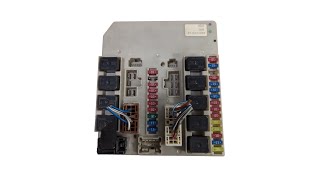


We Have This Part in Stock



The information in this article is provided for general reference and educational purposes only. Vehicle specifications, procedures, and part compatibility can vary by production date, trim level, and region. Always consult your vehicle's factory service manual and verify part numbers before purchasing or performing repairs. Safety-critical components such as airbags, seat belts, and braking systems should be installed by a qualified professional.
- Nissan XTERRA:
- 🎬 Helpful Videos
- 🛍️ Shop This Part
- What's Unique About the 2005-2012 Nissan XTERRA
- Diagnostic Flowchart
- Symptoms You May Notice
- Most Likely Causes
- Rare But Worth Checking
- Diagnosis Steps
- Parts You'll Likely Need
- Related Codes That Often Appear With This One
- Technical Service Bulletins (TSBs) & Recalls
- Platform-Specific Known Issues
- Mechanic-Grade Diagnostic Values
- Scan Tool Commands That Help
- Wiring & Ground Locations
- Real Owner Repair Stories
- "I Checked Everything" — The Actual Cause
- OEM Part Supersession History
- Model Year Variations Within This Range
- 🎟️ Get 5% Off