

U1001 on 2008-2014 Nissan Rogue: Causes and Fixes for CAN Communication Failure
The U1001 code on a 2008-2014 Nissan Rogue indicates a CAN communication network failure, not a specific bad part. The most common causes are poor electrical grounds (especially a specific wire near the passenger fender), a weak battery, a faulty IPDM (fuse box), or a damaged wiring harness. Start by cleaning battery terminals and key ground points before attempting more complex diagnostics.
- U1001 is a network code, not a part code. Your first step should never be to replace a computer.
- Always start with the simplest electrical checks: battery health and clean, tight ground connections.
- Diagnosing this code properly requires a scan tool that can show which specific modules are offline.
- The problem is almost always electrical: a bad ground, a weak battery, or a broken/corroded wire.
- Before replacing any module, confirm it has good power, ground, and that the CAN wires leading to it are intact.
What's Unique About the 2008-2014 Nissan ROGUE

For this generation of Nissan Rogue, like many Nissans from the era built on the shared 'Nissan C' platform (including the Sentra and Qashqai), the electronics are particularly sensitive to voltage and ground issues. The U1001 code is frequently a symptom of a simple underlying electrical problem rather than a catastrophic module failure. Nissan's own Technical Service Bulletins emphasize checking the basics like battery voltage and ground connections first, as these are common culprits that can cause modules to drop off the network. Before suspecting an expensive computer, a thorough check of the wiring and power supply is essential.
Diagnostic Flowchart

Tap your situation to follow the diagnostic path that matches what you're seeing on this vehicle.
Symptoms You May Notice
- Multiple warning lights illuminated on the dashboard (Check Engine, ABS, VDC/Traction Control, AWD)
- Transmission may shift harshly or become stuck in one gear (fail-safe mode)
- Engine cranks but fails to start.
- Speedometer or tachometer needle drops to zero while driving.
- Security light may stay on or blink incorrectly.
- Car may feel sluggish or hesitant during acceleration.
- Replacing the control module that stored the U1001 code. The TSB clearly states that the module reporting the code is often working normally; it's just noting that it can't hear from another module on the network.
Most Likely Causes

- Loose or Corroded Ground Connections 🔴 High Probability Nissans of this era are known to be sensitive to ground integrity. A specific weak point on the Rogue and its platform-mate, the Qashqai, is a thin ground wire running from the passenger side fender area to the engine block, which can corrode and break internally at the ring terminal, often with no visible external damage. 🎬 See how to diagnose and solve bad ground connections
How to confirm: Visually inspect and perform a voltage drop test on main ground straps from the battery to the chassis and engine. Pay special attention to the small ground wire on the passenger side of the engine bay. Unbolt, clean all contact surfaces to bare metal, and re-secure them.
Typical fix: Cleaning and tightening ground connections. Applying dielectric grease can help prevent future corrosion. If the specific weak ground wire is suspect, replace it or build a more robust new ground strap.
Est. part cost: $0-$20 - Low Battery Voltage or Failing Alternator 🟡 Medium Probability When system voltage drops below a certain threshold (e.g., 10V), control modules can shut down randomly and stop communicating, triggering communication codes.
How to confirm: Test the battery voltage with the engine off (should be >12.4V). Test the alternator output with the engine running (should be 13.5V-14.5V). A load test on the battery is the most definitive test.
Typical fix: Recharge or replace the battery. Replace the alternator if it is not charging correctly.
Est. part cost: $150-$400 - Damaged CAN Wiring Harness 🟡 Medium Probability Wiring can become chafed from vibration against the chassis or engine components, corroded from water intrusion, or damaged by rodents, leading to an open or short circuit in the CAN H or CAN L wires. A common trouble spot is the harness near the air filter box, where wires can be improperly secured and rub against ground.
How to confirm: Visually inspect harnesses in the engine bay and under the vehicle, especially near the ECM, TCM, and IPDM. A multimeter can be used to check for continuity and resistance between the CAN terminals at the OBD-II port (should be ~60 ohms with the battery disconnected).
Typical fix: Repairing the specific broken or shorted wire. In severe cases, a section of the harness may need to be replaced.
Est. part cost: $10-$500 - Faulty Intelligent Power Distribution Module (IPDM) 🟡 Medium Probability The IPDM is a 'smart' fuse and relay box that powers many modules. Internal corrosion or a failing relay within the IPDM can cut power to a critical module (like the ECM or TCM), causing it to drop off the CAN network and trigger a U1001 code elsewhere.
How to confirm: Run the IPDM's self-test function (search for procedure online 🎬 Watch: How to perform a Nissan IPDM self test) to check its outputs. Check for corrosion on the circuit board. A professional may need to verify power and ground signals at the IPDM connectors.
Typical fix: Replacing the IPDM. On this Rogue model, it is often a plug-and-play part that does not require programming.
Est. part cost: $150-$500 - Faulty Control Module (e.g., TCM, ECM) ⚪ Low Probability While less common, a module like the TCM, BCM, or ECM can fail internally, causing it to stop communicating or flood the network with bad data. The TCM is a known, though less frequent, point of failure.
How to confirm: This requires a professional scan tool to see which module is offline. After confirming the module has good power, ground, and CAN wiring to it, the module itself becomes the prime suspect.
Typical fix: Replacing the faulty module and potentially programming the new one to the vehicle. Some owners have had success using a pre-owned TCM.
Est. part cost: $200-$1000
Rare But Worth Checking
- Blown Fuse: A fuse that powers a specific module (like the TCM or ABS) can blow, causing that module to drop off the network and trigger a U1001 code in other modules. Check fuses in both the interior fuse box and the IPDM. A short in the harness can cause a fuse to blow intermittently.
- Aftermarket Electronics: Improperly installed remote starters, alarms, or audio equipment can interfere with the CAN bus by tapping into the wrong wires or introducing electrical noise, causing communication errors.
Diagnosis Steps
- Check Battery Health: Ensure the battery has at least 12.4 volts with the car off and that the alternator is charging correctly (13.5-14.5V) when running. Low system voltage (<10V) is a known cause of CAN errors.
- Perform a Full System Scan: Use a Nissan-compatible scan tool to see which modules are reporting the U1001 code and, more importantly, which modules are not communicating at all. This is the most critical step to narrow down the search.
- Inspect Fuses: Check all fuses related to the engine controller, transmission, and body control module in both the interior and engine bay fuse boxes (IPDM).
- Inspect and Clean Grounds: Locate, remove, clean, and securely reattach the main battery-to-chassis and engine-to-chassis ground connections. Pay special attention to the smaller ground wire located on the passenger side of the engine bay, as it is a known failure point.
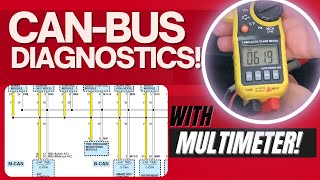
- Check CAN Bus Resistance: Disconnect the negative battery terminal and wait a few minutes for modules to power down. Use a multimeter to measure the resistance between Pin 6 (CAN-H) and Pin 14 (CAN-L) on the OBD-II port. A healthy network will read approximately 60 Ohms. A reading of 120 Ohms indicates an open circuit or a non-communicating terminating module. A reading near 0 Ohms indicates a short circuit between the CAN H and CAN L wires. 🎬 Watch: Quick and easy CAN bus testing with a multimeter
- Inspect Wiring: Visually inspect the wiring harness going to the non-communicating module (identified in Step 2) for any signs of chafing, corrosion, or physical damage. A common area for chafing is where the harness routes near the battery tray or air filter box.
- Isolate Modules: If the resistance reading was incorrect (e.g., 120 Ohms), you can disconnect modules one by one from the CAN network to see when the resistance returns to the correct value. This can help isolate a faulty module or section of wiring.
- Verify Power and Ground at the Module: Before condemning an expensive module, use a multimeter to confirm it is receiving proper battery voltage and has a solid ground connection at its main connector.
Parts You'll Likely Need
- Wiring Harness Repair Supplies — Often the fix is repairing a single corroded or broken wire in the CAN harness, not replacing a major component.
OEM price range: $10-$50
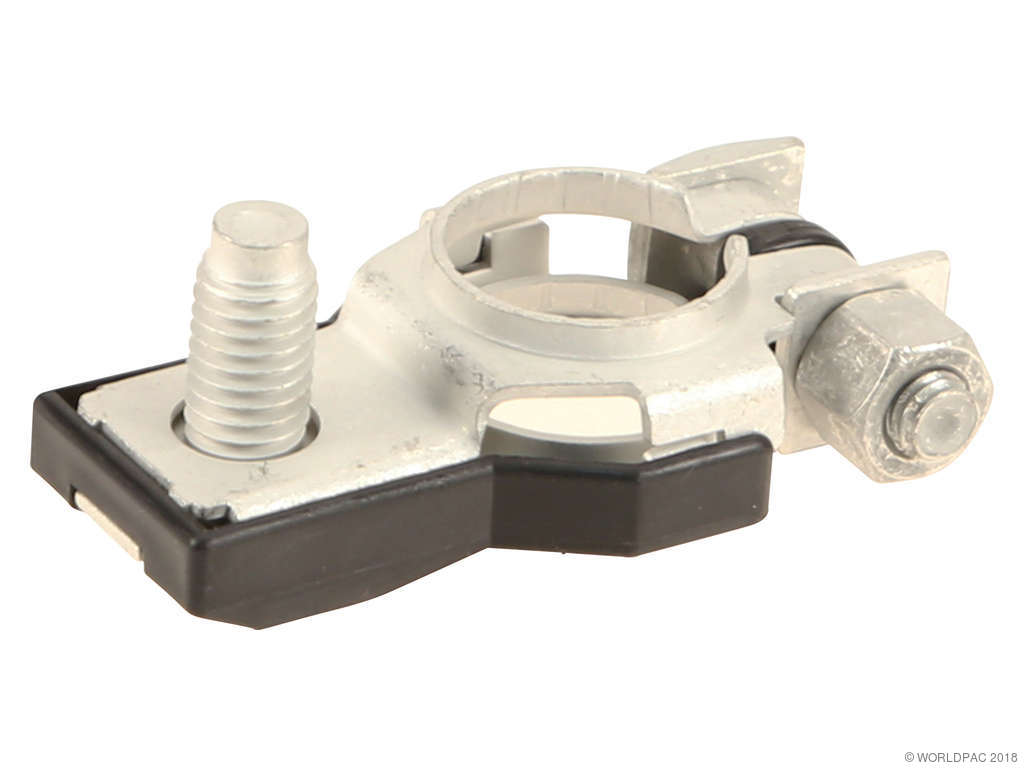
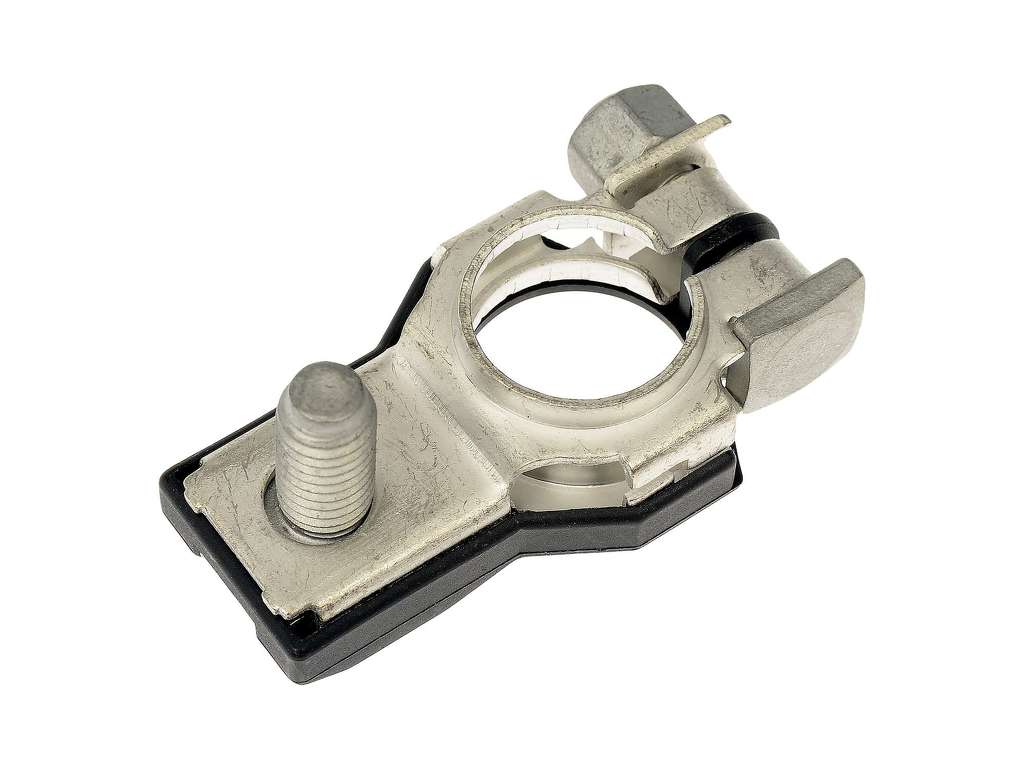
Aftermarket price range: $5-$25 - Battery — A weak battery is a frequent cause of various electronic glitches, including CAN communication codes.
Trusted brands: Interstate, DieHard
OEM price range: $200-$350
Aftermarket price range: $150-$250 - Intelligent Power Distribution Module (IPDM) — The IPDM contains integrated relays that can fail, cutting power to essential modules on the CAN network.
Trusted brands: Nissan OEM
OEM price range: $250-$500
Aftermarket price range: $150-$400
Related Codes That Often Appear With This One
- U1000 — U1000 is a general CAN Communication Circuit Malfunction code. U1001 is a more specific variant related to the ECM. They often appear together as different modules report the same network failure.
- U0101 — This code specifically means 'Lost Communication With TCM'. If the U1001 is related to a transmission module fault, U0101 will likely be present as well.
- U0122 — This code means 'Lost Communication With Vehicle Dynamic Control Module'. It often appears alongside other U-codes when a general network failure occurs.
Technical Service Bulletins (TSBs) & Recalls
- NTB10-066A: Provides diagnostic guidelines for CAN codes U1000, U1001, etc. It states that a module reporting a U1001 is often operating normally and that diagnosis should focus on the network. It also specifies checking CAN resistance (60 ohms for the circuit, 120 ohms at terminating modules).
- NTB13-027C: A broader CAN diagnostic bulletin that reiterates the diagnostic order (U-codes first). It defines U1001 as missing ECM communication related to the OBD2 system and notes that in low voltage situations (<10V), modules will stop communicating.
Platform-Specific Known Issues
- Weak Passenger-Side Engine Ground: A common failure point is a small ground wire that connects the engine block to the chassis on the passenger side of the engine bay. The wire can corrode and break inside the insulation right at the ring terminal, leading to intermittent CAN communication faults. A visual inspection may not be enough; a tug test or voltage drop test is recommended.
Mechanic-Grade Diagnostic Values
- CAN Bus Resistance (Battery Disconnected) — expected: ~60 Ω. Failure: 120 Ω indicates an open circuit or missing terminating module; ~0 Ω indicates a short between CAN H and CAN L.
- CAN H Voltage (Key ON, Engine Off) — expected: ~2.7 V (to ground). Failure: Significant deviation, 0V, or battery voltage indicates a fault.
- CAN L Voltage (Key ON, Engine Off) — expected: ~2.3 V (to ground). Failure: Significant deviation, 0V, or battery voltage indicates a fault.
- CAN H to L Shorted Resistance — expected: ~60 Ω. Failure: 0 Ω
- CAN H Short to Ground Resistance — expected: Open Circuit / MΩ. Failure: ~0 Ω
Scan Tool Commands That Help
- Nissan CONSULT-III Plus: CAN Diag Support Monitor — This is the primary professional diagnostic function. It should be used at the beginning of the diagnosis to get a system-wide map of which control units are communicating and which are offline, guiding all further troubleshooting.
- Built-in Vehicle Function: IPDM Auto Active Test (Self-Test) — Use this when you suspect the IPDM might be faulty. It confirms if the IPDM's internal logic and relays can activate various outputs (wipers, lights, etc.). A successful test shows the IPDM is likely functioning, while a failure points towards a bad IPDM. The sequence is: Ignition ON, press driver's door switch 10 times in 10 seconds, Ignition OFF, then Ignition ON again to start the test.
- Nissan CONSULT-III Plus: Data Monitor — Use this to record live data from various modules during a test drive. This is useful for capturing intermittent faults by setting a trigger condition (like a DTC) and reviewing the sensor data before and after the event.
Wiring & Ground Locations

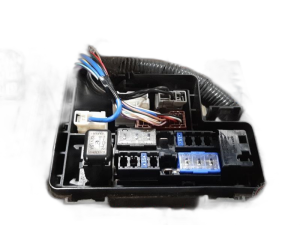
- IPDM (Intelligent Power Distribution Module) — Engine compartment, typically on the passenger's side, near the battery and firewall. It is a black plastic box with fuses.. The IPDM powers many of the modules on the CAN network. A failure within the IPDM can cut power to a module, causing it to go offline and trigger a U1001 code in other modules.
- Harness Chafe Point — In the engine bay, inspect the wiring harness loom in the area around and under the air filter box.. Harnesses in this area can be improperly secured, leading to rubbing against the chassis or other components. This can wear through the insulation on a CAN wire (or a power/ground wire for a module) and cause an intermittent short to ground, which is a common cause of U1001.
- OBD-II DLC Connector — Under the driver's side dashboard.. This is the primary access point for network-wide diagnostics. Pin 6 is CAN-H and Pin 14 is CAN-L. Measuring resistance and voltage here gives a quick health check of the entire main bus.
Real Owner Repair Stories
- YouTube channel 'Car Hospital' (2015 Nissan Sunny (similar platform and electronics)) — U1000 and U1001 codes present, intermittent stalling. A 10-amp fuse for a control unit would repeatedly blow.
❌ Tried (didn't work) Initial checks of fuses and grounds did not reveal the root cause, as the fault was intermittent.
✅ What actually fixed it The mechanic removed the air filter box and inspected the underlying harness. A wire, which had been improperly secured during a previous repair, was found to be rubbing against a metal edge. It would intermittently short to ground, blowing the fuse and taking the module offline. The fix was to repair the damaged wire insulation and properly secure the harness away from any sharp edges.
"I Checked Everything" — The Actual Cause
- The electrical equivalent of a 'smoke test clean' scenario for code U1001 is when standard resistance and continuity tests on the CAN harness pass, yet the code persists. This often points to an intermittent short or open circuit that only occurs under specific conditions (vibration, heat, etc.). A common real-world cause is a wire in the engine bay harness that has been improperly routed or secured. It may test fine when the vehicle is stationary, but while driving, engine movement causes it to briefly touch a ground point, triggering the communication loss. The fix requires a meticulous visual inspection of the entire harness, especially around the engine and under the air filter box, rather than just relying on multimeter readings at a standstill.
Helpful Videos

Used OEM Parts in Stock


New Aftermarket Parts Available


The information in this article is provided for general reference and educational purposes only. Vehicle specifications, procedures, and part compatibility can vary by production date, trim level, and region. Always consult your vehicle's factory service manual and verify part numbers before purchasing or performing repairs. Safety-critical components such as airbags, seat belts, and braking systems should be installed by a qualified professional.
- Nissan ROGUE:
- 🎬 Helpful Videos
- 🛍️ Shop This Part
- What's Unique About the 2008-2014 Nissan ROGUE
- Diagnostic Flowchart
- Symptoms You May Notice
- Most Likely Causes
- Rare But Worth Checking
- Diagnosis Steps
- Parts You'll Likely Need
- Related Codes That Often Appear With This One
- Technical Service Bulletins (TSBs) & Recalls
- Platform-Specific Known Issues
- Mechanic-Grade Diagnostic Values
- Scan Tool Commands That Help
- Wiring & Ground Locations
- Real Owner Repair Stories
- "I Checked Everything" — The Actual Cause
- 🎟️ Get 5% Off