

U1001 on 2005-2012 Nissan Pathfinder: CAN Communication Failure Causes and Fixes
The U1001 code on a 2005-2012 Nissan Pathfinder indicates a CAN communication network failure, specifically a loss of communication with the ECM. The most common causes are poor ground connections, a faulty Intelligent Power Distribution Module (IPDM), or low battery voltage. Start by cleaning all major ground points, checking the battery and charging system, and inspecting the IPDM for corrosion or blown fuses.
- U1001 is a serious network communication code, not a simple sensor failure. Do not drive the vehicle.
- Always start diagnostics with the simplest electrical checks: battery voltage and ground connections. These are the most common fixes.
- Do not replace expensive control modules like the ECM or TCM unless you have definitively proven they are the point of failure through systematic electrical testing.
- Diagnosing this code often requires tools beyond a basic code reader; a multimeter is essential, and a professional-grade scan tool is highly recommended.
What's Unique About the 2005-2012 Nissan PATHFINDER

The third-generation (R51) Pathfinder, along with its platform mates like the Frontier and Xterra, is notoriously sensitive to electrical system health. Issues that might not cause problems on other vehicles, such as minor corrosion on a ground strap or a slightly weak battery, can trigger network communication codes like U1001. The Intelligent Power Distribution Module (IPDM E/R), which is a smart fuse and relay box in the engine compartment, is a very common point of failure. These IPDMs are known to suffer from internal relay failures and are susceptible to water intrusion, which can cause widespread communication issues. The original white-cased IPDMs are particularly prone to failure; Nissan later released an updated black-cased version.
Diagnostic Flowchart

Tap your situation to follow the diagnostic path that matches what you're seeing on this vehicle.
Symptoms You May Notice
- Engine cranks but will not start.
- Multiple warning lights on the dashboard (Check Engine, ABS, VDC/Traction Control, 4WD).
- Erratic or non-functional instrument cluster (speedometer/tachometer at zero).
- Transmission shifting issues or being stuck in one gear (limp mode).
- Inability to shift out of Park.
- Cooling fans running constantly with the key on.
- Loss of communication with multiple control modules when using a scan tool.
- Brake lights staying on.
- Replacing the ECM or another control module without proper diagnosis. As one owner found, replacing the ECM did not solve the problem, which was later traced to wiring issues. The TSB NTB10-066a also warns to always confirm power, ground, and CAN resistance at the module connector before replacing it.
Most Likely Causes

- Loose, Corroded, or Damaged Ground Wires 🔴 High Probability Nissan vehicles of this era are known to be sensitive to poor grounds. Corrosion can build up on the main ground points near the battery, on the engine block, and on the chassis, interrupting the stable voltage required by control modules. Forum users frequently report that cleaning the main grounds, especially the one on the driver's side fender and the braided strap from the engine to the firewall, resolves U1001 issues.
How to confirm: Visually inspect the main battery ground cable, engine-to-chassis ground straps, and any smaller ground wires connected to the body near the ECM and IPDM. Pay close attention to the grounds on the driver-side fender well. Perform a voltage drop test from the battery negative post to the engine block and chassis; a reading above 0.2 volts indicates a problem.
Typical fix: Disconnect, clean all contact surfaces with a wire brush until they are shiny, and securely re-fasten the ground connections. Apply dielectric grease to prevent future corrosion. 🎬 See this guide on how to properly clean ground connections. Some owners add redundant ground wires to improve reliability.
Est. part cost: $0-$20 - Faulty Intelligent Power Distribution Module (IPDM) 🔴 High Probability The IPDM E/R (Engine Room) is a known weak point. It contains non-serviceable internal relays, including the ECM relay, that can fail and cause a no-start and U1001 code. The original white-cased units are particularly failure-prone. Water can also leak into the IPDM, causing corrosion and short circuits.
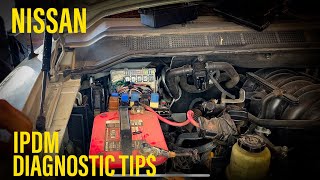
How to confirm: Perform the IPDM self-test 🎬 Watch: How to perform this Nissan IPDM self-test step-by-step. (turn the key on, press the driver's door switch 10 times within 20 seconds, turn key off, then on again) and observe if all components (wipers, lights, horn) activate. If the ECM relay within the IPDM is faulty, the self-test may run, but the engine will not start. Swapping the IPDM with a known-good unit is a common diagnostic step. Visually inspect for any white or green corrosion on the connectors.
Typical fix: Replacement of the entire IPDM unit. It is recommended to use the updated black-cased version. Aftermarket replacements are available, but OEM is often recommended for reliability. Applying dielectric grease to the connectors of the new unit is a good preventative measure.
Est. part cost: $150-$450 - Low Battery Voltage or Failing Alternator 🟡 Medium Probability When system voltage drops below a certain threshold (often around 10V), control modules can begin to shut down or communicate erratically, triggering CAN faults. This is a common trigger for intermittent communication codes on this platform.
How to confirm: With the engine off, check the battery voltage using a multimeter. A healthy battery should read approximately 12.6V. With the engine running, the voltage should be between 13.7V and 14.7V, indicating a healthy alternator.
Typical fix: Recharge or replace the battery. If the charging voltage is low, the alternator will need to be replaced.
Est. part cost: $150-$400 - Damaged CAN Bus Wiring Harness ⚪ Low Probability Wiring can become chafed from engine vibration or contact with sharp edges on the frame or other components, leading to a short or open circuit in the CAN high and CAN low wires. Rodent damage is also a possibility. One owner on a forum found that a wire had simply worked its way loose from a connector after a previous repair.
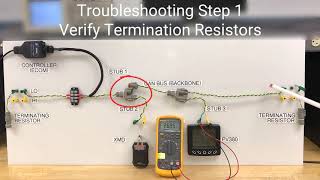
How to confirm: This is a complex diagnosis. It involves disconnecting the battery and measuring the resistance between pins 6 (CAN High) and 14 (CAN Low) at the OBD-II port. A healthy network should read approximately 60 ohms. If it reads 120 ohms, there is an open circuit or a terminating module is offline. 🎬 Watch: A deep dive into CAN Bus properties and troubleshooting. If it's near 0 ohms, the CAN wires are shorted together. A thorough visual inspection of the harness for damage, particularly where it runs near the engine block, firewall, and behind wheel wells, is necessary.
Typical fix: Repairing the specific section of damaged wiring. This can be very labor-intensive and requires carefully splicing, soldering, and heat-shrinking the affected wires.
Est. part cost: $10-$100 in materials
Rare But Worth Checking
- Faulty Transmission Control Module (TCM) due to Radiator Failure (SMOD): On 2005-2010 models, a notorious issue known as SMOD (Strawberry Milkshake of Death) can occur. The internal radiator partition separating coolant and transmission fluid fails, allowing coolant to contaminate the transmission fluid. This contaminated fluid can travel up the wiring harness to the TCM (located inside the transmission on many models), shorting it out and causing communication codes like U1000/U1001 and P0717. An owner on an Xterra forum experienced this exact scenario.
- Faulty Control Module (ECM, BCM): While a module can fail internally, it's more common for the issue to be in the wiring or power/ground supply to the module. A module should only be replaced after all other possibilities have been exhausted. An owner on a forum shared their experience of replacing the ECM only to find the U1001 code remained, indicating the problem was elsewhere in the wiring.
- Improperly Installed Aftermarket Electronics: Aftermarket alarms, remote starters, or stereos can be improperly tapped into the CAN bus wiring, causing interference or network instability. One forum user found that a poorly installed aftermarket relay for a ground wire was the source of their intermittent U-codes.
Diagnosis Steps
- Check Battery Health: Ensure the battery has a full charge (12.6V engine off, 13.7-14.7V engine on). A weak battery is a common cause of communication codes.
- Scan All Modules: Use a high-quality scanner to check for codes in ALL available modules (ECM, TCM, BCM, ABS, etc.). Note which modules are not communicating. This is crucial for pinpointing the source of the network failure.
- Inspect IPDM: Check all fuses in the IPDM (in the engine bay, passenger side), specifically those for 'Electronic Parts', 'IGN', 'ECM', or 'TCM'. Inspect the IPDM connectors for any signs of green or white corrosion from water intrusion.
- Perform IPDM Self-Test: With the ignition ON, press and release the driver's door jamb switch 10 times within 20 seconds, then turn the ignition OFF and back ON. The horn should chirp, and various accessories (wipers, lights, fans) will cycle. This confirms the IPDM's basic functions are working, though the internal ECM relay can still be faulty even if the test runs.
- Check Main Grounds: Disconnect, clean, and secure the primary ground points. Key locations include the negative battery terminal to the body, the braided strap from the passenger-side cylinder head to the firewall, and grounds on the driver-side inner fender.
- Test CAN Bus Resistance: Disconnect the battery. At the OBD-II port, measure the resistance between Pin 6 (CAN High) and Pin 14 (CAN Low). A healthy network should read approximately 60 Ohms. A reading of 120 Ohms indicates an open circuit or a missing terminating resistor. A reading near 0 Ohms indicates a short between the CAN wires.
Parts You'll Likely Need
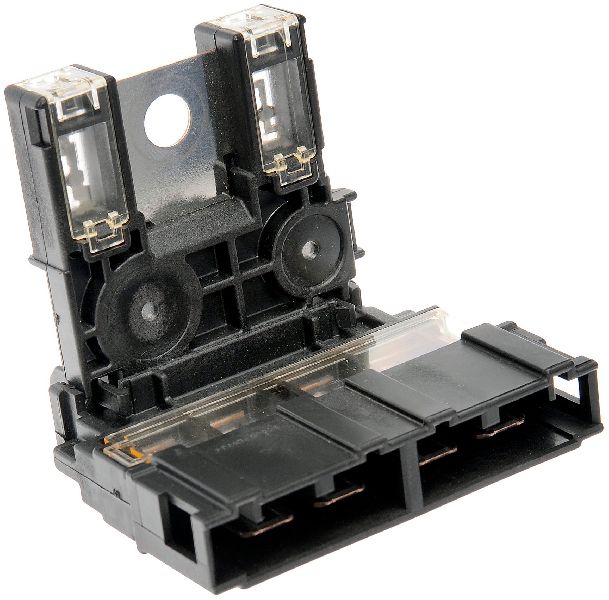
- Intelligent Power Distribution Module (IPDM)
(OEM #284B7-ZE03A (verify by VIN))— A very common failure point for this platform. The internal ECM relay fails, causing a no-start and U1001. The original white-cased modules are known to be less reliable than the updated black-cased versions.
Trusted brands: Nissan (OEM), Dorman
OEM price range: $350-$450
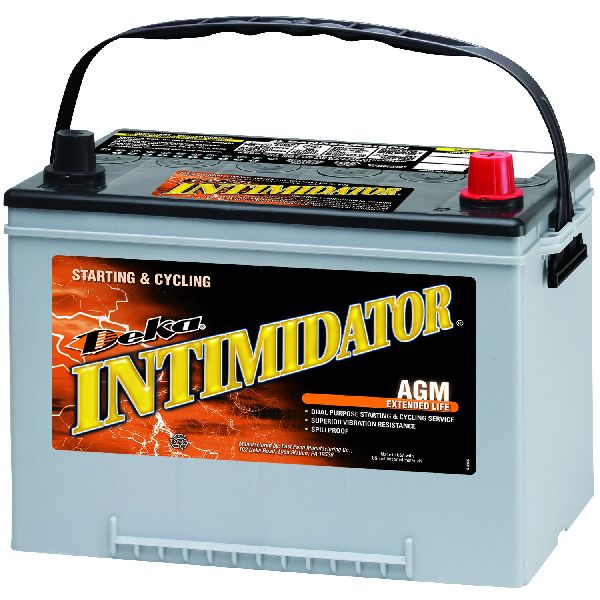
Aftermarket price range: $150-$250 - Battery — A weak or failing battery is a frequent cause of low voltage, which disrupts CAN network communication and can set spurious U-codes.
Trusted brands: Interstate, DieHard, Duralast
OEM price range: $200-$300
Aftermarket price range: $150-$250
Related Codes That Often Appear With This One
- U1000 — U1000 is a general CAN communication failure code. U1001 is a more specific subset indicating a communication loss with the ECM. They frequently appear together as they both indicate a network problem.
- P0717 — This code indicates an issue with the Turbine/Input Shaft Speed Sensor. A real-world owner complaint and a YouTube video diagnosis showed U1001 alongside P0717, suggesting the communication breakdown originated from or affected the transmission control module (TCM), often due to SMOD.
- U0101 — This code means 'Lost Communication with TCM'. If the TCM is failing or has lost power/ground (potentially due to SMOD), it can disrupt the entire CAN network, leading to other codes like U1001.
Technical Service Bulletins (TSBs) & Recalls
- NTB10-066a / NTB10-066b: CAN Communication Codes - Diagnostic Tips & Guidelines. This TSB provides the official diagnostic procedure from Nissan for U1000, U1001, etc. It emphasizes checking power, grounds, and CAN resistance before replacing modules.
- NTB13-027C: CAN Diagnostic Helpful Tips. This TSB reiterates to always diagnose CAN codes first and notes that low voltage can cause modules to stop communicating.
Platform-Specific Known Issues
- IPDM E/R (Intelligent Power Distribution Module Engine Room) Failure: This 'smart fuse box' located in the passenger-side rear of the engine bay is a primary cause of the U1001 code. Internal, non-serviceable relays (especially the ECM relay) fail, cutting power to critical modules. The original white-cased modules (e.g., 284B7-ZE03A) are known to be less reliable than the updated black-cased versions. Water intrusion is also common.
- Grounding Point Corrosion: The R51 platform is highly sensitive to ground integrity. The main ground points on the driver's side inner fender, the battery-to-chassis cable, and the engine-to-firewall strap are all common areas for corrosion that can cause intermittent and difficult-to-diagnose CAN bus faults.
- SMOD (Strawberry Milkshake of Death) on 2005-2010 Models: A well-documented failure of the internal radiator cooler allows engine coolant to mix with automatic transmission fluid. This contaminated fluid destroys the transmission and can wick up the wiring harness to short out the Transmission Control Module (TCM), causing catastrophic communication failures across the CAN bus, often presenting with U1000/U1001 codes.
Mechanic-Grade Diagnostic Values
- CAN Bus Network Resistance — expected: ~60 Ω. Failure: A reading of ~120 Ω indicates an open circuit or one of the two terminating resistors is offline. A reading near 0 Ω indicates a short between the CAN High and CAN Low wires. A reading of ~40 Ω may indicate a third, improper terminating resistor has been added (e.g., aftermarket device).
- CAN Bus Voltage (Key On, Engine Off) — expected: CAN High (Pin 6 to Ground): ~2.5V to ~3.5V. CAN Low (Pin 14 to Ground): ~2.5V to ~1.5V. Both lines should idle near 2.5V.. Failure: A line stuck high or low, or significant deviation from the 2.5V idle state, points to a faulty module transceiver or a short to power/ground.
- Voltage Drop on Main Grounds — expected: < 0.2 V. Failure: A reading higher than 0.2V indicates high resistance in the ground path, which can cause modules to malfunction.
Scan Tool Commands That Help
- Manual Procedure (No Scanner Needed): IPDM E/R Auto Active Test (Self-Test) — This is a crucial first step to verify if the IPDM is capable of powering up major components it controls. Turn ignition ON, press the driver's door switch 10 times within 10-20 seconds, turn ignition OFF, then turn ignition back ON. The horn will chirp and lights, wipers, and fans will cycle. If the test fails to start or components don't activate, the IPDM is highly suspect. Note that the engine-related relays (like the ECM relay) are not fully tested, so a successful test doesn't completely rule out a faulty IPDM.
- Nissan CONSULT-II / CONSULT-III plus: Self-Diagnostic Results — The dealer-level scan tool can communicate with each module individually to see which ones are reporting a 'U1001' and, more importantly, which modules are not responding at all. This helps create a map of the communication failure.
Wiring & Ground Locations

- CAN Bus Wires — Pins 6 (CAN High) and 14 (CAN Low) at the OBD-II diagnostic port. The harness is a twisted pair of wires running throughout the vehicle, connecting major control modules.. These are the primary data lines for the network. All diagnostic resistance and voltage tests for the network start here.
- IPDM E/R (Intelligent Power Distribution Module Engine Room) — In the engine bay, typically on the passenger side near the firewall/battery.. This is the 'smart' fuse and relay box that contains the non-serviceable ECM power relay. Failure of this internal relay is a top cause of U1001 and a no-start condition. Its connectors (e.g., E121, E124) and ground circuits are critical.
- Main Engine/Chassis Grounds — Key points include a braided strap from the passenger-side cylinder head/exhaust manifold to the firewall, the main negative battery cable connection to the inner fender, and various grounds on the engine block.. Poor connections at these points create unstable voltage for all modules on the network, leading to communication glitches that set U-codes.
- ECM (Engine Control Module) — Typically located in the engine compartment on the driver's side.. U1001 specifically points to a loss of communication with this module. Checking for solid power, ground, and CAN signals at its main connector (e.g., F10, F11, E16) is a key diagnostic step.
Real Owner Repair Stories
- YouTube channel 'Less Expensive fix' (Infiniti G35 (shares platform components and electrical architecture)) — Persistent U1000/U1001 codes.
❌ Tried (didn't work) Replacing the accelerator pedal position (APP) sensor.
✅ What actually fixed it The problem appeared after the owner disconnected the throttle body to install an intake manifold spacer. The codes were permanently resolved after performing the throttle body relearn procedure. This highlights that U-codes can be triggered by not re-initializing components after service. - YouTube channel 'Car Hospital' (Nissan Sunny (demonstrates a common wiring failure mode)) — U1000/U1001 codes, intermittent gear jerking, stalling.
❌ Tried (didn't work) Checking all fuses in the BCM., Checking body ground connections.
✅ What actually fixed it After removing the air filter box and control unit, a wire was found that had been improperly secured during a previous repair. It was intermittently shorting to ground. Securing and repairing this wire resolved the issue. - YouTube channel 'Repairs and Stuff' (Nissan Skyline 350GT (VQ Engine, demonstrates advanced diagnosis)) — Crank no-start, multiple U1000/U1001 codes across ECM, ABS, TCM. Ignition would not turn off.
❌ Tried (didn't work) Initial visual inspection.
✅ What actually fixed it The root cause was a corroded and broken wire in the main harness. The damage occurred because the harness was routed next to a clogged body drain passage behind the brake booster, causing it to sit in water. Repairing the corroded section of the CAN line restored communication to all modules.
OEM Part Supersession History
284B7-ZE03A (and others, often in a white case)→284B6-ZE03B (and others, typically in a black case)— The original white-cased IPDM units were known for high failure rates of the internal, non-serviceable relays. The updated black-cased parts are more robust.
Heads up: While many IPDMs look similar, the correct part number must be used for the vehicle's specific model and options. Using the wrong IPDM can cause various electrical functions to fail. Always match the part number from the original unit.
Model Year Variations Within This Range
- 2005-2010: These model years are highly susceptible to the 'Strawberry Milkshake of Death' (SMOD), where a failure in the original radiator design allows coolant to mix with automatic transmission fluid. This contaminated fluid can destroy the TCM, causing CAN communication codes like U1001. Models from 2011-2012 are generally considered safe from this specific radiator defect.
- 2005-2008 (approx.): These earlier models were typically fitted with the original, failure-prone white-cased IPDM. Later models from ~2009-2012 are more likely to have the updated black-cased IPDM from the factory.
Helpful Videos


Used OEM Parts in Stock


New Aftermarket Parts Available

The information in this article is provided for general reference and educational purposes only. Vehicle specifications, procedures, and part compatibility can vary by production date, trim level, and region. Always consult your vehicle's factory service manual and verify part numbers before purchasing or performing repairs. Safety-critical components such as airbags, seat belts, and braking systems should be installed by a qualified professional.
- Nissan PATHFINDER:
- 🎬 Helpful Videos
- 🛍️ Shop This Part
- What's Unique About the 2005-2012 Nissan PATHFINDER
- Diagnostic Flowchart
- Symptoms You May Notice
- Most Likely Causes
- Rare But Worth Checking
- Diagnosis Steps
- Parts You'll Likely Need
- Related Codes That Often Appear With This One
- Technical Service Bulletins (TSBs) & Recalls
- Platform-Specific Known Issues
- Mechanic-Grade Diagnostic Values
- Scan Tool Commands That Help
- Wiring & Ground Locations
- Real Owner Repair Stories
- OEM Part Supersession History
- Model Year Variations Within This Range
- 🎟️ Get 5% Off