

U1001 on 2009-2014 Nissan Murano: CAN Communication Loss Causes and Fixes
The U1001 code on a 2009-2014 Nissan Murano indicates a CAN communication network failure. The most common causes are a weak battery, poor electrical grounds (especially under the battery tray), or a faulty ABS module. Start by cleaning battery terminals and key ground points before suspecting expensive component failure.
- U1001 is a network communication code, not a bad part code. Do not replace any modules until you have ruled out simpler electrical issues.
- Always start your diagnosis by testing the battery and thoroughly inspecting and cleaning the main ground connections, especially the one under the battery tray.
- This code is often accompanied by U1000; they point to the same general problem.
- Diagnosing this code correctly requires a scan tool that can show which modules are online and which are offline.
- If you have a sunroof, check for water leaks in the front pillars and floorboards, as this can damage wiring and cause this code.
What's Unique About the 2009-2014 Nissan MURANO
The second-generation (Z51) Murano is known for having specific electrical vulnerabilities that can trigger a U1001 code. A primary weak point is the main body ground connection located directly under the battery tray. This area is susceptible to corrosion from battery fumes or leaks, leading to intermittent and difficult-to-diagnose network failures. Many owner experiences on forums like NICOclub confirm that addressing this specific ground point often resolves a host of communication codes, including U1001 and its common companion, U1000. Another common failure point leading to this code on the Murano is the ABS control module.
Diagnostic Flowchart
Tap your situation to follow the diagnostic path that matches what you're seeing on this vehicle.
Symptoms You May Notice
- Multiple warning lights on the instrument cluster (Check Engine, ABS, VDC/Slip, AWD).
- Transmission shifting erratically or getting stuck in one gear (fail-safe mode).
- Instrument cluster gauges behaving erratically or not working (e.g., speedometer at zero while driving).
- Engine cranks but does not start.
- Trip computer and other dash displays resetting with every ignition cycle.
- Brake pedal feels spongy or goes to the floor, especially after an ABS event.
- Replacing the Engine Control Module (ECM) first. The TSB NTB10-066a explicitly states that the module reporting a communication code is often working correctly; it's simply reporting a problem elsewhere on the network. [NTB10066A] The U1001 code is often stored in the ECM, but the ECM is rarely the cause.
Most Likely Causes
- Loose or Corroded Ground Connections 🔴 High Probability The main body ground point located under the battery and battery tray is highly susceptible to corrosion from battery acid and fumes, causing intermittent network issues. Nissans of this era are notoriously sensitive to poor grounds.
How to confirm: Visually inspect the main ground cables from the battery to the chassis and engine. Specifically, remove the battery and tray to access 🎬 Watch: How to remove the battery and tray to access grounds. and inspect the ground point on the chassis underneath. Look for green or white corrosion and ensure the connection is tight. A voltage drop test from the negative battery post to the chassis ground point should read less than 0.2V.
Typical fix: Disconnect the ground cable, thoroughly clean the cable end and the chassis contact point with a wire brush until shiny metal is exposed, then re-secure it tightly. Applying dielectric grease can help prevent future corrosion.
Est. part cost: $0-$20 - Weak or Failing Battery 🔴 High Probability
How to confirm: Test the battery with a multimeter. A healthy battery should have at least 12.5 volts with the engine off. Perform a load test to see if the voltage drops below 10 volts during cranking. Nissan states that in a low voltage situation (less than 10V), modules will stop communicating.
Typical fix: Replace the vehicle's 12V battery. Ensure the new battery terminals are clean and tight.
Est. part cost: $150-$250 - Faulty ABS Control Module / Actuator 🟡 Medium Probability The ABS module is a common point of failure on the CAN network for this platform. Internal failure of the module's electronics can cause it to stop communicating, which often results in the speedometer and odometer failing, along with ABS and VDC lights.
How to confirm: This is typically a process of elimination after grounds and battery are confirmed good. A professional scan tool will show the ABS module as 'offline' or not communicating. One owner on a forum confirmed the failure by following the factory service manual test for the ABS module, which failed multiple steps after all wiring and grounds were verified.
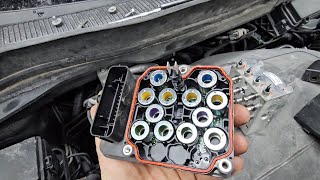
Typical fix: Replace the ABS module. The electronic module can sometimes be separated from the hydraulic pump assembly, making the repair easier. 🎬 See this pro tip for replacing the ABS module without bleeding brakes. Used modules are available but may require programming or calibration with a Nissan-specific scan tool. Some companies offer a repair service for the original module.
Est. part cost: $200-$1200 - Damaged CAN Bus Wiring Harness 🟡 Medium Probability
How to confirm: Visually inspect the wiring harnesses, particularly those running between the ECM, TCM, and ABS modules. Look for signs of chafing, rodent damage, or corrosion, especially at connector junctions. A multimeter can be used to check for continuity (no breaks) and resistance between the CAN High and CAN Low wires (pins 6 and 14) at the DLC with the battery disconnected.
Typical fix: Repair or replace the damaged section of the wiring harness. This may involve soldering broken wires and sealing with heat shrink tubing, or replacing an entire harness section.
Est. part cost: $10-$500 - Faulty Control Module (TCM, BCM) ⚪ Low Probability
How to confirm: This is typically a process of elimination. If the battery, grounds, wiring, and ABS module have all been confirmed to be good, and a professional scan tool shows one specific module is consistently offline, that module is the likely culprit. The module's power and ground inputs should be verified before replacement.
Typical fix: Replace the faulty module. Some modules, like the TCM or BCM, may require programming by a dealer or a qualified shop to work with the vehicle.
Est. part cost: $200-$1200
Rare But Worth Checking
- Blown Fuse for a Control Module: A fuse that powers a specific module (like the TCM or ABS) can blow, causing that module to drop off the network and trigger a U1001 in other modules. Check fuses in both the interior fuse box and the IPDM (Intelligent Power Distribution Module) in the engine bay. A shorted wire can cause a fuse to blow repeatedly.
- Aftermarket Electronics: Improperly installed remote starters, alarms, or audio equipment can interfere with the CAN bus by tapping into the wrong wires or introducing electrical noise, causing communication errors.
- Water Intrusion: On Muranos with a sunroof, clogged sunroof drains are a widely reported problem. The front drains can get clogged or the tubes can disconnect, causing water to leak into the A-pillar and footwell areas, potentially damaging wiring connectors or control modules like the BCM. 🎬 Watch: This mechanic's tutorial shows how to fix leaking sunroof drains.
- Faulty IPDM (Intelligent Power Distribution Module): The IPDM, which is the main fuse/relay box in the engine bay, contains non-serviceable internal relays. Failure of an internal relay, such as the ECM relay, can cut power to a critical module, causing a CAN communication fault. The IPDM itself can be diagnosed with a self-test procedure.
Diagnosis Steps
- Check and charge the battery. Ensure it has a static charge of at least 12.5 volts and holds a load. Low voltage is a primary trigger for CAN codes.
- Use a high-level scan tool (like Nissan CONSULT) to perform a full system scan. Identify which modules are storing the U1001 code and, more importantly, which modules are not communicating at all.
- Check all related fuses in the interior fuse panel and the IPDM (engine bay fuse box). Pay attention to fuses labeled 'Elec B', 'Ignition', or for specific modules like ABS or TCM.
- Perform a thorough visual inspection of the main ground connections. Disconnect, clean, and re-secure the battery negative terminal, the chassis ground under the battery tray, and engine block ground straps.
- Visually inspect the main CAN wiring harness for any signs of physical damage, chafing, or corrosion, paying close attention to connectors.
- If wiring appears intact, use a multimeter to check for 60 ohms of resistance across the CAN High and CAN Low pins (pins 6 and 14) at the DLC with the battery disconnected. This confirms the integrity of the main bus and terminating resistors.
- If a specific module is suspected (especially the ABS module), check for proper power and ground at that module's connector before condemning it.
Parts You'll Likely Need
- Battery — Low system voltage from a weak or failing battery is a primary cause of CAN communication errors.
Trusted brands: Interstate, DieHard, Duralast
OEM price range: $200-$300
Aftermarket price range: $150-$250 - ABS Control Module / Actuator
(OEM #47660-1AN0D, 47660-1AA6C, 47660-1SW0A)— The ABS module is a common point of failure on the CAN network. If it fails internally, it can stop communicating and cause other modules to set a U1001 code, often taking the speedometer with it.
Trusted brands: Hitachi, Bosch, Advics
OEM price range: $1000-$1900
Aftermarket price range: $400-$800 (Remanufactured/Used) - Transmission Control Module (TCM) — A faulty TCM can drop off the network, causing U1001 in the ECM and leading to severe shifting problems. This is less common than an ABS module failure but still a possibility.
Trusted brands: Jatco (OEM), Hitachi
OEM price range: $800-$1500
Aftermarket price range: $300-$700 (Remanufactured)
Related Codes That Often Appear With This One
- U1000 — U1000 is a general CAN communication failure code. U1001 is a more specific variant often related to the ECM. They frequently appear together as different modules report the same network failure.
- C1210 — This is an ABS/VDC code often seen with U1000/U1001. If the ABS module loses communication with the rest of the network, it can trigger U1000/U1001 in other modules while storing its own specific codes.
- P1212 — This code is for ABS/TCS communication line failure. It often appears with U1001 when the ABS module is the root cause of the network failure.
- P1614 — This is an immobilizer (NATS) code. Network issues can sometimes be triggered by or cause problems with the vehicle's anti-theft system, especially if water intrusion has affected the BCM.
Technical Service Bulletins (TSBs) & Recalls
- NTB10-066a / NTB10-066b: This bulletin provides diagnostic tips for CAN codes U1000, U1001, U1002, and U1010. It stresses diagnosing these codes first and confirms that the module reporting the code is usually not the one that has failed. It advises checking battery voltage and using a CONSULT scan tool for proper diagnosis. It also specifies checking for 60 ohms of resistance across the CAN circuit.
Platform-Specific Known Issues
- ABS Module Failure After Pothole or Hard Stop: Several owners have reported a sudden failure of the ABS system, accompanied by a spongy brake pedal and multiple warning lights (including U1001), immediately after hitting a pothole or performing a hard stop that activated the ABS. The diagnosis in these cases was a failed ABS actuator, a very expensive repair.
- Clogged Sunroof Drains Causing Electrical Mayhem: A well-documented issue on the Z51 Murano is the clogging of the front sunroof drain tubes. This causes rainwater to overflow the drain trough and leak down the inside of the A-pillars, soaking carpets, fuse boxes, and wiring harnesses. This water intrusion is a known cause of bizarre electrical problems, including CAN communication failures that trigger U1001. Videos on YouTube demonstrate how to clear these drains.
Mechanic-Grade Diagnostic Values
- CAN Bus Terminating Resistance — expected: Approximately 60 Ω. Failure: A reading of 120 Ω indicates one of the two terminating resistors (often in the ECM or ABS module) is missing from the circuit. A reading near 0 Ω indicates a short between the CAN High and CAN Low wires.
- CAN High Voltage to Ground — expected: Approximately 2.6V (average). Failure: Significant deviation from this voltage can indicate a short or open in the CAN High wire. The voltage should fluctuate between 2.5V and 3.5V on an oscilloscope.
- CAN Low Voltage to Ground — expected: Approximately 2.4V (average). Failure: Significant deviation from this voltage can indicate a short or open in the CAN Low wire. The voltage should fluctuate between 2.5V and 1.5V on an oscilloscope.
- System Voltage Threshold — expected: Above 10V. Failure: If system voltage drops below 10V during cranking or operation, various control modules may stop communicating, triggering U-codes.
Scan Tool Commands That Help
- Nissan CONSULT-II / CONSULT-III: CAN Diag Support Monitor — This function performs a system-wide check to see which control modules are actively communicating on the CAN bus. It is the primary tool for identifying which specific module is offline and is the likely source of the U1001 code stored in other modules.
- Nissan CONSULT-III or equivalent professional scanner: Steering Angle Sensor (SAS) Calibration/Reset — A SAS reset is mandatory after any wheel alignment or if steering/suspension components have been replaced. A loss of communication from the VDC/ABS system can sometimes be related to a decalibrated SAS, and performing a reset is a necessary step after replacing the ABS module.
Wiring & Ground Locations
- Main Chassis Ground — On the vehicle frame, directly underneath the battery tray. Requires removal of the battery and the plastic tray to access.. This is the most frequently cited failure point for U1000/U1001 codes on this platform. It is highly prone to corrosion from battery acid/fumes, creating a poor ground for multiple systems and disrupting CAN communication.
- DLC (OBD-II) Connector Pins — Under the driver's side dashboard.. Pin 6 is CAN High and Pin 14 is CAN Low. These are the primary access points for testing the entire CAN bus resistance (should be 60Ω) and checking for shorts to ground or between the two lines.
- ECM/TCM Location (2005 example) — On some earlier models, the ECM and TCM are located behind the glove box on the passenger side.. Knowing the physical location of the terminating modules (like the ECM) is critical for harness inspection and checking for power/ground directly at the module if it's suspected of failure.
- Ground near Brake Fluid Reservoir — A body ground point located near the brake fluid reservoir in the engine bay.. This is another critical body ground that can affect module communication if loose or corroded.
Real Owner Repair Stories
- NICOclub Forums user 'Brudface' (Nissan Murano (year not specified, but within Z51 generation based on forum context)) — On cold start, no issues. After 5-10 minutes of driving, the speedometer and odometer would stop working, and the ABS and TCS OFF lights would illuminate. Flashing 'AT CHECK' light on cold start. Codes pulled were U1001, P1212, P1574, and P0500.
❌ Tried (didn't work) Cleaning and re-seating all accessible electrical connectors with dielectric grease., Re-doing every ground connection under the hood., Checking all wheel speed sensors (all were in spec)., Re-doing ground connections inside the cabin.
✅ What actually fixed it The user followed the Factory Service Manual (FSM) test procedure for the ABS/TCS module, which failed multiple steps. The electronic portion of the ABS module was replaced (separated from the pump assembly while still on the vehicle). After replacement, the 'AT CHECK' light was gone, and after clearing codes, the ABS, TCS, and SES lights also went away, resolving all symptoms.
OEM Part Supersession History
47660-1AA0B, 47660-1AA0C, 47660-1AA4C→47660-1SW0A, 47660-1SW0B— Part revision/update by Nissan for the ABS Actuator and ECU Assembly.
Heads up: When replacing the ABS module, it is critical to match the part number or use a confirmed superseded part number. Using an incorrect module can lead to continued communication failures or improper ABS/VDC function.
Model Year Variations Within This Range
- 2011-2014: The Murano received a facelift for the 2011 model year. This included a new grille and bumper design, new LED taillights, and refreshed interior details, such as changing the instrument panel lighting from orange to white. While core electronics like the CAN system architecture remained the same, wiring harnesses and connector locations may have minor differences from the 2009-2010 models.
Helpful Videos


Used OEM Parts in Stock


New Aftermarket Parts Available

The information in this article is provided for general reference and educational purposes only. Vehicle specifications, procedures, and part compatibility can vary by production date, trim level, and region. Always consult your vehicle's factory service manual and verify part numbers before purchasing or performing repairs. Safety-critical components such as airbags, seat belts, and braking systems should be installed by a qualified professional.
- Nissan MURANO:
- 🎬 Helpful Videos
- 🛍️ Shop This Part
- What's Unique About the 2009-2014 Nissan MURANO
- Diagnostic Flowchart
- Symptoms You May Notice
- Most Likely Causes
- Rare But Worth Checking
- Diagnosis Steps
- Parts You'll Likely Need
- Related Codes That Often Appear With This One
- Technical Service Bulletins (TSBs) & Recalls
- Platform-Specific Known Issues
- Mechanic-Grade Diagnostic Values
- Scan Tool Commands That Help
- Wiring & Ground Locations
- Real Owner Repair Stories
- OEM Part Supersession History
- Model Year Variations Within This Range
- 🎟️ Get 5% Off