

U1001 on 2005-2012 Nissan Frontier: CAN Communication Failure Causes and Fixes
On a 2005-2012 Nissan Frontier, code U1001 is most often caused by a failing Intelligent Power Distribution Module (IPDM), specifically the internal ECM relay, or by corroded ground connections. Replacing the IPDM's ECM relay or cleaning major ground points is the most common and cost-effective fix. This issue is also common on the platform-mate Nissan Xterra, Pathfinder, and Suzuki Equator.
- U1001 is a network error, not a sensor error. Look for what is disrupting communication for the whole system.
- On a 2005-2012 Frontier, the prime suspect is almost always the IPDM (fuse box) or its internal ECM relay, especially if the truck stalls.
- Always start with the basics: check the battery's health and clean all major ground connections in the engine bay before buying expensive parts.
- If your Frontier has the original 'white' IPDM, consider replacing the ECM relay or the entire module as a preventative measure.
What's Unique About the 2005-2012 Nissan FRONTIER

The 2005-2012 Frontier is part of a generation of Nissan trucks and SUVs (including the Xterra, Pathfinder, and rebadged Suzuki Equator) known for a specific weak point: the Intelligent Power Distribution Module (IPDM), which is the main fuse/relay box in the engine bay. Early models (approx. 2005-2006) used a white-colored IPDM that is prone to internal relay failure, particularly the one controlling the ECM. This failure directly disrupts the CAN network, causing stalling and a host of electrical issues that trigger the U1001 code, making the IPDM a primary suspect on this platform.
Diagnostic Flowchart

Tap your situation to follow the diagnostic path that matches what you're seeing on this vehicle.
Symptoms You May Notice

- Engine stalls while driving, especially at low speeds
- Crank-but-no-start condition
- Multiple warning lights on the dashboard, such as Check Engine, ABS, VDC, and Traction Control
- Instrument cluster gauges behaving erratically or dropping to zero while driving
- Transmission shifting hard, getting stuck in one gear, or going into 'limp mode'
- Cooling fans running constantly at full speed, even when the engine is cold
- Headlights, wipers, or horn activating on their own
- Replacing individual sensors like O2 sensors or camshaft position sensors. If multiple, seemingly unrelated codes appear with U1001, the U1001 communication fault is the root cause, and the other codes are symptoms.
Most Likely Causes

- Faulty Intelligent Power Distribution Module (IPDM) 🔴 High Probability Early models (approx. 2005-2006) used a less reliable white-colored IPDM. The internal, non-serviceable ECM relay is a known failure point that causes stalling and communication loss. This was the subject of NHTSA recall 10V517000. Water intrusion can also corrode the internal circuit board on all years.
How to confirm: Perform the IPDM's self-test procedure (turn ignition on, open driver's door, press the door jamb switch 10 times, close door, turn ignition off then on). If components like wipers and lights activate in sequence, the IPDM is likely functional. If not, or if the vehicle has a white IPDM and stalling issues, the module is highly suspect. A common failure story involves the truck stalling and then having a crank-no-start condition.
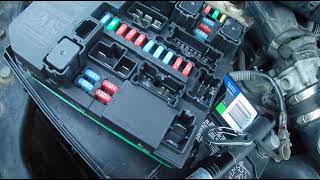
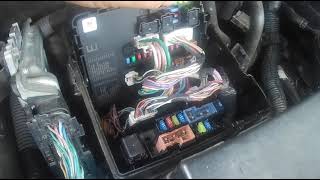
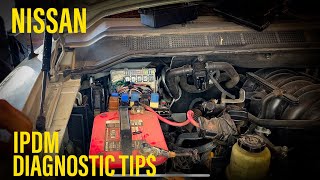
Typical fix: For stalling issues on 2005-2006 models, first check if the recall (NHTSA 10V517000) was performed to replace the ECM relay. If not, or on later models, replace the ECM relay inside the IPDM (Nissan P/N: 284B7-CW29E). For widespread corrosion or failure of the self-test, replace the entire IPDM assembly, 🎬 See these expert IPDM and engine relay diagnostic tips preferably with the updated black-colored version. After replacement, a security system reset may be necessary.
Est. part cost: $15-$25 for the relay, $250-$450 for a new IPDM assembly. - Corroded or Loose Ground Connections 🔴 High Probability As these vehicles age, the main ground points in the engine bay are exposed to moisture and road salt, leading to corrosion. A poor ground connection for the ECM or other modules can easily disrupt the sensitive CAN network.
How to confirm: Visually inspect the main ground straps. Key locations include the thick cable from the negative battery terminal to the intake manifold, a smaller ground from the back of the cylinder head to the firewall, and grounds near the battery tray. Use a multimeter to check for high resistance (voltage drop) between the negative battery terminal and the engine block/chassis. A good ground should measure 0.10 to 0.20 volts, with anything over 0.50V indicating a problem.
Typical fix: Remove the ground bolts/screws, clean the contact surfaces of the terminal and the chassis/engine block with a wire brush until shiny, and re-secure them tightly. Apply dielectric grease to prevent future corrosion.
Est. part cost: $0-$20 for cleaning supplies or a new ground strap. - Low Battery Voltage or Poor Battery Connections 🟡 Medium Probability
How to confirm: Test the battery with a multimeter; a healthy battery should read approximately 12.6 volts with the engine off and over 13.5 volts with the engine running. Check for corrosion on the battery terminals. Low voltage can cause various modules to stop communicating.
Typical fix: Clean the battery terminals and cable ends. If the voltage is low, charge or replace the battery.
Est. part cost: $150-$250 for a new battery. - Damaged CAN Bus Wiring ⚪ Low Probability A recall on some 2016 models (PC440) noted that the starter motor wire harness could be mis-routed and short against the heat shield, potentially causing electrical issues. While not directly a CAN wire, a significant short can disrupt the entire electrical system. Rodent damage is also a possibility.
How to confirm: Visually inspect wiring harnesses in the engine bay and under the vehicle for signs of chafing, melting, or rodent damage, particularly around the starter and IPDM. A professional may need to check for continuity and resistance on the CAN High and CAN Low wires.
Typical fix: Repair the damaged section of the wiring harness and protect it from future damage.
Est. part cost: $5-$50 for wiring repair supplies.
Rare But Worth Checking
- Failing Transmission Control Module (TCM): On some Frontier models, the TCM is located inside the transmission oil pan, mounted to the valve body. It is a known failure point that can short out the CAN bus, causing a U1001 code along with U0101 (Lost Communication with TCM) and shifting problems. Diagnosis involves disconnecting the TCM and seeing if network communication is restored.
- Failing Engine Control Module (ECM): While less common than wiring or IPDM issues, the ECM itself can fail internally and stop communicating on the network. This is usually a last resort after all other possibilities have been eliminated and confirmed with a professional scan tool.
Diagnosis Steps
- Check and record all fault codes. Prioritize diagnosis of the U1001/U1000 codes first, as recommended by Nissan TSB NTB10-066A. 🎬 Watch: DIY guide for fixing U1000 and U1001 communication codes
- Check the battery. Ensure it has a full charge (12.6V+) and that the terminals are clean and tight.
- Inspect all fuses in the IPDM and interior fuse panels, paying close attention to any labeled 'ECM', 'BCM', or 'ELEC PARTS'.
- Locate and inspect the main ground connections in the engine bay (battery to intake, cylinder head to firewall). Disassemble, clean, and re-tighten them.
- If the vehicle is a 2005-2006 model, check if NHTSA recall 10V517000 for the ECM relay was performed. If not, or if stalling is a symptom on any 2005-2012 model, consider replacing the ECM relay (P/N 284B7-CW29E) as a primary diagnostic step.
- With the battery disconnected, measure the resistance between Pin 6 (CAN-H) and Pin 14 (CAN-L) at the OBD-II port. A healthy network should read approximately 60 ohms. A reading of 120 ohms indicates a break in the circuit or a terminating module is offline.
- If the resistance is incorrect, begin disconnecting modules one by one (TCM, ABS, etc.) and re-checking the resistance to identify which module is causing the fault.
- If all wiring and modules check out, the fault may lie within the IPDM assembly itself or, rarely, the ECM.
Parts You'll Likely Need
- IPDM ECM Relay
(OEM #284B7-CW29E)— This specific relay inside the IPDM is a known high-failure part on 2005-2006 models that causes stalling and communication codes, and is known to fail on later models as well.
Trusted brands: Nissan OE
OEM price range: $15-$25
Aftermarket price range: $10-$20 - Intelligent Power Distribution Module (IPDM)
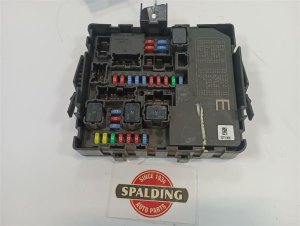
(OEM #284B6-ZE03B (or 284B7-ZE03B), 284B6-EA00B)— The entire module, especially the early white-colored units, is prone to failure from corrosion or internal faults beyond just the ECM relay. An updated black unit is the recommended replacement. Part number varies by year and engine; always verify with VIN.
Trusted brands: Nissan OE, Hitachi
OEM price range: $270-$450
Related Codes That Often Appear With This One
- U1000 — U1000 is a general CAN communication failure code. U1001 is a more specific version indicating the ECM has lost communication. They frequently appear together.
- P0335 — Crankshaft Position Sensor code. A failing IPDM can cut power to the ECM, which then loses the signal from the crank sensor, causing a stall and logging both a P0335 and a U1001.
- U0101 — Lost Communication with TCM. This often appears with U1001 if the TCM itself is failing or if a network-wide issue caused by the IPDM or wiring is preventing both the ECM and TCM from communicating.
Technical Service Bulletins (TSBs) & Recalls
- NTB10-066A: CAN Communication Codes - Diagnostic Tips & Guidelines
- NTB10-145A: ABS/VDC CAN Diagnosis Information
Platform-Specific Known Issues
- A recall was issued (NHTSA Campaign ID: 10V517000) for the ECM relay within the IPDM on 2005-2006 Frontier, Xterra, and Pathfinder models. The relay could develop silicon oxide on its contacts, leading to a poor connection that causes stalling at low speeds or a crank-no-start condition. The official remedy was for dealers to replace the faulty ECM relay inside the IPDM assembly free of charge. Even on vehicles outside the recall years, this relay remains a common failure point.
Mechanic-Grade Diagnostic Values
- CAN Bus Network Resistance — expected: ~60 Ω. Failure: A reading of ~120 Ω indicates an open circuit or a terminating module is offline. A reading of ~40 Ω or less suggests a short or an extra terminating resistor is present.
- CAN High (CAN-H) Voltage to Ground — expected: Idle/Recessive state: ~2.5V. Dominant state: ~3.5V.. Failure: Significant deviation from these voltages, or voltage that doesn't change, indicates a line fault or module issue. A multimeter will show an average voltage, typically between 2.7V and 3.3V on a running vehicle.
- CAN Low (CAN-L) Voltage to Ground — expected: Idle/Recessive state: ~2.5V. Dominant state: ~1.5V.. Failure: Significant deviation, or voltage that doesn't change, indicates a line fault. A multimeter will show an average voltage, typically between 1.7V and 2.3V on a running vehicle.
- Body Ground Voltage Drop — expected: 0.10V - 0.20V. Failure: A reading over 0.50V indicates a poor or corroded ground connection that needs to be cleaned or replaced.
Scan Tool Commands That Help
- Nissan CONSULT-II / CONSULT-III: CAN Diagnosis Support Monitor — This is the primary diagnostic function to use for U1000/U1001 codes. It displays a list of all CAN-connected modules and shows which ones are transmitting (TX) and receiving (RX) signals, allowing a technician to quickly identify the module that is offline.
- Nissan CONSULT-II / CONSULT-III: IPDM Auto Active Test — This built-in self-test commands the IPDM to cycle various components (wipers, lights, fans, etc.). If the test runs successfully, it confirms that the CAN communication line between the BCM and the IPDM is intact. If the test fails to initiate, it points towards a problem with the IPDM, BCM, or the CAN link between them.
Wiring & Ground Locations
- E15, E24 — Right front of the engine compartment.. These are primary grounding points for numerous engine bay components, including potentially the IPDM E/R and lighting systems. Corrosion here can cause widespread electrical issues.
- F10 — Left front of the engine, near the block.. This is a main engine ground point. A poor connection here can directly affect the ECM and other critical engine sensors, leading to communication faults.
- M57 — Behind the left side of the dashboard, in the passenger cabin.. This is a major interior ground point for components like the BCM and combination meter. A fault here can cause instrument cluster issues and communication codes.
- Cylinder Head to Firewall Strap — A braided ground strap running from the back of the passenger-side cylinder head to the firewall.. This is a critical ground path for the engine to the chassis. Corrosion or a loose connection is a common cause of intermittent electrical and communication problems.
Real Owner Repair Stories
- Reddit user in r/Xterra (2005-2010 Nissan Xterra (platform mate)) — Crank but no start, no drive gears, codes U1000 and U1001.
❌ Tried (didn't work) Vehicle sat for a year after the previous owner experienced the failure.
✅ What actually fixed it The issue was identified as a likely TCM (Transmission Control Module) failure due to water intrusion, a common problem on this platform. The diagnostic step was to check fuse #49 in the IPDM; if it blows immediately upon replacement, it confirms a shorted TCM. - YouTube video by 'No Start No Crank Fix IPDM' (2010 Suzuki Equator (rebadged Nissan Frontier)) — Crank no start, vehicle stranded.
❌ Tried (didn't work) Replacing the fuel pump ($70+).
✅ What actually fixed it The problem was solved by replacing the small ECM relay inside the IPDM. The part number was 284B7-CW29E and cost under $10. This fixed the no-start condition immediately.
OEM Part Supersession History
284b6ze03a→284B6-ZE03B— Update/revision to the IPDM assembly.
Heads up: Part 284B6-ZE03B is listed for 2009+ models, while earlier models used different IPDM versions. Always verify the correct IPDM part number with the vehicle's VIN.
Model Year Variations Within This Range
- 2005-2006 (4.0L V6) & 2005-2008 (2.5L I4): These 'Early Style' models were often equipped with a white-colored IPDM that was particularly prone to internal ECM relay failure, causing stalling and U1001 codes.
- 2007-2012 (4.0L V6) & 2009-2012 (2.5L I4): These 'Late Style' models use an updated, typically black-colored IPDM. While more reliable than the early white units, they can still fail due to moisture intrusion or other internal faults, but the widespread ECM relay issue is less common.
Helpful Videos


We Have This Part in Stock




The information in this article is provided for general reference and educational purposes only. Vehicle specifications, procedures, and part compatibility can vary by production date, trim level, and region. Always consult your vehicle's factory service manual and verify part numbers before purchasing or performing repairs. Safety-critical components such as airbags, seat belts, and braking systems should be installed by a qualified professional.
- Nissan FRONTIER:
- 🎬 Helpful Videos
- 🛍️ Shop This Part
- What's Unique About the 2005-2012 Nissan FRONTIER
- Diagnostic Flowchart
- Symptoms You May Notice
- Most Likely Causes
- Rare But Worth Checking
- Diagnosis Steps
- Parts You'll Likely Need
- Related Codes That Often Appear With This One
- Technical Service Bulletins (TSBs) & Recalls
- Platform-Specific Known Issues
- Mechanic-Grade Diagnostic Values
- Scan Tool Commands That Help
- Wiring & Ground Locations
- Real Owner Repair Stories
- OEM Part Supersession History
- Model Year Variations Within This Range
- 🎟️ Get 5% Off