

OBD-II Code U1001: Lost Communication with a Control Module
What U1001 means, why it triggers, and how to fix it
- U1001 indicates a CAN bus network failure where at least one computer module has stopped communicating for over 2 seconds.
- Test your battery and clean the main chassis ground wires first, as voltage drops below 12.4V cause the majority of these communication errors.
- Never replace a $500+ ECM or TCM without using a full-system scanner to pinpoint exactly which module dropped off the network.
- On Nissan and Infiniti models from 2004-2015, inspect the Intelligent Power Distribution Module (IPDM) and passenger floorboard for water damage before checking anything else.
What Does U1001 Mean?

The code U1001 means there is a communication breakdown on your car's internal computer network, called the CAN bus. Think of it like the WiFi going out in your car: one or more computers (modules) stopped talking to the network for at least two seconds.
Technical definition: The official SAE/ISO definition for U1001 is "CAN (Controller Area Network) Communication Circuit Malfunction." It indicates that a control module lost communication with one or more other modules on the network. Nissan-specific definitions note that U1001 is logged by the ECM (Engine Control Module) when it stops receiving communications from another module.
Can I Drive With U1001?
Yes, But With Caution. You can drive, but you risk sudden stalling, harsh shifting into a single gear (limp mode), or the complete loss of safety systems like ABS and traction control. Ignoring this code leaves you stranded and adds hundreds to thousands of dollars in transmission wear if the vehicle gets stuck in limp mode.
Common Causes

- Poor or Corroded Ground Connections (Very Common) — Corroded or loose ground wires connecting the electronics to the car's frame disrupt communication, especially on Nissan and Infiniti vehicles.
- Low Battery Voltage or Faulty Alternator (Very Common) — Modern car computers are highly sensitive to voltage. A weak or dying battery causes electronic glitches and communication errors long before it fails to start the car.
- Failing Intelligent Power Distribution Module (IPDM) (Common) — On Nissan, Infiniti, and Suzuki models, the IPDM (a smart fuse/relay box) is a known weak point. Internal relays fail, cutting power to the ECM and triggering a U1001 code. 🎬 Watch: How to perform a Nissan IPDM self test
- Water Intrusion and Clogged Drains (Common) — Clogged sunroof drains leak water onto the Body Control Module (BCM), shorting it out and taking down the network. On Nissan trucks, coolant contaminates the transmission wiring harness ('SMOD') and causes failures.
- Damaged or Corroded Wiring/Connectors (Common) — Wires in the CAN bus harness fray, get chewed by rodents, or corrode from moisture, causing a short or an open circuit in the network.
- Blown Fuse (Less Common) — A single blown fuse takes a critical computer offline and triggers a network-wide communication code.
- Failing Control Module (Less Common) — A computer module itself, like the Engine Control Module (ECM), Transmission Control Module (TCM), or ABS module, fails internally and disrupts the entire network.
- Aftermarket Electronics (Rare) — Improperly installed aftermarket stereos, alarms, remote start systems, or cheap OBD-II plug-in devices interfere with the CAN bus network and cause communication faults.
- Failing Camshaft/Crankshaft Position Sensors (Rare) — Failing camshaft or crankshaft position sensors create electrical noise or erratic signals that disrupt CAN bus communication, leading to a U1001 code alongside engine misfire codes.
Symptoms

- Multiple Warning Lights — The Check Engine, ABS, Traction Control (TCS/VDC), and SLIP lights illuminate simultaneously.
- Erratic Instrument Cluster — Gauges like the speedometer or tachometer drop to zero, jump erratically, or stop working entirely.
- Engine Stalls or No-Start Condition — The engine stalls while driving or cranks without starting because the computers cannot coordinate fuel and spark.
- Cooling Fans Run Constantly — Radiator cooling fans run at full speed immediately upon ignition, acting as a fail-safe response to lost ECM communication.
- Trip Computer Resets — The trip odometer and fuel economy displays reset to zero every time the vehicle turns off.
- Transmission Problems (also visible on scanner) — The transmission shifts harshly, locks into a single gear (limp mode), or the dash gear indicator goes blank.
Diagnostic Flowchart
Tap your situation to follow the diagnostic path that matches what you're seeing on this code.
Common Fixes & Costs
- Clean or Repair Ground Connections — Parts: $0-$20, Labor: $150-$250, ~1.5 hr book time (DIY)
- Replace Weak or Faulty Battery — Parts: $150-$350, Labor: $50-$100, ~0.5 hr book time (DIY)
- Replace Faulty IPDM (Intelligent Power Distribution Module) — Parts: $250-$500, Labor: $100-$200, ~0.8 hr book time (Intermediate)
- Repair Damaged CAN Bus Wiring — Parts: $10-$50, Labor: $250-$1200+, ~4.5 hr book time (Professional)
- Replace a Faulty Control Module (e.g., ECM, BCM, ABS) — Parts: $200-$1500, Labor: $150-$500, ~2.5 hr book time (Professional)
Used vs. New Parts: Buying Guide
When a used part is worth it: For simple, non-programmable modules like an IPDM, a used part from a reputable source is a good way to save money. For complex modules like an ECM or BCM, used only makes sense if you have a confirmed path for reprogramming, as most are VIN-locked and will not work as a simple swap.
Donor-vehicle mileage cap: roughly under 100000 miles for the part to have meaningful remaining life.
Donor quality checklist:
- Verify the part number on the used module EXACTLY matches the original.
- Purchase from sellers who provide the VIN of the donor car to help verify compatibility.
- Avoid parts from vehicles in areas with heavy road salt (rust belt) or flood zones, as corrosion is a primary failure cause.
- Ask for a warranty or return policy, even if it's just 30-90 days.
Decision logic:
- If The part is an IPDM that does not require programming → Used is a great option. Verify the part number.
- If The part is a BCM or ECM for a Nissan/Infiniti → Strongly favor a new OEM part. Many used modules cannot be re-VIN-ed or configured, even by the dealer, leading to wasted money.
- If The part is from a low-mileage accident vehicle and you have access to professional programming tools → Used may be a viable, but risky, option. Factor in the cost of programming.
Warranty tradeoff: Used parts typically have a 30-90 day warranty for the part only. New aftermarket parts offer 1 year to lifetime warranties. New OEM parts usually carry a 12-month/12,000-mile warranty.
Worst-case if a used part fails: $500-$1000 if a used, programmed module fails. This includes the cost of the failed part plus non-refundable labor and programming fees for both the failed attempt and the successful replacement.
What Happens If You Wait — Timeline
- 0-1 month: Intermittent warning lights (ABS, VDC, SLIP) appear, often during startup on a cold day, but may go away. Trip computer might reset. No major drivability symptoms. (MPG impact: 0%% · Added cost: $0)
- 1-3 months: Warning lights stay on permanently. The vehicle may occasionally crank for longer than usual to start or experience a sudden stall. Gauges may erratically drop to zero while driving. (MPG impact: 0-5%% · Added cost: $50-$150 (Cost of potential tow if it fails to start))
- 3-6 months: Drivability is now significantly affected. The transmission may get stuck in 'limp mode' (usually 2nd or 3rd gear), causing very high RPMs at moderate speeds. A no-start condition becomes more frequent. (MPG impact: 10-25% (due to limp mode)% · Added cost: $500-$2,500 (Risk of additional stress/wear on the transmission from operating in limp mode, potential damage to other modules from underlying voltage issue).)
- 6+ months: The root cause (e.g., a bad alternator, water leak, or shorted wire) has likely caused cascading failures. A bad alternator may have destroyed the new battery you installed. A water leak may have corroded multiple connectors or modules. The car is likely undrivable and now requires a much more complex and expensive repair. (MPG impact: N/A (Vehicle likely inoperable)% · Added cost: $1,500-$4,000+ (Cost of replacing multiple control modules like the ECM and BCM, plus extensive diagnostic labor).)
Cost of Not Fixing It
- Immediate: Vehicle may not start or could stall while driving, posing a significant safety risk and potentially leaving you stranded. (Added cost: $150-$300 (Towing))
- 1-3 months: Driving in 'limp mode' with the transmission stuck in one gear causes excessive wear on the transmission clutches and fluid due to high RPMs, potentially leading to premature transmission failure. (Added cost: $2500-$5000 (Transmission Rebuild/Replacement))
- 3+ months: A persistent underlying electrical issue (like water intrusion or a failing alternator) causes cascading failures, damaging other expensive control modules on the network. (Added cost: $500-$2000+ (Additional Module Replacement))
Diagnosis Steps
- Check the Battery and Charging System
Use a multimeter to test the battery. It must read above 12.4 volts with the engine off and between 13.5 and 14.5 volts while running. A low reading confirms a weak battery or failing alternator.
Tools: Multimeter (Beginner) - Inspect and Clean Ground Connections
Visually inspect and clean the main ground points. Scrub the negative battery terminal, engine block straps, and chassis grounds with a wire brush to remove green or white corrosion.
Tools: Wire Brush, Socket Set (Beginner) - Perform a Voltage Drop Test on Grounds
Set your multimeter to a low DC volts scale. Place the red lead on the negative battery post and the black lead on the engine block. A reading above 0.2 volts while the engine is running confirms a bad ground connection.
Tools: Multimeter (Intermediate) - Check Fuses
Inspect all fuses related to the ECM, TCM, and BCM. Pay special attention to the IPDM (Intelligent Power Distribution Module) located near the battery on Nissan vehicles.
Tools: Fuse Puller or Pliers (Beginner) - Perform a Full Vehicle Scan
Use a professional-grade scan tool to see which modules are online and which are offline. A network topology map instantly highlights the non-communicating module.
Tools: Professional OBD-II Scan Tool (Intermediate) - Test the CAN Bus Resistance
With the battery disconnected, measure resistance between Pin 6 (CAN High) and Pin 14 (CAN Low) at the OBD-II port. A healthy network reads 60 ohms. 120 ohms means an open circuit; 0 ohms means a short.
Tools: Multimeter (Advanced) - Perform a 'Wiggle Test'
While monitoring live scan tool data or multimeter resistance, gently wiggle wiring harnesses near the offline module. If values flicker, you found the intermittent short or open wire.
Tools: Professional OBD-II Scan Tool or Multimeter (Advanced) - Check CAN Waveform with an Oscilloscope
Connect an oscilloscope to CAN High (Pin 6) and CAN Low (Pin 14). A healthy bus shows two clean, mirrored square waves. Distorted signals confirm a wiring fault or corrupted module.
Tools: Oscilloscope (Professional) - Check Fuel Pressure in a No-Start Condition
If U1001 pairs with a crank/no-start and U0100, check for power at the fuel pump. Zero pressure (normally 45-55 PSI) indicates the ECM or IPDM failed to send the power command.
Tools: Fuel Pressure Gauge, Multimeter, Professional OBD-II Scan Tool (Advanced)
When This Code Triggers (Freeze-Frame Conditions)
- System Voltage: 9.5V - 11.5V (during crank / low battery)
- Engine Coolant Temp: 180-200°F (fully warmed up, during steady driving)
- RPM: 0 or 1500-2500 (key-on engine-off or cruise / steady throttle)
- Vehicle Speed: 0 mph or 45-65 mph (at startup or during highway driving)
Related Codes
- U1000 — Nearly identical to U1001. U1001 is logged by the ECM, while U1000 is logged by the BCM. Seeing both confirms a widespread failure.
- U0100 — Lost Communication with ECM. If the BCM logs U1001 and the ABS logs U0100, the ECM or its power supply is the root problem.
- U0101 — Lost Communication with TCM. Indicates the Transmission Control Module dropped off the network. Start by checking TCM power and grounds.
- C1109 — ABS battery voltage issue. Seeing this with U1001 confirms the root cause is a weak battery or failing alternator, not a complex network failure.
- P0300 — Random Misfire. A symptom of U1001. The ECM loses critical sensor data and triggers misfires. Fixing the network resolves the misfire.
Climate & Environmental Factors
- High Humidity / Road Salt: Accelerates corrosion of electrical ground points, wiring connectors, and IPDM internals.
- Heavy Rain / Clogged Drains: Clogged sunroof drains leak rainwater into the passenger footwell, saturating and destroying the Body Control Module (BCM).
- Extreme Cold: Weakens battery performance, causing voltage drops during cold starts that trigger communication glitches.
How to Talk to a Mechanic About This Code
Say this: "I have a U1001 communication code with multiple warning lights on. I'd like to schedule a diagnostic appointment. I've confirmed the battery is good, so please start by checking the main electrical grounds and running a full CAN network scan to see which modules are offline before recommending any part replacements."
This signals you are an informed customer. It directs the mechanic to follow a logical diagnostic path (grounds, network test) instead of jumping to expensive conclusions like replacing the ECM. It establishes a 'test, don't guess' expectation.
Avoid saying:
- 'My car's electronics are going crazy, just fix it.'
- 'I searched online and I think I need a new computer.'
- 'My check engine light is on, can you just look at it?'
Questions to ask before authorizing the repair:
- What specific tests did you perform to condemn this part?
- Can you show me the results of the network scan that indicates which module is offline?
- Did you confirm that the power and ground connections to the failed module are good?
- If you are recommending a module replacement, does it require programming and is that cost included in the quote?
Where to Take It: Dealer vs Independent vs Chain
- Dealer:
A strong, but expensive, choice. Best reserved for warranty work or if a trusted independent shop cannot solve the problem.
Best for: Vehicles under warranty, Complex electrical issues where an independent shop has failed, Repairs that are guaranteed to require module programming with manufacturer-specific tools.
Downsides: Significantly higher labor rates, often 1.5-2x more than independent shops., May be quicker to replace an entire assembly rather than diagnose a smaller component. (Typical cost: +50% vs. baseline) - Independent Shop:
Best overall fit. A good independent shop with a skilled electrical diagnostician is the most cost-effective choice for tackling a U1001 code on an out-of-warranty vehicle.
Best for: Out-of-warranty vehicles where cost is a concern., Diagnosing the most common causes of U1001, like bad grounds, wiring, or IPDM failures.
Downsides: Diagnostic skill for complex electrical issues can vary greatly. It is crucial to find a shop with a reputation for strong electrical diagnostics. (Typical cost: +0% vs. baseline) - Chain Shop:
AVOID for diagnosis. These shops are not equipped for the complex electrical diagnosis required for a U1001 code. They may correctly identify a bad battery, but they are ill-suited for any deeper network or wiring issues.
Best for: Simple, routine maintenance like oil changes, tires, and battery replacements.
Downsides: Technicians often lack the specialized training and tools for complex network diagnostics., Business model is focused on high volume of simple repairs, not time-consuming electrical diagnosis. (Typical cost: -10% vs. baseline)
When to Walk Away From the Repair
If the estimated repair cost for the U1001 code exceeds 40-50% of your car's private-party market value, you should seriously consider selling the car as-is or trading it in.
- Car worth $4000, fix is $300: Fix it. This is a minor repair cost relative to the car's value.
- Car worth $4000, fix is $1800: Borderline. The repair cost is approaching half the car's value. Get a second opinion before authorizing, and consider selling it as a 'mechanic's special'.
- Car worth $2500, fix is $1800: Walk away. The repair cost is far too high relative to the vehicle's value. Sell the car as-is or for scrap.
What Scan Tool You Need for This Code

Minimum: A scanner that can perform a 'Full System Scan' or 'All Module Scan' to see which specific modules (ABS, BCM, TCM, etc.) are online and which are not communicating.
A basic $20 code reader will only show the U1001 code stored in the Engine Control Module. It cannot tell you which *other* module has stopped communicating, making it impossible to find the source of the problem. You need to see the entire vehicle network.
Budget: Autel MaxiAP AP200 (~$60) — This is a Bluetooth dongle that pairs with your smartphone. It performs a full system scan on all modules, allowing you to see which ones are not responding, which is essential for diagnosing U1001.
Mid-range: Foxwell NT510 Elite (~$180) — A powerful handheld tool that provides all-system diagnostics and bidirectional controls to actively test components. This allows you to not only see which module is offline but also command specific functions to test wiring and component integrity.
Professional: Autel MaxiCOM MK808S (~$500) — A professional-level tablet scanner that offers full system diagnostics, bidirectional control, and on some vehicles, a network topology map. The topology map visually displays the entire CAN network, showing which modules are online (green) and offline (red), dramatically speeding up diagnosis.
Rent vs buy: For a U1001 code, buying is recommended. Free rental scanners at auto parts stores are typically basic code readers that are not sufficient for this network-level diagnosis. Investing in a tool like the Autel AP200 is often cheaper than a single diagnostic fee at a shop.
How to Clear the Code After You Fix It
- Reconnect battery (if disconnected for repair)
- Use a professional OBD-II scan tool to clear all codes from all modules
- Perform an ECU reset/relearn procedure if specified for the repair (e.g., throttle body relearn).
- Drive the vehicle for at least one full warm-up cycle to confirm the fix
Drive cycle (~20 minutes): Cold start the vehicle. Allow it to idle for 2-3 minutes. Drive in mixed city/highway conditions for at least 15 minutes, ensuring the vehicle comes to a complete stop and reaches speeds above 45 mph. Allow the vehicle to cool completely to ambient temperature.
Readiness monitors affected: Comprehensive Component Monitor, Misfire Monitor
Watch out for:
- Using a basic code reader that only clears codes from the ECM, leaving U-codes in other modules.
- Not fixing the root cause (e.g., a corroded ground), causing the code to return immediately.
- Disconnecting the battery will clear the code but also resets all emissions readiness monitors, which will cause an automatic smog test failure until a full drive cycle is completed.
Will This Fail Emissions / State Inspection?
Yes — this code typically fails an OBD-II emissions inspection.
- California: An illuminated Check Engine Light is an automatic failure. After repairs, you must complete a specific drive cycle to set the readiness monitors before re-testing. A tuned ECU that deletes the code may be detected and cause a failure.
- New York: The NYS DMV inspection includes an OBD-II scan. A U1001 code that turns on the Check Engine Light will result in an automatic failure.
- Texas: In counties requiring emissions testing (like Harris, Dallas, Tarrant), an illuminated Check Engine Light is an automatic failure. After clearing the code, you can only have one monitor 'Not Ready' (two for cars from 1996-2000) to pass.
Most Commonly Affected Vehicles
- Nissan Titan (2004-2015) — Prone to bad grounds and IPDM failure. Early models suffer radiator failures ('SMOD') that destroy the TCM.
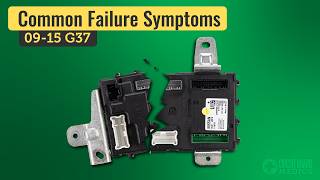
- Infiniti G35 / G37 (2005-2013) — Highly susceptible due to bad grounds, low voltage, or water-damaged BCMs from clogged sunroof drains.
- Nissan Pathfinder / Xterra / Frontier (2005-2012) — Commonly caused by a faulty IPDM. Original white-cased IPDMs fail frequently.
- Nissan 350Z / 370Z (2003-2020) — Bad grounds and weak batteries are the primary culprits. Key ground points are near the battery and timing cover.
- Nissan Versa / Murano (2005-2014) — Appears with transmission symptoms due to ground issues. Murano ECM/TCMs sit behind the glove box, risking water damage.
- Ford F-150 (2013-2023) — Exhibits widespread communication codes due to intermittent power loss from bad fuse box connections.
- Chevrolet Silverado (2007-2018) — Triggered by software glitches requiring an ECM reflash or a poor BCM ground at location G218.
- Subaru Outback / Legacy / Forester (2005-2014) — Failing ABS control modules corrupt the network. Also triggered by aftermarket head units lacking CAN bus adapters.
Manufacturer-Specific Notes

- Nissan / Infiniti: Highly susceptible to U1001 from simple issues like corroded grounds or a weak battery. The IPDM is a known weak point requiring replacement.
- General Motors: Communication codes point to software glitches requiring reprogramming or a 'logic lock' fixed by a battery disconnect.
- Ford: Logs widespread codes due to a poor connection for a single fuse in the main fuse box, causing intermittent PCM power loss.
- Subaru: The ABS/VDC control module frequently fails, broadcasting corrupt data that brings down the entire CAN network.
Real Owner Stories
2008 Nissan Titan with multiple warning lights
Owner experienced multiple warning lights (VDC, SLIP, ABS) and the truck would sometimes crank but not start. The issue was intermittent.
What they tried:
- Initially suspected a bad battery, but it tested good.
- Considered replacing the expensive IPDM or ECM based on initial internet searches.
Outcome: The owner inspected the main ground wire from the battery to the chassis and found it was severely corroded. After replacing the ground cable ($25 part) and cleaning the connection point to bare metal, all codes cleared and the starting issue was resolved.
Lesson: Always check the simplest, cheapest things first. On Nissan trucks, corroded grounds are the #1 cause of U1001 and mimic the symptoms of a failed computer.
2012 Infiniti G37x with a wet floor and electrical chaos
After a heavy rain, the owner found the passenger side floorboard was wet. Soon after, the car began exhibiting bizarre electrical problems, including a no-start condition and 13 different trouble codes, including U1001, U0101 (Lost Comm with TCM), and P0463 (Fuel Level Sensor).
What they tried:
- The owner initially taped up the sunroof, suspecting it as the leak source.
- Took the car to a shop that was unable to diagnose the complex web of codes.
Outcome: The root cause was clogged sunroof drains, which caused water to leak into the cabin and damage the Body Control Module (BCM) located in the passenger kick panel. The fix required replacing the BCM (a $500+ part plus programming) and clearing the clogged drains to prevent a recurrence.
Lesson: On Infiniti G-series cars, any sign of water in the passenger footwell combined with electrical codes is a huge red flag for a damaged BCM. Address the water leak immediately before replacing any electronics.
2009 Infiniti G37 after a DIY radar detector installation
Immediately after hardwiring a radar detector to the auto-dimming mirror, the VDC and SLIP lights came on, and the trip computer started resetting on every startup. The car threw U1000 and U1001 codes.
What they tried:
- Checked fuses and found a blown 10A fuse in the interior fuse panel, which was replaced.
- Disconnected and reconnected the battery multiple times, which temporarily cleared some lights but not the main issue.
- A dealership suggested the cause was low brake fluid, which was incorrect.
Outcome: The owner accidentally shorted a wire while tapping into the mirror's power. This electrical short on the CAN bus caused the communication failure. The fix required taking it to a trusted mechanic with advanced diagnostic tools to properly diagnose the CAN network and trace the fault back to the mirror wiring.
Lesson: Tapping into modern vehicle wiring, especially circuits connected to the CAN bus (like advanced mirrors), is risky. A simple mistake can cause network-wide failures that are difficult to diagnose without professional tools. Always disconnect the battery before cutting or splicing wires.
How to Prevent This Code From Triggering
- Periodically Clean Electrical Grounds (Every 2-3 years, or when changing the battery) — Corrosion on the main battery-to-chassis and chassis-to-engine grounds increases resistance, causing voltage drops that destabilize control modules. Cleaning these points to bare metal and applying dielectric grease prevents this primary cause of U1001.
- Clear Sunroof and Cowl Drains (Annually, especially before rainy seasons) — Leaves and debris clog drains, causing rainwater to overflow into the vehicle cabin. On many cars (notably Infiniti G37), this water directly drips onto the BCM or other electronics, causing shorts and communication failures.
- Use a Battery Tender for Stored Vehicles (Any time the vehicle will sit for more than 2 weeks) — A battery's voltage naturally drops over time. A tender maintains an optimal charge, preventing the battery from weakening and providing the unstable, low voltage that frequently triggers communication codes on startup.
- Inspect Wiring Aftermarket Installations (After any non-OEM electronic device is installed) — Improperly tapping power or using non-isolated wiring for stereos, alarms, or remote starters can introduce electrical noise or shorts onto the CAN bus, disrupting communication. Ensure any installer is reputable and understands modern vehicle networks.
Frequently Asked Questions
What is a CAN bus?
The Controller Area Network (CAN) bus is your car's nervous system. It lets computers like the engine, transmission, and brake modules talk to each other using twisted wires.
Can a weak battery really cause this code?
Yes. A weak battery providing unstable voltage is the most common cause of U1001. Computers require a steady power supply to communicate.
Can I fix a U1001 code myself?
You can test the battery, clean ground wires, and check fuses yourself. If those fail, stop DIY and take it to a shop, as network diagnosis requires professional scanners.
The code is stored in my Engine Control Module (ECM). Does that mean my ECM is bad?
No. The module storing the code is usually working correctly and simply reporting it cannot hear from another module. Never replace the ECM without a full network diagnosis.
Will clearing the code make it go away?
Clearing the code turns off the light temporarily if the problem is intermittent. However, the code returns immediately until you fix the underlying electrical fault.
My cheap code reader only shows U1001. How do I find the real problem?
Basic readers only see generic engine codes. You need a professional-grade scan tool to perform a full network test and identify exactly which module stopped responding.
What's the difference between U1000 and U1001?
Both indicate a CAN communication failure. The ECM logs U1001 when it loses communication, while the BCM logs U1000. Seeing both confirms a network-wide issue.
I replaced a part but the code is still there. Do I need to do a 'relearn' procedure?
Yes. Replacing a BCM or ECM requires dealer-level programming and key registration to recognize the new part. Skipping this causes a no-start condition.
Key Takeaways
- U1001 indicates a CAN bus network failure where at least one computer module has stopped communicating for over 2 seconds.
- Test your battery and clean the main chassis ground wires first, as voltage drops below 12.4V cause the majority of these communication errors.
- Never replace a $500+ ECM or TCM without using a full-system scanner to pinpoint exactly which module dropped off the network.
- On Nissan and Infiniti models from 2004-2015, inspect the Intelligent Power Distribution Module (IPDM) and passenger floorboard for water damage before checking anything else.
Helpful Videos



The information in this article is provided for general reference and educational purposes only. Vehicle specifications, procedures, and part compatibility can vary by production date, trim level, and region. Always consult your vehicle's factory service manual and verify part numbers before purchasing or performing repairs. Safety-critical components such as airbags, seat belts, and braking systems should be installed by a qualified professional.
- 🎬 Helpful Videos
- What Does U1001 Mean?
- Can I Drive With U1001?
- Common Causes
- Symptoms
- Diagnostic Flowchart
- Common Fixes & Costs
- Used vs. New Parts: Buying Guide
- What Happens If You Wait — Timeline
- Cost of Not Fixing It
- Diagnosis Steps
- When This Code Triggers (Freeze-Frame Conditions)
- Related Codes
- Climate & Environmental Factors
- How to Talk to a Mechanic About This Code
- Where to Take It: Dealer vs Independent vs Chain
- When to Walk Away From the Repair
- What Scan Tool You Need for This Code
- How to Clear the Code After You Fix It
- Will This Fail Emissions / State Inspection?
- Most Commonly Affected Vehicles
- Manufacturer-Specific Notes
- Real Owner Stories
- 2008 Nissan Titan with multiple warning lights
- 2012 Infiniti G37x with a wet floor and electrical chaos
- 2009 Infiniti G37 after a DIY radar detector installation
- How to Prevent This Code From Triggering
- Frequently Asked Questions
- What is a CAN bus?
- Can a weak battery really cause this code?
- Can I fix a U1001 code myself?
- The code is stored in my Engine Control Module (ECM). Does that mean my ECM is bad?
- Will clearing the code make it go away?
- My cheap code reader only shows U1001. How do I find the real problem?
- What's the difference between U1000 and U1001?
- I replaced a part but the code is still there. Do I need to do a 'relearn' procedure?
- Key Takeaways
- 🎟️ Get 5% Off