

U1000 on 2007-2014 Chevrolet Silverado 2500HD: Network Communication Failure Causes and Fixes
On a 2007-2014 Silverado 2500HD, code U1000 almost always indicates a network communication failure caused by a bad ground connection, a weak battery, or a damaged wiring harness. The fix is typically a low-cost wire or ground repair, not an expensive part replacement, but diagnosis can be complex.
- U1000 is a network code, not a part code. It means 'communication is down' somewhere in the system.
- Before any complex diagnostics, check the easiest and most common culprits: the battery's state of charge and the cleanliness and tightness of all major ground connections.
- The 'Service StabiliTrak' warning is a very common symptom of this network code on a Silverado and does not automatically mean the stability system itself is faulty.
- Diagnosis is a process of elimination. Do not replace any expensive modules like the ECM or BCM unless you have definitively proven it is the source of the network failure.
- If you have an auxiliary battery, be aware of GM Recall #14260 regarding a potentially melting fusible link, which can cause this code.
What's Unique About the 2007-2014 Chevrolet Silverado 2500HD
On the GMT900 platform Silverado HD, a U1000 code is frequently accompanied by 'Service StabiliTrak' and 'Service Traction Control' messages on the dashboard. This is because the stability system relies heavily on communication with the engine and brake control modules; when that communication is lost, the system shuts down as a safety precaution. These trucks are also known for having corrosion-prone ground locations and potential issues with the auxiliary battery fusible link, which can create the exact electrical instability that triggers this code. A particularly notorious ground is G218, located under the driver's side dash, which is often improperly seated from the factory.
Symptoms You May Notice
- Check Engine Light is on
- "Service StabiliTrak" or "Service Traction Control" messages displayed
- Engine may crank but not start
- Sudden stalling or rough idle
- Reduced engine power or "limp mode"
- Instrument cluster gauges (speedometer, tachometer) behaving erratically or not working
- Scan tool fails to communicate with vehicle modules
- Radio or climate controls may not function
- "Service 4 Wheel Drive" message may appear
- Replacing the Engine Control Module (ECM) without proper diagnosis. The ECM is often just one of many modules reporting the U1000 code; it is rarely the root cause.
- Replacing the throttle body or wheel speed sensors for a StabiliTrak message when U1000 is present. The StabiliTrak warning is usually a symptom of the network failure, not the cause.
Most Likely Causes
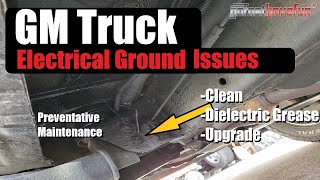
- Poor Ground Connections or Weak Battery 🔴 High Probability GM trucks of this era are known for having chassis and engine grounds that are susceptible to corrosion. Specifically, ground G218 (under the driver's dash kick panel) is infamous for having sound-deadening material trapped under the terminal from the factory, causing a poor connection for the BCM. Other key grounds like G103 (on the cowl) and the main battery-to-frame ground are also common failure points.
How to confirm: Check battery voltage; it should be above 12.4V with the engine off. Load test the battery. Disassemble, clean, and inspect the main battery terminals, engine block ground straps, and frame grounds. For G218, remove the driver's kick panel, unbolt the ground, and ensure no insulation is caught under the terminal. Clean all contact surfaces to bare metal.
Typical fix: Clean all corrosion from battery terminals and ground connection points with a wire brush, then secure them tightly. For G218, specifically trim away any interfering insulation mat before re-securing. Replace corroded ground straps or battery cables.
Est. part cost: $5-$50 - Damaged Wiring Harness 🟡 Medium Probability Harnesses can chafe against the frame, engine components, or aftermarket accessories. The main harness running along the driver's side frame rail is a common area for damage, as is the wiring near the parking brake mechanism and the harness going to the transfer case. A shorted wire to the starter solenoid has also been found to be a cause.
How to confirm: Visually inspect wiring harnesses for signs of chafing, melting, or rodent damage, paying close attention to areas where the harness bends or is secured by clips. A multimeter can be used to check for continuity on the Class 2 data wire (typically a tan wire at Pin 2 of the OBD-II port).
Typical fix: Repair the broken or shorted wire using solder and heat shrink tubing. Secure the harness away from sharp edges or hot components.
Est. part cost: $1-$20 - Faulty Control Module ⚪ Low Probability Any module on the network (BCM, EBCM, TCM, IPC, etc.) can fail internally, causing it to either stop communicating or flood the network with corrupt data, bringing down the entire system. While possible, this is far less common than a wiring or ground issue.
How to confirm: This requires a high-end scan tool to perform a 'module roll-call' to see which module is not responding. A technician may then unplug the suspect module; if communication is restored to the other modules, the disconnected module is the culprit.
Typical fix: Replace the faulty module. Note that many modules, such as the BCM or ECM, require programming by a dealer or qualified shop after installation.
Est. part cost: $200-$1000 - Aftermarket Electronics Interference ⚪ Low Probability Improperly installed aftermarket diesel tuners, remote starters, alarms, or stereos can tap into the wrong wires, disrupting network communication. Leaving a diagnostic dongle or tuner plugged into the OBD-II port can also sometimes cause these codes.
How to confirm: Temporarily disconnect all aftermarket electronic devices, especially those connected to the OBD-II port or spliced into the main harnesses. Clear the codes and see if the problem disappears.
Typical fix: Remove the device or have it professionally re-installed correctly.
Est. part cost: $0
Rare But Worth Checking
- Blown Module Fuse: A simple blown fuse for a key module like the BCM or instrument cluster can take it offline and trigger a U1000 code in other modules. Always check the fuse boxes before beginning complex wiring diagnostics.
Diagnosis Steps
- Check Battery Health: Ensure the battery has a full charge (12.4V+) and clean, tight terminals. A weak battery is a very common cause.
- Scan All Modules: Use a professional scan tool to attempt communication with every module on the truck (ECM, BCM, TCM, EBCM, IPC, etc.). Make a list of which modules are responding and which are not.
- Check for Other Codes: Look for 'Lost Communication' codes (e.g., U0100, U0101) which can help identify which module went offline first.
- Disconnect Aftermarket Devices: Unplug any aftermarket tuners, remote starters, or stereo equipment. Clear codes and re-test.
- Inspect and Clean Ground G218: This is the most critical step. Remove the driver's side kick panel. Locate the ground stud near the A-pillar. Unbolt the 10mm nut, remove the terminals, and trim away any sound insulation matting caught underneath. Clean the terminals, stud, and nut to bare metal and re-tighten securely.
- Inspect Other Key Grounds: Visually inspect and physically check the main engine-to-chassis and battery-to-chassis ground straps for corrosion or looseness.
- Inspect Wiring Harnesses: Visually inspect the main harnesses, especially along the driver's side frame rail and around the fuse box, for any signs of chafing, rubbing, or heat damage.
- Isolate the Faulty Module: If one or more modules are not communicating, a technician will typically unplug the suspect module. If communication returns to the rest of the network, that module is the likely source of the problem.
- Test Module Power/Ground: Before replacing a non-communicating module, confirm it is receiving proper power and has a good ground connection at its connector.
Parts You'll Likely Need
- Wiring Repair Supplies — The most common fix is repairing a damaged wire or ground connection, not replacing a major component.
Trusted brands: 3M, Dorman
OEM price range: $5-$25
Aftermarket price range: $5-$25 - Body Control Module (BCM)
(OEM #Supersedes to 25971917, 25790509, 15263363. Check with VIN.)— If a module is confirmed to be faulty, the BCM acts as a central hub for communication and is a potential point of failure. This is a last resort after thorough diagnosis. Requires programming.
Trusted brands: ACDelco
OEM price range: $250-$400
Aftermarket price range: $150-$300 - Electronic Brake Control Module (EBCM) — The EBCM is a common module to lose communication, often due to a poor ground connection under the battery tray, which can trigger a U1000 code in other modules. The module itself fails less frequently than its ground.
Trusted brands: ACDelco
OEM price range: $300-$500
Aftermarket price range: $200-$400
Related Codes That Often Appear With This One
- U0100 — Lost Communication With ECM/PCM. This code is often logged by other modules (like the TCM or BCM) when they can no longer hear from the engine computer due to the network fault that also causes U1000.
- U0101 — Lost Communication with TCM. Similar to U0100, this indicates the transmission control module has dropped off the network.
- U0073 — Control Module Communication Bus 'A' Off. This is a more generic CAN bus code that can appear alongside the Class 2-specific U1000 code on newer vehicles in the date range.
Technical Service Bulletins (TSBs) & Recalls
- GCUS-3-423: Mentions U1000 on a different Chevrolet model related to engine harness issues causing a no-start.
- PIC3557: Advises that on some GM vehicles, U1000 may be set without a clear fault and can sometimes be disregarded, highlighting its nature as a symptom.
- PIT5369A / PIT5369: Link U1000 to crank/no-start conditions caused by engine harness problems on other Chevrolet models.
- GM Recall #14260: Addresses a melting fusible link for the auxiliary battery on 2007-2011 Silverado HDs, a fault which can cause network communication failures.
Platform-Specific Known Issues
- The G218 Ground Point Defect: Numerous owner and technician reports confirm that a primary cause of U1000 on the GM
Mechanic-Grade Diagnostic Values
- Class 2 Serial Data Bus Voltage — expected: Toggles between 0V (inactive) and 7V (active).. Failure: Voltage stuck high (e.g., over 10V) indicates a module is shorted and flooding the bus. Voltage stuck at 0V indicates an open or short to ground.
- High Speed GMLAN (CAN) Bus Resistance — expected: Approximately 60 Ohms between Pin 6 (CAN-H) and Pin 14 (CAN-L) at the DLC with the battery disconnected.. Failure: A reading of 120 Ohms suggests a break in the circuit or a missing terminating resistor. A reading near 0 Ohms indicates a short between the two CAN wires.
- High Speed GMLAN (CAN) Bus Voltage — expected: CAN High (Pin 6) should be ~2.5-3.5V and CAN Low (Pin 14) should be ~1.5-2.5V, with both idling around 2.5V.. Failure: Voltages that are stuck high, low, or at 0V indicate a short to power, ground, or an open circuit.
- Ground Circuit Voltage Drop — expected: Less than 0.2 volts when testing from a module's ground pin to the negative battery terminal under load.. Failure: Voltage higher than 0.2V indicates high resistance in the ground path, which is a common cause of communication issues.
Scan Tool Commands That Help
- Tech 2 / GDS2: Module Roll-Call / Network Health Test — This is the first step in diagnosis. The tool 'pings' every module on the network to create a list of which ones are communicating and which are offline, immediately narrowing down the search area.
- Tech 2: Class 2 Message Monitor — After identifying a non-communicating module, this function allows a technician to see the raw data traffic on the Class 2 bus to determine if a faulty module is sending corrupt data or if there is no data at all.
- GDS2: Data Bus Diagnostic Tool — For newer models in the range using GMLAN, this tool acts as an external module to send messages on the bus to help locate faults and identify which modules are not responding.
- Tech 2 / GDS2: BCM Primary Key Reset / SDM Handshake — After replacing a Body Control Module (BCM), this procedure is required to sync the new BCM with the airbag system's Sensing and Diagnostic Module (SDM) to re-enable airbag functionality.
Wiring & Ground Locations
- G218 — Under the driver's side dash, behind the kick panel, near the A-pillar.. This is a primary ground point for the Body Control Module (BCM). It is notoriously prone to having sound-deadening material caught under the terminal from the factory, causing a poor connection and widespread communication faults.
- G103 / G104 — On the firewall/cowl area in the engine compartment, typically on the driver's side.. These are major engine and chassis grounds. Corrosion here can disrupt power to multiple systems, including the ECM and fuse block, leading to network instability.
- Splice Pack (SP205/J205) — Located under the driver's side of the dash, often taped to a harness near the steering column.. This is a junction where the Class 2 data wires from many different modules meet. A technician can remove a comb-like connector from the splice pack to isolate individual module circuits for testing without having to access each module directly.
- TCCM Grounds — The Transfer Case Control Module (TCCM) is located behind the lower dash panel to the left of the steering column. Its ground connections are critical.. A faulty TCCM or its ground can disrupt the data bus. A loss of communication with the TCCM often sets a U0102 code but can also contribute to a general U1000 fault.
- DLC (OBD-II Port) Pins — Under the driver's side dash.. Pin 2 is the Class 2 Serial Data line. Pins 6 (CAN-H) and 14 (CAN-L) are for the High-Speed GMLAN network. Pin 4 is chassis ground, and Pin 5 is signal ground. These pins are used for all network diagnostics.
Real Owner Repair Stories
- YouTube channel 'Diesel Truck Authority' (2007 Chevy Silverado Classic Duramax) — No crank, no start. Multiple communication codes including U0101 (Lost Communication with TCM) and U1000.
❌ Tried (didn't work) Initially suspected a common failure of the Transmission Control Module (TCM) itself.
✅ What actually fixed it Found a blown 40-amp fuse for the TCM. Further diagnosis revealed the purple wire going to the starter solenoid had chafed through on the edge of the oil pan, causing an intermittent short to ground. Repairing the wire and securing it away from the sharp edge resolved the issue. - Reddit user in r/Silverado (2008 Silverado Z71 5.3L with 150,000 miles) — Check Engine Light with code U0102 (Lost Communication with TCCM), no lights on the 4WD selector switch.
❌ Tried (didn't work) Checking fuses and connections.
✅ What actually fixed it Replaced the Transfer Case Control Module (TCCM) located behind the lower driver's dash. After installation, performed a specific reprogramming procedure without a scan tool (cycling the key) which successfully restored function.
OEM Part Supersession History
15263363, 25790509→25971917, and later 25835966— Internal revisions and component updates by the manufacturer.
Heads up: While multiple part numbers may physically fit, the internal hardware and software can differ. Using the wrong BCM can cause features to not work. Always order by VIN or match the part number from the original module exactly.
Model Year Variations Within This Range
- 2007-2008 (approx.): These earlier models rely more heavily on the older, single-wire GM Class 2 (J1850 VPW) data bus for communication between body and interior modules. U1000 is the primary code for these network faults.
- 2009-2014 (approx.): These later models use a mix of the Class 2 network and the faster, two-wire High Speed GMLAN (CAN bus). The BCM acts as a gateway module, translating messages between the two networks. On these trucks, you may see CAN-specific codes like U0073 alongside the U1000 code.
Diagnostic Flowchart
Other Known Issues on This Vehicle
Issues unrelated to this code that are worth knowing about as an owner of this generation:
- Cracked Dashboard 🟠 Medium — Extremely common across all GMT900 models, often appearing after 3-5 years or 50,000+ miles. Cracks typically form near the passenger airbag and on the driver's side corner. (Ref: No recall, but subject of a class-action lawsuit. GM has redesigned replacement dashes with more reinforcement.)
- Intermediate Steering Shaft Clunk 🟡 Low — Common issue causing a clunk or rattle felt in the steering wheel over bumps. Can occur at various mileages. (Ref: GM issued TSB #19153614 for earlier models. The fix is often to replace the shaft with an updated part or to re-grease the existing shaft's slip-joint.)
- CP4 High-Pressure Fuel Pump Failure (LML Duramax 2011-2014) 🔴 High — A catastrophic failure point for the 2011-2014 LML engine. When the pump fails, it sends metal debris throughout the entire fuel system, requiring a >$10,000 repair. (Ref: No recall, but a well-known design flaw and subject of a class-action lawsuit. Many owners install a more robust CP3 pump as a preventative measure.)
- Diesel Particulate Filter (DPF) and EGR Clogging (LMM Duramax 2007.5-2010) 🟠 Medium — Common on trucks with frequent short trips or high idle time, leading to constant regeneration cycles, reduced power, and poor fuel economy.
- DEF System Failures (LML Duramax 2011-2014) 🟠 Medium — Failures of the DEF heater, level sensors, and NOx sensors are common, leading to "Service Emissions System" warnings, speed limitations, and no-start conditions. (Ref: Multiple TSBs exist to address sensor calibration and heater issues.)
- Leaking Transmission Cooler Lines (LMM Duramax 2007.5-2010) 🟡 Low — The factory crimps on the Allison transmission cooler lines are a known weak point and can begin to seep or leak, especially in cold weather.
Used vs. New Parts: Buying Guide for This Vehicle
When a used part is the smart pick: A used Body Control Module (BCM) or Transfer Case Control Module (TCCM) from a salvage yard can be a cost-effective option, provided you have a plan for programming. For wiring harnesses or ground straps, used parts are a perfectly acceptable and economical choice.
Donor-vehicle mileage cap: roughly under 150000 miles for the part to have meaningful remaining life.
What to inspect on the donor part:
- For modules, ensure the part number on the used unit EXACTLY matches your original module.
- Check for any signs of water intrusion, corrosion on the pins, or physical damage to the case.
- For wiring, look for uncut connectors and ensure the insulation is not brittle or cracked.
OEM-only on this vehicle (don't cheap out):
- While aftermarket modules exist, OEM (ACDelco) or remanufactured OEM modules are strongly recommended for critical components like the BCM, ECM, and EBCM to ensure compatibility and successful programming.
Aftermarket brands forum-validated for this vehicle:
- Dorman (for some connectors and wiring pigtails)
- Cardone (for remanufactured modules)
Brands owners have reported issues with on this vehicle:
- Unbranded, no-name electronic modules from online marketplaces should be avoided due to high failure rates and programming issues.
Real Owner Stories
Aggregated from forums and TSBs cited above. Mileages and costs reflect what owners reported in those sources.
2012 Chevrolet Silverado 2500HD
Symptoms: Owner was concerned about potential electrical issues and proactively sought out all hidden ground locations on the frame, cowl, and engine block.
What fixed it: Proactively cleaned all major ground points to bare metal to prevent electrical network failures.
Source hint: GM-Trucks.com thread titled 'Where do they hide all the electrical grounds?'
2008 Chevrolet Silverado 2500HD Duramax
Symptoms: General communication fault code U1000 present; discussion noted that the code is often a symptom and the reporting module is frequently not the culprit.
What fixed it: The discussion emphasized that U1000 is a general communication fault and often not a cause for immediate alarm unless other symptoms are present.
Source hint: Diesel Bombers thread titled '*** DTC... U1000? ***'
2007-2014 Chevrolet Silverado 2500HD
Symptoms: Repeated U1000 codes being set while using diagnostic equipment.
What fixed it: Disconnecting aftermarket scanners or tuners from the OBD-II port, as they were interfering with module communication.
Source hint: LS1TECH thread titled 'U1000 trouble codes? Anybody know about them'
Related OBD-II Codes
Frequently Asked Questions
Does GM Recall #14260 apply to my 2007-2011 Silverado 2500HD regarding network failures?
I'm seeing 'Service StabiliTrak' and my gauges are acting crazy. Could this be the G218 ground I've heard about?
Can my diesel tuner cause a U1000 code on my Silverado?
Where should I look for wiring damage on my 2500HD frame?
My scan tool won't communicate with my truck at all. Is the Class 2 data wire the problem?
Is it true that the module reporting the U1000 code isn't actually the broken one?
Helpful Videos

We Have This Part in Stock



The information in this article is provided for general reference and educational purposes only. Vehicle specifications, procedures, and part compatibility can vary by production date, trim level, and region. Always consult your vehicle's factory service manual and verify part numbers before purchasing or performing repairs. Safety-critical components such as airbags, seat belts, and braking systems should be installed by a qualified professional.
- Chevrolet Silverado 2500HD:
- 🎬 Helpful Videos
- 🛍️ Shop This Part
- What's Unique About the 2007-2014 Chevrolet Silverado 2500HD
- Symptoms You May Notice
- Most Likely Causes
- Rare But Worth Checking
- Diagnosis Steps
- Parts You'll Likely Need
- Related Codes That Often Appear With This One
- Technical Service Bulletins (TSBs) & Recalls
- Platform-Specific Known Issues
- Mechanic-Grade Diagnostic Values
- Scan Tool Commands That Help
- Wiring & Ground Locations
- Real Owner Repair Stories
- OEM Part Supersession History
- Model Year Variations Within This Range
- Diagnostic Flowchart
- Other Known Issues on This Vehicle
- Used vs. New Parts: Buying Guide for This Vehicle
- Real Owner Stories
- 2012 Chevrolet Silverado 2500HD
- 2008 Chevrolet Silverado 2500HD Duramax
- 2007-2014 Chevrolet Silverado 2500HD
- Related OBD-II Codes
- Frequently Asked Questions
- 🎟️ Get 5% Off