

OBD-II Code U0422: Invalid Data Received From Body Control Module
The Ultimate 2026 Guide: What U0422 means, why it triggers, and how to fix it for good
- Code U0422 triggers when a network module receives illogical data from the Body Control Module (BCM), disabling features like power windows or the immobilizer.
- Never replace the BCM as a first step; in over 70% of cases, the root cause is a weak 12V battery, damaged wiring, or a faulty gateway module.
- Expect immediate failures in essential safety systems like exterior lights and wipers, with a high risk of a complete no-start condition that requires a $100-$300 tow.
- Diagnosing U0422 requires a full-system bidirectional scanner capable of reading 'B' (Body) and 'C' (Chassis) codes to pinpoint the exact module sending bad data.
- Always check for Technical Service Bulletins (TSBs) before starting repairs, as manufacturers like GM and Chrysler frequently resolve this exact code with a 1-hour dealership software update.
What Does U0422 Mean?

The U0422 code means your car's main computer (like the Powertrain Control Module) received data from the Body Control Module (BCM) that it considers incorrect, illogical, or unreliable. The BCM is the computer managing electronic comfort and convenience features, such as power windows, door locks, lights, wipers, and the security system. When other computers on the vehicle's Controller Area Network (CAN) bus cannot make sense of the BCM's information, they flag it as invalid and trigger this code.
Technical definition: The official SAE/OBD-II definition for code U0422 is "Invalid Data Received From Body Control Module." This indicates a module on the CAN bus detected the data stream from the BCM is illogical, corrupt, or out of expected parameters. It is a network communication error, not necessarily a hardware fault within the BCM itself.
Can I Drive With U0422?
Yes, But With Caution. You can drive the vehicle, but do so with extreme caution and only for short distances to a repair shop. Essential body-related electronic functions like exterior lights, wipers, or the immobilizer fail unpredictably. In some vehicles, this code causes a no-start condition, a stall, or activates a 'limp mode' that restricts speed. Ignoring the issue causes a parasitic battery drain, destroying a new battery (a $150-$350 loss) as modules fail to shut down correctly.
Common Causes

- Low or Unstable Battery Voltage (Very Common) — Sensitive electronic modules require a steady, clean power supply. A weak battery, failing alternator, or poor ground connection causes voltage drops or spikes that scramble the data from the BCM, triggering the code.
- Wiring and Connector Issues (Very Common) — Damaged, corroded, loose, or shorted wires and connectors in the BCM's circuit or the CAN bus are frequent culprits. This results from wire chafing against brackets, improper repairs, or moisture intrusion.
- Faulty Gateway Module (e.g., SDGM) (Common) — Modern vehicles route BCM data through a central gateway module (like GM's Serial Data Gateway Module). A fault, logic lock, or loose connection in this gateway corrupts the BCM's data, causing other modules to set a U0422 code even when the BCM is perfectly fine.
- BCM Software/Programming Glitches (Common) — Software bugs frequently cause this issue. A failed software update, memory degradation, or a programming glitch causes the BCM to transmit data that other modules see as invalid. This is a documented issue on specific Chrysler and GM models.
- Water Intrusion and Corrosion (Less Common) — Water leaking into the cabin from a bad windshield seal, clogged sunroof drain, or door seal drips directly onto the BCM or its connectors, causing corrosion and short circuits that generate invalid data.
- Faulty Body Control Module (BCM) (Less Common) — The BCM fails internally due to electronic component failure (like solder-joint fatigue) or circuit board corrosion. This forces it to send corrupt or nonsensical data to other network modules.
- Aftermarket Accessories and Tuners (Less Common) — Improperly installed aftermarket electronics, such as remote starters, alarm systems, or performance tuners (like FORScan), 🎬 Watch: How to use FORScan for BCM programming and resets interfere with the CAN bus network. This interference corrupts communications and triggers invalid data codes.
- Faulty Input Sensors (Rare) — A sensor providing information to the BCM (like a door latch or fuel level sensor) fails and sends incorrect data. The BCM passes this bad information along the network, causing other modules to flag it as invalid.
- CAN Bus Termination Fault (Rare) — The CAN bus network utilizes a 120-ohm resistor at each end. If one terminating resistor is missing or fails, it causes signal reflections and data corruption across the entire network.
Symptoms
- Malfunctioning Body Electronics — Features controlled by the BCM act erratically or stop working entirely. This includes power windows, door locks, interior/exterior lights, sunroof, wipers, radio, and accessory power outlets.
- Vehicle Won't Start or Stalls — If the immobilizer system data is corrupted, the vehicle fails to crank or starts and immediately stalls. This is a primary symptom on GM trucks with gateway module issues.
- Instrument Cluster Warnings and Check Engine Light — The Malfunction Indicator Lamp (MIL) illuminates. The instrument panel flashes, gauges sweep erratically or drop to zero, and warnings for ABS, Stabilitrak, or traction control appear.
- Remote Start Disabled or Inoperative — An active Check Engine Light disables the remote start feature. On models like the Chrysler Pacifica Hybrid, the fault triggering U0422 is directly tied to the remote start sequence.
- Parasitic Battery Drain (also visible on scanner) — Because the communication network fails to shut down properly, modules stay awake when the car is off, leading to a dead battery overnight or after a few days.
Diagnostic Flowchart
Tap your situation to follow the diagnostic path that matches what you're seeing on this code.
Common Fixes & Costs
- Replacing a Weak Battery — Parts: $150-$350, Labor: $25-$75, ~0.5 hr book time (DIY)
- Repairing Damaged Wiring or Connectors — Parts: $10-$50, Labor: $150-$500, ~2.5 hr book time (Intermediate)
- Updating or Reprogramming Control Modules — Parts: $0, Labor: $150-$300, ~1.5 hr book time (Professional)
- Replacing the Gateway Module (e.g., SDGM)
— Parts: $150-$500, Labor: $150-$250, ~1.5 hr book time
(Professional)
Chevrolet Silverado / GMC Sierra (2017-2020): OEM GM P/Ns 15284816, 25826124, 84532753 (numbers vary by year/option) (Alt: Dorman 502-000 (Remanufactured, approx. $150-$250).) - Replacing the Body Control Module (BCM)
— Parts: $400-$700, Labor: $150-$300, ~2 hr book time
(Professional)
Ford F-150 (2015-2017): OEM Ford P/Ns GL3T-15604-xx, DL3Z-15604-B (letter suffix varies). (Alt: Dorman 502-023 (Reman, approx. $235 + core), Cardone 73-40101 (Reman).)
Chevrolet Silverado (2017-2019): OEM GM P/Ns 25971917, 25835966 (numbers vary). (Alt: Dorman 502-000 (Reman, approx. $150-$250), Cardone 73-8908 (Reman).)
Chrysler Pacifica (2021): OEM Mopar P/N 68491084AG (approx. $330). (Alt: Remanufactured units available from specialty electronics rebuilders.)
DIY vs Professional
- Replacing a Weak Battery — Beginner:
Tools: Wrench set, terminal cleaner, memory saver (optional but recommended). - Repairing Damaged Wiring or Connectors — Beginner:
Tools: Multimeter, wire strippers, crimpers, heat shrink tubing, soldering iron, vehicle-specific wiring diagrams. - Updating or Reprogramming Control Modules — Beginner:
Tools: Manufacturer-specific diagnostic software (e.g., GM GDS2, Ford FJDS, Chrysler wiTECH) and a J2534 pass-thru device. - Replacing the Gateway Module (e.g., SDGM) — Beginner:
Tools: Trim removal tools, socket set, and professional programming tools. - Replacing the Body Control Module (BCM) — Beginner:
Tools: Trim removal tools, socket set, and professional programming/configuration tools.
Used vs. New Parts: Buying Guide
When a used part is worth it: For electronic modules like a BCM or Gateway, buying used is highly risky and generally not recommended. It only makes sense if a new part is unavailable for an older vehicle and you have access to a specialist who can test, virginize (reset), and reprogram the used module.
Donor-vehicle mileage cap: roughly under 40000 miles for the part to have meaningful remaining life.
Donor quality checklist:
- Must be the exact same part number, including hardware and software revisions.
- Verify the donor vehicle was not scrapped due to flood, fire, or major electrical failure.
- Purchase from a reputable recycler that offers a start-up warranty and accepts returns.
Decision logic:
- If The part is a BCM, Gateway, or other programmable module → Strongly favor a new OEM or high-quality remanufactured part. The cost of programming, and the risk of a used part being VIN-locked or faulty, outweighs the initial savings.
- If A new part is available and the vehicle is less than 10 years old → Buy new. You get a full warranty and guarantee of compatibility.
- If The budget is extremely tight and you accept the risk of failure → A used part is an option, but factor in the non-refundable cost of a shop attempting (and possibly failing) to program it.
Warranty tradeoff: Used parts from salvage yards typically have a 30-90 day warranty on the part itself, but not on labor. New OEM parts have a 1-2 year warranty. Professional remanufactured parts often come with a lifetime warranty.
Worst-case if a used part fails: $500-$1000 if a used module is bad or cannot be programmed. This includes the cost of the used part plus the labor for installation and failed programming attempts, requiring you to start over with a new part.
What Happens If You Wait — Timeline
- 0-4 weeks: Check Engine Light is on with code U0422. You notice occasional, minor glitches like a single power window acting slow or the radio presets resetting. Symptoms are intermittent and not easily repeatable. (MPG impact: 0-2%% · Added cost: $0)
- 1-3 months: Electrical issues become frequent. Multiple body functions act erratically (e.g., lights flicker, locks cycle randomly). A parasitic drain begins, causing a weak battery if the car sits for several days. (MPG impact: 1-4%% · Added cost: $20-$60 in wasted fuel and potential battery strain.)
- 3-6 months: A significant parasitic drain develops, killing a healthy battery overnight. The vehicle intermittently fails to start due to immobilizer communication failure. Essential safety systems like exterior lights or wipers fail without warning. (MPG impact: 3-7%% · Added cost: $250-$650 (Cost of a new battery, $150-$350, plus potential towing fees, $100-$300).)
- 6+ months: The root cause experiences a hard failure. The vehicle enters a permanent no-start condition. Constant electrical noise and voltage instability on the CAN bus causes stress and logic failures in other connected modules (like the PCM or ABS controller). (MPG impact: 5-10%% · Added cost: $500-$2000+ (Cost of original repair plus potential replacement of other damaged control modules).)
Cost of Not Fixing It
- Immediate: Unpredictable failure of essential systems like exterior lights, wipers, door locks, and anti-theft immobilizer, posing a safety and security risk. Results in a no-start condition, leaving you stranded. (Added cost: $100-$300 (for a tow or emergency locksmith))
- 1-3 months: If caused by a parasitic drain, the constant discharge and recharge cycles weaken and eventually destroy the vehicle's battery through sulfation, requiring premature replacement. (Added cost: $150-$350 (for a new battery))
- 3+ months: Continued electrical stress and communication errors shorten the lifespan of other sensitive electronic modules on the same network, turning a single-point failure into a multi-system problem. (Added cost: $500-$2000+ (for additional module replacements))
Diagnosis Steps

- Read All Trouble Codes from All Modules
Use a high-quality OBD-II scanner capable of reading manufacturer-specific codes from ALL modules (BCM, PCM, ABS, SDGM, etc.). Do not use a basic code reader. The U0422 code is a symptom; other 'U', 'B', or 'C' codes are the clues leading to the root cause.
Tools: Professional/Bi-Directional OBD-II Scanner (Beginner) - Check the Battery and Charging System
Ensure the battery has a full charge (12.4-12.6 volts at rest) and terminals are clean and tight. With the engine running, use a multimeter to verify the alternator provides stable voltage (13.5-14.5 volts). Unstable voltage is a top cause of communication errors.
Tools: Multimeter, Battery Terminal Cleaner (Beginner) - Check for Technical Service Bulletins (TSBs)
Vehicle manufacturers release TSBs for known issues. There is often a known software glitch or common wiring problem for your specific vehicle causing a U0422 code. Many U0422 issues on GM and Chrysler vehicles are solved exclusively with a software update.
Tools: Google Search, Professional Diagnostic Database (e.g., AllData) (Intermediate) - Perform a Thorough Visual Inspection
Carefully inspect the wiring harnesses and connectors for the BCM and any gateway module (like GM's SDGM). Look for obvious signs of damage: chafed/broken wires, green corrosion, water stains, or loose pins. Check main chassis ground connections for tightness and corrosion.
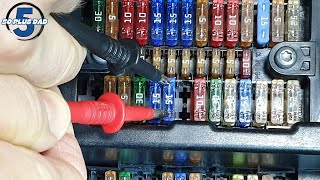
Tools: Flashlight, Inspection Mirror (Beginner) - Check Fuses for BCM and Gateway
Consult your owner's manual to locate and inspect all fuses related to the Body Control Module and Serial Data Gateway Module. A blown fuse takes a module offline or causes erratic behavior.
Tools: Fuse Puller or Needle-Nose Pliers (Intermediate) - Test for Parasitic Draw
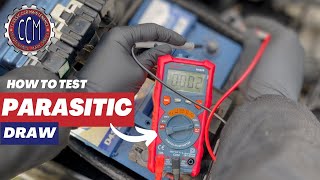
If a dead battery is a symptom, test for parasitic draw. With the vehicle off and doors closed for 30 minutes, disconnect the negative battery terminal. Place a multimeter set to 10A DC in-line between the cable and battery post. A normal reading is 20-85 milliamps. A higher reading indicates a module is not shutting down.
Tools: Multimeter with 10A capability (Advanced) - Test CAN Bus Resistance
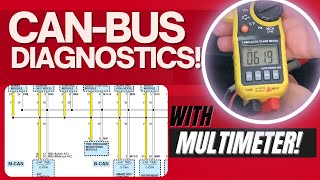
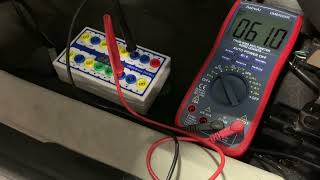
Disconnect the battery. At the DLC (OBD-II port), measure the resistance between Pin 6 (CAN High) and Pin 14 (CAN Low). 🎬 Watch: How to test CAN bus resistance with a multimeter A healthy network reads approximately 60 ohms. A reading of 120 ohms indicates an open circuit or missing termination resistor. A reading near 0 ohms indicates a short between the two lines.
Tools: Multimeter, Vehicle-Specific Wiring Diagram (Advanced) - [PRO TIP] Isolate the Network by Disconnecting Modules
If the CAN bus resistance is incorrect, start disconnecting modules one by one. After unplugging each module on the affected network, re-check the CAN bus resistance. When the resistance returns to the correct value (e.g., from 0 to 60 ohms), you have found the module with the internal short.
Tools: Multimeter, Trim Removal Tools, Vehicle Wiring Diagram (Advanced) - [PRO TIP] Test BCM Input Sensor Data
If a specific function is erratic (e.g., fuel gauge), test the associated sensor. For a Ford fuel level sensor, measure its resistance (typically 16 ohms empty to 158 ohms full). If the sensor's resistance is out of spec, it sends bad data to the BCM, which broadcasts it, causing other modules to set U0422.
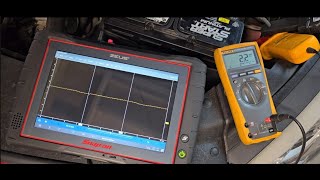
Tools: Multimeter, Vehicle-Specific Sensor Specifications (Advanced) - [PRO TIP] Analyze CAN Bus Signal with an Oscilloscope
Connect a dual-channel oscilloscope to CAN High and CAN Low. A healthy high-speed CAN bus waveform shows two mirror-image square waves idling at ~2.5V. During communication, CAN High jumps to ~3.5V and CAN Low drops to ~1.5V. Distorted signals or incorrect voltages indicate wiring faults or a failing module.
Tools: Dual-Channel Automotive Oscilloscope (Professional)
When This Code Triggers (Freeze-Frame Conditions)
- Vehicle Speed: 25-55 mph (The code sets during normal driving as modules actively communicate over the CAN bus.)
- Engine State: Running (The fault occurs when the engine is running and modules are powered and expecting valid data.)
- System Voltage: 13.5-14.5 Volts (Code triggers during normal charging system operation, but is also caused by voltage drops or spikes outside this range.)
- Network Status: Active (The fault is logged when a specific module on the CAN bus fails to receive a valid signal from the BCM during a communication cycle.)
Related Codes
- U0140 — Lost Communication With Body Control Module. This code often appears with U0422. U0140 means the signal from the BCM is completely gone (module is offline), while U0422 means the signal is present but corrupted (module is online but talking nonsense). Diagnosis for U0140 starts with checking BCM power and ground.
- U0073 — Control Module Communication Bus 'A' Off. This is a more severe network code indicating the entire CAN bus has shut down, due to a short circuit in the wiring or a catastrophic failure of a single module that brought the whole network down.
- B-prefix codes (e.g., B1001) — Body codes (starting with 'B') are crucial. A 'B' code is the BCM reporting a fault with one of its own inputs or outputs. U0422 is another module reporting on the BCM. Finding a 'B' code alongside U0422 identifies the specific problem causing the invalid data.
- C-prefix codes (e.g., C0277) — Chassis codes (starting with 'C') are often the root cause. For example, GM TSB 19-NA-202 for the Chevy Malibu shows that a software issue in the brake module causes it to set a 'C' code and also cause a U0422 to be set by other modules.
Climate & Environmental Factors
- High Humidity: High humidity levels (above 60%) significantly accelerate corrosion on wiring connectors, fuse blocks, and module circuit boards. This moisture causes short circuits or high resistance, leading to corrupted data and communication codes like U0422.
- Cold Weather: Extreme cold reduces a battery's cranking power and overall efficiency. The resulting lower or unstable voltage during startup causes modules to boot up improperly and send invalid data, triggering temporary communication codes.
- Water Leaks: Physical water intrusion from clogged sunroof drains, leaking windshield seals, or bad door seals drips directly onto the BCM or other modules located in the passenger footwell or under the dash. This direct water damage is a primary cause of BCM failure.
How to Talk to a Mechanic About This Code
Say this: "I have a U0422 code and some erratic electrical symptoms. I'd like to schedule a diagnostic for a network communication issue. Please start by checking for any related TSBs, performing a full-system scan for other codes, and checking the battery and gateway module before quoting a BCM replacement."
This signals you understand that U0422 is a network symptom, not a guaranteed BCM failure. It directs the technician to follow a logical diagnostic path, preventing them from jumping to the most expensive conclusion and showing you can't be easily upsold.
Avoid saying:
- 'Just replace the BCM'
- 'My check engine light is on, can you look at it?' (too vague, invites a high diagnostic fee)
- 'The internet said it's the BCM' (This antagonizes a technician)
Questions to ask before authorizing the repair:
- Did you find any Technical Service Bulletins for this code on my VIN?
- What other DTCs were present in other modules (ABS, SDGM, etc.)?
- What was the result of the CAN bus resistance test and what was the battery voltage under load?
- If you are recommending a module replacement, can you explain why a wiring repair or software update has been ruled out?
Where to Take It: Dealer vs Independent vs Chain
- Dealer:
Recommended. For many modern cars, U0422 is caused by a software glitch or a faulty gateway module that only a dealer can efficiently update or program.
Best for: Vehicles under warranty, Vehicles with known TSBs requiring software updates (common for GM, Chrysler), Complex programming of new modules (BCM, SDGM)
Downsides: Highest labor rates (often $180-$250+/hour), Often replace expensive modules before performing detailed wiring diagnostics. (Typical cost: +50% vs. baseline) - Independent Shop:
Good Alternative. A top-tier independent shop specializing in diagnostics is a cost-effective choice, especially for older vehicles. Ensure they have the tools to scan all modules and check TSBs.
Best for: Out-of-warranty vehicles where the cause is likely wiring or a bad battery, Shops with a strong reputation for electrical diagnostics (look for ASE L1 certification)
Downsides: Often lack expensive, manufacturer-specific programming tools for newer modules., Quality varies greatly; requires vetting. (Typical cost: +0% vs. baseline) - Chain Shop:
AVOID. This is a complex electronic code that is far outside the scope of a typical chain repair shop. They lack the specialized tools and training required for an accurate diagnosis.
Best for: Simple battery replacement if you've already confirmed it's the cause.
Downsides: Technicians are generally not trained for complex network diagnostics., High pressure to sell parts and services; risk of misdiagnosis is very high. (Typical cost: -10% vs. baseline)
When to Walk Away From the Repair
If the estimated repair cost for the U0422 fault exceeds 40-50% of your car's private-party value, it's time to seriously consider selling or trading it in.
- Car worth $5000, fix is $2200: Walk away. The repair cost is too high relative to the car's value. The risk of other age-related electronic issues is also high.
- Car worth $15000, fix is $1200: Fix it. This repair is well within a reasonable cost for a vehicle of this value.
- Car worth $3000, fix is $1000: Borderline. Get a second opinion. If the fix is confirmed, it might be worth it if the car is otherwise in excellent condition.
What Scan Tool You Need for This Code

Minimum: A scanner that can read codes from ALL vehicle modules (BCM, ABS, TCM, etc.), not just the engine computer (PCM). This is often called an 'All-System' or 'Full-System' scanner.
A basic $20-$50 code reader only pulls generic powertrain codes (like U0422 from the PCM) but misses the critical 'B' (Body) or 'C' (Chassis) codes from other modules that point to the root cause. You cannot diagnose U0422 without seeing the full picture.
Budget: Kingbolen Ediag Elite / MUCAR BT200 (~$90) — These Bluetooth dongles pair with your smartphone and offer full-system diagnostics and some bidirectional tests, allowing you to see codes from the BCM and other modules to properly start your diagnosis.
Mid-range: Foxwell NT809 / Autel MaxiCOM MK808S (~$350) — These tablet-style scanners offer full-system diagnostics, extensive live data graphing, and numerous service functions. They provide a clear, fast interface to analyze data from the BCM and related modules, making it easier to spot irregularities.
Professional: Autel MS906 Pro / Topdon Phoenix Smart (~$900-1500) — Provides full bidirectional control to command modules and components directly, along with OEM-level diagnostics and potential for online programming/coding. This is the level of tool a professional uses to definitively diagnose and fix the issue.
How to Clear the Code After You Fix It
- Reconnect the battery if it was disconnected for the repair.
- Use a quality OBD-II scan tool to erase all Diagnostic Trouble Codes (DTCs).
- Perform a complete OBD-II drive cycle to allow readiness monitors to run and confirm the fix.
Drive cycle (~30 minutes): Start with a cold engine. Idle for 2-3 minutes with accessories like A/C on. Drive for 15 minutes in mixed city/highway conditions, including steady speeds around 55 mph for at least 5 minutes. Allow the vehicle to cool down completely.
Readiness monitors affected: Comprehensive Component Monitor, Misfire Monitor, Fuel System Monitor
Before emissions retest: drive at least 100 miles to fully set monitors.
Watch out for:
- Simply disconnecting the battery clears the Check Engine Light but resets all readiness monitors to 'Not Ready', guaranteeing an emissions test failure.
- If the root cause of the U0422 code is not fixed, the code returns as soon as the fault condition is met again.
- Not driving long enough or under the correct conditions prevents readiness monitors from setting, leading to a 'Not Ready' failure at an emissions station.
Will This Fail Emissions / State Inspection?
Yes — this code typically fails an OBD-II emissions inspection.
- California: An illuminated Check Engine Light due to a U0422 code is an automatic failure. After repair, a full drive cycle must be completed to set readiness monitors before a retest is possible.
- New York: The NYVIP3 inspection checks for DTCs and readiness monitor status. A U0422 code causes an automatic failure. For 2001+ vehicles, only one monitor is allowed to be 'Not Ready'.
- Texas: In counties requiring emissions testing (like Harris, Dallas, Tarrant), an active Check Engine Light is an automatic failure. You cannot pass inspection until the code is cleared and the readiness monitors are set.
Most Commonly Affected Vehicles
- Ford F-150 (2015-2020) — Often appears after modifications with tuners or tools like FORScan (e.g., changing tire size, gear ratios) or adding aftermarket electrical accessories. Reverting to the stock BCM programming resolves the issue.
- Chevrolet Suburban/Tahoe (2017-2024) — For 2017-2020 (K2XX platform), this code is frequently caused by a faulty Serial Data Gateway Module (SDGM) or loose connections at its X1/X2 connectors, per TSBs PIT5586G and 20-NA-212. For 2021+ models, the cause is a software anomaly requiring a dealer update.
- Chevrolet Silverado (2017-2020) — Shares the same platform and issues as the Suburban/Tahoe. The most common fix is resetting the SDGM by pulling fuse F26DL for 60 seconds to clear a 'logic lock', or inspecting the X1/X2 connectors for poor terminal tension.
- Chevrolet Malibu (2016-2019) — A software anomaly causes U0422 to set along with Stabilitrak warnings. TSB 19-NA-202 advises that an Electronic Brake Control Module (EBCM) software update is the required fix, not BCM replacement.
- Chevrolet Equinox (2018-2019) — A GM Technical Service Bulletin (16-NA-407) notes that this code sets intermittently on startup due to high bus traffic and must be ignored if it is a 'history' code and no other BCM codes are present.
- GMC Sierra/Yukon (2017-2024) — Mechanically identical to the Silverado/Suburban/Tahoe, these models suffer from the same SDGM connector, logic lock, and software issues detailed in GM TSBs PIT5586G and 20-NA-212.
- Chrysler Pacifica Hybrid (2021-2023) — On these models, U0422 is almost always caused by a software glitch in the Hybrid Control Processor (HCP), triggered by using the remote start. The official fix is a dealership software update per TSBs S2108000041 and S2208000202.
- Ford C-Max (2013-2018) — Triggered by issues with the fuel level sensor providing invalid data to the BCM, which then broadcasts the bad data across the network.
- Volkswagen Jetta/Golf (2012-2017) — On these models, the code points to general CAN bus communication errors between the BCM (often called the Central Electronics Module or CECM) and other modules like the instrument cluster or gateway.
Manufacturer-Specific Notes
- General Motors (GM): On many 2017+ trucks and SUVs, U0422 is almost never a bad BCM. The cause is overwhelmingly a faulty Serial Data Gateway Module (SDGM), a poor connection at the SDGM, or a software glitch causing a 'logic lock'. TSBs like 20-NA-212 and PIT5586G are essential reading.
- Ford: This code is very common on Ford vehicles after a user makes changes with programming tools like FORScan (e.g., changing tire size, enabling/disabling features). Reverting the BCM programming to its 'as-built' data is the fix. It is also caused by a faulty fuel level sensor sending bad data with a resistance reading outside the expected 16-158 ohm range.
- Chrysler/Stellantis: On newer models, particularly hybrids like the Pacifica, U0422 is frequently a software bug. TSB S2208000202 for the Pacifica Hybrid notes that the code sets after using remote start and is fixed by updating the Hybrid Control Processor (HCP) software, not by touching the BCM.
- Subaru: While less common, on some Subaru models, the U0422 code definition is manufacturer-specific and points to an issue with the A/C refrigerant pressure sensor circuit, demonstrating how the same code has different meanings between brands.
Real Owner Stories
2019 Ford F-150 with 10-speed transmission
U0422 code appeared immediately after using a FORScan tool to adjust the tire circumference in the BCM to correct the speedometer for larger tires. No other symptoms were present, but the code could not be cleared.
What they tried:
- Attempted to clear the DTC with the FORScan tool, but it returned instantly.
- Performed a PCM relearn procedure, which cleared a related P160A code but not U0422.
Outcome: The owner discovered through forum research that changing the tire circumference value by more than 39mm triggers the U0422 code. By adjusting the value to 38mm greater than stock, the speedometer was corrected and the U0422 code permanently cleared.
Lesson: When using aftermarket programming tools like FORScan, specific changes cause persistent communication codes. The solution is reverting the change or finding a known 'safe' value from community forums for your specific vehicle.
2017 Chevrolet Corvette at 16k miles
After disconnecting the battery to install a new air filter, the car developed a rough idle and a U0422 code appeared on an OBD-II reader, though no Check Engine Light was on.
What they tried:
- Cleared the code with the OBD reader, but it returned.
- Re-checked the MAF sensor connection disturbed during the filter install.
- Suspected the battery, which was of unknown age.
Outcome: The owner performed a full system reboot by disconnecting the negative battery terminal for 10 minutes. After reconnecting, the systems rebooted and the U0422 code did not return. The intermittent communication glitch was caused by modules rebooting improperly after the initial battery reconnection.
Lesson: If a communication code like U0422 appears immediately after a battery disconnect, perform a hard reset. Disconnecting the negative terminal for 15 minutes allows all modules to fully power down and resolves temporary communication conflicts.
2015 Ford C-Max Hybrid with no CEL
A U0422 code was stored in the computer, but with no Check Engine Light on and no noticeable driving issues. The owner was concerned about what it might mean.
What they tried:
- Plugged in an advanced scan tool reading the full code string: U0422-82, 'Alive / Sequence Counter Incorrect / Not Updated'.
- Forum members suggested checking for other DTCs and noted intermittent 'U' codes are sometimes ignored if there are no symptoms.
Outcome: A user suggested a non-obvious cause: a faulty fuel level sensor. The sensor sends bad data to the BCM, which the BCM broadcasts over the network. Other modules see this bad data from the BCM and set the U0422 code. The problem is the input, not the BCM.
Lesson: U0422 means 'Invalid Data FROM the BCM', not necessarily 'Invalid Data IN the BCM'. Always check for other codes first. A fault in a seemingly unrelated part, like a fuel sensor, is often the true root cause.
How to Prevent This Code From Triggering
- Maintain Battery and Terminal Health (Every 6 months) — A weak battery or corroded terminals cause unstable voltage, a primary trigger for communication faults. Clean terminals with a baking soda/water mixture and ensure connections are tight. Test battery health annually after 3 years.
- Inspect for Water Leaks (Annually (especially before rainy season)) — Water intrusion is a leading cause of BCM failure. Check that sunroof drains are clear, and inspect windshield and door seals for damage allowing water to drip onto modules located in kick panels or under the dash.
- Apply Dielectric Grease to Connectors (Whenever a module connector is disconnected) — Applying a thin layer of dielectric grease to the seals of electrical connectors creates a barrier against moisture and oxygen, preventing the corrosion that leads to high resistance and invalid data signals.
- Use Caution with Aftermarket Electronics (During installation) — Improperly installed alarms or remote starters tap into CAN bus wires, introducing electrical noise and interference that corrupts data. Ensure accessories are high-quality and installed by a professional.
- Avoid Improper Jump-Starting (As needed) — Incorrectly connecting jumper cables creates a significant voltage spike in the electrical system, permanently damaging the sensitive microprocessors inside the BCM and other modules.
Frequently Asked Questions
What is a Body Control Module?
The Body Control Module (BCM) is a computer in your car that manages the electronic systems inside the main cabin. It controls your power windows, power locks, interior and exterior lights, alarm system, and climate control.
How much does it cost to fix a U0422 code?
A simple software update costs $150-$300, while a wiring repair ranges from $150 to $500. Replacing a gateway module costs $300-$750, and replacing the BCM itself is typically between $550 and $1000 including parts and programming.
Can I fix a U0422 code myself?
You can perform basic checks yourself, such as inspecting the battery, checking fuses, and looking for obvious wiring damage. However, diagnosing network issues and replacing or reprogramming a module requires professional diagnostic tools and expertise.
What is the most common misdiagnosis for U0422?
The most common mistake is replacing the Body Control Module (BCM) unnecessarily. The U0422 code is set by another module receiving bad data; it is a symptom, not the disease. The actual problem is often a faulty gateway module, a software bug, or a simple wiring issue.
Can a weak battery really cause all these weird electronic problems?
Absolutely. Control modules are sensitive computers that require a stable voltage to communicate properly. A weak battery causes voltage drops and spikes that corrupt the data signals on the CAN bus, leading to a cascade of communication codes like U0422.
What is the CAN bus and why does it matter for U0422?
The Controller Area Network (CAN) bus is the nervous system of your car, allowing all the different computers (modules) to talk to each other. Code U0422 is a CAN bus error, indicating that the conversation has been corrupted.
I just changed my battery and now I have a U0422 code. What happened?
Disconnecting the battery causes communication modules to reboot improperly or in the wrong order, leading to temporary communication codes like U0422. Try clearing the code and driving the vehicle to see if it returns. If it does, the new battery unmasked a pre-existing issue.
My scan tool shows U0422 with a '-71' suffix. What does that mean?
The '-71' suffix specifically means 'Invalid Data', confirming the code's definition. GM service information dictates that technicians must not replace the module reporting U0422-71. Instead, they must identify which other module is originating the corrupted data.
Will clearing the code make it go away?
You can clear the code with an OBD-II scanner, but if the underlying electrical or software problem hasn't been fixed, the code will immediately return.
What's the difference between a 'stored/history' code and an 'active/current' code?
An 'active' code indicates the fault is happening right now, while a 'stored' code means the fault occurred in the past. For U0422, some manufacturers issue bulletins advising to ignore stored codes unless accompanied by other faults, as they set erroneously during startup.
Key Takeaways
- Code U0422 triggers when a network module receives illogical data from the Body Control Module (BCM), disabling features like power windows or the immobilizer.
- Never replace the BCM as a first step; in over 70% of cases, the root cause is a weak 12V battery, damaged wiring, or a faulty gateway module.
- Expect immediate failures in essential safety systems like exterior lights and wipers, with a high risk of a complete no-start condition that requires a $100-$300 tow.
- Diagnosing U0422 requires a full-system bidirectional scanner capable of reading 'B' (Body) and 'C' (Chassis) codes to pinpoint the exact module sending bad data.
- Always check for Technical Service Bulletins (TSBs) before starting repairs, as manufacturers like GM and Chrysler frequently resolve this exact code with a 1-hour dealership software update.
Helpful Videos



The information in this article is provided for general reference and educational purposes only. Vehicle specifications, procedures, and part compatibility can vary by production date, trim level, and region. Always consult your vehicle's factory service manual and verify part numbers before purchasing or performing repairs. Safety-critical components such as airbags, seat belts, and braking systems should be installed by a qualified professional.
- 🎬 Helpful Videos
- What Does U0422 Mean?
- Can I Drive With U0422?
- Common Causes
- Symptoms
- Diagnostic Flowchart
- Common Fixes & Costs
- DIY vs Professional
- Used vs. New Parts: Buying Guide
- What Happens If You Wait — Timeline
- Cost of Not Fixing It
- Diagnosis Steps
- When This Code Triggers (Freeze-Frame Conditions)
- Related Codes
- Climate & Environmental Factors
- How to Talk to a Mechanic About This Code
- Where to Take It: Dealer vs Independent vs Chain
- When to Walk Away From the Repair
- What Scan Tool You Need for This Code
- How to Clear the Code After You Fix It
- Will This Fail Emissions / State Inspection?
- Most Commonly Affected Vehicles
- Manufacturer-Specific Notes
- Real Owner Stories
- 2019 Ford F-150 with 10-speed transmission
- 2017 Chevrolet Corvette at 16k miles
- 2015 Ford C-Max Hybrid with no CEL
- How to Prevent This Code From Triggering
- Frequently Asked Questions
- What is a Body Control Module?
- How much does it cost to fix a U0422 code?
- Can I fix a U0422 code myself?
- What is the most common misdiagnosis for U0422?
- Can a weak battery really cause all these weird electronic problems?
- What is the CAN bus and why does it matter for U0422?
- I just changed my battery and now I have a U0422 code. What happened?
- My scan tool shows U0422 with a '-71' suffix. What does that mean?
- Will clearing the code make it go away?
- What's the difference between a 'stored/history' code and an 'active/current' code?
- Key Takeaways
- 🎟️ Get 5% Off