

OBD-II Code U0418: Invalid Data From Brake System Control Module
The ultimate guide to what U0418 means, its causes, and how to fix it.
- Always test your 12V battery and check for manufacturer software updates before replacing parts, as voltage drops below 11V or software bugs cause 80% of U0418 codes.
- Limit driving to short trips to a repair shop; active U0418 codes disable your ABS and Electronic Stability Control, increasing stopping distances by up to 30% on wet roads.
- Search the NHTSA database with your VIN immediately, as over 1.2 million vehicles (including 2019+ Ram 1500s) have free dealer software updates to permanently fix this code.
- Never authorize a $1,000+ ABS module replacement until a technician has physically load-tested the battery and verified the CAN bus wiring resistance reads a healthy 60 ohms.
What Does U0418 Mean?

Your car's main computer, the Powertrain Control Module (PCM), is receiving illogical signals from the brake control module. The modules are communicating, but the data is corrupted or out of range. Because the vehicle cannot trust the incoming brake data, it automatically disables smart safety features like ABS and traction control to prevent unsafe automated braking.
Technical definition: Invalid Data Received From Brake System Control Module 'A'. A control module on the Controller Area Network (CAN) received data from the Brake System Control Module (BSCM) flagged as implausible or outside the expected range. This is a communication error, not a mechanical failure of the brakes.
Can I Drive With U0418?
Yes, But With Caution. Yes, but limit driving to short trips to a repair shop. Your Anti-Lock Braking (ABS) and Electronic Stability Control (ESC) systems are disabled, increasing stopping distances by up to 30% on slippery surfaces and significantly raising the risk of losing control in an emergency maneuver. In some vehicles, this code triggers a reduced-power 'limp mode' or prevents the vehicle from shifting out of Park.
Common Causes

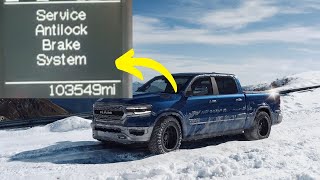
- Control Module Software Glitch (Very Common) — A bug in the brake control module or related module software. This is the root cause for over 1.2 million recalled Ram trucks 🎬 Watch: Dealing with the Service Antilock Brake System warning on Ram 1500. and numerous Technical Service Bulletins (TSBs) for Jeep, Ford, and Chrysler models. Manufacturers resolve this with a free software reflash.
- Low or Unstable Battery Voltage (Main or Auxiliary) (Very Common) — Modern CAN bus networks require stable voltage. A weak 12V battery, or a failing auxiliary battery on vehicles with Engine Stop/Start (ESS), causes voltage to drop below 11V. This voltage starvation corrupts data packets, triggering U0418.
- Damaged Wiring or Loose Connector Pins (Common) — Road debris, corrosion, or vibration damages the wiring harness leading to a wheel speed sensor or the main ABS module. A single broken wire or a backed-out terminal pin creates an intermittent connection that corrupts the entire data stream.
- Faulty Wheel Speed Sensor (Less Common) — A failing wheel speed sensor sends erratic signals to the ABS module. The ABS module broadcasts this bad information across the network, causing the PCM to log U0418. This is almost always accompanied by a specific wheel speed sensor C-code.
- Wiring Short in an Unrelated Circuit (Less Common) — A short-to-ground in a seemingly unrelated system on the same network, like a rear differential locker or transfer case, disrupts the entire CAN bus. This network noise corrupts messages from the brake module.
- Failed Brake System Control Module (ABS Module) (Rare) — Internal circuit damage from moisture, heat, or vibration destroys the module. Because this is a $1,000+ repair, replace this part only after ruling out software updates, battery voltage, and wiring integrity.
Symptoms

- ABS and Traction/Stability Control Lights On — The Anti-Lock Braking System and Electronic Stability Control (ESC) warning lights illuminate simultaneously, indicating both systems are disabled.
- Disabled Safety and Cruise Control Features — Advanced driver-assistance systems like Pre-Collision Assist, Adaptive Cruise Control, and Lane-Keeping Assist become unavailable.
- Check Engine Light On — The Malfunction Indicator Lamp (MIL) illuminates as the PCM logs the network communication fault.
- Limp Mode or Shifting Issues — The vehicle enters a reduced-power 'limp mode' or prevents the transmission from shifting out of Park to protect the drivetrain.
- Service 4WD Light On — On 4WD vehicles, the 'Service 4WD' light illuminates as the transfer case module loses trusted communication with the brake system.
- Brake Pedal Feel Change — On brake-by-wire or hybrid systems, the brake pedal feels soft, delayed, or unusually hard.
Diagnostic Flowchart

Tap your situation to follow the diagnostic path that matches what you're seeing on this code.
Common Fixes & Costs
- Control Module Software Update — Parts: $0, Labor: $0 - $200, ~1 hr book time (Professional)
- Replace 12V Vehicle Battery (Main or Auxiliary)
— Parts: $150 - $350, Labor: $50 - $150, ~0.5 hr book time
(DIY)
Chrysler Pacifica (Auxiliary Battery): OEM Mopar BPAUX101AB (Alt: Duralast AUX12, Bosch S6590B) - Repair Damaged Wiring or Connector — Parts: $10 - $50, Labor: $150 - $450, ~2 hr book time (Intermediate)
- Replace Wheel Speed Sensor
— Parts: $50 - $150, Labor: $100 - $200, ~1 hr book time
(DIY)
Jeep Cherokee (KL) Front: OEM Mopar 68141887AF (Alt: Standard Motor Products ALS2593)
Ford Escape: OEM Motorcraft BRAB-552 (Alt: Bosch 0265009909) - Replace ABS Control Module
— Parts: $600 - $1,500, Labor: $200 - $400, ~2.5 hr book time
(Professional)
Ram 1500 (2019+): OEM Mopar 68728126AA (Alt: Remanufactured units available, programming required.)
DIY vs Professional
- Control Module Software Update — Beginner:
- Replace 12V Vehicle Battery — Beginner:
- Repair Damaged Wiring or Connector — Beginner:
- Replace Wheel Speed Sensor — Beginner:
- Replace ABS Control Module — Beginner:
Used vs. New Parts: Buying Guide
When a used part is worth it: Buy a used ABS module for vehicles over 8 years old where a new $1,000+ OEM module exceeds the car's economic value.
Donor-vehicle mileage cap: roughly under 100000 miles for the part to have meaningful remaining life.
Donor quality checklist:
- Verify the exact part number matches your original module.
- Purchase from a reputable seller offering a 30-90 day warranty.
- Avoid parts from flood-damaged or heavily corroded vehicles.
Decision logic:
- If The fix is a software update or a weak battery → Do not buy any module. Address the root cause.
- If A new OEM module is available for < $800 → Buy new for the warranty and guaranteed compatibility.
- If A new OEM module costs > $1,500 and the vehicle is over 8 years old → Purchase a used or rebuilt module to save money.
- If You cannot find a shop willing to program a used module → Send your original module to a specialized rebuilding service to bypass programming requirements.
Warranty tradeoff: Used parts carry a 30-90 day warranty. Rebuilt modules offer 1-year warranties. New OEM parts carry a 1-2 year warranty.
Worst-case if a used part fails: $300-600. Paying for installation and programming ($200-$400) only to find the used module is faulty requires paying labor twice.
What Happens If You Wait — Timeline
- Immediate: Code sets, ABS and ESC warning lights illuminate. Safety systems are disabled. (MPG impact: 0%% · Added cost: $0, but accident risk increases significantly due to longer stopping distances.)
- 0-2 months: The vehicle enters 'limp mode' or prevents shifting out of Park, leaving you stranded. (MPG impact: 0%% · Added cost: $100 - $300 for an emergency tow.)
- 2-6 months: If caused by a failing auxiliary battery, it continuously drains and destroys the main 12V battery. (MPG impact: 0%% · Added cost: $200 - $450 to replace the main battery.)
- 6+ months: Driving with warning lights normalizes them. A critical mechanical brake failure goes unnoticed because the lights are already on. (MPG impact: 0%% · Added cost: Potential cost of an accident resulting from total brake failure.)
Cost of Not Fixing It
- Immediate: Significantly increased accident risk. Disabled ABS and ESC systems increase stopping distances on wet or icy roads by up to 30%. (Added cost: Potential cost of an accident or insurance deductible.)
- 0-1 Month: Vehicle enters 'limp mode' or refuses to shift out of Park, leaving you stranded without warning. (Added cost: $100 - $300 for an emergency tow.)
- 1-6+ Months: A failing auxiliary battery continuously drains the main 12V battery, destroying both batteries prematurely. (Added cost: $200 - $450 to replace the main battery in addition to the original fault.)
Diagnosis Steps
- Check for Recalls and TSBs
Search the NHTSA database or manufacturer website using your VIN. The most common fix for U0418 is a free dealer software update addressing known bugs in the ABS or Power Steering modules.
Tools: VIN, Internet Access (Beginner) - Load Test the Battery and Charging System
Perform a load test on the 12V battery (and the auxiliary battery, if equipped). A healthy battery shows 12.4-12.6V engine-off and maintains above 11V during cranking. Replace any battery that fails a load test before proceeding.
Tools: Electronic Battery Load Tester, Multimeter (Beginner) - Scan All Modules for Trouble Codes
Use an advanced scanner to read codes from the ABS, BCM, and PCM. A basic code reader only shows U0418. Look for specific C-codes (e.g., wheel speed sensors) or U-codes (e.g., transfer case) that pinpoint the source of the invalid data.
Tools: Advanced OBD-II Scanner (Intermediate) - Inspect Wiring and Connectors
Visually inspect the wiring harnesses to each wheel speed sensor and the main ABS module. Look for chafing, melting, or corrosion. Unplug connectors and check for bent or backed-out pins.
Tools: Flashlight, Inspection Mirror (Intermediate) - Analyze Live Wheel Speed Sensor Data
View live data for all four wheel speed sensors while driving slowly in a straight line. All four must read identically. A sensor that drops to zero or fluctuates erratically identifies the faulty circuit.
Tools: Advanced OBD-II Scanner (Intermediate) - Check Power and Ground at the ABS Module
Identify the power and ground pins on the ABS module connector using a wiring diagram. Verify it receives 12.4V+ (engine off). Perform a voltage drop test on the ground circuit; it must read less than 0.2V (200mV) with the system active.
Tools: Multimeter, Vehicle-Specific Wiring Diagram (Advanced) - Check CAN Bus Network Resistance
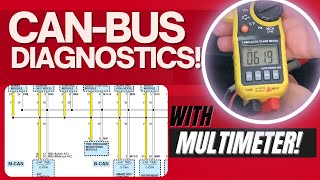
Disconnect the battery. Measure resistance between CAN High (Pin 6) and CAN Low (Pin 14) at the OBD-II port. A healthy network reads exactly 60 Ω. A reading of 120 Ω indicates an open circuit; 0 Ω indicates a short.
Tools: Multimeter (Advanced) - Scope the CAN Bus Signal
Use an oscilloscope to view the CAN bus signal at the OBD-II port. CAN High toggles between ~2.5V and ~3.5V; CAN Low toggles between ~2.5V and ~1.5V. Distortion or flat-lining indicates a physical network problem.
Tools: Oscilloscope (Professional)
When This Code Triggers (Freeze-Frame Conditions)
- System Voltage: 9.5V - 11.5V (at time of fault) (A voltage drop below 11V during engine cranking or driving is the primary trigger for this code on modern vehicles.)
- Vehicle Speed: 40-60 mph (Sets during steady-state highway driving when a momentary communication glitch or wheel speed sensor dropout occurs.)
- Engine RPM: 1500-2500 RPM (Typical for highway cruising speeds; rarely sets during high acceleration.)
- Engine Coolant Temp: 180-210°F (Occurs when the vehicle is fully warmed up and operating in closed-loop.)
Related Codes
- U0121 — Lost Communication With Brake System Control Module. U0418 means data is invalid; U0121 means data is completely gone. Both point to wiring, power, or module failure.
- U140A / U1409 — Implausible Wheel Speed Signal. These codes identify the specific wheel sending the 'invalid data' that triggers the U0418 code.
- C00-series codes — Chassis codes for wheel speed sensors (C0031-C0038) or steering angle sensors (C0051) pinpoint the hardware providing bad data to the brake module.
- U0403 — Invalid Data Received From Transfer Case Control Module. Appears with U0418 on 4WD vehicles when a wiring short disrupts multiple modules on the CAN bus.
Climate & Environmental Factors
- Cold Weather: Exacerbates weak battery issues. Cold temperatures reduce a battery's voltage output, making it highly likely to dip below the 11V threshold during startup and trigger U0418.
- High Humidity / Salt Belt Regions: Accelerates corrosion on exposed wheel speed sensor harnesses and ABS module connectors, creating high resistance or short circuits that corrupt data.
How to Talk to a Mechanic About This Code
Say this: "I have a U0418 code and my ABS/ESC lights are on. Based on my research, the most common causes are a software bug, a weak battery, or a wiring issue. Please check for any open recalls or TSBs for my VIN, perform a load test on the battery, and check for other codes in the ABS module before quoting a new ABS module."
This directs the service advisor to follow a logical diagnostic path starting with the cheapest fixes (software, battery), preventing them from jumping to a $1,500 ABS module replacement.
Avoid saying:
- 'My ABS light is on, can you just fix it?'
- 'I think I need a new ABS computer.'
- 'Just do whatever you think is best.'
Questions to ask before authorizing the repair:
- Were there any open recalls or TSBs related to this code for my vehicle?
- What were the exact voltage results of the battery load test?
- Were there any other 'C' or 'U' codes stored in the ABS module?
- If you recommend an ABS module replacement, how did you rule out a wiring or ground issue?
Where to Take It: Dealer vs Independent vs Chain
- Dealer:
Recommended First Stop. Due to the high probability of a software-related fix covered by TSBs, the dealer has the proprietary scan tools required for module updates.
Best for: Vehicles under warranty., Newer vehicles where the cause is likely a software update., Diagnosing manufacturer-specific quirks (like Ford PSCM or Ram recalls).
Downsides: Highest labor rates., May default to replacing entire modules rather than repairing wires. (Typical cost: +50% vs. baseline) - Independent Shop:
Good Alternative. Excellent for diagnosing battery and wiring causes, but they may have to send you to the dealer if a software update is required.
Best for: Out-of-warranty vehicles where the cause is a battery or wiring issue., Older vehicles where a used or rebuilt module is a cost-effective option.
Downsides: May lack the latest manufacturer scan tools for software updates., Quality varies; ensure they have ASE-certified electrical technicians. (Typical cost: +0% vs. baseline) - Chain Shop:
AVOID for diagnosis. Use only for a battery replacement if you have already confirmed it is the root cause.
Best for: Simple battery testing and replacement.
Downsides: Not equipped for complex CAN bus network diagnostics., High risk of misdiagnosis leading to unnecessary parts replacement. (Typical cost: -10% vs. baseline)
When to Walk Away From the Repair
If the estimated worst-case repair cost (ABS module replacement) exceeds 50% of the car's private-party market value, consider selling the car as-is.
- Car worth $4000, fix is $2200: Walk away. The repair cost is over half the car's value.
- Car worth $15000, fix is $600: Fix it. A wiring or battery repair is well below the threshold and restores critical safety features.
- Car worth $2500, fix is $1800: Walk away. The repair is not justified on a low-value vehicle.
What Scan Tool You Need for This Code
Minimum: A scanner that reads codes from ALL vehicle modules (ABS, SRS, BCM, PCM) and displays live data for wheel speed sensors.
A basic $20 engine-only code reader cannot see the critical fault codes stored in the ABS module necessary for diagnosis.
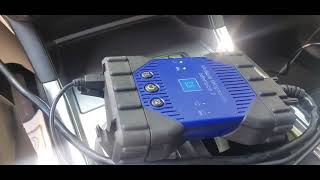
Budget: BlueDriver Bluetooth Pro (~$99) — Reads codes from all modules and views live wheel speed sensor data to spot a faulty sensor.
Mid-range: Foxwell NT530 or Innova 5610 (~$180-350) — Offers bidirectional controls to perform an 'automated bleed' function, which cycles the internal pump after an ABS module replacement.
Professional: Autel MaxiCOM MK808S (~$450-550) — Provides extensive bidirectional controls, all-system scanning, ABS bleeding, and module programming capabilities.
Rent vs buy: Auto parts stores only loan basic engine code readers. For a one-time diagnosis, paying a shop a $150 diagnostic fee is more effective than buying the wrong tool.
How to Clear the Code After You Fix It
- Ensure the new part is installed correctly and all connectors are secure.
- Reconnect the vehicle's battery if it was disconnected.
- Use an advanced OBD-II scan tool to clear codes from ALL modules (PCM, ABS, BCM). Disconnecting the battery does not clear hard codes from the ABS module.
- Perform the specific drive cycle for your vehicle to allow readiness monitors to run.
Drive cycle (~30 minutes): Perform a cold start (sit for 8+ hours). Idle for 3 minutes. Drive in mixed city traffic for 15 minutes with several stops. Drive at a steady 55-60 mph for 10 minutes. Let the vehicle cool down completely.
Readiness monitors affected: Comprehensive Component Monitor, Misfire Monitor
Before emissions retest: drive at least 50 miles to fully set monitors.
Watch out for:
- Clearing the code without fixing the root cause results in immediate code return.
- Using a basic $20 code reader fails to clear the underlying fault stored in the ABS module.
- Testing emissions before readiness monitors read 'Ready' guarantees an automatic failure.
Will This Fail Emissions / State Inspection?
Yes — this code typically fails an OBD-II emissions inspection.
- California: An active U0418 code triggers the Check Engine Light, resulting in an automatic smog check failure. All monitors must be 'Ready'.
- New York: An active U0418 code causes an immediate OBD-II failure, preventing vehicle registration renewal.
- Texas: In the 17 counties requiring emissions testing, an illuminated Check Engine Light from a U-code results in a failed test.
Most Commonly Affected Vehicles
- Ram 1500 (2019, 2021-2024) — Subject to NHTSA safety recall 24V-653 for an ABS software bug causing U0418. The fix is a free dealer software update. The 2020 model year is excluded.
- Jeep Cherokee (KL) (2019-2021) — Highly prone to U0418 due to low battery voltage (TSB 18-078-22). The Engine Stop-Start (ESS) system puts extreme demands on the battery.
- Ford Escape, Bronco Sport, Maverick (2020-2022) — TSB SSM 51437 identifies a software bug in the Power Steering Control Module (PSCM) as the root cause. The fix is a PSCM software update, not a brake module repair.
- Chrysler Pacifica (2017-2021) — Almost exclusively caused by the failure of the small auxiliary battery used for the Engine Stop/Start system. Always test both batteries first.
- Jeep Wrangler (JL) / Gladiator (JT) (2018-2024) — Commonly caused by damaged wheel speed sensor wiring from off-roading, or shorts in the transfer case/differential locker circuits disrupting the CAN bus.
- Chevrolet / GMC Silverado 1500, Sierra 1500 (2021-2024) — U0418 appears with U1610 (Lost Communication with Brake Module), pointing to a CAN bus communication failure or loose fuse block connector.
- Honda CR-V Hybrid (2019-2022) — U0418-68 indicates a failure of the Electric Servo Brake (ESB) unit, leading to a hard brake pedal.
Manufacturer-Specific Notes
- Stellantis (Jeep, Ram, Chrysler, Dodge): Extremely sensitive to low battery voltage. TSB 18-078-22 explicitly states battery voltage below 10V erroneously sets U0418. Always load test the battery (or dual batteries) first.
- Ford / Lincoln: On 2020-2022 models, U0418 is caused by a software issue in the Power Steering Control Module (PSCM), not the brake module. The fix is a PSCM update per TSB SSM 51437.
- General Motors (GMC, Chevrolet): U0418 often appears with U1610, indicating a physical CAN bus failure. TSBs for some EV models explicitly instruct technicians NOT to attempt repairs while GM develops a software patch.
- Porsche: U0418 sets in the transmission module if it receives a momentary fault from the stability management system (e.g., hitting a large pothole). Clear the code if no other faults exist.
Real Owner Stories
2018 Chrysler Pacifica with 65,000 miles
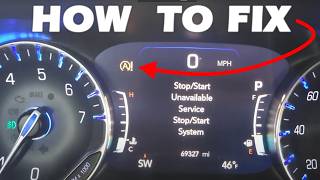
ABS, Traction Control, and 'Service Stop/Start' lights illuminated. The vehicle hesitated to shift out of Park.
What they tried:
- Checked main battery, which tested 'good'.
- Cleared codes, but they returned immediately.
- Received a $1,800 quote from a local shop to replace the ABS module.
Outcome: The owner replaced the small $150 auxiliary battery themselves. All warning lights extinguished and the codes never returned.
Lesson: On vehicles with a Stop/Start system, a failing auxiliary battery causes system-wide voltage drops. Always replace the aux battery before suspecting a major module failure.
2021 Ford Escape with 30,000 miles
Check Engine light illuminated alongside 'Pre-Collision Assist Not Available' messages.
What they tried:
- An independent mechanic scanned U0418, spent two hours checking wiring, and suggested replacing the ABS module.
Outcome: A Ford dealership referenced TSB SSM 51437 and performed a software update on the Power Steering Control Module (PSCM) for $150, solving the issue permanently.
Lesson: A communication code doesn't mean the named module is broken. Always check TSBs; the root cause is often a software bug in a completely different module.
2019 Jeep Wrangler Rubicon with 50,000 miles
After off-roading, ABS and 'Service 4WD' lights illuminated with codes U0418 and U0403 (Invalid Data from TCCM).
What they tried:
- Visually inspected wheel speed sensors and cleared codes, which returned upon engaging 4WD.
- Dealer suspected a failed Transfer Case Control Module.
Outcome: A technician found the rear differential locker wiring harness rubbed through on the frame, causing a short to ground. Repairing the single wire fixed all codes.
Lesson: On 4WD vehicles, U0418 paired with transfer case codes points to a wiring short. A short in one system disrupts the entire CAN bus network.
How to Prevent This Code From Triggering
- Perform annual battery load tests (Annually, especially before winter) — Identifies a failing battery before it causes the voltage drops that corrupt module communication.
- Use a battery tender for long-term storage (When vehicle is parked for 2+ weeks) — Prevents the battery from discharging to a low voltage state, avoiding communication faults upon startup.
- Apply dielectric grease to exposed connectors (During brake jobs or suspension work) — Seals out moisture and prevents corrosion on wheel speed sensor connectors in salt-belt regions.
- Inquire about software updates during service (At every dealership service visit) — Proactively applies PCM, BCM, or ABS module reflashes that fix known communication bugs before they trigger codes.
Frequently Asked Questions
Can I just clear the U0418 code and keep driving?
You can clear it, but it returns immediately if the root cause remains. Driving with an active U0418 disables your ABS and stability control, creating a severe safety risk. Diagnose and repair the issue before resuming normal driving.
What is the most common misdiagnosis for U0418?
The most common mistake is immediately replacing the $1,000+ ABS control module. Real-world data proves the root cause is usually a software glitch, a weak battery, or damaged wiring. Reject any ABS module replacement quote if the shop hasn't load-tested the battery and checked for TSBs.
I replaced the wheel speed sensor, but the U0418 code came back. What now?
The fault is likely in the wiring harness or connector pins, not the sensor itself. Internal wire damage from suspension movement causes intermittent signal loss. Perform a continuity test between the sensor connector and the ABS module to locate the break.
Why are my ABS and traction control lights on with a U0418 code?
The ABS module is broadcasting invalid data across the vehicle's network. As a safety precaution, the main computer disables ABS and traction control because it cannot trust the sensor inputs. These systems remain offline until communication is restored.
The garage wants to replace my ABS module for $1,500. Should I do it?
Do not authorize this repair without confirming it is the absolute last resort. Actual ABS module failures are rare compared to software bugs, weak batteries, or wiring shorts. Demand proof that the shop load-tested the battery and verified CAN bus integrity first.
My car has a U0418 code but no other codes. What does that mean?
A standalone U0418 points to a systemic issue like a software glitch or a system-wide voltage drop. Hardware failures like bad wheel speed sensors almost always trigger accompanying C-codes or U140A. Focus your diagnosis on battery load testing and checking for manufacturer software updates.
Can a bad alignment cause code U0418?
Indirectly, yes. Severe misalignment causes the steering angle sensor to report values that conflict with wheel speed sensor data. The ABS module flags this conflicting data as invalid, triggering U0418 alongside a specific steering angle sensor code.
I got code U0418 right after replacing my battery. Why?
The new battery is likely undercharged or the incorrect type (e.g., standard instead of AGM). Disconnecting the old battery also causes temporary voltage interruptions that scramble module memory. Clear the codes with a scanner; if they return, verify the new battery's voltage and type.
Key Takeaways
- Always test your 12V battery and check for manufacturer software updates before replacing parts, as voltage drops below 11V or software bugs cause 80% of U0418 codes.
- Limit driving to short trips to a repair shop; active U0418 codes disable your ABS and Electronic Stability Control, increasing stopping distances by up to 30% on wet roads.
- Search the NHTSA database with your VIN immediately, as over 1.2 million vehicles (including 2019+ Ram 1500s) have free dealer software updates to permanently fix this code.
- Never authorize a $1,000+ ABS module replacement until a technician has physically load-tested the battery and verified the CAN bus wiring resistance reads a healthy 60 ohms.
Helpful Videos
![How To Test CAN BUS With A Multimeter [CAN Bus Resistance Check] Mechanic Mindset](https://img.youtube.com/vi/JPE42HSJxAk/mqdefault.jpg)

The information in this article is provided for general reference and educational purposes only. Vehicle specifications, procedures, and part compatibility can vary by production date, trim level, and region. Always consult your vehicle's factory service manual and verify part numbers before purchasing or performing repairs. Safety-critical components such as airbags, seat belts, and braking systems should be installed by a qualified professional.
- 🎬 Helpful Videos
- What Does U0418 Mean?
- Can I Drive With U0418?
- Common Causes
- Symptoms
- Diagnostic Flowchart
- Common Fixes & Costs
- DIY vs Professional
- Used vs. New Parts: Buying Guide
- What Happens If You Wait — Timeline
- Cost of Not Fixing It
- Diagnosis Steps
- When This Code Triggers (Freeze-Frame Conditions)
- Related Codes
- Climate & Environmental Factors
- How to Talk to a Mechanic About This Code
- Where to Take It: Dealer vs Independent vs Chain
- When to Walk Away From the Repair
- What Scan Tool You Need for This Code
- How to Clear the Code After You Fix It
- Will This Fail Emissions / State Inspection?
- Most Commonly Affected Vehicles
- Manufacturer-Specific Notes
- Real Owner Stories
- 2018 Chrysler Pacifica with 65,000 miles
- 2021 Ford Escape with 30,000 miles
- 2019 Jeep Wrangler Rubicon with 50,000 miles
- How to Prevent This Code From Triggering
- Frequently Asked Questions
- Can I just clear the U0418 code and keep driving?
- What is the most common misdiagnosis for U0418?
- I replaced the wheel speed sensor, but the U0418 code came back. What now?
- Why are my ABS and traction control lights on with a U0418 code?
- The garage wants to replace my ABS module for $1,500. Should I do it?
- My car has a U0418 code but no other codes. What does that mean?
- Can a bad alignment cause code U0418?
- I got code U0418 right after replacing my battery. Why?
- Key Takeaways
- 🎟️ Get 5% Off