

OBD-II Code U0417: Invalid Data From Park Brake Control Module
What U0417 means, why it triggers, and the ultimate guide to fixing it
- Code U0417 indicates the electronic parking brake module is broadcasting corrupt data, which immediately disables your ABS and stability control systems.
- Always test your battery voltage (must be above 12.4V) and inspect the under-car wiring harness for corrosion before spending $800+ on a new control module.
- Driving with an active U0417 code is dangerous because it disables your ABS and Electronic Stability Control, drastically increasing the risk of wheel lock-up during emergency stops.
- Never compress rear brake calipers manually on a vehicle with an electronic parking brake; failing to use a scan tool to enter 'Service Mode' destroys the $300 actuator motor and triggers this code.
What Does U0417 Mean?

Code U0417 means your car's main computer system received a corrupt or illogical message from the electronic parking brake control module (PBCM). This module applies and releases your electronic parking brake. When other computers on the vehicle's network, like the ABS module, cannot make sense of the data it sends, they flag it as 'invalid' and trigger this code. The message is not lost; the message being received is nonsensical or corrupt.
Technical definition: The official SAE/OBD-II definition is 'Invalid Data Received From Park Brake Control Module'. This indicates that a control module on the Controller Area Network (CAN) bus received data from the Park Brake Control Module (PBCM) that falls outside the expected range, format, or value. The data packets transmit successfully, but their contents fail the integrity check performed by the receiving module.
Can I Drive With U0417?

Yes, But With Caution. You can drive, but do so with extreme caution. A U0417 code means your electronic parking brake (EPB) fails to engage or release, and more critically, the Anti-Lock Braking System (ABS) and Electronic Stability Control (ESC) are disabled. This results in an increased risk of wheel lock-up and losing control during emergency braking or evasive maneuvers, especially in wet or slippery conditions. Continued driving with a stuck or dragging parking brake destroys the rear brake pads, rotors, and calipers from overheating, adding over $500 to the repair bill. Diagnose and repair it immediately.
Common Causes

- Wiring and Connector Problems (Very Common) — The wiring harness and connectors for the park brake module and wheel actuators sit under the car, exposed to moisture, road salt, and vibrations. This causes corrosion on the pins, loose connections, broken locking tabs, or severed wires, disrupting the signal.
- Low or Unstable Battery Voltage (Very Common) — Modern car electronics require stable voltage. A weak battery (below 12.4V), failing alternator, or a bad ground connection causes voltage fluctuations that corrupt the data signals between modules, triggering a U0417 code.
- Improper Service Procedures (Common) — On vehicles with an EPB, the system must enter a special 'Service Mode' via a scan tool before replacing rear brake pads. Manually forcing the caliper piston back physically destroys the brake actuator's internal motor and electronically damages the control module.
- Software or Programming Issues (Common) — The module's firmware becomes corrupted or outdated over time. A software mismatch between modules leads to communication errors. Manufacturers frequently issue Technical Service Bulletins (TSBs) to fix this with a 30-minute software update.
- Failing Park Brake Control Module (PBCM) (Common) — The electronic module fails internally due to water intrusion, failed solder joints on the circuit board, or component degradation over time, causing it to broadcast corrupted data.
- Seized Rear Brake Caliper or Actuator (Less Common) — Seized rear caliper slide pins or a binding EPB actuator motor draw excessive electrical current. The PBCM interprets this electrical anomaly as an internal fault and sends invalid data as a secondary result.
- Spilled Liquids on Console Switch (Less Common) — For vehicles with the EPB switch on the center console, spilled drinks seep into the switch mechanism. This causes a short circuit or erratic signals, which the PBCM broadcasts as a fault.
- CAN Bus Network Fault (Rare) — A short or open circuit in the vehicle's main communication network (CAN bus) distorts messages from multiple modules, making the PBCM data appear invalid to the rest of the network.
Symptoms
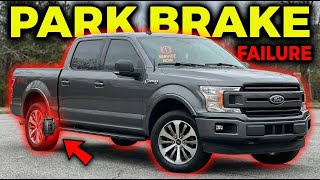
- Parking Brake Warning Light is On or Flashing — A steady or flashing warning light for the parking brake illuminates, often accompanied by a 'Service Parking Brake' message on the dashboard. 🎬 Watch: Troubleshooting a Ford F150 park brake malfunction message.
- ABS and Traction/Stability Control Lights On — Because the parking brake system integrates with the anti-lock brake and stability control systems, warning lights for these systems illuminate simultaneously.
- Parking Brake Won't Engage or Release — The electronic parking brake button or lever fails to respond, leaving the brake either stuck on (preventing movement) or unable to apply.
- Grinding or Clicking Noises from Rear Brakes — Unusual clicking, whirring, or grinding sounds emit from the rear wheels when attempting to apply or release the EPB, indicating a damaged actuator motor.
- Car Won't Shift Out of Park — On specific vehicles, the parking brake status links to the transmission's shift interlock, preventing you from shifting out of Park if a critical EPB fault exists.
Diagnostic Flowchart
Tap your situation to follow the diagnostic path that matches what you're seeing on this code.
Common Fixes & Costs
- Repairing Damaged Wiring or Connectors — Parts: $10-$50, Labor: $150-$450, ~1.5 hr book time (Intermediate)
- Replacing a Weak or Failing Battery — Parts: $150-$400, Labor: $50-$100, ~0.5 hr book time (DIY)
- Updating or Reflashing Module Software — Parts: $0, Labor: $150-$275, ~1.0 hr book time (Professional)
- Replacing the EPB Switch Assembly — Parts: $70-$200, Labor: $80-$150, ~0.8 hr book time (DIY)
- Replacing the Park Brake Control Module (PBCM) — Parts: $350-$900, Labor: $250-$400, ~2.0 hr book time (Professional)
Used vs. New Parts: Buying Guide
When a used part is worth it: A used Park Brake Control Module (PBCM) is a budget-friendly option for older, high-mileage vehicles where a new OEM module is cost-prohibitive. It makes sense only if sourced from a reputable recycler guaranteeing the part matches your exact part number.
Donor-vehicle mileage cap: roughly under 100000 miles for the part to have meaningful remaining life.
Donor quality checklist:
- Verify the part number, including any suffix letters, matches your original module exactly.
- Buy from a licensed salvage yard offering a warranty and return policy.
- Inspect photos for signs of water damage, corrosion, or physical damage to the housing or connectors.
Decision logic:
- If The fix is a known software issue addressed by a TSB → Do not buy any part; pay a dealer to perform the software update.
- If Vehicle is less than 10 years old and the new part is under $500 → Buy a new OEM or high-quality aftermarket part for reliability and warranty.
- If A used module requires programming to your vehicle's VIN → Factor in the $150-$250 cost for a shop to program the used part before deciding.
Warranty tradeoff: Used modules typically come with a 30-90 day warranty covering only the part itself, not the labor to install it. New OEM or aftermarket modules carry a 1-year or longer warranty.
Worst-case if a used part fails: $300-$600 if the used module is faulty or incompatible, requiring repeat labor costs for removal, installation, and programming of another part.
What Happens If You Wait — Timeline
- 0-1 month: Code U0417 sets. The 'Service Parking Brake', ABS, and Stability Control lights illuminate. The EPB functions intermittently or not at all. The primary risk is the loss of ABS/ESC in an emergency. (MPG impact: 0%% · Added cost: $0)
- 1-3 months: If the fault stems from a seized actuator causing the brake to drag, fuel economy decreases and rear brake pads wear rapidly. A burning smell emits from the rear wheels after driving. (MPG impact: 3-7%% · Added cost: $50-$150 in wasted fuel and premature pad wear.)
- 3-6 months: Continuous dragging generates extreme heat, warping the rear brake rotors and causing a pulsation when braking. The brake pads wear down to the metal backing plates. (MPG impact: 5-12%% · Added cost: $300-$700 to replace destroyed rear pads and rotors.)
- 6+ months: Severe overheating boils the grease out of the wheel bearing, leading to bearing failure. The caliper seizes completely, destroying the internal seals and piston. (MPG impact: 10-20%% · Added cost: $800-$2000+ to replace the caliper, rotor, pads, and wheel bearing hub assembly.)
Cost of Not Fixing It
- Immediate: Loss of Anti-Lock Brakes (ABS) and Electronic Stability Control (ESC), increasing the risk of wheel lock-up or spinning out in an emergency maneuver or on slippery surfaces. (Added cost: N/A (Safety Risk))
- 0-3 months: If the EPB is stuck partially engaged, it causes rapid wear of rear brake pads and rotors and a noticeable decrease in fuel economy. (Added cost: $300-$700)
- 3+ months: Continuous overheating from a dragging brake destroys the rear calipers, damages wheel bearings, and leads to a complete loss of braking ability in the rear. (Added cost: $800-$2000+)
Diagnosis Steps
- Check for TSBs and Other Codes
Use an advanced OBD-II scanner to read all stored trouble codes from all modules. U0417 often appears with other codes that pinpoint the root cause. Search for Technical Service Bulletins (TSBs) for your vehicle's make, model, and year related to the EPB system, as a software update is a frequent fix.
Tools: Advanced OBD-II Scanner, Internet Access (Beginner) - Inspect Battery and Charging System
Use a digital multimeter to verify the battery has a static charge of at least 12.4 volts. Start the engine and confirm the alternator charges at 13.5-14.5 volts. Ensure battery terminals are clean and tight. A weak battery is a primary cause of electronic communication faults.
Tools: Digital Multimeter (Beginner) - Visually Inspect Wiring and Connectors
Locate the Park Brake Control Module (often in the trunk, under the center console, or near the rear axle). Unplug its main connector and the connectors at each rear brake caliper actuator. Look for green/white corrosion, bent pins, or water damage. Inspect the harness under the vehicle for chafed or broken wires.
Tools: Flashlight, Trim Removal Tools (optional) (Intermediate) - Check Power and Ground at the Module
Using a vehicle-specific wiring diagram, identify the power and ground pins on the PBCM connector. With the key on, use a multimeter to confirm the module receives full battery voltage (12.0V+). Switch the multimeter to Ohms (key off) and check resistance between the ground pin and a clean chassis ground point. A reading above 0.5 Ohms indicates a poor ground.
Tools: Digital Multimeter, Vehicle-Specific Wiring Diagram (Advanced) - Perform a 'Wiggle Test'
With the vehicle on and the scanner monitoring live data from the park brake module, gently wiggle the wiring harness and connectors for the PBCM and at the rear wheels. If the data stream cuts out or error frames appear on the bus, you have pinpointed an intermittent wiring fault.
Tools: Advanced OBD-II Scanner, Gloves (Intermediate) - Analyze Scan Tool Live Data (PIDs)
Monitor live data Parameter IDs (PIDs) from the Park Brake Module. Watch 'EPB Switch Status' (must change state when pressing the button), 'EPB Motor Current' (must spike several amps during activation, then drop to zero), and 'EPB Status'. An unchanging switch status points to a bad switch; abnormal current suggests a binding actuator or wiring issue.
Tools: Advanced OBD-II Scanner (Advanced) - Load Test Actuator Circuit
If a specific actuator motor code is present, disconnect the actuator and connect a headlight bulb or load-pro tool to the actuator's power and ground wires in the harness. Command the EPB on/off with a scan tool. If the bulb lights brightly, the wiring and module driver are good, meaning the actuator is faulty. A dim bulb indicates high resistance in the wiring.
Tools: Headlight Bulb with Wires or Load-Pro Tool, Advanced Scan Tool, Wiring Diagram (Advanced) - Test the CAN Bus Network
At the DLC or PBCM connector, measure resistance between CAN High (Pin 6) and CAN Low (Pin 14) with the battery disconnected; it must be ~60 Ohms. With the key on, check for ~2.5V on both CAN High and CAN Low relative to ground. Using an oscilloscope, verify a clean, mirrored square wave pattern on the CAN lines.
Tools: Oscilloscope or Advanced Scan Tool, Multimeter (Advanced) - Isolate the Module
If the CAN bus shows incorrect voltage, disconnect the PBCM to see if it restores the network to normal operation. If disconnecting the module corrects the CAN bus voltage or allows other modules to communicate again, the PBCM is internally shorted and causing the network to crash.
Tools: Advanced Scan Tool, Trim Removal Tools (Professional)
When This Code Triggers (Freeze-Frame Conditions)
- Battery Voltage: 11.8V - 12.4V (Low or unstable voltage during module communication at startup or while driving.)
- Vehicle Speed: Any (The fault logs at any speed, including 0 MPH, as modules communicate whenever the ignition is on.)
- EPB Status: Transitioning (Occurs when the EPB is being applied or released, as this is when the module actively sends command and status data.)
- System Time: 0-10 seconds after Key-On (The fault frequently logs during the initial self-test and network handshake immediately after starting the vehicle.)
Related Codes
- U0121 — 'Lost Communication With Anti-Lock Brake System (ABS) Control Module.' U0417 means 'I am getting a signal from the PBCM, but it is corrupt,' while U0121 means 'I am not getting any signal at all from the ABS module.' If you have both, the fault lies with the ABS module or main CAN bus.
- C0089 — 'Traction Control System (TCS) Performance.' This is a symptom of a U-code like U0417. The TCS relies on valid data from the brake system. When the PBCM sends invalid data, the ABS/TCS module logs C0089 because it cannot trust the signals. Resolving U0417 clears C0089.
- U0415 — 'Invalid Data Received From Anti-Lock Brake System (ABS) Control Module.' This code points to the main ABS module instead of the parking brake module. If you have both, the fault lies in the ABS module itself or a shared network circuit broadcasting invalid data.
- U3000 — 'Control Module Internal Electronic Failure.' When stored in the Park Brake Control Module, this confirms the module has an internal processing fault. If you find U3000 in the PBCM alongside U0417 in other modules, the PBCM requires replacement.
Climate & Environmental Factors
- Road Salt / Cold Climates: Salt spray from winter roads coats the undercarriage, accelerating corrosion on the PBCM housing, connectors, and wiring harness. The salt mixture holds moisture against metal pins, leading to high resistance and short circuits.
- High Humidity: Moisture finds its way into non-weatherproof connectors or module housings, causing corrosion and signal degradation over time even without road salt.
- Extreme Cold: Very cold temperatures make wiring insulation brittle and prone to cracking. It also causes marginal batteries to fail, leading to low voltage issues that trigger communication codes.
How to Talk to a Mechanic About This Code
Say this: "I have a U0417 code, and the ABS and parking brake lights are on. I'd like to schedule a diagnostic appointment. Please start by checking for TSBs, verifying battery voltage and ground connections, and inspecting the under-vehicle wiring harness for corrosion before quoting a module replacement."
This signals you understand the common, simple causes for this code. It directs the technician to follow a logical, cost-effective diagnostic path instead of immediately defaulting to the most expensive repair.
Avoid saying:
- 'My parking brake is broken, fix it.'
- 'My dashboard is lit up like a Christmas tree.'
- 'Just replace the parking brake computer.'
Questions to ask before authorizing the repair:
- Did you check for any software updates or Technical Service Bulletins (TSBs) related to this code?
- What was the battery's voltage under load, and did you check the module's ground resistance?
- Can you show me the corroded connector or damaged wire you found?
- If you are recommending a module replacement, how did you rule out a wiring issue or a fault in another module sending it bad data?
Where to Take It: Dealer vs Independent vs Chain
- Dealer:
Recommended. The high likelihood of needing a software update or module programming makes the dealer a reliable, albeit expensive, choice. They have guaranteed access to the correct tools and bulletins.
Best for: Vehicles under warranty., Cases where a known TSB requires a proprietary software update., Complex electrical issues on newer or European models where manufacturer-specific tools are essential.
Downsides: Highest labor rates and part costs., Quicker to replace a whole assembly rather than diagnose a smaller component or wiring fault. (Typical cost: +50% vs. baseline) - Independent Shop:
Good fit, with a catch. An independent shop is an excellent choice for diagnosing common causes (wiring, battery, grounds). Confirm beforehand that they have the capability to program a new module or perform software updates if necessary.
Best for: Out-of-warranty vehicles where the cause is likely a common issue like wiring or battery problems., Shops that specialize in electrical diagnostics or your specific vehicle brand.
Downsides: Lacks the expensive, manufacturer-specific tools to perform software updates or program a new module, requiring a second trip to a dealer., Diagnostic skill varies widely; a good electrical diagnostician is crucial. (Typical cost: +0% vs. baseline) - Chain Shop:
Avoid for diagnosis. While they can test or replace your battery, they are not the right choice for diagnosing a U0417 code. Their business model focuses on high-volume, simple repairs, not complex electrical troubleshooting.
Best for: Battery testing and replacement.
Downsides: Not equipped for in-depth network communication or electrical diagnostics., High risk of misdiagnosis, leading to unnecessary part replacement. (Typical cost: -10% vs. baseline)
When to Walk Away From the Repair
If the estimated repair cost exceeds 50% of the car's private-party value, sell the car as-is or trade it in. Because this code disables key safety systems (ABS/ESC), the argument to fix it is stronger than for a non-safety-related code.
- Car worth $5000, fix is $2800: Walk away. The repair cost is over half the car's value. The fault is safety-critical, making it hard to sell to a private party. Trade it in or sell to a car-buying service.
- Car worth $15000, fix is $1200: Fix it. The cost is well within a reasonable threshold, and the repair restores critical safety functions, preserving the vehicle's value.
- Car worth $3000, fix is $800: Borderline. The cost is significant relative to the car's value. Get a second opinion to confirm the diagnosis before proceeding. If confirmed, it is likely worth doing to have a safe vehicle.
What Scan Tool You Need for This Code

Minimum: A scanner that reads codes from ALL vehicle modules, including ABS, SRS, and the Body Control Module, and displays live data from those modules.
A basic $20 code reader only communicates with the Engine Control Unit (ECU). U0417 is a network code involving the brake modules, meaning a basic reader cannot see the code, related ABS faults, or live data.
Budget: BlueDriver Pro (~$90) — Connects to a smartphone app and reads codes from all modules (including ABS/EPB) on modern vehicles. It views live data, which is essential for diagnosis.
Mid-range: Foxwell NT510 Elite / Autel MaxiCheck Pro (~$160) — Offers full-system diagnostics, bidirectional controls, and special service functions. They put the EPB into 'Service Mode' for brake jobs and command the EPB motor to test its function.
Professional: Autel MaxiCOM MK808 / MK906BT (~$500-1200) — Provides full bidirectional control of all modules, advanced service functions like module coding/programming, and detailed live data graphing. Essential for programming a new Park Brake Control Module.
Rent vs buy: For a one-time diagnosis, try a rental scanner from a parts store, but verify it reads ABS/brake system codes. If you plan to do your own maintenance, buying a mid-range scanner with the 'EPB Service' function pays for itself.
How to Clear the Code After You Fix It
- Reconnect battery if disconnected for repair.
- Use an OBD-II scan tool to perform the 'Clear All DTCs' function.
- Cycle the ignition off, then on, and attempt to operate the electronic parking brake to confirm functionality.
- Perform a drive cycle to allow vehicle systems to run their self-tests.
Drive cycle (~20 minutes): A generic drive cycle involves: 1. Cold start (engine temp below 122°F). 2. Idle for 2-3 minutes. 3. Drive in mixed city/highway traffic for 15-20 minutes, including steady speeds around 55 mph for at least 3 minutes and stop-and-go periods. 4. Safely come to a stop and idle for 1 minute before shutting down.
Readiness monitors affected: Since U0417 is a communication code, it does not directly fail an emissions monitor like the Catalyst or O2 sensor monitors. However, clearing the code resets all monitors to 'Not Ready'.
Before emissions retest: drive at least 50 miles to fully set monitors.
Watch out for:
- Disconnecting the battery will not clear a 'hard' fault and does not guarantee readiness monitors will run.
- The code returns immediately if the root cause, such as a wiring short or faulty module, is not fixed.
- Some vehicles require a specific EPB calibration or relearn procedure with a scan tool after clearing codes, especially if the module or an actuator was replaced.
Will This Fail Emissions / State Inspection?
Yes — this code typically fails an OBD-II emissions inspection.
- California: An active U0417 code with an illuminated Malfunction Indicator Lamp (MIL), which includes the brake warning light, causes an automatic failure of the smog inspection. All readiness monitors must be set to 'Ready'.
- New York: A vehicle fails the annual safety inspection if the ABS or brake warning light is illuminated on the dashboard. Since U0417 triggers these lights, it results in a failed inspection.
- Texas: In counties requiring emissions testing, an illuminated Check Engine Light or a related system fault code like U0417 causes an automatic failure. Even in counties without emissions testing, a lit brake warning light fails the separate safety inspection.
Most Commonly Affected Vehicles
- Dodge/Ram 1500, 2500 (2014-2022) — Prone to issues with internal parking brake hardware and actuators seizing from corrosion, leading to electrical faults. Recalls exist for ABS module software failures that present with U-codes.
- Ford F-150 (2015-2021) — Known for wiring issues near the rear axle and at the EPB module connector. Ford issued recall 20S31 for 2020 models where the rear axle wiring harness contacts the axle housing, damaging EPB wires.
- Chevrolet / GMC Silverado, Sierra, Equinox (2017-2022) — Software glitches and module failures are frequent. Many enter service mode without a scan tool, but failure to execute the manual procedure during a brake job is a primary cause of U0417.
- Jeep Grand Cherokee, Cherokee (2014-2021) — Failures of the Park Brake Control Module itself are a known issue. On the Cherokee (KL), checking fuses F84 and F94 in the under-hood fuse box is a primary step, as they control the actuators directly.
- Subaru Outback/Legacy (2010-2018) — Subaru issued an extended warranty (WUA-01/WUB-02) for EPB assembly failures on 2010-2014 models to 15 years/unlimited miles. Bulletin 06-87-22R covers 2015-2018 models for a cracked EPB connector lock tab.
- Honda Accord, Civic, CR-V (2016-2022) — TSB 17-064 for the 2017 CR-V notes DTC U0416-68 sets after a battery replacement and requires a software update. U0417 is also triggered by the millimeter-wave radar system receiving bad data from the VSA/EPB system.
- Toyota Camry, RAV4, Corolla (2020-2022) — Subject to TSB T-SB-0078-21, addressing a 'Parking Brake Malfunction' message caused by a software glitch in the Skid Control ECU. The fix is a software reflash, not hardware replacement.
- Volkswagen Tiguan, Passat, Jetta (2009-2021) — Notorious for setting faults after brake service if not put in service mode with a scan tool. TSBs exist for outdated software causing erroneous DTCs.
Manufacturer-Specific Notes
- General Motors (Chevrolet/GMC): You can enter EPB Service Mode without a scan tool by starting the engine, pressing and holding the brake pedal, and then pressing and holding the EPB switch for 10 seconds until the brake warning light flashes. Forgetting this procedure destroys the actuator.
- Honda: Honda documents this code as U0417-68. It is often triggered by the millimeter-wave radar receiving failure information from the VSA/EPB system. TSB A17-064 addresses multiple brake-related DTCs appearing after a battery disconnect, fixed by a software update.
- Subaru: Subaru extended the warranty to 15 years/unlimited miles for EPB actuator failures on 2010-2014 Legacy/Outback models and for cracked EPB harness connectors on 2015-2018 models (TSB 06-87-22R). Always check for warranty coverage before paying for a repair.
- Toyota: TSB T-SB-0078-21 for 2020-2022 Corolla, RAV4, and Camry models addresses a 'Parking Brake Malfunction' message. The specified repair is a software update to the Skid Control ECU, not hardware replacement.
- Ford: EPB service mode can be entered without a scan tool via a sequence of ignition cycles and pedal presses. Wiring harness damage near the rear axle is a frequent failure point; check for recall 20S31 on affected models.
Real Owner Stories
2016 Ram 1500 at 85,000 miles
Owner reported a 'Service Parking Brake' message and U0417 code appeared intermittently, especially in wet weather. The parking brake occasionally refused to release.
Outcome: The mechanic cleaned the corroded pins on the module and the connector harness, then applied dielectric grease to seal the connection. The code cleared and did not return. Total cost was one hour of diagnostic labor ($150).
Lesson: Always start with a visual inspection of undercarriage wiring. Corrosion is the most frequent cause of U0417 on trucks and SUVs, and cleaning a connector saves hundreds of dollars over a module replacement.
2018 Ford F-150 at 60,000 miles
U0417 code and ABS/Traction Control lights appeared immediately after the owner replaced the rear brake pads and rotors themselves.
Outcome: The owner manually pushed the rear caliper pistons back without putting the system into service mode, damaging the internal actuator. The dealer replaced one rear brake caliper actuator and performed a software recalibration. The repair cost $600.
Lesson: Failing to use the manufacturer-specified 'Service Mode' before a rear brake job destroys the EPB actuator. Never attempt a DIY rear brake job on an EPB-equipped vehicle without the proper scan tool or manual procedure.
2017 Chevrolet Equinox at 110,000 miles
The 'Service Parking Brake' light illuminated alongside the ABS and stability control lights with code U0417. The parking brake still functioned normally.
Outcome: The owner requested a check for Technical Service Bulletins (TSBs). The shop found a GM TSB stating a software glitch causes the U0417 code erroneously. The owner took the car to a GM dealership for the software update, resolving the issue for $175.
Lesson: Always check for TSBs before authorizing expensive part replacements. A software update is a common, inexpensive fix for communication-related trouble codes.
How to Prevent This Code From Triggering
- Apply Dielectric Grease to Connectors (During any under-car service or every 2-3 years in salt-belt regions) — Dielectric grease is a non-conductive, waterproof sealant. Applying it to the EPB module and actuator connectors prevents moisture and road salt from causing corrosion on the electrical pins.
- Perform Regular Undercarriage Washes (Monthly during winter in areas with road salt) — Washing the undercarriage removes corrosive salt and brine that eats away at wiring insulation and electrical connectors, preserving the EPB system's integrity.
- Always Use EPB 'Service Mode' for Brake Jobs (Every time rear brake pads are replaced) — Putting the system in service mode electronically retracts the brake actuator. This prevents physical damage to the actuator's internal gears and electronic damage to the control module.
- Clean and Test Battery Terminals and Ground Straps (Annually or with every oil change) — Corroded battery terminals or a weak chassis ground create high resistance, leading to unstable voltage. Clean connections prevent the voltage drops that cause communication codes like U0417.
- Exercise the Electronic Parking Brake (At least once a month) — Regularly engaging and disengaging the EPB keeps the actuator motors and caliper slide pins from seizing due to corrosion or lack of use.
Frequently Asked Questions
Can a weak battery really cause code U0417?
Yes. Control modules require a stable voltage above 12.4V to communicate properly. A weak battery or failing alternator causes voltage drops that corrupt these signals, making it a primary cause for communication codes.
What is the most common misdiagnosis for U0417?
Technicians frequently replace the expensive Park Brake Control Module without checking for simpler causes. They overlook a weak battery, a poor ground connection under the car, or an available software update (TSB) that fixes the problem.
I got this code after changing my rear brakes. What happened?
You failed to put the electronic parking brake into 'Service Mode' before compressing the caliper piston. Manually forcing the piston back breaks the internal gear drive inside the actuator motor and triggers this code.
Will the code U0417 clear itself?
If the fault was a temporary voltage spike, the code moves to history and the light turns off after several successful drive cycles. If the code remains active and warning lights stay on, you have a hard fault requiring repair.
My parking brake is stuck ON and the car won't move. What can I do?
If your battery is dead, you cannot release the brake without a jump start. If the battery is fine but the system failed, check your owner's manual for an emergency manual release procedure. This involves a special tool and a release cable located in the trunk or under the center console.
Is replacing the Park Brake Control Module (PBCM) a DIY job?
No. A new module must be programmed to your vehicle's specific VIN using a professional, manufacturer-specific scan tool. Installing a new module without programming it results in a non-functional part.
What is the difference between a yellow and red parking brake light?
A yellow or amber warning light indicates an electrical fault or service requirement within the EPB system. A red brake warning light indicates a critical failure, such as the brake being applied while driving or a hydraulic system issue. With a U0417 code, you often see both.
Key Takeaways
- Code U0417 indicates the electronic parking brake module is broadcasting corrupt data, which immediately disables your ABS and stability control systems.
- Always test your battery voltage (must be above 12.4V) and inspect the under-car wiring harness for corrosion before spending $800+ on a new control module.
- Driving with an active U0417 code is dangerous because it disables your ABS and Electronic Stability Control, drastically increasing the risk of wheel lock-up during emergency stops.
- Never compress rear brake calipers manually on a vehicle with an electronic parking brake; failing to use a scan tool to enter 'Service Mode' destroys the $300 actuator motor and triggers this code.
Helpful Videos

The information in this article is provided for general reference and educational purposes only. Vehicle specifications, procedures, and part compatibility can vary by production date, trim level, and region. Always consult your vehicle's factory service manual and verify part numbers before purchasing or performing repairs. Safety-critical components such as airbags, seat belts, and braking systems should be installed by a qualified professional.
- 🎬 Helpful Videos
- What Does U0417 Mean?
- Can I Drive With U0417?
- Common Causes
- Symptoms
- Diagnostic Flowchart
- Common Fixes & Costs
- Used vs. New Parts: Buying Guide
- What Happens If You Wait — Timeline
- Cost of Not Fixing It
- Diagnosis Steps
- When This Code Triggers (Freeze-Frame Conditions)
- Related Codes
- Climate & Environmental Factors
- How to Talk to a Mechanic About This Code
- Where to Take It: Dealer vs Independent vs Chain
- When to Walk Away From the Repair
- What Scan Tool You Need for This Code
- How to Clear the Code After You Fix It
- Will This Fail Emissions / State Inspection?
- Most Commonly Affected Vehicles
- Manufacturer-Specific Notes
- Real Owner Stories
- 2016 Ram 1500 at 85,000 miles
- 2018 Ford F-150 at 60,000 miles
- 2017 Chevrolet Equinox at 110,000 miles
- How to Prevent This Code From Triggering
- Frequently Asked Questions
- Can a weak battery really cause code U0417?
- What is the most common misdiagnosis for U0417?
- I got this code after changing my rear brakes. What happened?
- Will the code U0417 clear itself?
- My parking brake is stuck ON and the car won't move. What can I do?
- Is replacing the Park Brake Control Module (PBCM) a DIY job?
- What is the difference between a yellow and red parking brake light?
- Key Takeaways
- 🎟️ Get 5% Off