

OBD-II Code U0416: Invalid Data From Vehicle Dynamics Control Module
The Ultimate 2026 Guide to Meaning, Diagnosis, and Repair
- Code U0416 disables critical active safety systems like ABS and Electronic Stability Control, increasing fatal single-vehicle crash risk by 49%.
- Test your battery and ground connections first; voltage drops below 12.4V are the leading cause of CAN bus data corruption.
- Never replace the $800+ ABS control module without first checking for a miscalibrated Steering Angle Sensor or a $50 faulty wheel speed sensor.
- On 2016-2024 Honda models, this code frequently triggers after a simple battery replacement and requires a dealer software update per TSB 17-064.
- Do not use a basic $20 code reader; diagnosing U0416 requires a mid-range scanner (like the $150 Foxwell NT510) to read ABS module data and perform sensor calibrations.
What Does U0416 Mean?
Code U0416 means your car's main computer received incorrect or implausible data from the Vehicle Dynamics Control Module (VDCM). The VDCM controls active safety systems like ABS and ESC. When it broadcasts bad data over the Controller Area Network (CAN) bus, the vehicle disables these safety systems as a precaution and illuminates dashboard warning lights.
Technical definition: The SAE/OBD-II definition is "Invalid Data Received From Vehicle Dynamics Control Module". This indicates a control module on the CAN bus received missing, implausible, or incorrect data from the VDCM. Unlike U0121 (total communication loss), U0416 means the module is powered on and communicating, but its internal logic or sensor inputs are faulty.
Can I Drive With U0416?

Yes, But With Caution. You can drive the vehicle, as standard hydraulic brakes still function. However, critical active safety systems—Anti-lock Brakes (ABS), Traction Control (TCS), and Electronic Stability Control (ESC)—are disabled. The IIHS estimates ESC reduces fatal single-vehicle crash risk by 49%. Without ABS, wheels lock during panic stops, preventing evasive steering. Drive with extreme caution, double your following distance, and schedule a diagnostic appointment immediately.
Common Causes

- Low Battery Voltage or Poor Grounds (Very Common) — A weak battery or corroded ground strap causes voltage fluctuations that corrupt data messages between modules. This forces the VDCM to send garbled information, frequently triggering the code during engine cranking.
- Damaged Wiring or Loose Connectors (Very Common) — Wires connecting the VDCM to the CAN bus corrode, fray, or short out. A loose or water-damaged connector pin at the ABS module is a frequent culprit.
- Faulty Input Sensor (e.g., Wheel Speed, Steering Angle) (Common) — The VDCM relies on external sensor data. If a wheel speed, steering angle, or brake pressure sensor sends bad data to the VDCM, the VDCM broadcasts that invalid data downstream to the rest of the network.
- Steering Angle Sensor (SAS) Miscalibration (Common) — After a wheel alignment or battery disconnect, the SAS requires recalibration. An incorrect 'zero' position forces the sensor to send plausible but wrong data to the VDCM.
- Faulty Vehicle Dynamics Control Module (VDCM/ABS Module) (Common) — The module itself fails due to internal hardware issues, such as a bad relay, failed processor, or cracked solder joints on the circuit board.
- Software or Firmware Mismatch (Less Common) — Outdated or corrupted module software causes communication errors. This also occurs if a replacement module lacks proper VIN programming.
- Aftermarket Accessories or Modifications (Rare) — Improperly installed remote starters, alarms, or LED lighting introduce electromagnetic interference (EMI) onto the CAN bus, corrupting module communication.
Symptoms

- Stability Control, Traction Control, or ABS Warning Lights On — The ESC, VSC, VDC, or ABS light illuminates permanently on your dashboard.
- Loss of Stability/Traction Control — Systems designed to prevent skidding and wheel spin are disabled. The vehicle feels less stable during hard turns or on slippery roads.
- Malfunction of Driver-Assist Systems (ADAS) — Advanced systems like Adaptive Cruise Control (ACC), Lane Keeping Assist (LKAS), and Collision Mitigation Braking System (CMBS) disable because they depend on valid VDCM data.
- Start/Stop System Disabled — Vehicles with automatic start/stop disable the feature, as it relies on vehicle dynamics data to function safely.
- Erratic, Heavy, or Stiff Steering — On vehicles with Electric Power Steering (EPS), U0416 forces the EPS module into a safe mode, reducing power steering assistance.
- Check Engine Light On — This communication error triggers the main Malfunction Indicator Lamp (MIL) on most modern vehicles.
Diagnostic Flowchart
Tap your situation to follow the diagnostic path that matches what you're seeing on this code.
Common Fixes & Costs
- Replace a Weak Battery and Clean Ground Connections — Parts: $150-$350, Labor: $50-$100, ~0.8 hr book time (DIY)
- Repair Damaged Wiring or Clean Connectors — Parts: $5-$50, Labor: $150-$450, ~2.5 hr book time (Intermediate)
- Steering Angle Sensor Recalibration — Parts: $0, Labor: $100-$200, ~0.8 hr book time (Intermediate)
- Replace a Faulty Brake Booster Pressure Sensor (VW-specific)
— Parts: $50-$150, Labor: $150-$250, ~1.5 hr book time
(Intermediate)
Volkswagen Golf (2014-2018): OEM 5Q0906207 (Alt: Bosch 0265005323) - Update or Reprogram the Control Module Software — Parts: $0, Labor: $150-$250, ~1.2 hr book time (Professional)
- Replace the Vehicle Dynamics / ABS Control Module
— Parts: $800-$1800, Labor: $250-$500, ~2.5 hr book time
(Professional)
Honda CR-V (2018-2022): OEM 57100-TLA-A95 (Alt: Remanufactured units available by VIN)
Ford F-150 (2015-2017): OEM GL3Z-2C215-B (Alt: Dorman 599-739)
Chevrolet Silverado (2005-2007): OEM 15212923 (Alt: Dorman 599-736)
Used vs. New Parts: Buying Guide
When a used part is worth it: A used module is ideal for older, high-mileage vehicles where a new part's cost exceeds 20% of the car's value, or if the OEM part is discontinued.
Donor-vehicle mileage cap: roughly under 100000 miles for the part to have meaningful remaining life.
Donor quality checklist:
- Purchase from a reputable supplier that tests parts and offers a minimum 6-month warranty.
- Match the OEM part number exactly; a one-digit difference guarantees incompatibility.
- Ensure the seller accepts returns if the part requires VIN programming that cannot be completed.
- Avoid modules from flood-damaged vehicles.
Decision logic:
- If The vehicle is less than 7 years old or has under 80,000 miles. → Purchase a new or professionally remanufactured OEM part for longevity and warranty.
- If A new OEM part costs over $1,200 and a warrantied used part is under $300. → Buy the used part, but budget $150-$250 for professional VIN programming.
- If The original module can be repaired by a specialist rebuild service. → Rebuild the original unit. It is cheaper than new and bypasses the need for VIN programming.
Warranty tradeoff: Junkyard parts offer 30-90 day warranties. Reputable online rebuilders offer 1 year to lifetime warranties. New OEM parts typically carry a 1-year warranty.
Worst-case if a used part fails: $300-$600 if a used part fails after installation, covering repeat labor for replacement, bleeding, and programming.
What Happens If You Wait — Timeline
- 0-1 week: Code U0416 sets. ABS, Traction Control, and Stability Control warning lights illuminate. Active safety features are immediately disabled. (MPG impact: 0%% · Added cost: $0)
- 1 week - 3 months: Driving continues with disabled safety systems. If the root cause is a minor electrical fault, vibration and moisture degrade the connection further, complicating diagnosis. (MPG impact: 0%% · Added cost: $150-$400 (Diagnostic cost increases as intermittent faults become harder to trace).)
- 3-9 months: A persistent poor ground or voltage issue permanently damages microprocessors inside the ABS control module. A simple wiring repair now requires a module replacement. (MPG impact: 0%% · Added cost: $1200-$2300 (Requires a new ABS module, programming, and brake fluid flush).)
- 9+ months: Catastrophic failure risk increases. On certain models, an ignored ABS module fault leads to an electrical short and engine compartment fire. (MPG impact: 0%% · Added cost: Potential for total vehicle loss in case of fire, or cascading electronic failures costing over $3000.)
Cost of Not Fixing It
- Immediate: ABS, Traction Control, and Stability Control systems are disabled. This dramatically increases the risk of losing vehicle control during emergency maneuvers or on wet roads. (Added cost: Potential for vehicle damage, injury, and increased insurance premiums in the event of an accident.)
- Short Term (0-3 months): Continued operation masks the root cause. A simple wiring issue worsens over time due to vibration and moisture, leading to a more expensive module replacement. (Added cost: A $200 wiring repair becomes a $1500+ module replacement.)
- Long Term (6+ months): Ignoring the issue leads to unpredictable behavior from related systems. On certain Hyundai/Kia models, failing modules pose a fire risk due to internal short circuits. (Added cost: Risk of cascading electronic failures or total vehicle loss due to fire.)
Diagnosis Steps

- Read All Trouble Codes from All Modules
Use a professional-grade OBD-II scanner to read codes from all modules (ABS, BCM, TCM, EPS), not just the engine. Look for specific sensor codes (e.g., C0051 for steering angle) or manufacturer sub-codes (like -68 on Hondas).
Tools: Advanced OBD-II Scanner (Beginner) - Check Battery and Grounds
Verify the battery rests above 12.4 volts. Inspect main battery terminals and chassis ground connections to ensure they are clean, tight, and free of corrosion.
Tools: Multimeter, Socket set/wrenches, Wire brush (Beginner) - Visually Inspect Wiring and Connectors
Locate the VDCM (often attached to the ABS pump) and inspect its main electrical connector for corrosion, bent pins, or water damage. Trace the wiring harness for chafing or rodent damage.
Tools: Flashlight, Inspection mirror (Intermediate) - Perform Steering Angle Sensor (SAS) Recalibration
If the code appeared after a wheel alignment, battery replacement, or steering repair, recalibrate the SAS using a scan tool. This resets the sensor's zero point and resolves invalid data issues.
Tools: Advanced OBD-II Scanner with SAS calibration function (Intermediate) - Analyze Sensor Live Data
View live data from the VDCM's primary inputs. All four wheel speeds must read identically when driving straight. The steering angle must read 0° (±5°) when the wheel is centered.
Tools: Advanced OBD-II Scanner with live data (Advanced) - Test Wheel Speed Sensors
If a wheel speed sensor code is present, test it. For passive sensors, measure resistance (typically 800-2000 Ohms). For active sensors, verify the 5V/12V reference voltage and use an oscilloscope to check for a clean square wave signal.
Tools: Multimeter, Oscilloscope, Vehicle-specific resistance specs (Advanced) - Test CAN Bus Communication Lines
With ignition on, check voltage on CAN High (approx. 2.7V) and CAN Low (approx. 2.3V) at the VDCM connector. With battery disconnected, verify 60 ohms resistance between the two lines.
Tools: Multimeter, Vehicle-specific wiring diagram (Advanced) - Check for Software Updates and TSBs
Check for Technical Service Bulletins (TSBs) or available software updates for the VDCM. Manufacturers frequently release software patches to fix false U0416 triggers.
Tools: Manufacturer-specific diagnostic tool (e.g., i-HDS, VCDS) (Professional) - Isolate Modules via Network Reset
Disconnect the battery, unplug all modules on the affected CAN bus, and reconnect them one by one. Cycle the ignition each time to identify which specific module crashes the network.
Tools: Socket set/trim removal tools, Advanced OBD-II Scanner (Professional)
When This Code Triggers (Freeze-Frame Conditions)
- Vehicle Speed: 25-55 mph (Sets during steady-state driving, not necessarily during dynamic braking or turning events.)
- Engine RPM: 1200-2500 RPM (Normal cruising RPM range; the system is actively monitoring but not under heavy load.)
- Battery Voltage: 13.2-14.5 V (Normal operating voltage. A low voltage reading in freeze frame points directly to a power supply issue.)
- Time Since Engine Start: 5-15 minutes (Occurs after the vehicle runs long enough for all system self-checks to complete.)
Related Codes
- U0121 — U0121 means 'Lost Communication With ABS Module'—the module is completely offline due to power, ground, or network failure. U0416 means the module is online but sending corrupt data.
- C0051 — Indicates a Steering Angle Sensor (SAS) fault. If the SAS sends bad data to the VDCM, the VDCM broadcasts it, triggering U0416. Always diagnose and fix C0051 first.
- C0063 — Indicates a Yaw Rate Sensor fault. If this sensor provides an illogical signal, the VDCM cannot perform stability calculations and sends invalid data, triggering U0416.
- U3000 — A generic 'Control Module Internal Malfunction' code. On Hondas, U3000-49 appearing alongside U0416-68 strongly indicates the Electric Power Steering module has an internal failure and requires replacement.
Climate & Environmental Factors
- Corrosion (Humidity/Salt): Vehicles in the 'Salt Belt' or coastal climates are highly prone to U0416. Salt and moisture accelerate wiring harness and ground point corrosion, introducing high resistance that corrupts CAN bus data signals.
- Thermal Cycling (Extreme Temperatures): Repeated exposure to extreme engine bay heat followed by cooling cycles stresses delicate solder joints inside the ABS module, eventually causing microscopic cracks and internal data failures.
How to Talk to a Mechanic About This Code
Say this: "I have a U0416 code with the ABS and stability control lights on. Please perform a full-system scan for related sensor codes and inspect the battery, grounds, and ABS module wiring before concluding the module itself is bad. I want to rule out a miscalibrated steering angle sensor or a software glitch first."
This signals you are an informed customer. It directs the technician to follow a logical diagnostic path, starting with the cheapest-to-fix causes, rather than defaulting to a $1,500 module replacement.
Avoid saying:
- 'My ABS light is on, can you fix it?'
- 'Just do whatever it takes to fix it.'
- 'My friend said it's probably the ABS module.'
Questions to ask before authorizing the repair:
- Did you find any other communication or sensor codes in any other modules?
- What were the exact results of the battery and charging system test?
- If you recommend a module replacement, did you test the power, ground, and CAN bus wires at the module connector?
- Are there any Technical Service Bulletins (TSBs) for this code on my vehicle requiring a software update?
Where to Take It: Dealer vs Independent vs Chain
- Dealer:
Recommended. The dealer is the best choice if the issue is a known software bug or if module programming is required.
Best for: Vehicles under warranty., Known manufacturer-specific software bugs (e.g., Honda issues after a battery change)., Complex diagnostics requiring proprietary tools and VIN programming.
Downsides: Highest labor rates, often 1.5x to 2x more than independent shops., Defaults to replacing entire assemblies rather than repairing wiring. (Typical cost: +50% vs. baseline) - Independent Shop:
Good Alternative. A well-equipped independent shop is excellent for diagnosing wiring and sensor issues. Ask if they have CAN bus diagnostic experience.
Best for: Out-of-warranty vehicles where cost is a major factor., Diagnosing common faults like bad wiring, grounds, or sensors., Shops specializing in your vehicle's brand.
Downsides: Diagnostic equipment varies greatly. Ensure they have advanced, all-system scanners., May lack access to the latest TSBs or software update files. (Typical cost: +0% vs. baseline) - Chain Shop:
AVOID for diagnosis. This code requires advanced electronic troubleshooting skills beyond the scope of a chain repair shop.
Best for: Simple, unrelated repairs like tires, oil changes, or battery replacement.
Downsides: Technicians lack specialized training for complex network diagnostics., Business model encourages replacing parts based on the code alone, leading to misdiagnosis. (Typical cost: -10% vs. baseline)
When to Walk Away From the Repair
If the estimated repair cost exceeds 50% of the car's current private-party market value, consider selling or trading in the vehicle.
- Car worth $5000, fix is $2500: Walk Away. The repair cost is 50% of the car's value. Disabled safety systems make it hard to sell privately, so trading in is the best exit.
- Car worth $15000, fix is $2200: Fix it. The repair is less than 15% of the vehicle's value and restores critical safety functions, preserving its worth.
- Car worth $3000, fix is $450: Fix it. A low-cost repair for a wiring or sensor issue is well worth it to restore safety, even on an older vehicle.
What Scan Tool You Need for This Code

Minimum: A scanner that reads and clears codes from ALL vehicle systems (ABS, SRS, BCM) and performs Steering Angle Sensor (SAS) calibrations.
A basic $20 engine code reader cannot communicate with the ABS module, cannot read related C-codes, and cannot perform the necessary SAS recalibration.
Budget: N/A for full DIY fix (~$None) — Scanners in this range read ABS codes but lack the critical Steering Angle Sensor calibration function required to complete the repair.
Mid-range: Topdon ArtiDiag500S / Foxwell NT510 Elite (~$150-250) — Reads codes from all modules, views live data from wheel speed sensors, and performs the required Steering Angle Sensor (SAS) reset.
Professional: Autel MaxiCOM MK808S (~$400-500) — Adds bidirectional control to command components like the ABS pump and solenoids, verifying module function before replacing it.
Rent vs buy: Rent a tool from AutoZone for an initial scan. However, rental tools cannot perform SAS calibrations. If the fix requires calibration, you must buy a mid-range scanner or visit a shop.
How to Clear the Code After You Fix It
- Reconnect battery if disconnected for repair.
- Use a professional-grade OBD-II scan tool to clear the code from the ABS/VDC module, not just the engine module.
- Perform a VSA sensor neutral position memorization if required by the manufacturer.
- Perform the specific drive cycle recommended by the manufacturer.
Drive cycle (~20 minutes): Start the engine cold (off for 8+ hours) and idle for 3 minutes. Drive steadily at 55 mph for 5 minutes, incorporating several normal stops and accelerations to allow the onboard computer to run its self-tests.
Readiness monitors affected: This 'U' code does not directly affect emissions readiness monitors., However, if the Check Engine Light is illuminated, emissions monitors must run and complete before passing a state inspection.
Before emissions retest: drive at least 50 miles to fully set monitors.
Watch out for:
- Using a basic code reader that only clears engine codes fails to erase a U0416 stored in the ABS module.
- On Honda vehicles, the code returns after a battery disconnect due to a software bug and requires a dealer tool to permanently clear.
- Clearing the code without fixing the root cause results in the code returning immediately.
Will This Fail Emissions / State Inspection?
No — by itself this code doesn't fail OBD inspection (but it can keep readiness monitors from setting, which causes a separate fail).
- California: An illuminated ABS light does NOT cause a smog inspection failure. The test only checks emissions-related codes and the Check Engine Light.
- New York: Current NYS DMV regulations state an illuminated ABS warning light is NOT a cause for rejection during a safety inspection, though proposed legislation aims to change this.
- Texas: An illuminated ABS light does NOT cause a failure of the annual safety inspection.
Most Commonly Affected Vehicles
- Honda CR-V, Pilot, Accord, Civic (2016-2024) — Extremely common. Sets with suffixes U0416-68 or U0416-92. Per TSB 17-064, this is frequently a software bug triggered by battery disconnection, requiring a radar unit software update rather than an ABS module replacement.
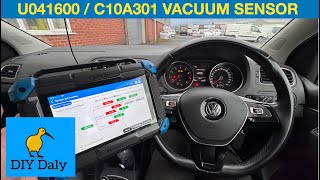
- Volkswagen Polo, Golf, Caddy (2014-2018) — If the start/stop system is also disabled, the root cause is almost always a faulty brake booster vacuum/pressure sensor (P/N 5Q0906207), not the dynamics module.
- Ford F-150, Expedition, Ranger (2011-2026) — Communication issues with the Integrated Trailer Brake Module (TBM) flood the CAN bus with errors, causing U0416. Disconnect the TBM to test.
- Chevrolet / GM Cruze, Malibu, Silverado (2012-2017) — Appears alongside a 'Service StabiliTrak' message. Causes trace to chafed wiring on wheel speed sensor harnesses or corrosion at the Electronic Brake Control Module (EBCM) connector.
- Hyundai / Kia Elantra, Santa Fe, Sorento (2017-2022) — Associated with recalls for ABS modules at risk of short-circuiting due to moisture intrusion. Check the NHTSA database for open fire-risk recalls before diagnosing.
- Chrysler / Dodge / Jeep Grand Cherokee, 200, Grand Caravan (2011-2017) — Defined as 'Implausible Data Received from ESP Module.' Frequently points to CAN bus wiring issues near the front wheels or requires a PCM software update.
- Subaru Forester, Crosstrek, Outback (2015-2019) — Triggered by a failing relay inside the VDC unit or when the EyeSight system detects invalid data. Often requires full module replacement.
- Land Rover Discovery 4, Range Rover Sport (2014-2018) — Appears after a wheel alignment if the steering angle sensor is not recalibrated. The Ride Level Control Module logs U0416-68 due to invalid steering angle data.
Manufacturer-Specific Notes
- Honda: Per TSB 17-064, disconnecting the battery triggers U0416-68 or U0416-92 due to a software bug. The official fix is a software update for the millimeter wave radar unit, not the VSA module.
- Volkswagen / Audi: Code U0416 is highly misleading on VWs. The root cause is frequently a faulty brake booster vacuum sensor (OEM P/N 5Q0906207) affecting the start/stop system, not the ABS module.
- Ford: A faulty Trailer Brake Module (TBM) causes this code by constantly sending garbage data onto the CAN bus. Disconnecting the TBM is the fastest diagnostic step to verify this.
- Dodge / Chrysler / Jeep: Defines the code as 'Implausible Data Received from ESP Module.' Diagnosis frequently points toward CAN bus wiring harness damage near the front wheel wells.
Real Owner Stories
2019 Honda Accord with U0416-68 after major engine work
After a head gasket replacement, a cluster of warning lights (ACC, LKAS, Brake System) appeared. All related safety systems were inoperative.
Outcome: The root cause was a poor ground connection that was not properly re-seated during the engine repair. Tightening the ground straps between the engine and chassis permanently resolved the code.
Lesson: If U0416 appears immediately after a major repair, the root cause is almost certainly a disturbed wiring harness or a forgotten ground connection, not a spontaneous module failure.
2015 VW Polo 1.0 with U0416 and Start/Stop error
The Check Engine Light illuminated, and the Start/Stop system disabled with an error message. A basic scan showed code U0416.
Outcome: Replacing the faulty Brake Booster Pressure Sensor (P/N 5Q0906207) for $60 resolved all codes and restored the Start/Stop system.
Lesson: On VW group vehicles, U0416 combined with a disabled Start/Stop system is a definitive indicator of a faulty brake booster pressure sensor, not a failed ABS module.
2017 Honda CR-V with U0416-68 and U0416-92 after battery replacement
Immediately after replacing the battery, multiple warning lights illuminated. A scan showed codes U0416-68, U0416-92, and C0051-54.
Outcome: This is a known software bug documented in Honda TSB ATS 161223. The dealer cleared the codes using the i-HDS tool and performed a software update for the millimeter wave radar unit, fixing the issue permanently.
Lesson: Do not panic if U0416 appears after a battery change on a modern Honda. It is a known software glitch requiring a dealer update, not a hardware failure.
How to Prevent This Code From Triggering
- Clean and protect battery terminals and chassis grounds (Every 12 months) — Corrosion creates high resistance, leading to voltage drops that corrupt data packets between modules. Cleaning and applying terminal protector prevents this.
- Apply dielectric grease to critical electrical connectors (When exposed during repairs) — Dielectric grease blocks moisture and oxygen from reaching metal pins, preventing the corrosion that causes intermittent signals and invalid data faults.
- Flush brake fluid at manufacturer-recommended intervals (Every 2-3 years) — Brake fluid absorbs moisture over time. This moisture causes internal corrosion within the ABS hydraulic control unit, leading to module failure.
- Keep vehicle plenums and sunroof drains clear of debris (Every 6-12 months) — Clogged drains cause rainwater to overflow into the cabin, soaking critical control modules under carpets. Water damage disrupts the CAN network, causing U0416.
- Test battery health annually after 3 years of service (Annually) — Aging batteries fail under load, causing significant voltage drops during engine start-up. These fluctuations trigger temporary communication glitches.
Frequently Asked Questions
Can a bad wheel speed sensor cause a U0416 code?
Yes. A faulty wheel speed sensor sends bad data to the ABS module, which then broadcasts that invalid data to other computers, triggering U0416. You will usually see a specific wheel speed sensor code (e.g., C0035) alongside it.
What is the most common misdiagnosis for U0416?
The most common mistake is replacing the expensive ABS module without ruling out simpler causes. Technicians must verify battery voltage, check grounds, inspect wiring, and check for TSBs first. On VWs, the true cause is often a $50 brake booster pressure sensor.
Why did the U0416 code appear after I replaced my battery?
On many modern vehicles, especially Hondas, disconnecting power causes a software glitch that sets code U0416. It requires a dealer to clear the code with a proprietary tool and perform a software update per TSB 17-064.
Can a wheel alignment cause a U0416 code?
Yes. A wheel alignment changes steering geometry, but the Steering Angle Sensor (SAS) retains the old 'straight' position. This mismatch forces the SAS to send incorrect data to the VDCM, triggering U0416. A post-alignment SAS recalibration fixes this.
Can aftermarket LED lights or a remote starter cause this code?
Yes. Poorly designed aftermarket electronics generate electromagnetic interference (EMI). This noise disrupts sensitive CAN bus communications, leading to corrupted data and U0416 codes.
How much does it cost to diagnose a U0416 code?
Repair shops charge a diagnostic fee covering one to two hours of labor. Expect to pay between $150 and $400 for a thorough network and wiring diagnosis.
Will clearing the code fix the problem?
No. Unless the code was set by a temporary glitch like a low battery during cranking, clearing it only turns the light off temporarily. The code returns immediately if the underlying hardware or software fault remains.
What do the suffixes like -68 and -92 mean on a Honda U0416 code?
These are manufacturer sub-codes. U0416-68 points to a 'Brake Actuator Malfunction' (internal logic failure). U0416-92 means 'Rejected Control Request,' which happens when the module rejects a command due to a software glitch after a battery disconnect.
Key Takeaways
- Code U0416 disables critical active safety systems like ABS and Electronic Stability Control, increasing fatal single-vehicle crash risk by 49%.
- Test your battery and ground connections first; voltage drops below 12.4V are the leading cause of CAN bus data corruption.
- Never replace the $800+ ABS control module without first checking for a miscalibrated Steering Angle Sensor or a $50 faulty wheel speed sensor.
- On 2016-2024 Honda models, this code frequently triggers after a simple battery replacement and requires a dealer software update per TSB 17-064.
- Do not use a basic $20 code reader; diagnosing U0416 requires a mid-range scanner (like the $150 Foxwell NT510) to read ABS module data and perform sensor calibrations.
Helpful Videos

The information in this article is provided for general reference and educational purposes only. Vehicle specifications, procedures, and part compatibility can vary by production date, trim level, and region. Always consult your vehicle's factory service manual and verify part numbers before purchasing or performing repairs. Safety-critical components such as airbags, seat belts, and braking systems should be installed by a qualified professional.
- 🎬 Helpful Videos
- What Does U0416 Mean?
- Can I Drive With U0416?
- Common Causes
- Symptoms
- Diagnostic Flowchart
- Common Fixes & Costs
- Used vs. New Parts: Buying Guide
- What Happens If You Wait — Timeline
- Cost of Not Fixing It
- Diagnosis Steps
- When This Code Triggers (Freeze-Frame Conditions)
- Related Codes
- Climate & Environmental Factors
- How to Talk to a Mechanic About This Code
- Where to Take It: Dealer vs Independent vs Chain
- When to Walk Away From the Repair
- What Scan Tool You Need for This Code
- How to Clear the Code After You Fix It
- Will This Fail Emissions / State Inspection?
- Most Commonly Affected Vehicles
- Manufacturer-Specific Notes
- Real Owner Stories
- 2019 Honda Accord with U0416-68 after major engine work
- 2015 VW Polo 1.0 with U0416 and Start/Stop error
- 2017 Honda CR-V with U0416-68 and U0416-92 after battery replacement
- How to Prevent This Code From Triggering
- Frequently Asked Questions
- Can a bad wheel speed sensor cause a U0416 code?
- What is the most common misdiagnosis for U0416?
- Why did the U0416 code appear after I replaced my battery?
- Can a wheel alignment cause a U0416 code?
- Can aftermarket LED lights or a remote starter cause this code?
- How much does it cost to diagnose a U0416 code?
- Will clearing the code fix the problem?
- What do the suffixes like -68 and -92 mean on a Honda U0416 code?
- Key Takeaways
- 🎟️ Get 5% Off