

U0269 on 2017-2018 Chevrolet Volt: Side Detection System Failure Causes and Fixes
U0269 means your Volt has lost communication with the passenger-side blind spot monitoring module. This is usually caused by a failed module in the rear bumper due to water damage. The fix requires bumper removal and a new module that must be professionally programmed.
- U0269 on a 2017-2018 Volt points to a communication failure with the passenger-side blind spot radar module in the rear bumper.
- The most common cause is the module itself failing due to water damage; the second is a corroded wiring connector.
- Before replacing parts, a technician must rule out a faulty diagnostic cable (TSB PIT5441C) and check if a software update is the correct fix (TSB 16-NA-122).
- Repair requires removing the rear bumper cover, and any new module must be professionally programmed to the vehicle.
What's Unique About the 2017-2018 Chevrolet VOLT
The second-generation Chevrolet Volt (built on the GM D2XX platform) shares its active safety system architecture with many other GM vehicles from this period, such as the Chevrolet Malibu and Cadillac XT5. As a result, it is susceptible to the same common failures, primarily the side detection modules failing due to their placement in the rear bumper where they are exposed to moisture and road spray. A key issue for technicians is to be aware of GM TSB PIT5441C, which warns that a faulty diagnostic tool cable (GM MDI) can induce this code by failing to properly communicate on the specific data pins (3 and 11) used by the object detection bus, leading to a misdiagnosis.
Diagnostic Flowchart
Tap your situation to follow the diagnostic path that matches what you're seeing on this vehicle.
Symptoms You May Notice
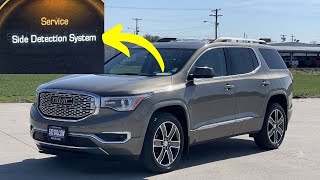
- "Service Side Detection System" message on the Driver Information Center (DIC). 🎬 Watch: See how this warning appears and what causes it.
- The warning light in the passenger-side mirror does not illuminate when a vehicle is in the blind spot.
- The blind spot system may give false alerts or no alerts at all, sometimes detecting stationary objects like walls before failing completely.
- Rear Cross Traffic Alert system is disabled.
- The amber warning light in the side mirror may stay on constantly.
- Replacing the side detection module when the actual fault is a corroded connector pigtail 🎬 See why replacing sensors alone doesn't always fix the problem. that could be replaced for less.
- Replacing vehicle components when the code was falsely induced by a faulty diagnostic scan tool cable, as noted in TSB PIT5441C.
- Replacing the module when only a software update was needed, as per TSB 16-NA-122 (when DTC B101E-43 is present).
Most Likely Causes
- Failed Passenger-Side Object Detection Module 🔴 High Probability The modules are located in the corners of the rear bumper, making them highly vulnerable to water intrusion from rain, car washes, and road spray. The seals on the module housing can fail, allowing moisture to corrode the internal circuit board, causing failure. This is a well-documented issue across many GM platforms.
How to confirm: After removing the rear bumper, inspect the module for cracks, swelling, or signs of water entry. A scan tool (like GM's GDS2) that can communicate with the Active Safety Module will show no response from the passenger-side sensor ('Module B'). Unplugging the connector may reveal green or white corrosion on the module's pins.
Typical fix: Replace the faulty module and program the new one to the vehicle. The connector and pigtail may also need replacement if corroded. The new module must be programmed using the GM Service Programming System (SPS).
Est. part cost: $200-$400 - Damaged Wiring or Corroded Connector 🟡 Medium Probability The wiring harness and connector for the module are also in the splash zone behind the rear wheels. Road salt and moisture can corrode the connector pins, leading to a loss of power, ground, or the serial data communication signal.
How to confirm: With the bumper cover removed, unplug the module and inspect the connector pins for green or white corrosion, bent pins, or broken wires. Water may drip from the connector itself. A multimeter can be used to check for 12V power and good ground at the appropriate pins on the harness side of the connector.
Typical fix: Clean the connector with electrical contact cleaner if corrosion is minor. If the damage is severe, the connector pigtail must be cut out and a new one spliced in. This requires weather-proof butt connectors or solder and heat shrink tubing to prevent future moisture intrusion.
Est. part cost: $40-$70 - Side Object Sensor Module Software Issue ⚪ Low Probability TSB 16-NA-122 indicates that on 2016-2017 Volts, a 'Service Side Detection System' message can be caused by outdated software, which can be resolved without replacing parts. This TSB specifically applies when DTC B101E-43 is also present.
How to confirm: A GM dealer or a shop with a subscription to GM's TIS2Web can check the current software calibration of the module against the latest available version. This is the primary fix if DTC B101E-43 is found.
Typical fix: Reprogram the Side Object Sensor Module with the latest software using the Service Programming System (SPS). The bulletin states not to replace any parts for this specific condition.
Est. part cost: $0 (if covered), otherwise 1-2 hours of labor for programming.
Rare But Worth Checking
- Faulty Diagnostic Tool Cable: As per TSB #PIT5441C, a damaged Multiple Diagnostic Interface (MDI) cable used by the technician can cause a false U0269 code. The object detection bus communicates on DLC pins 3 and 11, and a fault in the cable can mimic a module communication failure. The technician should test their MDI cable on a known-good vehicle or use a self-test adapter to rule this out before replacing vehicle parts.
Diagnosis Steps
- Scan the Active Safety Control Module with a professional-grade scan tool capable of reading GM-specific 'U' codes (e.g., GM GDS2). Confirm U0269 is present and note if it is 'current' or 'history'.
- Check for other communication codes like U026A, U0075, or software codes like B101E-43.
- Be aware of TSB PIT5441C. If using a GM MDI tool, inspect the diagnostic cable for damage and test it to ensure it's not inducing a false code.
- If DTC B101E-43 is present, consult TSB 16-NA-122. The recommended fix is a software update, not part replacement.
- If no software update applies, gain access to the rear bumper. This requires removing the rear bumper cover, 🎬 Watch: This guide shows how to access sensors behind the bumper. which involves removing screws in the wheel wells (often 7mm) and under the vehicle, and carefully releasing clips.
- Visually inspect the passenger-side module and its electrical connector for physical damage, cracks, or corrosion. Unplug the connector and check for water and corroded pins.
- If the connector is corroded, test for power, ground, and communication signals at the harness side. If power/ground is missing, trace the wiring harness for breaks. If power/ground is present but the module won't communicate, the module is the likely culprit.
- If the module is replaced, it must be programmed using GM's Service Programming System (SPS). This procedure requires a stable vehicle voltage and a subscription to GM's technical information service.
Parts You'll Likely Need
- Side Obstacle Detection Control Module (Passenger Side)
(OEM #84430634)— This is the radar sensor that most commonly fails due to water intrusion, causing code U0269. This part number supersedes previous versions 23424942 and 84037295.
Trusted brands: ACDelco, GM Genuine
OEM price range: $250-$400
Aftermarket price range: $150-$250 - Module Connector Pigtail
(OEM #Not sold as a specific OEM part number, must use aftermarket.)— If the electrical connector is corroded beyond cleaning, it must be replaced to ensure a reliable connection to the new module. Aftermarket pigtails with 8-inch wire leads are available.
Trusted brands: ACDelco (generic), Dorman, Connector Experts
OEM price range: $40-$70
Aftermarket price range: $20-$40
Related Codes That Often Appear With This One
- U026A — This is the corresponding code for the driver's side ('A') module. If both appear, it points towards a shared power, ground, or wiring issue rather than two independently failed modules. It could also be caused by the faulty MDI tool issue described in TSB PIT5441C.
- U0075 — A general communication bus failure code ('Control Module Communication Bus Off'). It can appear with U0269 if a wiring issue is present or if the diagnostic tool is faulty, as mentioned in TSB PIT5441C.
- B101E-43 — This DTC for 'Control Module Incorrect Software' specifically points to the software update outlined in TSB 16-NA-122 as the required fix, rather than a hardware replacement.
Technical Service Bulletins (TSBs) & Recalls
- PIT5441C: Warns that a faulty diagnostic tool cable (MDI) can falsely set U0269 and other communication codes by failing to communicate on the object d
Platform-Specific Known Issues
- Owner Experience with Intermittent Failure: An owner on Reddit with a 2017 Volt reported their driver-side sensor began failing intermittently, detecting large trucks but not smaller cars, and sometimes giving random alerts before the 'Service Side Detection System' message appeared. This highlights that the failure may not be sudden but can degrade over time.
- Special Coverage N172097060 for other GM models: While not specifically for the Volt, GM issued a special coverage program for other vehicles like the Chevy Cruze and Impala for the exact same issue: water intrusion causing the Side Blind Zone Alert (SBZA) modules to fail. This demonstrates that GM is aware of the design vulnerability.
- Front Fascia Harness Chafing: GM Service Bulletin PIT5487F notes that on some vehicles, the front bumper wiring harness can chafe on the end of the right front bumper bar. While this TSB focuses on front-facing systems, it lists U0269 as a possible resulting DTC, indicating that a short in this harness can potentially disrupt the entire active safety communication bus. A visual inspection of the harness near the right front frame rail is recommended if multiple communication codes are present.
Mechanic-Grade Diagnostic Values
- Module Power Supply Voltage — expected: 12V (system voltage). Failure: Voltage below 9V or absent.
- Module Ground — expected: Good continuity to chassis ground (near 0 ohms).. Failure: High resistance on the ground circuit.
- Object Detection CAN Bus High Voltage (Key On) — expected: Fluctuates between 2.5V (recessive) and 3.5V (dominant).. Failure: Stuck high, stuck low, or no fluctuation. A short to ground will pull voltage near 0V; a short to power will pull it to 5V or 12V.
- Object Detection CAN Bus Low Voltage (Key On) — expected: Fluctuates between 2.5V (recessive) and 1.5V (dominant).. Failure: Stuck high, stuck low, or no fluctuation. A short to ground will pull voltage near 0V; a short to power will pull it to 5V or 12V.
Scan Tool Commands That Help
- GDS2 (Global Diagnostic System 2): Module Diagnostics > Side Object Detection Module > Configuration/Reset > Module Setup — This function is required after replacing a side obstacle detection module. The new module must be programmed and calibrated to the vehicle's specific configuration to function correctly. Failure to perform this step will result in the new part not working and the code returning.
- GDS2 (Global Diagnostic System 2): Vehicle DTC Information > Clear All DTCs — After a repair is completed (e.g., replacing a module or fixing wiring), this command is used to clear the U0269 code from the Active Safety Control Module's memory. A key cycle is typically required after clearing.
Wiring & Ground Locations
- Side Obstacle Detection Module B Connector — Plugged into the module located in the right (passenger) rear corner of the vehicle, behind the bumper fascia.. This is the primary connection point for the module. It is highly susceptible to corrosion from water and road salt, which can interrupt power, ground, or the CAN bus signals, directly causing code U0269.
- Rear Compartment Fuse Box — Located in the cargo area, under the load floor.. This fuse box contains the fuse that provides power to the side obstacle detection modules. A blown fuse here will cause both modules to lose communication.
- Chassis Ground — While a specific ground point number (e.g., G402) for the rear bumper harness is not easily identified, the module's ground wire (Pin 7) must have a clean, tight connection to the vehicle's chassis in the rear of the vehicle.. A corroded or loose ground connection is a common cause of intermittent or total module failure. The module cannot communicate without a solid ground reference.
Real Owner Repair Stories
- Reddit user blacklvrose (2017 Chevrolet Volt Premier) — "Service Side Detection System" message appeared. Both side mirror warning lights came on simultaneously and then would turn on and off together, though they still seemed to detect cars correctly some of the time.
❌ Tried (didn't work) Hoping rain would wash off any dirt from a recent snowfall.
✅ What actually fixed it The owner took the vehicle to the dealer, and the repair was covered under warranty. While the specific part was not named by the owner, a warranty-covered repair for this symptom almost always involves the replacement of the failed side detection module.
OEM Part Supersession History
23424942→84037295, then 84430634— Part revision and improvement by the manufacturer, likely to improve sealing against water intrusion.
Heads up: The newest part number, 84430634, is the recommended replacement for all previous versions and is backward compatible for the specified vehicles.
Helpful Videos
We Have This Part in Stock


The information in this article is provided for general reference and educational purposes only. Vehicle specifications, procedures, and part compatibility can vary by production date, trim level, and region. Always consult your vehicle's factory service manual and verify part numbers before purchasing or performing repairs. Safety-critical components such as airbags, seat belts, and braking systems should be installed by a qualified professional.
- Chevrolet VOLT:
- 🎬 Helpful Videos
- 🛍️ Shop This Part
- What's Unique About the 2017-2018 Chevrolet VOLT
- Diagnostic Flowchart
- Symptoms You May Notice
- Most Likely Causes
- Rare But Worth Checking
- Diagnosis Steps
- Parts You'll Likely Need
- Related Codes That Often Appear With This One
- Technical Service Bulletins (TSBs) & Recalls
- Platform-Specific Known Issues
- Mechanic-Grade Diagnostic Values
- Scan Tool Commands That Help
- Wiring & Ground Locations
- Real Owner Repair Stories
- OEM Part Supersession History
- 🎟️ Get 5% Off