

OBD-II Code U0235: Lost Communication With Cruise Control Front Distance Range Sensor
The Ultimate 2026 Guide to What U0235 Means, Why It Triggers, and Exactly How to Fix It
- Clean the front emblem and lower bumper grille with mild soap and water before attempting any repairs, as dirt or ice causes over 40% of U0235 codes.
- Inspect the radar sensor's electrical connector for green corrosion or loose pins, especially if the vehicle recently had front bumper repairs.
- Test your battery with a multimeter to ensure it reads above 12.4V, because a weak battery frequently triggers false U0235 communication errors during startup.
- Budget between $250 and $800 for a mandatory professional ADAS calibration if you replace the radar sensor or remove the front bumper.
What Does U0235 Mean?

Code U0235 means your car's main computer network lost connection to the front-facing radar sensor. This sensor acts as the primary 'eye' for Adaptive Cruise Control (ACC) and the Pre-Collision System (PCS). When modules like the Engine Control Module (ECM) stop receiving the sensor's signal for even a few seconds, they instantly disable these safety features and trigger a dashboard warning.
Technical definition: SAE/OBD-II defines U0235 as 'Lost Communication With Cruise Control Front Distance Range Sensor.' This indicates a communication failure on the Controller Area Network (CAN) bus between the front millimeter-wave radar sensor and other control modules. The code sets when the expected periodic status message from the radar sensor is absent for a manufacturer-specified duration.
Can I Drive With U0235?
Yes, But With Caution. Yes, but critical safety systems like Adaptive Cruise Control (ACC) and Pre-Collision Braking are completely disabled. Mechanically, the car is safe to operate and will brake normally, much like a vehicle from the 1990s. However, driving without these proactive safety nets significantly increases collision risk. Schedule a diagnosis promptly.
Common Causes

- Obstructed or Dirty Radar Sensor (Very Common) — Physical blockage is the most frequent trigger. Dirt, mud, snow, ice, or thick wax buildup over the sensor (usually behind the front emblem or lower bumper grille) blocks the radar waves.
- Damaged or Disconnected Wiring/Connector (Common) — The front bumper wiring harness is highly vulnerable. Minor collisions, curb strikes, or road debris sever wires, cause connector corrosion, or unplug the sensor entirely. Technicians frequently find this connector left loose after bodywork.
- Sensor Misalignment (Common) — A slight bump to the front bumper knocks the sensor out of precise alignment. The ADAS control module detects the skewed angle, shuts the system down, and logs a fault. This requires professional recalibration.
- Faulty Front Radar Sensor (Common) — The sensor fails internally due to age, moisture intrusion from a compromised seal, or direct impact damage. A failed sensor stops broadcasting on the CAN network and requires replacement.
- Low Battery Voltage or Electrical System Faults (Less Common) — ADAS modules are highly sensitive to voltage drops. A weak battery, failing alternator, or blown 7.5A/10A fuse causes temporary communication glitches across the CAN network during startup.
- Incorrect Coding or Incompatible Parts (Rare) — Occurs frequently after replacing an unrelated module (like a BCM) or installing a used radar sensor. If the module lacks the correct software coding or the used sensor is VIN-locked to another car, communication fails.
Symptoms
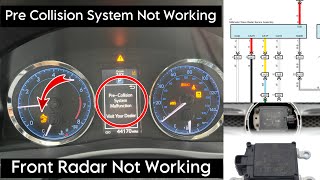
 🎬 Watch: How to fix a Toyota Pre-Collision System malfunction' or 'Radar Sensor Blocked' warning message." loading="lazy" style="max-width:100%;height:auto;border-radius:6px;display:block;box-shadow:0 2px 8px rgba(0,0,0,0.1);" />
- Cruise Control Systems Disabled — Adaptive Cruise Control (ACC) and standard cruise control fail to engage and appear grayed out on the instrument panel.
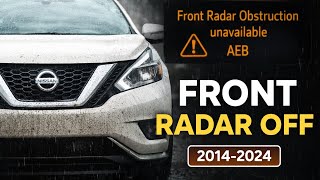
- Pre-Collision/ADAS Warning Lights — Messages like 'Pre-Collision System Malfunction' or 'Front Radar Sensor Blocked 🎬 See this easy fix for Nissan front radar obstruction warnings' appear alongside a general Check Engine Light.
- Automatic High Beams Disabled — Because automatic high beams rely on shared forward-facing camera and radar data, this feature becomes unavailable.
Diagnostic Flowchart

Tap your situation to follow the diagnostic path that matches what you're seeing on this code.
Common Fixes & Costs
- Cleaning the Front Sensor/Emblem — Parts: $0, Labor: $0, ~0.1 hr book time (DIY)
- Wiring Harness or Connector Repair — Parts: $20-$100, Labor: $150-$350, ~1.5 hr book time (Intermediate)
- Front Radar Sensor Calibration Only — Parts: $0, Labor: $250-$800, ~2.5 hr book time (Professional)
- Front Radar Sensor Replacement & Calibration — Parts: $500-$1500, Labor: $350-$1050, ~3.5 hr book time (Professional)
- Control Module Software Update or Recoding — Parts: $0, Labor: $120-$250, ~1.2 hr book time (Professional)
Used vs. New Parts: Buying Guide
When a used part is worth it: Buying a used radar sensor is strongly discouraged. Only consider it for older, high-mileage vehicles where OEM parts are discontinued and you accept a high risk of failure.
Donor-vehicle mileage cap: roughly under 50000 miles for the part to have meaningful remaining life.
Donor quality checklist:
- Verify the part number is an exact match.
- Ensure the donor vehicle did not suffer a front-end collision.
- Check for water intrusion or corrosion on the connector pins.
Decision logic:
- If The part is a modern ADAS radar sensor. → Buy new OEM. Used parts carry a high risk of VIN-locking, software incompatibility, and hidden internal damage.
- If You choose to buy used against advice. → Purchase from a reputable salvage yard with a 90-day return policy and test communication immediately before paying for calibration.
Warranty tradeoff: Used sensors offer 30-90 day warranties, failing to cover intermittent issues. New OEM parts carry 1-year+ warranties. Aftermarket sensors are virtually non-existent for this component.
Worst-case if a used part fails: $500-$1200. If a used sensor fails calibration, you pay for initial labor, diagnostic time, removal, a new OEM part, and a second calibration fee.
What Happens If You Wait — Timeline
- Immediate: Code U0235 sets. The warning light illuminates. Adaptive Cruise Control and Pre-Collision Braking disable instantly. (MPG impact: 0%% · Added cost: $0)
- Ongoing: The driver assumes 100% responsibility for maintaining safe following distances. Collision risk increases significantly. (MPG impact: 0%% · Added cost: Variable (increased accident risk))
- State Inspection Time: The vehicle fails state safety/emissions inspections due to the active Check Engine Light. (MPG impact: 0%% · Added cost: $50 - $250 (inspection re-test fees, fines))
- The day you need it: A moment of distraction results in a front-end collision that the disabled Pre-Collision System would have prevented. (MPG impact: 0%% · Added cost: $2,000 - $15,000+ (collision repair, deductibles, premium hikes))
Cost of Not Fixing It
- Immediate: Complete loss of Adaptive Cruise Control (ACC) and Pre-Collision/Forward Collision Warning systems. (Added cost: $0)
- Ongoing: Significantly increased risk of a front-end collision. You lose the proactive safety net proven to reduce rear-end crashes by up to 50%. (Added cost: Variable (potential accident costs))
- Long-Term: Failure to pass state safety or emissions inspections due to the illuminated Check Engine Light. (Added cost: $50 - $250 (inspection re-test fees, fines))
Diagnosis Steps
- Clean the Front Radar Sensor and Windshield
Locate the front radar sensor behind the vehicle emblem or lower bumper grille. Clean it thoroughly with a soft cloth and mild soap. Clean the windshield in front of the rearview mirror. Restart the car and drive above 30 mph to see if the code clears.
Tools: Soft cloth, mild soap, glass cleaner (Beginner) - Visually Inspect Sensor and Connector
Examine the sensor and mounting bracket for cracks or impact damage. Push the electrical connector firmly to ensure it clicks into place. Look for green corrosion or bent pins inside the connector.
Tools: Flashlight (Beginner) - Check Battery Health and Fuses
Test the battery voltage; it must read above 12.4V with the engine off. Locate the interior and under-hood fuse boxes and inspect the fuses labeled for ADAS, PCS, or Cruise Control.
Tools: Multimeter, fuse puller (Beginner) - Scan All Modules and Wiggle Test
Use an all-module OBD-II scanner to check for widespread network codes (like U0100). With the ignition on (engine off), gently wiggle the wiring harness at the radar sensor. If the scanner loses connection or dashboard lights flicker, you have a broken wire.
Tools: OBD-II Scanner (all-module capability), Hands (Intermediate) - Analyze Live Data for Sensor Alignment
Access the Cruise Control Module live data. Check the 'Radar Misalignment Angle' parameter. A value consistently outside ±3 degrees indicates physical misalignment requiring calibration, even if the wiring is perfect.
Tools: Bi-Directional Scan Tool (Advanced) - Perform CAN Bus Resistance and Voltage Checks
Disconnect the battery and measure resistance between DLC Pins 6 and 14 (should be ~60 Ohms). Reconnect the battery, turn the ignition on, and measure voltage at the sensor connector. CAN High should be ~2.6V; CAN Low should be ~2.4V. Identical voltages indicate a short.
Tools: Multimeter, back-probe pins (Advanced) - Pinpoint Electrical Tests at the Sensor
Disconnect the sensor. Verify 12V on the power wire and less than 1 Ohm of resistance on the ground wire. Use an oscilloscope to confirm a valid square wave data signal on the CAN lines.
Tools: Multimeter, vehicle-specific wiring diagram, oscilloscope (optional) (Advanced)
When This Code Triggers (Freeze-Frame Conditions)
- Engine Coolant Temp: 180-200°F (The engine is fully warmed up, ensuring all systems are at normal operating temperature.)
- Vehicle Speed: 22-70 mph (The vehicle is moving at a speed where ACC is active. Many systems set the fault only when speed exceeds 22 mph for a specific duration.)
- System Voltage: 13.5-14.5V (The charging system functions correctly, ruling out low system voltage as the trigger.)
Related Codes
- U0100 — 'Lost Communication with ECM/PCM.' Indicates a systemic CAN bus failure. Diagnose main network power and grounds first; U0235 is merely a symptom.
- U0415 — 'Invalid Data Received From ABS.' The ACC system shuts down because it receives illogical wheel speed data from the ABS module. Diagnose the ABS system first.
- C1A50 — Toyota-specific 'Brake System Malfunction.' The Pre-Collision System faults because it cannot trust the brake system status. Fix brake codes first.
- P2583 — Honda-specific 'Misalignment of Millimeter Wave Radar.' The sensor communicates perfectly but detects physical misalignment. Skip wiring checks and proceed to calibration.
Climate & Environmental Factors
- Snow and Ice: Snow or slush builds up directly on the sensor face, blocking the radar signal. The system restores itself after you clear the obstruction.
- Road Salt and Corrosion: Corrosive road salt infiltrates the sensor's electrical connector over time, destroying pins and severing communication.
- Heavy Rain or Fog: Extremely dense water particles temporarily attenuate the radar signal, causing a brief system shutdown until weather improves.
How to Talk to a Mechanic About This Code
Say this: "I have a U0235 code and the pre-collision warning light is on. I've cleaned the sensor and checked the battery. I need a diagnostic to check for wiring issues or a module fault before assuming the sensor needs replacement. Do you perform ADAS calibrations in-house?"
Directs the shop toward logical diagnostics (wiring/network) instead of jumping to expensive parts. Confirming in-house calibration ensures they can complete the job without costly subletting.
Avoid saying:
- 'My cruise control isn't working.'
- 'My check engine light is on, can you just fix it?'
- 'I think I need a new radar sensor.'
Questions to ask before authorizing the repair:
- What were the results of the CAN bus health check (resistance and voltage)?
- Did you find a specific wiring fault, like a broken wire or corroded connector?
- Is the mandatory ADAS calibration included in the total estimate?
- Will you use a new OEM sensor, and what is the warranty?
Where to Take It: Dealer vs Independent vs Chain
- Dealer:
Recommended for warranty work or if independent diagnosis fails. They guarantee access to correct software and calibration tools.
Best for: Vehicles under warranty, Complex electrical issues on German makes (VW, Audi), Recalls or Technical Service Bulletins (TSBs)
Downsides: Highest labor rates, Often defaults to replacing the sensor assembly rather than repairing wiring (Typical cost: +50% vs. baseline) - Independent Shop:
Best fit for out-of-warranty scenarios ONLY IF they confirm they perform ADAS calibrations in-house.
Best for: Out-of-warranty vehicles, Diagnosing wiring faults, Post-collision repairs
Downsides: Many lack modern ADAS calibration equipment. (Typical cost: +0% vs. baseline) - Chain Shop:
AVOID. U0235 requires complex electronic diagnosis and safety system calibration beyond their scope.
Best for: Oil changes or tires
Downsides: Lack specialized diagnostic and calibration equipment., Technicians lack training for complex network diagnostics. (Typical cost: -10% vs. baseline)
When to Walk Away From the Repair
If the total estimated repair cost (diagnostics, parts, labor, calibration) exceeds 40-50% of your car's current private-party value, evaluate your options.
- Car worth $5000, fix is $2500: Walk away. Investing 50% of the car's value into a non-essential safety feature is financially imprudent.
- Car worth $25000, fix is $2500: Fix it. The repair cost is 10% of the vehicle's value, a reasonable investment to restore critical safety systems.
- Car worth $8000, fix is $3500: Borderline. Get a second opinion from an independent ADAS specialist.
What Scan Tool You Need for This Code
Minimum: A scanner that reads codes from ALL vehicle modules (Engine, ABS, Airbag, BCM), not just a basic engine code reader.
A $20 engine-only reader cannot see U0235 or identify which modules are offline. Network diagnostics require full-system visibility.
Budget: BlueDriver Pro (~$119) — Scans all systems to confirm U0235, checks if other modules are offline, and provides freeze-frame data.
Mid-range: Foxwell NT510 Elite (~$180) — Provides brand-specific software, performs bi-directional controls, and reads ADAS live data like sensor alignment status.
Professional: Autel MaxiCOM MK808S (~$500-600) — Performs full bi-directional control and maps network topology to efficiently diagnose network faults. (Cannot perform final ADAS calibration).
Rent vs buy: Buy. Renting a basic scanner from an auto parts store is insufficient for network codes. If the problem requires more than a BlueDriver, you need professional shop-level tools.
How to Clear the Code After You Fix It
- Ensure all connectors are secure and the battery reads above 12.4V.
- Use a professional OBD-II scan tool to clear the U0235 code from the ADAS/Cruise Control module.
- Perform a static or dynamic calibration if the sensor was replaced or the bumper removed.
- Test drive above 30 mph to initialize the system.
Drive cycle (~20 minutes): Start the vehicle and idle for 3 minutes. Drive for 15-20 minutes in mixed conditions, including steady highway driving above 30 mph to test cruise control engagement. If the fault was a temporary obstruction, the light often clears on its own after this cycle.
Readiness monitors affected: Network 'U' codes do not directly affect emissions readiness monitors. However, an active Check Engine Light automatically fails emissions testing in most states.
Before emissions retest: drive at least 50 miles to fully set monitors.
Watch out for:
- Clearing the code without fixing the underlying wiring fault guarantees the code returns immediately.
- Skipping the mandatory ADAS calibration after sensor replacement leaves the safety systems permanently disabled.
- Ignoring a weak battery; the code clears temporarily but returns during the next cold start.
Will This Fail Emissions / State Inspection?
Yes — this code typically fails an OBD-II emissions inspection.
- California: An illuminated Check Engine Light (MIL) due to a 'U' code is an automatic failure of the smog inspection.
- New York: NYS inspections check for an illuminated MIL and verify safety system readiness. U0235 results in immediate failure.
- Texas: In emissions-testing counties, an illuminated Check Engine Light is an automatic failure, regardless of recent safety inspection law changes.
Most Commonly Affected Vehicles
- Toyota RAV4, Camry, Sienna, Tundra (2018-2025) — Highly sensitive to sensor obstruction and aftermarket emblems. 2022-2025 RAV4 models frequently log variant U023587.
- Honda CR-V, Accord, Civic (2018-2025) — Honda Sensing radar brackets bend easily. Minor curb strikes misalign the sensor, requiring a $300+ recalibration even without visible bumper damage.
- Ford F-150, Explorer, Expedition (2018-2025) — Battery Management System (BMS) voltage drops frequently trigger this code. Sensor replacement and calibration at a dealership often exceeds $1,500.
- Subaru Outback, Forester, Crosstrek (2017-2025) — A class-action settlement extended the warranty for certain EyeSight repairs on 2013-2024 models, covering 75% of costs for specific failures.
- Chevrolet / GMC Tahoe, Suburban, Yukon, Silverado (2021-2025) — GM Service Bulletin PIT6377 identifies a pinched front fascia jumper harness as the primary cause. Inspect wiring before replacing the sensor.
- Volkswagen Jetta, Passat, Golf, Tiguan (2013-2024) — Frequently appears after battery replacement due to CAN Gateway software corruption. Requires recoding rather than hardware replacement.
Manufacturer-Specific Notes
- Toyota: Systems require the exact OEM emblem on the grille. Aftermarket emblems, vinyl wraps, or thick paint distort the radar signal and cause constant U0235 codes.
- Honda: The system mandates recalibration after any work involving front bumper removal, regardless of whether the sensor itself was touched.
- GM (Chevrolet/GMC): The front fascia jumper harness frequently pinches near the radar sensor on newer trucks. Always inspect this harness before condemning the sensor.
- Volkswagen / Audi: Replacing an unrelated module (like a TCM) without exact hardware-matching software configuration causes the gateway to search for non-existent ACC sensors, triggering the code.
Real Owner Stories
2020 Toyota Tundra with 'Pre-Collision System Malfunction'
The warning light appeared immediately after a body shop replaced the front bumper.
What they tried:
- Scanned the vehicle, revealing code U0235.
Outcome: The owner inspected the radar sensor behind the Toyota emblem and found the electrical connector unplugged. Pushing the connector until it clicked resolved the issue instantly.
Lesson: If U0235 appears immediately after front-end service, check for a disconnected sensor connector before assuming hardware failure.
2019 Toyota Camry after a front-end accident
After a collision, the owner replaced the front bumper and radar sensor, but U0235 persisted.
What they tried:
- Replaced the front radar sensor.
- Checked forward recognition camera connections.
Outcome: The system required mandatory ADAS calibration. Replacing the component is insufficient; professional calibration is required to re-establish communication.
Lesson: Replacing a radar sensor is never plug-and-play. It mandates professional calibration.
Volkswagen Golf with intermittent U0235 after battery change
U0235 appeared and returned immediately after clearing, following a battery replacement.
What they tried:
- Charged the battery fully.
- Cleared codes with a VCDS tool.
Outcome: The low voltage event corrupted the CAN Gateway software coding. Recoding the Gateway to match the vehicle's hardware resolved the phantom error.
Lesson: On German vehicles, persistent U0235 codes after battery events indicate software configuration issues, not hardware failures.
How to Prevent This Code From Triggering
- Regularly clean the front radar sensor area (Monthly and after driving in snow, mud, or bug-heavy conditions) — Prevents dirt, ice, or insects from blocking the radar signal and triggering false U0235 codes.
- Apply dielectric grease to the sensor connector (Whenever the connector is disconnected for service) — Repels moisture and prevents pin corrosion in climates with heavy road salt or high humidity.
- Maintain a healthy battery and charging system (Test battery annually after 3 years) — Ensures stable system voltage, preventing random communication glitches during vehicle startup.
Frequently Asked Questions
Can a car wash cause the U0235 code?
Yes. High-pressure water forces moisture into weathered connector seals, or heavy wax coatings obstruct the radar signal. This triggers a 'sensor blocked' message and the U0235 code.
Why did the U0235 code appear after I replaced the battery or jump-started my car?
ADAS modules are highly sensitive to voltage drops. After a battery change or jump-start, the module temporarily fails to initialize. Drive the vehicle for 15 minutes above 30 mph to allow the system to re-initialize and clear the code.
Can an aftermarket grille or emblem cause this code?
Yes. Front emblems on modern cars use radar-transparent materials. Aftermarket emblems, thick paint, or vinyl wraps block radar waves and cause a U0235 fault.
I had a minor accident and now I have this code. What's the likely cause?
Even minor impacts damage the sensor internally, sever wiring, or knock the radar out of alignment. The system requires professional diagnosis to pinpoint the damage. Even if the sensor survives, it mandates professional recalibration.
Can I replace the front radar sensor myself?
You can physically bolt on a new sensor, but the repair remains incomplete. New sensors require mandatory electronic calibration using specialized targets and scan tools. The vehicle's safety systems will not function until a professional completes this step.
What is a common misdiagnosis for code U0235?
The most common misdiagnosis is replacing the expensive radar sensor when the actual fault is a loose connector or damaged wire. Incorrect software coding in a different module also frequently triggers this code on German vehicles.
What is ADAS calibration and why is it so expensive?
Calibration precisely aligns cameras and radar sensors using large, level floor spaces and expensive specialized targets. Shops invest upwards of $25,000 in this equipment and require extensive technician training. The $250-$800 fee reflects this massive overhead and safety-critical precision.
Key Takeaways
- Clean the front emblem and lower bumper grille with mild soap and water before attempting any repairs, as dirt or ice causes over 40% of U0235 codes.
- Inspect the radar sensor's electrical connector for green corrosion or loose pins, especially if the vehicle recently had front bumper repairs.
- Test your battery with a multimeter to ensure it reads above 12.4V, because a weak battery frequently triggers false U0235 communication errors during startup.
- Budget between $250 and $800 for a mandatory professional ADAS calibration if you replace the radar sensor or remove the front bumper.
Helpful Videos

The information in this article is provided for general reference and educational purposes only. Vehicle specifications, procedures, and part compatibility can vary by production date, trim level, and region. Always consult your vehicle's factory service manual and verify part numbers before purchasing or performing repairs. Safety-critical components such as airbags, seat belts, and braking systems should be installed by a qualified professional.
- 🎬 Helpful Videos
- What Does U0235 Mean?
- Can I Drive With U0235?
- Common Causes
- Symptoms
- Diagnostic Flowchart
- Common Fixes & Costs
- Used vs. New Parts: Buying Guide
- What Happens If You Wait — Timeline
- Cost of Not Fixing It
- Diagnosis Steps
- When This Code Triggers (Freeze-Frame Conditions)
- Related Codes
- Climate & Environmental Factors
- How to Talk to a Mechanic About This Code
- Where to Take It: Dealer vs Independent vs Chain
- When to Walk Away From the Repair
- What Scan Tool You Need for This Code
- How to Clear the Code After You Fix It
- Will This Fail Emissions / State Inspection?
- Most Commonly Affected Vehicles
- Manufacturer-Specific Notes
- Real Owner Stories
- 2020 Toyota Tundra with 'Pre-Collision System Malfunction'
- 2019 Toyota Camry after a front-end accident
- Volkswagen Golf with intermittent U0235 after battery change
- How to Prevent This Code From Triggering
- Frequently Asked Questions
- Can a car wash cause the U0235 code?
- Why did the U0235 code appear after I replaced the battery or jump-started my car?
- Can an aftermarket grille or emblem cause this code?
- I had a minor accident and now I have this code. What's the likely cause?
- Can I replace the front radar sensor myself?
- What is a common misdiagnosis for code U0235?
- What is ADAS calibration and why is it so expensive?
- Key Takeaways
- 🎟️ Get 5% Off