

U0197 on 2012-2019 Dodge Journey: Lost Communication With Hands-Free Module Fixes
On a 2012-2019 Dodge Journey, code U0197 almost always means the Hands-Free Module (HFM) for your Bluetooth has a software glitch or has failed. A software update at the dealer is the most common fix; if that doesn't work, the module needs to be replaced. A failing HFM is also a very common cause of parasitic battery drain on these vehicles.
- U0197 on a Dodge Journey means your Bluetooth module has stopped communicating.
- The most common and manufacturer-recommended first step is a software update performed by a dealer.
- A simple temporary fix you can try is pulling the HFM fuse (F131) for a few minutes to reset the module.
- If a software update doesn't work, or if you have a parasitic battery drain that disappears when fuse F131 is pulled, the Hands-Free Module itself has likely failed and needs to be replaced.
- Replacing the module is a difficult DIY job due to its location deep within the dashboard above the steering column.
What's Unique About the 2012-2019 Dodge JOURNEY

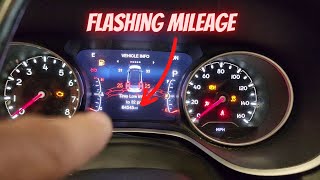
For this generation of Dodge Journey, the U0197 code is very commonly caused by software issues within the Hands-Free Module (HFM) itself, rather than a wiring or hardware failure. Dodge has issued Technical Service Bulletins (TSBs) outlining specific software updates to resolve these communication dropouts. This is often the first and most effective repair, making a trip to the dealer for a reflash a more likely fix than for many other vehicles where this code points to wiring problems. Furthermore, a complete internal failure of the HFM is a well-documented cause of significant parasitic battery drain that kills the battery overnight. The flashing odometer symptom, common on other FCA vehicles with this issue, is also seen on the Journey and points directly to a communication failure with a module like the HFM.
Diagnostic Flowchart

Tap your situation to follow the diagnostic path that matches what you're seeing on this vehicle.
Symptoms You May Notice

- Bluetooth phone and audio functions are inoperative
- Cannot pair a new phone
- Phone screen on the radio is inaccessible or says "Hands-Free Module Loading".
- Voice Recognition (VR) button on the steering wheel does not respond.
- Loss of audio during a Bluetooth phone call.
- Check Engine Light (Malfunction Indicator Lamp) may be illuminated.
- Parasitic battery drain, causing the battery to go dead overnight or after a few days of sitting.
- Flashing mileage on the odometer. 🎬 Watch: Why your mileage is flashing and what it means.
- Replacing the radio/head unit. The radio is usually just reporting the communication loss; the problem lies with the separate Hands-Free Module that it's trying to talk to. Some owners have been incorrectly quoted for radio repairs by dealers. Note that on some models with factory navigation, the HFM is internal to the radio, but this is less common on the Journey.
Most Likely Causes

- Hands-Free Module (HFM) Software Glitch 🔴 High Probability Manufacturer TSB #08-083-19 directly addresses numerous software-related bugs causing this code on the 2012-2019 Journey. Symptoms covered include the U0197 code, loss of audio, the module not booting, and being unresponsive to the wiTECH scan tool.
How to confirm: A dealership or a properly equipped independent shop can check the current software version of the HFM against the latest version available from Dodge. If an update is available, this is the likely cause. The TSB provides a detailed procedure for checking the version via voice commands.
Typical fix: Reprogramming (flashing) the Hands-Free Module with the latest software version using the dealer's wiTECH scan tool and a specific USB process. The dealer cost for this flash is typically 1-1.5 hours of labor.
Est. part cost: $0 - Failed Hands-Free Module (HFM) 🟡 Medium Probability These modules are known to fail internally, sometimes causing a parasitic battery drain of several hundred milliamps that kills the battery. This is a very common point of failure across many Chrysler/Dodge vehicles of this era. Some owners report the module feels warm to the touch even after the vehicle has been off for hours, indicating an internal short causing the drain.
How to confirm: If a software update does not fix the issue or cannot be performed because the module is unresponsive, and power/ground/network tests are good, the module itself is condemned. A key diagnostic step for battery drain is to measure the vehicle's current draw after it goes to sleep, then pull the HFM fuse (F131) and see if the draw drops significantly. A normal draw should be under 50mA.
Typical fix: Replace the Hands-Free Module. Some owners and mechanics report that no reprogramming was needed after replacement, while service information suggests a 'Proxy Configuration Alignment' may be required. Disconnecting the old module is often enough to stop a parasitic drain.
Est. part cost: $150-$300 - Blown Fuse or Power/Ground Issue ⚪ Low Probability While less common than module failure, any electronic component can lose power. A temporary fix reported by many owners is to pull the HFM fuse for a few minutes to reset the module. This suggests the module can lock up and a power cycle can restore it temporarily. Poor chassis grounds are also a known issue on this platform, which can cause various electrical problems.
How to confirm: Check the fuse for the HFM (often F131, a 10A red fuse in the passenger compartment fuse box under the glove box) to see if it's blown. Use a multimeter to verify battery power and a solid ground at the module's electrical connector. Inspect and clean main engine-to-chassis ground points.
Typical fix: Replace the blown fuse. If the fuse blows again, there is a short circuit that needs to be diagnosed. Repair any damaged power or ground wires. Adding supplementary ground wires is a common preventative fix by some owners.
Est. part cost: $1-$5
Rare But Worth Checking
- CAN Bus Wiring Fault: The network wiring that connects all the modules can become damaged, shorted, or corroded, preventing communication. This is less likely than a module or software issue but should be checked if other steps fail.
Diagnosis Steps
- Scan for all DTCs to confirm U0197 is the primary code and see which other modules are logging it.
- Check for applicable TSBs, specifically #08-083-19, for your vehicle's VIN.
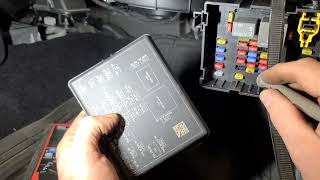
- As a simple reset, locate the HFM fuse (F131, a 10A fuse in the fuse box under the glove box) and remove it for 5-10 minutes, then reinstall. 🎬 See how to reset the module by pulling the fuse. This is a temporary fix for many owners that forces the module to reboot.
- If you have a parasitic battery drain, perform a parasitic draw test with an ammeter. 🎬 Watch: How to perform a parasitic draw test on a Journey. After the vehicle sleeps, pull fuse F131. If the amperage draw drops to a normal level (under 50mA), the HFM has failed internally and is the source of the drain.
- If the issue persists, have a dealer or qualified shop attempt to perform the software update outlined in TSB 08-083-19.
- If the software update fails or the module is unresponsive, the next step is to access the HFM itself. It is located deep in the dashboard, above the steering column, making it very difficult to reach.
- Inspect the wiring and connectors at the HFM for any visible damage, corrosion, or loose pins.
- Using a multimeter, verify that the module is receiving proper battery voltage and has a good ground connection.
- Test the CAN bus wiring. With the battery disconnected, measure the resistance between the two CAN bus pins at the HFM connector. The reading should be approximately 60 ohms if the network is intact. A reading of 120 ohms indicates an open in the bus, and a reading near 0 ohms indicates a short between the two CAN wires.
- If power, ground, and wiring are all confirmed to be good, the Hands-Free Module has failed and needs to be replaced.
Parts You'll Likely Need
- Hands-Free Module (HFM)
(OEM #05091072AH)— This module is the root cause of the U0197 code, either due to a software glitch or internal hardware failure. It is also a common cause of parasitic battery drain.
Trusted brands: Mopar
OEM price range: $200-$300
Aftermarket price range: $150-$250
Related Codes That Often Appear With This One
- U0184 — This code means 'Lost Communication with Radio'. It can appear alongside U0197 if the HFM's failure is disrupting communication with the radio on the same network.
Technical Service Bulletins (TSBs) & Recalls
- 08-083-19: Flash: Hands Free Module (HFM) Software Enhancements
- 08-055-17 REV. A: Flash: Hands Free Module (HFM) Software Enhancements
- 08-112-14: Hands Free Feature Inoperative (applies to platform mates)
Platform-Specific Known Issues
- TSB 08-083-19 describes a specific software update to fix U0197 and symptoms like loss of audio on calls, the module not booting properly, or being unresponsive.
- TSB 08-055-17 REV. A also points to U0197 when the steering wheel VR button doesn't work or the phone screen is inaccessible, sometimes related to non-supported language selection.
- The location of the Hands-Free Module is notoriously difficult to access. It is positioned above the steering column, and official service procedures may require removing the brake pedal assembly to reach it. Many DIY videos and forum posts confirm this difficult location.
- Parasitic battery drain is a very common symptom of a failed HFM on the Journey. Owners report a dead battery overnight, and diagnosis frequently points to pulling the HFM fuse (F131) as the step that resolves the high current draw.
Mechanic-Grade Diagnostic Values
- CAN Bus Network Resistance — expected: ~60 Ω (Ohms). Failure: A reading of ~120 Ω indicates an open circuit or one of the two terminating resistors is not seen. A reading near 0 Ω indicates a short between the CAN High and CAN Low wires.
- Parasitic Current Draw (HFM) — expected: < 50 mA (milliamps) after vehicle enters sleep mode (approx. 5-15 minutes).. Failure: A sustained draw significantly above 50mA (e.g., 0.8A or 800mA) that drops to a normal level immediately after pulling fuse F131 for the HFM confirms the HFM is the cause of the drain.
- CAN Bus Voltage (Ignition ON, Engine OFF) — expected: CAN High: ~2.7V, CAN Low: ~2.3V. Voltages should mirror each other.. Failure: One line stuck high (at 5V or 12V) or low (at 0V) indicates a short to power or ground.
Hidden / Shadow Codes Worth Checking
- U0197-00: This is the full code with the Failure Type Code (-00) which means "No Sub Type Information." It's the standard format seen by dealer-level scan tools like wiTECH and confirms the generic 'Lost Communication' status. (see via A professional scan tool like Mopar wiTECH or high-end aftermarket scanners.)
Scan Tool Commands That Help
- wiTECH (or equivalent like AlfaOBD): Proxy Configuration Alignment — This procedure is required after replacing the Hands-Free Module (or many other modules on the vehicle). It synchronizes the configuration of the new module with the Body Control Module (BCM) and the rest of the vehicle network. Failure to perform this can result in a flashing odometer and persistent communication codes.
- wiTECH: Restore Vehicle Configuration — This is sometimes performed before a Proxy Alignment. It restores the BCM's stored vehicle configuration, ensuring the alignment process starts from a known-good baseline.
Wiring & Ground Locations
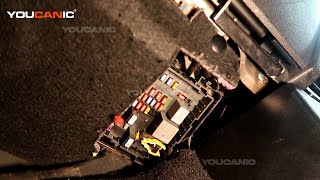
- HFM Fuse F131 — In the passenger compartment fuse box, located under the glove box. It is typically a 10-Amp red fuse.. This fuse provides the primary power to the Hands-Free Module. Pulling this fuse is the quickest way to reset a locked-up module and is a key diagnostic step for confirming a parasitic drain caused by the HFM.
- Driver-Side Strut Tower Ground — A stud on the driver's side strut tower in the engine bay where the main negative battery cable connects to the chassis.. This is a critical grounding point for the entire vehicle's electrical system. Corrosion or looseness here can cause a wide range of electrical issues, including module communication problems. Some owners add a supplementary ground wire from the engine block directly to this point.
- Passenger-Side Strut Tower Ground — A set of ground studs on the passenger side strut tower, near the engine mount.. This is another primary chassis ground point. Forum users have noted that the factory ground wire from the engine mount to this point can be insufficient, and adding a heavier gauge wire can improve electrical stability.
Real Owner Repair Stories
- DodgeForum.com user 'lofasz' (2012 Dodge Journey) — Battery drain (dead after 2 days), parasitic draw measured at 0.8A (800mA). Dealer report noted the HFM was dead and the likely cause of the excessive IOD (Ignition-Off Draw).
❌ Tried (didn't work) Initial diagnosis by the dealer did not pinpoint the drain, but they identified the HFM was inoperative.
✅ What actually fixed it The owner located the HFM above the steering column and noted it was warm to the touch even after the vehicle sat for 8 hours. Physically unplugging the module resolved the parasitic drain. The owner opted to leave it unplugged rather than replace it due to not needing the Bluetooth function. - Dodge Journey Forum user 'Dean H' (2016 Dodge Journey 3.6L) — General electrical issues, with a focus on preventative maintenance.
❌ Tried (didn't work) N/A - This was a proactive upgrade.
✅ What actually fixed it The owner identified undersized (4-gauge) factory battery and ground cables as a potential source of electrical problems. They upgraded the main engine-to-chassis grounds with heavier 2-gauge and 4-gauge cables, specifically adding a cable from the engine block to the driver's side strut tower ground and reinforcing the ground from the passenger side engine mount to the corresponding strut tower. This is a common fix for intermittent electrical issues on this platform.
Model Year Variations Within This Range
- All (2012-2019): While the HFM failure is common across the model years, vehicles equipped with the larger 8.4-inch Uconnect screen with factory navigation may have the hands-free functionality integrated directly into the radio head unit itself, rather than a separate module. In these specific cases, a radio replacement would be necessary. For the more common 4.3-inch and non-nav 8.4-inch systems, the HFM is a separate, remotely mounted module.
Helpful Videos
We Have This Part in Stock



The information in this article is provided for general reference and educational purposes only. Vehicle specifications, procedures, and part compatibility can vary by production date, trim level, and region. Always consult your vehicle's factory service manual and verify part numbers before purchasing or performing repairs. Safety-critical components such as airbags, seat belts, and braking systems should be installed by a qualified professional.
- Dodge JOURNEY:
- 🎬 Helpful Videos
- 🛍️ Shop This Part
- What's Unique About the 2012-2019 Dodge JOURNEY
- Diagnostic Flowchart
- Symptoms You May Notice
- Most Likely Causes
- Rare But Worth Checking
- Diagnosis Steps
- Parts You'll Likely Need
- Related Codes That Often Appear With This One
- Technical Service Bulletins (TSBs) & Recalls
- Platform-Specific Known Issues
- Mechanic-Grade Diagnostic Values
- Hidden / Shadow Codes Worth Checking
- Scan Tool Commands That Help
- Wiring & Ground Locations
- Real Owner Repair Stories
- Model Year Variations Within This Range
- 🎟️ Get 5% Off