

U0197 on 2012-2017 Chrysler 300: Hands-Free Module Communication Loss Fixes
This code almost always means the Hands-Free Module (HFM) for the Uconnect Bluetooth system has failed. A common symptom is a dead battery caused by a parasitic drain. The typical fix is to replace the module, which costs $150-$250 for an aftermarket or used part and is a simple DIY replacement. A new OEM part can be significantly more expensive. Simply disconnecting the faulty module is a common temporary fix to prevent battery drain.
- U0197 on a Chrysler 300 points directly to a problem with the Hands-Free (Bluetooth) Module.
- The most common cause is a complete failure of the module itself, which is a known issue for this platform.
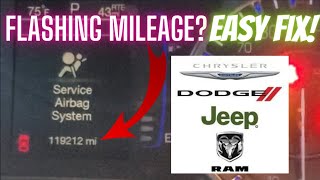
- Key symptoms are a loss of Bluetooth/VR functions and, most notably, a parasitic battery drain that can leave you stranded. A flashing odometer is also a key indicator.
- The fix is usually replacing the module, which is an easy DIY job located under the driver's side dash. Simply disconnecting the old module can be a temporary or permanent fix for the battery drain.
- Before replacing, check for software updates via a dealership, as a flash can sometimes resolve the issue per TSB 08-083-19, but this is less likely on a completely dead module.
What's Unique About the 2012-2017 Chrysler 300

On this generation of Chrysler 300 and its platform mates, the Hands-Free Module (HFM) is a notoriously common failure point. When it fails, it often doesn't just shut down; it can stay partially active, preventing other vehicle modules from going to 'sleep' when the car is off. This leads to a significant parasitic battery drain that can kill a battery overnight. The flashing odometer is another key symptom specific to FCA vehicles, indicating a 'proxy configuration mismatch'—the Body Control Module (BCM) detects that a module it expects to see on the network (the HFM) is missing, and flashes the odometer to signal the error.
Diagnostic Flowchart
Tap your situation to follow the diagnostic path that matches what you're seeing on this vehicle.
Symptoms You May Notice
- Bluetooth connectivity is lost or will not pair.
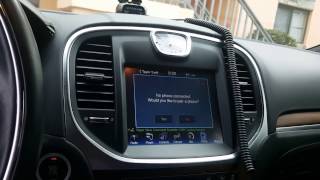
- Radio display stuck on "Hands-Free Module Loading" or "Please Wait".
- Voice Recognition (VR) button on the steering wheel does not respond.
- Unable to enter the 'Phone' screen on the radio.
- Flashing mileage on the odometer, which indicates a proxy alignment issue.
- Parasitic battery drain, leading to a dead battery after the car sits for a few hours 🎬 Watch: How to troubleshoot this specific parasitic battery drain or overnight.
- The HFM module itself may feel warm to the touch even after the vehicle has been off for an extended period, indicating it is not shutting down properly.
- Replacing the radio head unit when the separate, external Hands-Free Module is the actual point of failure.
- Replacing the battery multiple times without diagnosing the underlying parasitic draw caused by the faulty HFM.
- Replacing the alternator due to a dead battery, when the root cause is the HFM's parasitic drain.
Most Likely Causes

- Failed Hands-Free Module (HFM) 🔴 High Probability The internal electronics of the factory HFM are a known weak point across many Chrysler, Dodge, and Jeep models from this era, leading to widespread failures. The failure is so common that a market for refurbished modules exists.
How to confirm: The combination of U0197, loss of Bluetooth, and a parasitic battery drain is the strongest indicator. A parasitic draw test that shows a significant drop in amperage after disconnecting the HFM (or its fuse) confirms the diagnosis. A scan tool will also show the HFM as 'off the bus' or unresponsive.
Typical fix: Replace the Hands-Free Module. In many cases, simply disconnecting the faulty module will stop a battery drain issue until a replacement can be installed. After replacement, a 'Proxy Alignment' procedure may be needed to stop the odometer from flashing, though often it is not required if a compatible part is used.
Est. part cost: $150 - $800 - Software Glitch 🟡 Medium Probability Chrysler has issued multiple TSBs to address communication issues with the HFM that can sometimes be resolved with a software update.
How to confirm: A dealership technician using a wiTECH scan tool can check the current software version of the HFM against the latest available version referenced in TSBs. This is often the first step a dealer will take.
Typical fix: Reprogramming (flashing) the HFM with the latest software. This must be done at a dealership or a properly equipped independent shop using a specific process that may involve a special USB cable. However, if the module has failed internally, a software flash will not be possible or will not fix the issue.
Est. part cost: $0 - Wiring or Connector Issue ⚪ Low Probability
How to confirm: Visually inspect the wiring harness and connectors at the HFM for any signs of damage, corrosion, or loose pins. Use a multimeter to check for proper power and ground at the module's connector. Check the fuse for the HFM, often located in the trunk fuse panel (e.g., F23).
Typical fix: Repair the damaged wiring, clean/replace the connector, or replace a blown fuse.
Est. part cost: $5 - $50
Diagnosis Steps
- Scan the vehicle for all Diagnostic Trouble Codes (DTCs). Confirm U0197 is active or stored.
- Check for common symptoms: loss of Bluetooth, non-responsive VR buttons, flashing odometer, or a dead battery.
- To test for parasitic draw, connect a multimeter in series with the negative battery terminal. After allowing all modules to go to sleep (can take 5-30 minutes), observe the amperage draw. A reading significantly above 50mA (0.05A) is suspect. A draw of 1A or more is common with this issue.
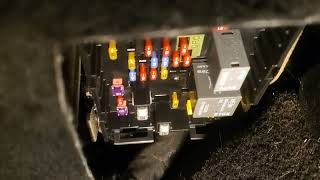
- While monitoring the draw, pull the fuse for the HFM (often labeled M12, F23, or similar in the trunk fuse box). If the amperage draw drops to a normal level (e.g., under 50mA), the HFM is confirmed as the source of the drain.
- Locate the Hands-Free Module. In the 2012-2017 Chrysler 300, it is mounted under the driver's side dashboard, to the left of the steering column, often on a metal bracket. 🎬 See this walkthrough for replacing the HFM on a 300C
- Inspect the module's electrical connectors for corrosion or damage. Disconnect the module and see if the battery drain stops.
- If you have access to a dealership-level scan tool (like wiTECH) or advanced aftermarket tools (like AlfaOBD), check if a software update is available per TSB 08-083-19 before replacing the module.
- If no software update is available, the module is unresponsive to the scan tool, or it's confirmed to be causing a parasitic draw, replace the Hands-Free Module.
- After replacement, if the odometer is flashing, a 'Proxy Alignment' procedure is required. This can be done by a dealer or with tools like AlfaOBD to make the BCM recognize the new module. 🎬 Watch: How to fix a flashing odometer with proxy alignment
Parts You'll Likely Need

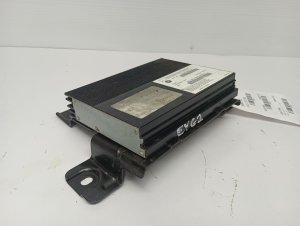
- Hands-Free Module (Telematics Module)
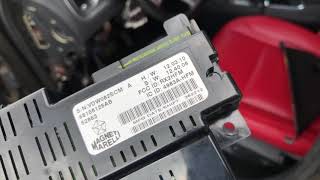
(OEM #68222278AA)— This module is the direct cause of the U0197 code and its associated symptoms. It fails internally, losing communication with the vehicle network and often causing a parasitic battery drain.
Trusted brands: Mopar
OEM price range: $750-$800
Aftermarket price range: $150-$250 (Used or Refurbished)
Technical Service Bulletins (TSBs) & Recalls
- 08-083-19: Flash: Hands Free Module (HFM) Software Enhancements
- 08-055-17 REV. A: Flash: Hands Free Module (HFM) Software Enhancements
- 08-112-14: Hands Free Module (HFM) Update
Platform-Specific Known Issues
- TSB #08-083-19 specifically calls out DTC U0197-00 and symptoms like loss of audio during a Bluetooth call, the HFM not booting properly, and the module being unresponsive. It recommends a software update as a potential fix.
- TSB #08-055-17 REV. A also notes U0197-00 with symptoms like the steering wheel VR button not working and being unable to access the phone screen on the radio.
- A very common owner complaint is a severe parasitic battery drain (often over 1 amp) caused by the failed module, which can kill a new battery in a day or two. Many owners simply disconnect the module as a permanent fix if they don't need Bluetooth.
- The flashing odometer symptom is a direct result of the HFM falling off the CAN bus network, requiring a 'Proxy Alignment' to resolve after a new module is installed.
Mechanic-Grade Diagnostic Values
- CAN Bus Network Resistance — expected: ~60 Ω (Ohms) between CAN_H and CAN_L pins at the DLC with the battery disconnected.. Failure: A reading of ~120 Ω indicates an open in the bus or one of the two terminating resistors is offline. A reading near 0 Ω indicates a short between the CAN_H and CAN_L wires.
- CAN Bus Voltage (at HFM connector) — expected: Key On, Engine Off: CAN_H (Pin D466) should be ~2.6V. CAN_L (Pin D467) should be ~2.4V.. Failure: Voltages that are identical, stuck high/low, or 0V indicate a bus wiring fault (short to power, ground, or together).
- HFM Power and Ground (at HFM connector) — expected: Key On: Pin A922 should have battery voltage (~12V). Pin Z911 should have less than 0.1V (good ground).. Failure: No voltage on the power pin indicates a blown fuse (check Fuse 10A) or open wire. High voltage on the ground pin indicates a bad ground connection at G911.
Hidden / Shadow Codes Worth Checking
- U0197-00: The '-00' suffix indicates 'No Sub Type Information'. This is the standard way for the module to report a general loss of communication without specifying a more detailed sub-fault, such as voltage issues. (see via Standard on most OEM and professional-level scan tools.)
Scan Tool Commands That Help

- AlfaOBD / wiTECH: Proxy Alignment — This procedure is required after replacing the Hands-Free Module (or any other module on the CAN bus) if the odometer is flashing. It synchronizes the vehicle's configuration, making the Body Control Module (BCM) recognize the new module and clearing the configuration mismatch error.
Wiring & Ground Locations

- HFM Connector — Under the driver's side dashboard, to the left of the steering column.. This is the main connection point for the module. Testing for power, ground, and CAN signals here is the most direct way to confirm if the module has what it needs to operate. Key pins are A922 (Power), Z911 (Ground), D466 (CAN+), and D467 (CAN-).
- G911 — Left side of the dash.. This is the designated ground point for the Hands-Free Module (via circuit Z911). A corroded or loose connection at this point will cause the module to lose power and stop communicating, setting a U0197 code.
- Fuse F23 (Trunk) / Fuse 10A — Trunk fuse panel or Interior Power Distribution Center.. TSB 08-083-19 calls for pulling fuse F23 in the trunk to reset the module during a software flash. A wiring diagram indicates the module's main power comes from a 10A fuse. Both should be checked if the module has no power.
- CAN Star Connector (CAN Hub) — In later models, this is located in the trunk, near the battery and rear fuse box area, often under a small cover.. This is a junction point where multiple modules on the same network connect. While rare, an internal failure or corrosion in this connector can disrupt the entire network, causing communication codes for multiple modules, including the HFM. It's a point to investigate if U0197 is present with other communication codes and the HFM itself seems fine.
Real Owner Repair Stories
- YouTube user 'brian freeman' (2012 Chrysler 300) — Radio screen stuck on loading message, no Bluetooth or voice recognition functionality.
❌ Tried (didn't work) Took vehicle to the dealership for diagnosis.
✅ What actually fixed it The dealership quoted approximately $600 to replace the Hands-Free Module. The owner purchased the part himself for around $135 and replaced it in under 30 minutes following a DIY procedure. He warns against buying used modules from eBay without a guarantee, as his first attempt was with a faulty used part. The new module was plug-and-play and resolved all symptoms.
OEM Part Supersession History
5091072AE, 5091072AF, 5091072AG, 5091072AH, 5091072AJ, 5091072AK, 68158125AA, 68158125AB, 68158125AC→68222278AA— Part revisions to address failure modes and component updates.
Heads up: Ensure the replacement module is compatible with your vehicle's model year range (e.g., 2012-2014 vs 2015+). Some parts may physically fit but have incorrect firmware for the Uconnect system in the vehicle.
Model Year Variations Within This Range
- 2012-2014: These pre-facelift models are the most common vehicles to experience the failure of the separate, external Hands-Free Module located under the driver's dashboard. TSBs and most online documentation refer to this specific configuration.
- 2015-2017: These facelift models received an updated Uconnect system. On some trims, especially those with navigation, the Hands-Free Module functionality is integrated directly into the radio head unit. In these cases, there is no separate external module to replace, and the radio itself is the point of failure.
Helpful Videos
We Have This Part in Stock



The information in this article is provided for general reference and educational purposes only. Vehicle specifications, procedures, and part compatibility can vary by production date, trim level, and region. Always consult your vehicle's factory service manual and verify part numbers before purchasing or performing repairs. Safety-critical components such as airbags, seat belts, and braking systems should be installed by a qualified professional.
- Chrysler 300:
- 🎬 Helpful Videos
- 🛍️ Shop This Part
- What's Unique About the 2012-2017 Chrysler 300
- Diagnostic Flowchart
- Symptoms You May Notice
- Most Likely Causes
- Diagnosis Steps
- Parts You'll Likely Need
- Technical Service Bulletins (TSBs) & Recalls
- Platform-Specific Known Issues
- Mechanic-Grade Diagnostic Values
- Hidden / Shadow Codes Worth Checking
- Scan Tool Commands That Help
- Wiring & Ground Locations
- Real Owner Repair Stories
- OEM Part Supersession History
- Model Year Variations Within This Range
- 🎟️ Get 5% Off