

OBD-II Code U0170: Lost Communication With Restraints System Sensor 'A'
The Ultimate 2026 Guide to Diagnosing and Fixing U0170
- Code U0170 completely disables your vehicle's airbag system, meaning airbags will not deploy in a crash.
- On General Motors vehicles, this code almost exclusively points to a failed Passenger Presence Module under the passenger seat, not a front impact sensor.
- Always disconnect the negative battery terminal and wait 15 minutes before touching any yellow-wrapped SRS connectors to prevent accidental airbag deployment.
- A standard $20 OBD-II code reader cannot read or clear U0170; you must use an SRS-capable scanner to diagnose and reset the system.
- Before buying a $300 replacement sensor, check the wiring harness for corrosion or unplugged connectors, which cause over 50% of U0170 faults.
What Does U0170 Mean?

Code U0170 indicates a communication failure between the main Restraint Control Module (RCM) and Restraints System Sensor 'A'. When this connection drops, the system disables the airbags as a failsafe and illuminates the dashboard warning light.
Technical definition: The SAE/OBD-II definition for U0170 is "Lost Communication With Restraints System Sensor 'A'". This means the Restraint Control Module failed to receive data from the designated satellite acceleration sensor. On most modern General Motors vehicles, this code specifically translates to "Lost Communication with Passenger Presence Module".
Can I Drive With U0170?
No — Do Not Drive. Driving with code U0170 means your vehicle's entire airbag system is disabled. Airbags will NOT deploy in a collision. The vehicle is unsafe for occupants until this critical safety issue is repaired.
Common Causes

- Damaged, Corroded, or Unplugged Wiring (Very Common) — Wiring harnesses routed in vulnerable areas like the front radiator support or under passenger seats suffer physical damage, moisture corrosion, or get kicked loose. A connector left unplugged after a previous repair is also a frequent culprit.
- Failed Passenger Presence Module (PPM) / OCS Mat (Common) — On GM, Hyundai, and Subaru vehicles, the pressure-sensitive mat inside the passenger seat cushion fails. This prevents the system from detecting occupant weight, triggering a communication fault.
- Faulty Front Impact Sensor 'A' (Common) — The physical crash sensor fails internally due to age, moisture intrusion, or front-end impact damage, stopping all signal transmission to the control module.
- Latched Crash Data from Prior Accident (Common) — After an accident, the main SRS module stores permanent 'crash data' that standard scanners cannot clear. This manifests as a persistent communication code even after replacing damaged sensors.
- Low Battery Voltage or Poor Ground (Less Common) — Airbag modules require precise voltage. A weak battery, failing alternator, or corroded ground wire causes voltage drops that interrupt CAN bus network communication.
- Faulty Restraints Control Module (RCM) (Less Common) — The main airbag computer fails due to internal circuit board degradation, software corruption, or water intrusion.
- Blown SRS/OCS Fuse (Rare) — A blown dedicated fuse cuts power to the SRS or OCS modules, resulting in a total loss of communication.
Symptoms

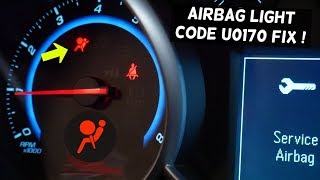
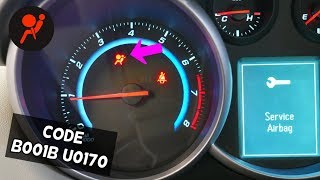
- Airbag Warning Light On — The dashboard airbag icon or 'SRS' light remains permanently illuminated or flashes.
- SRS Disabled Message — The driver information center displays 'Service Airbag System' or 'Passenger Airbag Off'.
- Erratic Passenger Airbag Indicator — The passenger airbag status light stays on or off regardless of whether someone occupies the seat. 🎬 Watch: How to perform a passenger presence system re-zero calibration.
- Airbags Will Not Deploy (scan-tool only — no driver-felt sign) — The entire supplemental restraint system is inactive and provides zero protection in a collision.
Diagnostic Flowchart

Tap your situation to follow the diagnostic path that matches what you're seeing on this code.
Common Fixes & Costs
- Repair Damaged Wiring or Clean Connectors — Parts: $5-$25, Labor: $125-$300, ~1.5 hr book time (Intermediate)
- Replace Passenger Presence Module / OCS Sensor Mat — Parts: $250-$800, Labor: $150-$400, ~2.5 hr book time (Professional Only)
- Replace Faulty Impact Sensor 'A' — Parts: $120-$300, Labor: $75-$150, ~1.0 hr book time (Intermediate)
- Recalibrate Occupant Classification System — Parts: $0, Labor: $100-$250, ~1.0 hr book time (Professional)
- Replace SRS/Restraints Control Module — Parts: $700-$1500, Labor: $200-$400, ~1.5 hr book time (Professional Only)
DIY vs Professional
- Repair Damaged Wiring or Clean Connectors — Beginner:
Tools: Multimeter, wire strippers, solder, heat shrink tubing, contact cleaner. - Replace Faulty Impact Sensor 'A' — Beginner:
Tools: Socket set, torque wrench, SRS-capable OBD-II scanner. - Replace Passenger Presence Module / OCS Sensor Mat — Beginner:
Tools: Upholstery tools, OEM-level scan tool. - Replace SRS/Restraints Control Module — Beginner:
Tools: OEM-level scan tool for programming.
Used vs. New Parts: Buying Guide
When a used part is worth it: Never buy used electronic SRS components. The only acceptable used part is a replacement wiring pigtail connector.
Donor-vehicle mileage cap: roughly under 10000 miles for the part to have meaningful remaining life.
Donor quality checklist:
- Verify the donor vehicle was not in an accident.
- Avoid parts from flood-damaged vehicles.
Decision logic:
- If The part is an electronic sensor, module, or OCS mat → Always buy new OEM. The safety risk of a compromised used part is too high.
- If The part is a wiring pigtail → A used connector from a reputable recycler is acceptable if a new one is unavailable.
Warranty tradeoff: Used SRS components have a 30-day warranty at best. New OEM parts carry warranties from 1 year to a lifetime.
Worst-case if a used part fails: $500-2000+. If a used module fails, you pay for repeat labor, a new part, and reprogramming. The worst-case scenario is the part failing during a collision.
What Happens If You Wait — Timeline
- Immediately: Code U0170 sets, the airbag warning light illuminates, and the entire SRS system disables. Airbags will NOT deploy in a crash. (MPG impact: 0%% · Added cost: $0)
- First State Inspection: The vehicle fails annual safety inspections in strict states (e.g., Virginia, New York), preventing registration renewal. (MPG impact: 0%% · Added cost: $50 - $250 in fines and re-inspection fees.)
- At Time of Sale/Trade-in: An active airbag light flags the car as a major safety risk. Dealerships slash trade-in offers by 20-40%. (MPG impact: 0%% · Added cost: $1500 - $4000+ in lost resale value.)
Cost of Not Fixing It
- Immediately: Total loss of airbag system functionality. Airbags and seatbelt pretensioners will NOT deploy in an accident. (Added cost: N/A)
- During Ownership: Inability to pass state safety inspections, preventing vehicle registration renewal. (Added cost: $100 - $500 in fines or re-inspection fees)
- At Resale: Significantly reduced vehicle trade-in value. Dealerships heavily penalize active safety system faults. (Added cost: $1500 - $3000+)
Diagnosis Steps
- Read and Record All Codes
Use an SRS-capable OBD-II scanner to read the Restraint Control Module. Record U0170 and any accompanying codes (e.g., U0171, B0081). Clear the codes to see which return immediately.
Tools: Advanced OBD-II Scanner (SRS capable) (Beginner) - Check SRS Fuses
Locate the fuses for the SRS, RCM, or OCS module in the interior and under-hood fuse boxes. Test them with a multimeter. Replace any blown fuses and re-scan.
Tools: Owner's Manual, Multimeter, Fuse Puller (Beginner) - Locate Sensor and Visually Inspect Wiring
For Chrysler/Dodge, locate the front satellite sensor on the radiator support. For GM, locate the Passenger Presence Module under the passenger seat. Inspect the connector and harness for corrosion, pinched wires, or improper seating.
Tools: Flashlight, Repair Manual (Intermediate) - Disconnect Battery and Reseat Connectors
CRITICAL: Disconnect the negative battery terminal and wait 15 minutes for the SRS backup power to discharge. Unplug the sensor connector, inspect pins for green corrosion, and reconnect it firmly until it clicks. Reconnect the battery and re-scan.
Tools: Wrench Set, Safety Glasses (Intermediate) - Test Power and Ground at the Sensor
With the battery reconnected and ignition on, back-probe the sensor's power wire. It must read 11.5V to 12.5V. With the battery disconnected, test the ground wire for continuity to the chassis. High resistance indicates a broken ground.
Tools: Multimeter, Back-probe Kit, Wiring Diagram (Advanced) - Test the CAN Bus Network
With the battery disconnected, measure resistance between CAN High and CAN Low at the DLC. It should read 60 Ohms. A reading of 120 Ohms indicates a broken communication wire or missing terminating resistor.
Tools: Multimeter, Wiring Diagram (Advanced) - Perform Oscilloscope Waveform Analysis
Connect an oscilloscope to the CAN High and Low lines. With the ignition on, verify a clean, mirrored square wave pattern. A flat line or heavy distortion confirms a hard network failure.
Tools: Oscilloscope, Back-probe Kit, Wiring Diagram (Professional)
When This Code Triggers (Freeze-Frame Conditions)
- System State: Key-On Self-Test (The SRS module performs a self-check of all components immediately after the ignition turns on.)
- System Voltage: 10.5V - 14.5V (The code sets if voltage drops during the self-test, interrupting module communication.)
- Code Status: Current / Active (Indicates the communication loss is happening right now, rather than an intermittent history code.)
Related Codes
- U0171 — U0170 is Sensor 'A' (left), while U0171 is Sensor 'B' (right). Both codes together indicate a shared harness fault or a failed Restraints Control Module.
- B0081 — On GM vehicles, B0081 confirms the U0170 fault is isolated to the Passenger Presence Module in the passenger seat.
- U0001 — Indicates a total High Speed CAN Bus failure. U0170 is merely a symptom of this larger network crash.
- B0074 — Points directly to the passenger seat sensor mat on Subaru and Hyundai vehicles, confirming the cause of the U0170 communication loss.
Climate & Environmental Factors
- High Humidity and Road Salt: Moisture and salt rapidly corrode the exposed wiring and connector pins of front impact sensors on Dodge and Chrysler vehicles, interrupting the communication signal.
- Cabin Water Intrusion: Water leaking from bad window seals or clogged sunroof drains pools under carpets, destroying floor-mounted SRS modules and under-seat connectors.
How to Talk to a Mechanic About This Code
Say this: "I have an airbag light on and my scanner shows code U0170. On my [Make/Model], I understand this usually points to the [Passenger Presence Module / Front Impact Sensor]. Can you please start by inspecting the wiring and connectors before quoting a full module replacement?"
This signals you understand the manufacturer-specific nature of the code and directs the technician toward the most common, cheapest failure point.
Avoid saying:
- 'My airbag light is on, can you just fix it?'
- 'I think I need a new airbag sensor.'
- 'Just do whatever it takes to turn the light off.'
Questions to ask before authorizing the repair:
- Did you test for power and ground at the sensor connector?
- Was the connector loose or were the pins corroded?
- Does the new part require calibration, and is that cost included in the quote?
Where to Take It: Dealer vs Independent vs Chain
- Dealer:
Recommended if the fix requires OCS calibration or SRS module programming. They have the proprietary software to do it right.
Best for: Vehicles under warranty or with a related recall., Repairs requiring OCS/Passenger Presence Module calibration., Main SRS module replacements requiring VIN programming.
Downsides: Highest labor rates and part costs., Defaults to replacing entire assemblies rather than repairing wiring. (Typical cost: +50% vs. baseline) - Independent Shop:
Good fit for initial diagnosis and common fixes like wiring repair. Verify they have an SRS-capable scan tool.
Best for: Out-of-warranty vehicles where the cause is likely wiring or a simple sensor swap.
Downsides: May lack the expensive, brand-specific tools to perform OCS calibration. (Typical cost: +0% vs. baseline) - Chain Shop:
AVOID. This is a critical safety system fault requiring specialized knowledge beyond a chain shop's scope.
Best for: Simple maintenance like oil changes or tires.
Downsides: Not equipped for complex electronic or safety system diagnostics., High risk of misdiagnosis. (Typical cost: -10% vs. baseline)
When to Walk Away From the Repair
If the estimated repair cost for the U0170 code exceeds 40% of your car's current private-party market value, seriously consider selling the car as-is.
- Car worth $3500, fix is $1500: Walk away. The repair cost is over 40% of the car's value.
- Car worth $15000, fix is $1200: Fix it. The repair is less than 10% of the vehicle's value and restores safety.
- Car worth $2500, fix is $800: Borderline. The repair is 32% of the car's value. Get a second opinion to confirm the diagnosis.
What Scan Tool You Need for This Code
Minimum: A scanner that reads and clears Supplemental Restraint System (SRS) / Airbag codes.
A standard $20 engine code reader cannot see SRS codes and falsely reports 'No Codes Found'. Diagnosing U0170 requires an SRS-capable scanner.
Budget: Autel AutoLink AL619 (~$90) — Reads and clears engine, ABS, and SRS codes. It confirms the U0170 code and allows you to clear it after a repair.
Mid-range: BlueDriver Pro (~$120) — Connects to your smartphone, provides SRS code reading/clearing, and offers repair reports based on a database of verified fixes.
Professional: Autel MaxiCOM MK808S (~$350) — Offers bidirectional control to test components and includes special functions like basic OCS resets essential for post-repair procedures.
Rent vs buy: Auto parts store loaner tools are basic engine readers and CANNOT read SRS codes. Buying a budget SRS-capable scanner is a mandatory investment for this repair.
How to Clear the Code After You Fix It
- Ensure the physical repair is complete and all connectors are seated.
- Reconnect the negative battery terminal.
- Connect an SRS-capable OBD-II scan tool.
- Select 'Clear Codes' within the Restraint Control Module menu.
- Cycle the ignition off, then on. The airbag light should illuminate for 5 seconds and turn off permanently.
Drive cycle (~5 minutes): An SRS fault does not require a driving cycle. A simple key-off, key-on cycle confirms the fix. If the light stays off after the 5-second self-test, the repair is successful.
Readiness monitors affected: None
Watch out for:
- Using a basic engine code reader that cannot communicate with the SRS module.
- Forgetting to manually clear the code; the airbag light remains on even if the hardware is fixed.
- Failing to wait 15 minutes after disconnecting the battery before starting repairs.
Will This Fail Emissions / State Inspection?
No — by itself this code doesn't fail OBD inspection (but it can keep readiness monitors from setting, which causes a separate fail).
- California: An airbag light does not fail the smog check, but fails separate safety inspections required for certain vehicle transactions.
- New York: An illuminated airbag warning light is noted as an advisory during the safety inspection but is NOT a cause for failure.
- Texas: An illuminated airbag light is NOT a cause for failure during the annual safety inspection.
- Virginia: An illuminated airbag light IS an automatic failure of the state safety inspection. The vehicle cannot be legally driven.
Most Commonly Affected Vehicles
- Dodge Journey (2009-2019) — Highly prone to U0170 due to vulnerable front satellite acceleration sensors mounted on the radiator support.
- Dodge Dart (2013-2016) — Frequently suffers communication failures with the front left/right crash sensors.
- Chrysler 200 (2012-2017) — The wiring harness connector for the front left crash sensor is a known failure point.
- Chevrolet / GMC Silverado / Sierra (2007-2018) — U0170 almost exclusively means 'Lost Communication with Passenger Presence Module'. The issue is the under-seat connector or sensor mat.
- Chevrolet Cruze (2011-2016) — Points to the Passenger Presence Module. Often accompanied by code B0081.
- Hyundai Sonata (2006-2008) — Subject to NHTSA Campaign 08V161000 for Occupant Classification System (OCS) failures.
- Subaru Outback / Forester (2015-2022) — Subject to recalls and warranty extensions (WRA-24) for defective ODS sensors in the passenger seat.
- Jeep Wrangler (JK) (2007-2018) — Experiences intermittent U0170 codes traced to front sensor wiring stressed by off-road use.
Manufacturer-Specific Notes
- General Motors (Chevrolet/GMC/Buick/Cadillac): U0170 does NOT refer to a front impact sensor. It specifically means 'Lost Communication with Passenger Presence Module'. The problem is a bad connection under the passenger seat or a failed sensor mat.
- Chrysler/Dodge/Jeep: U0170 refers to the front-left satellite acceleration sensor. The cause is almost always a corroded connector at the sensor on the front radiator support.
- Subaru: Uses a highly sensitive electrostatic capacitance sensor in the passenger seat. Placing wet items or electronic devices (like laptops) on the seat triggers ODS faults and communication codes.
Real Owner Stories
2015 Dodge Dart - Unplugged Connector
The airbag light illuminated with codes U0170 and U0171 after the owner performed front-end maintenance.
Outcome: Both front impact sensor connectors were found unplugged. Reconnecting them and clearing the codes resolved the issue instantly.
Lesson: If a code appears immediately after a repair, check for forgotten connectors. Always disconnect the battery for 15 minutes before handling airbag components.
2016 Chevy Volt - Expensive Seat Module Failure
The 'Service Airbag' warning stayed on for a year with code U0170. A dealership quoted $1,200 for a bad passenger presence module.
Outcome: The owner declined the repair, but the vehicle's trade-in value dropped by $2,000 due to the active airbag light.
Lesson: On GM vehicles, U0170 almost always points to the passenger seat system. If reseating the connector fails, the sensor mat requires expensive replacement and calibration.
2016 Dodge Grand Caravan - Reversed Wiring Polarity
A post-accident vehicle had a persistent U0171 code despite a shop installing a brand-new front impact sensor.
Outcome: The repair shop used a pigtail connector with reversed pinout polarity. Swapping the pins restored communication and fixed the code.
Lesson: After an accident, verify wiring polarity and continuity. Replacing parts will not fix a compromised wiring harness.
How to Prevent This Code From Triggering
- Address Cabin Water Leaks Immediately (As needed) — Water pooling under carpets from clogged sunroof drains destroys floor-mounted SRS modules and under-seat connectors.
- Keep the Under-Seat Area Clear (Daily habit) — Shoving items under the passenger seat damages wiring or dislodges the Passenger Presence Module connector, instantly causing a U0170 fault.
- Avoid Placing Wet Items on the Passenger Seat (Daily habit) — Moisture ruins the sensitive Occupant Classification System (OCS) sensor mat inside the seat cushion.
Frequently Asked Questions
Can I reset the airbag light myself for a U0170 code?
No. Even after fixing the root cause, the airbag light remains on until cleared from the Restraints Control Module. You must use an SRS-capable OBD-II scanner to erase the fault.
Is it safe to work on the airbag system at home?
Working on the airbag system is dangerous if proper procedures are ignored. Always disconnect the negative battery terminal and wait 15 minutes for the capacitors to discharge before touching any yellow SRS connectors. This prevents accidental deployment and severe injury.
What is a Satellite Acceleration Sensor?
It is a small crash sensor mounted on the vehicle's frame, typically near the radiator support. It measures rapid deceleration during a collision. The main airbag computer uses this data to determine when and how forcefully to deploy the airbags.
What is a Passenger Presence Module?
Also called an Occupant Classification System (OCS), this is a weight-sensing mat inside the passenger seat cushion. It tells the airbag computer whether the seat holds an adult, a child, or is empty. This ensures the passenger airbag only deploys when safe.
Is there a recall for code U0170?
There is no universal recall for code U0170, but manufacturers frequently recall the components that cause it. For example, Hyundai and Subaru have issued major recalls for faulty OCS sensors. Always check your specific VIN on the NHTSA website for active safety recalls.
I replaced the sensor but the U0170 code is still there. What now?
If a new sensor does not fix the code, the wiring harness has a break or short circuit. Alternatively, the main SRS module may have latched crash data from a previous accident. Latched crash data requires a specialist service to clear and cannot be erased with a standard scanner.
My airbag light is on but my scanner finds no codes. What does that mean?
This means your scanner cannot read SRS data. Standard engine code readers only access the powertrain control module and will falsely report zero codes. You must use an advanced scanner capable of communicating with the Restraints Control Module.
Key Takeaways
- Code U0170 completely disables your vehicle's airbag system, meaning airbags will not deploy in a crash.
- On General Motors vehicles, this code almost exclusively points to a failed Passenger Presence Module under the passenger seat, not a front impact sensor.
- Always disconnect the negative battery terminal and wait 15 minutes before touching any yellow-wrapped SRS connectors to prevent accidental airbag deployment.
- A standard $20 OBD-II code reader cannot read or clear U0170; you must use an SRS-capable scanner to diagnose and reset the system.
- Before buying a $300 replacement sensor, check the wiring harness for corrosion or unplugged connectors, which cause over 50% of U0170 faults.
Helpful Videos

The information in this article is provided for general reference and educational purposes only. Vehicle specifications, procedures, and part compatibility can vary by production date, trim level, and region. Always consult your vehicle's factory service manual and verify part numbers before purchasing or performing repairs. Safety-critical components such as airbags, seat belts, and braking systems should be installed by a qualified professional.
- 🎬 Helpful Videos
- What Does U0170 Mean?
- Can I Drive With U0170?
- Common Causes
- Symptoms
- Diagnostic Flowchart
- Common Fixes & Costs
- DIY vs Professional
- Used vs. New Parts: Buying Guide
- What Happens If You Wait — Timeline
- Cost of Not Fixing It
- Diagnosis Steps
- When This Code Triggers (Freeze-Frame Conditions)
- Related Codes
- Climate & Environmental Factors
- How to Talk to a Mechanic About This Code
- Where to Take It: Dealer vs Independent vs Chain
- When to Walk Away From the Repair
- What Scan Tool You Need for This Code
- How to Clear the Code After You Fix It
- Will This Fail Emissions / State Inspection?
- Most Commonly Affected Vehicles
- Manufacturer-Specific Notes
- Real Owner Stories
- 2015 Dodge Dart - Unplugged Connector
- 2016 Chevy Volt - Expensive Seat Module Failure
- 2016 Dodge Grand Caravan - Reversed Wiring Polarity
- How to Prevent This Code From Triggering
- Frequently Asked Questions
- Can I reset the airbag light myself for a U0170 code?
- Is it safe to work on the airbag system at home?
- What is a Satellite Acceleration Sensor?
- What is a Passenger Presence Module?
- Is there a recall for code U0170?
- I replaced the sensor but the U0170 code is still there. What now?
- My airbag light is on but my scanner finds no codes. What does that mean?
- Key Takeaways
- 🎟️ Get 5% Off