

OBD-II Code U0154: Lost Communication With Restraints Occupant Classification System Module
The Ultimate 2026 Guide to Meaning, Diagnosis, and Repair Costs
- Code U0154 disables the passenger airbag due to a communication failure with the seat sensor, creating an immediate safety hazard.
- A loose or corroded wiring connector under the passenger seat causes over 70% of U0154 faults and costs under $20 to clean and secure.
- Never allow passengers to ride in the front seat while this code is active, as the airbag will not deploy in a frontal collision.
- Replacing a failed OCS module costs between $600 and $1,600 because it requires a new sensor mat and mandatory dealer-level software calibration.
What Does U0154 Mean?

Code U0154 means your vehicle's Restraints Control Module (RCM) lost connection to the Occupant Classification System (OCS) module. The OCS module uses a pressure-sensitive mat in the passenger seat to weigh the occupant and determine if the airbag should deploy in a crash. When communication drops, the system defaults to disabling the passenger airbag to prevent improper deployment.
Technical definition: The SAE/OBD-II definition is "Lost Communication With Restraints Occupant Classification System Module". The OCS module stopped sending or receiving CAN bus network signals for a specific duration, typically 2.5 to 5 seconds depending on the manufacturer.
Can I Drive With U0154?
Yes, But With Caution. You can drive the vehicle, as the code does not affect engine performance. However, the passenger airbag system is disabled as a fail-safe. In a crash, the passenger airbag will not deploy. Do not carry passengers in the front seat until this fault is repaired.
Common Causes

- Damaged or loose wiring under the passenger seat (Very Common) — This is the most frequent cause. Wires under the passenger seat get kicked, stretched from seat movement, or snagged by objects stored under the seat (like umbrellas or bottles). Moisture from spilled drinks also corrodes the connector pins.
- Low battery voltage or recent power loss (Common) — A weak battery or a recent jump-start causes communication modules to glitch and fail their power-on self-test. If the module fails to 'wake up' correctly, it won't join the network and flags as offline.
- Faulty Occupant Classification System (OCS) module (Less Common) — The module itself fails internally due to electrical surges, water damage, or component degradation, requiring a full replacement and recalibration.
- Blown fuse for the OCS/SRS system (Less Common) — A short circuit or overload blows the OCS module's power fuse, instantly cutting power and dropping the module from the communication network.
- Damage from previous collision repair (Uncommon) — If the vehicle was in a prior accident, body shops sometimes fail to properly re-secure or repair SRS wiring harnesses, leading to intermittent connection issues months later.
- Aftermarket accessory interference (Uncommon) — Improperly installed remote starters, alarms, or audio equipment introduce noise or voltage drops onto the CAN bus network, causing communication dropouts.
- Corrupted module software (Rare) — The firmware on the OCS module becomes corrupted, often after an interrupted over-the-air update or voltage spike, requiring a dealer re-flash.
- Failed CAN bus termination resistor (Rare) — The CAN bus network relies on two 120-ohm terminating resistors. If one fails, it alters the entire network's resistance and disrupts communication across multiple modules.
Symptoms

- Airbag / SRS warning light is on — The primary dashboard indicator for the airbag system stays lit or flashes continuously.
- Passenger airbag 'OFF' light is illuminated — The center console indicator shows the passenger airbag is disabled, even when an adult occupies the seat.
- Warning message on the instrument cluster — The driver information center displays "Service Airbag System" or "Passenger Airbag Disabled".
- Audible chime on startup — A warning chime sounds alongside the airbag light when starting the engine.
- Incorrect seatbelt reminder status — The system fails to detect a passenger, disabling the seatbelt reminder chime for that seat.
Diagnostic Flowchart

Tap your situation to follow the diagnostic path that matches what you're seeing on this code.
Common Fixes & Costs
- Repairing wiring or cleaning connector under the passenger seat — Parts: $0-$20, Labor: $125-$250, ~1.5 hr book time (Intermediate)
- Replacing a blown fuse — Parts: $1-$5, Labor: $0-$50, ~0.1 hr book time (DIY)
- Replacing the Occupant Classification System (OCS) module/sensor — Parts: $400-$1200, Labor: $200-$400, ~2.5 hr book time (Professional)
- Reprogramming the OCS module — Parts: $0, Labor: $150-$300, ~1.5 hr book time (Professional)
- CAN bus network diagnosis and repair — Parts: $10-$100, Labor: $250-$800, ~3.0 hr book time (Professional)
Used vs. New Parts: Buying Guide
When a used part is worth it: Buying a used Occupant Classification System module is strongly discouraged. The safety risks and programming hurdles outweigh the cost savings.
Donor-vehicle mileage cap: roughly under 20000 miles for the part to have meaningful remaining life.
Donor quality checklist:
- A used module has an unknown history and may have internal impact or water damage.
- Modern SRS components are VIN-locked to the original vehicle and cannot be reprogrammed.
- There is a high risk of purchasing a deployed or improperly salvaged part.
Decision logic:
- If The part is a safety-critical electronic module like an OCS or airbag controller. → Buy a new OEM part from a reputable dealer to guarantee it functions and can be properly calibrated.
- If You are considering a used OCS module to save money. → Reconsider. The part is likely VIN-locked and non-functional in your car, wasting both time and money.
Warranty tradeoff: Used salvage parts carry a 30-day warranty covering only the part, not the expensive labor or programming fees. New OEM parts installed by a dealer carry a full parts and labor warranty.
Worst-case if a used part fails: $1500 (Cost of the non-functional used part plus repeated labor and diagnostic fees before ultimately buying the required new part).
What Happens If You Wait — Timeline
- 0-3 months: Fault is intermittent. The airbag light comes on after hitting a bump and turns off on the next ignition cycle due to a loose pin. (MPG impact: 0%% · Added cost: $0)
- 3-6 months: Fault becomes permanent. The airbag light stays on continuously. The passenger airbag is permanently disabled. (MPG impact: 0%% · Added cost: $0-$50)
- 6-12 months: Severe corrosion destroys the connector pins, making a simple cleaning impossible. A chafed wire shorts to ground. (MPG impact: 0%% · Added cost: $250-$800)
- Immediate upon collision: Catastrophic safety failure. The passenger airbag will not deploy, dramatically increasing the risk of serious injury or death. (MPG impact: 0%% · Added cost: N/A (Irreversible safety risk))
Cost of Not Fixing It
- Immediate: The passenger-side front airbag is disabled. In a frontal collision, it will not deploy, drastically increasing the risk of serious injury or fatality for a front-seat passenger. (Added cost: N/A (Safety Risk))
- 0-6 Months: A simple intermittent fault caused by a loose connector becomes permanent. Continued vibration and moisture exposure irreparably damages the wiring harness or module pins. (Added cost: $200 - $800)
- 6+ Months / Long-Term: The vehicle fails state safety inspections. In an accident, evidence of a long-ignored safety system fault creates complex insurance liability issues. (Added cost: Potential for denied insurance claims.)
Diagnosis Steps

- Read All Trouble Codes
Use an OBD-II scanner capable of reading SRS/Airbag codes. Confirm U0154 is present. If multiple U-codes exist across different systems (like U0100, U0142), you have a larger CAN bus network issue, not an isolated OCS problem.
Tools: SRS-capable OBD-II Scanner (Beginner) - Inspect and Wiggle Under-Seat Wiring
Remove any items stored under the passenger seat. Inspect the yellow SRS wiring harness and connectors for pinched wires, stretched cables, or corrosion. With the ignition on (engine off), gently wiggle the harness while watching the airbag light. If the light flickers, you have an intermittent connection.
Tools: Flashlight (Beginner) - Check Battery Health & System Voltage
Test the battery voltage. It must read 12.2V-12.6V with the engine off, and 13.7V-14.8V with the engine running. A weak battery causes communication errors during vehicle startup.
Tools: Multimeter (Beginner) - Check Fuses
Locate the fuse for the Occupant Classification System (OCS) or Supplemental Restraint System (SRS) in the owner's manual. Pull the fuse and test it for continuity.
Tools: Owner's Manual, Fuse Puller, Multimeter (Intermediate) - Test Power and Ground at the OCS Module
Disconnect the battery for 30 minutes. Unplug the OCS module connector. Reconnect the battery and turn the ignition ON. Verify the module receives 12V+ on the power pin and has less than 0.5 ohms of resistance to chassis ground.
Tools: Multimeter, Vehicle-specific Wiring Diagram (Advanced) - Check Live Data PIDs
Using a bidirectional scanner, access the OCS module's live data. Look for occupant weight and sensor status. If the module is offline, you cannot access this data. If accessible but values are frozen, the sensor mat has failed.
Tools: Bidirectional Scan Tool (Advanced) - Check CAN Bus Network Resistance
Disconnect the battery and wait 3 minutes. Measure resistance between CAN High and CAN Low at the OBD-II port (pins 6 and 14). A healthy network reads 60 ohms. A reading of 120 ohms indicates a broken wire or faulty terminating resistor.
Tools: Multimeter (Advanced) - PRO TIP: Check CAN Bus Voltages (Live Test)
With the ignition on, backprobe the CAN High and CAN Low lines at the OCS module. CAN High fluctuates around 2.6-3.5V; CAN Low sits around 1.5-2.4V. A line stuck at 0V indicates a short to ground.
Tools: Multimeter, Backprobe Kit, Wiring Diagram (Pro Level) - PRO TIP: Use an Oscilloscope for Signal Analysis
Connect an oscilloscope to CAN High and Low to view the signal waveform. Look for a clean, mirrored square wave. Signal dropouts or distorted waveforms point to complex network noise a multimeter cannot detect.
Tools: Oscilloscope, Probes (Pro Level) - ADVANCED: Perform Zero Point Calibration
If the module or seat is replaced, perform a 'Zero Point Calibration' using a dealer-level scan tool. This resets the baseline for an empty seat. Failure to calibrate results in permanent OCS codes.
Tools: Dealer/Professional Scan Tool (Professional)
When This Code Triggers (Freeze-Frame Conditions)
- System Voltage: 10.0V - 16.0V (Sets during startup when module voltage is critical for a successful self-test and network handshake.)
- Ignition Status: ON (Run) (The fault is checked continuously when the ignition is on.)
- Time Since Ignition On: > 2.5 seconds (Triggers after the main SRS module fails to receive a signal from the OCS module for a set period (e.g., 2.5 seconds on Mitsubishi, 5 seconds on Toyota).)
- Module Communication Status: No Response / Timeout (A scan tool shows the OCS module is 'offline' or not responding to network requests.)
Related Codes
- U0155 — 'Lost Communication With Instrument Panel Cluster'. Seeing U0154 and U0155 together points to a broader CAN bus network failure rather than an isolated seat sensor issue.
- U0100 — 'Lost Communication with ECM/PCM'. Paired with U0154, this confirms a network-wide problem affecting the entire vehicle, likely a main CAN bus wiring break or gateway module failure.
- B00A0 — 'Occupant Classification System'. This 'B' code points to an internal hardware fault within the OCS system. Seeing both codes strongly suggests the OCS module itself has failed.
- U0001 — 'High Speed CAN Communication Bus'. A generic code confirming a fault on the main communication network, reinforcing the need to diagnose CAN bus wiring and termination.
Climate & Environmental Factors
- High Humidity and Moisture: Moisture from wet climates, road salt spray, or spilled drinks seeps into unsealed connectors under the seat. This corrodes pins, increases electrical resistance, and disrupts sensitive data signals.
- Extreme Temperature Fluctuations: Cycles of hot and cold cause plastic connector housings and metal pins to expand and contract. Over time, this forces electrical pins to loosen or 'back out' of the connector.
- Vibration: Constant road vibration slowly works connectors loose, especially if improperly seated during assembly. Vibration also causes wires to chafe against sharp seat frame edges.
How to Talk to a Mechanic About This Code
Say this: "I have an airbag light on and my scanner shows code U0154, 'Lost Communication with the Occupant Classification System Module.' Please start by thoroughly inspecting the wiring and connectors under the passenger seat for damage or corrosion before recommending any module replacements."
This directs the technician to start with the most likely and least expensive potential fix (wiring), preventing them from immediately quoting a costly module replacement.
Avoid saying:
- 'My airbag light is on, can you fix it?'
- 'I have a U0154 code, just replace the sensor.'
- 'Do whatever you think is necessary.'
Questions to ask before authorizing the repair:
- Did you perform a 'wiggle test' on the under-seat harness, and what were the results?
- Did you test for power, ground, and CAN bus signals at the OCS module connector itself?
- If you are recommending a module replacement, what specific tests ruled out a wiring issue?
- Does the quoted price for a module replacement include the mandatory VIN programming and Zero Point Calibration?
Where to Take It: Dealer vs Independent vs Chain
- Dealer:
Recommended if a module replacement and programming is required, or for recall-related service.
Best for: Vehicles under warranty or with an active recall., When a module replacement is confirmed, as they have the tools for programming and calibration., Complex software-related issues or TSBs.
Downsides: Highest labor rates., May be quicker to recommend module replacement over detailed wiring diagnostics. (Typical cost: +50% vs. baseline) - Independent Shop:
Best starting point. A good independent shop resolves the most common causes (wiring) for the lowest cost.
Best for: Initial diagnosis and inspection., Repairing wiring, cleaning connectors, or tracing CAN bus faults., Cost-effective diagnosis before committing to expensive parts.
Downsides: Quality varies greatly; choose a shop with a reputation for electrical diagnostics., May lack OEM-specific tools for programming, requiring a second trip to a dealer. (Typical cost: +0% vs. baseline) - Chain Shop:
AVOID. This is a safety-critical system beyond the scope of most chain repair shops.
Best for: Not recommended for this type of repair.
Downsides: Technicians lack specialized training for SRS and network diagnostics., High risk of misdiagnosis leading to unnecessary part recommendations. (Typical cost: -10% vs. baseline)
When to Walk Away From the Repair
If the estimated repair cost for a major failure (like OCS module replacement) exceeds 40-50% of your car's private-party value, evaluate your options.
- Car worth $10000, fix is $1600: Fix it. The repair cost is reasonable and restores a critical safety feature.
- Car worth $4000, fix is $1800: Borderline. Get a second opinion to confirm a module replacement is truly needed. If so, consider selling the car 'as-is'.
- Car worth $2500, fix is $1500: Walk away. The repair cost is too high relative to the vehicle's value.
What Scan Tool You Need for This Code
Minimum: A scan tool that reads and clears SRS / Airbag system codes. A basic engine-only code reader will NOT see or clear a U0154 code.
A standard $20 code reader only communicates with the Engine Control Module. The U0154 code is stored in the Supplemental Restraint System module.
Budget: Autel AutoLink ML629 / ANCEL FX2000 (~$90) — Reads and clears codes from the SRS, ABS, Engine, and Transmission modules. This is the minimum required to confirm and clear U0154.
Mid-range: BlueDriver Pro / Foxwell NT630 Plus (~$120) — Reads/clears SRS codes and displays live data from the SRS module to see if the module is communicating.
Professional: Autel MaxiCOM MK808 / Launch CRP919 (~$500-800) — Provides full bidirectional control and performs the 'Zero Point Calibration' required after replacing an OCS module.
Rent vs buy: Auto parts store loaner scanners typically DO NOT read SRS codes. You must purchase your own SRS-capable scanner or pay for a professional diagnosis.
How to Clear the Code After You Fix It
- Ensure the physical repair is complete and connectors are secure.
- Reconnect the vehicle's main battery.
- Turn the ignition to the 'ON' position (engine off).
- Use an SRS-capable OBD-II scan tool to erase the U0154 fault code from the Restraints Control Module.
- Cycle the ignition off, wait 30 seconds, and start the vehicle to confirm the airbag warning light stays off.
Drive cycle (~15 minutes): Drive for 10-15 minutes, including starting and stopping. This allows the system to run self-checks under normal operating conditions and ensures the fault does not return.
Readiness monitors affected: Not applicable to the SRS system directly., If the battery was disconnected, all emissions readiness monitors reset to 'Not Ready'.
Before emissions retest: drive at least 50 miles to fully set monitors.
Watch out for:
- Using a basic $20 code reader will not clear the code, as it cannot access the SRS module.
- Disconnecting the battery does not clear active SRS fault codes stored in non-volatile memory.
- If the root communication fault is not fixed, the code returns immediately after clearing.
- Forgetting that a battery disconnect resets emissions monitors leads to an automatic smog test failure.
Will This Fail Emissions / State Inspection?
Yes — this code typically fails an OBD-II emissions inspection.
- California: An airbag light does not fail the smog check itself. However, if you disconnected the battery to clear the code, the emissions monitors reset, causing an automatic failure until a drive cycle is completed.
- New York: An illuminated airbag warning light is an advisory item, not an automatic failure for the safety inspection. However, individual shops may refuse to pass the vehicle based on safety standards.
- Texas: An illuminated airbag light is not an item on the Texas vehicle safety inspection checklist. The vehicle passes inspection with this code active.
- General Note: States with comprehensive safety inspections (like Virginia or Pennsylvania) automatically fail a vehicle for any active airbag warning light.
Most Commonly Affected Vehicles
- Dodge / Chrysler / Jeep Charger, Durango, Grand Cherokee, Ram, 200/300 (2005-2020) — These systems are frequently 'self-healing'. The airbag light turns off automatically after the physical connection is restored, though a history code remains.
- Ford F-150, Focus, Fusion, Escape (2010-2018) — Ford service manuals note this code sets intermittently due to high network traffic. However, a loose connector under the seat remains the primary physical cause.
- Chevrolet / GMC Silverado, Sierra, Cruze, Equinox, Tahoe (2010-2019) — Corrosion or backed-out pins in the main yellow connector under the passenger seat are highly common. Unplugging and replugging the connector often resolves the issue.
- Hyundai / Kia Elantra, Sonata, Optima, Sorento (2011-2018) — The OCS sensor mat built into the seat cushion is a known failure point, often requiring replacement of the entire seat cushion assembly.
- Nissan Altima, Murano, Rogue, Sentra (2013-2019) — Subject to a massive recall (NHTSA #16V244000) for OCS failures. Fixes involve software updates (Campaign R1609) or full module replacement (Campaign R1607).
- Subaru Outback, Forester, Impreza, Crosstrek (2009-2017) — The occupant detection system is a common failure point, leading to class-action lawsuits and extended warranty programs for affected owners.
- Toyota RAV4, Camry, Corolla (2019-2022) — The code sets if communication drops for exactly 5 seconds. A 'Zero Point Calibration' is mandatory after any seat or sensor replacement.
- Land Rover Range Rover Evoque, LR2 (2012-2015) — TSB LTB00507v6 notes the fault is caused by internal memory (EEPROM) wear within the OCS module, requiring module replacement.
Manufacturer-Specific Notes
- Chrysler / Dodge / Jeep / Fiat: These systems are 'self-healing'. Once the connection problem is fixed, the airbag light turns off on its own without needing a scanner to clear the code.
- Toyota: The system sets code U0154 if communication stops for exactly 5 seconds. A 'Zero Point Calibration' is a mandatory step after any seat or sensor replacement.
- Land Rover: TSB LTB00507v6 notes that on Evoque and LR2 models, this code sets due to internal memory wear in the control module, appearing intermittently before becoming permanent.
- Nissan: Subject to large-scale recalls (NHTSA #16V244000). Depending on the VIN, the fix is a software reprogram, a full OCS control unit replacement, or a seat cushion assembly replacement.
Real Owner Stories
2015 Dodge Charger - The Easy Fix
Airbag light came on intermittently, then stayed on. A scan revealed code U0154.
Outcome: The owner firmly re-seated the connector until the locking tab clicked. After reconnecting the battery, the airbag light went out on the next startup. The fix cost $0.
Lesson: Always start with the simplest cause. A loose connector from passenger foot traffic is the number one culprit for U0154. A simple 'unplug and replug' often solves the problem.
2013 Nissan Altima - A Recall Story
Airbag light and passenger airbag 'OFF' light were constantly on. The owner was aware of a major recall (NHTSA #16V244000) for OCS issues.
Outcome: After insisting the symptoms matched the recall, the dealer performed the service. The fix involved replacing the entire OCS control unit for free under the recall campaign.
Lesson: Check for active recalls or technical service bulletins (TSBs) for your specific VIN before paying for diagnostics. This saves hundreds of dollars.
2012 Range Rover Evoque - The Intermittent Gremlin
The U0154 code appeared randomly, illuminating the airbag light, but cleared itself on the next ignition cycle.
Outcome: The issue was traced to Land Rover TSB LTB00507v6. The cause was internal memory wear within the OCS module. The dealer replaced and programmed the module to permanently fix the issue.
Lesson: For intermittent faults not resolved by wiring checks, search for TSBs. The root cause is often a known hardware flaw requiring a module replacement.
2010 Chevrolet Cruze - Misdiagnosis Avoided
Airbag light on, code U0154 present along with a B00A0 code. An initial quote was over $1,200 to replace the OCS module.
Outcome: The mechanic cleaned the corroded pins with contact cleaner and applied dielectric grease. Both codes cleared. Total cost was $180 for diagnostic labor.
Lesson: Never agree to an expensive module replacement until the wiring and connectors are meticulously inspected and cleaned.
How to Prevent This Code From Triggering
- Keep the area under the passenger seat clear (Always) — Prevents objects from snagging or disconnecting the OCS wiring harness during seat movement.
- Clean and protect under-seat connectors (Every 3-5 years or after any spill) — Applying electrical contact cleaner and dielectric grease prevents moisture intrusion and corrosion, the primary cause of communication failure.
- Maintain a healthy battery (Ongoing) — Stable voltage prevents modules from failing their self-test and dropping off the communication network during startup.
- Be cautious with interior detailing (During cleaning) — Avoiding excessive water near the floor prevents moisture from seeping into connectors and causing corrosion.
- Secure wiring after seat service (After repairs) — Ensures the wiring harness is routed correctly and secured in original clips, preventing chafing in the seat tracks.
Frequently Asked Questions
What is the Occupant Classification System (OCS)?
It is a sensor system, usually a pressure mat in the passenger seat, that detects occupant weight and position. It tells the main airbag computer whether to enable or disable the passenger airbag. This prevents the airbag from deploying and injuring a child or small adult.
Will my airbags work in a crash if I have a U0154 code?
The driver's side and side-curtain airbags will function normally. However, the passenger's front airbag is completely disabled as a fail-safe. Do not allow anyone to ride in the passenger seat until the system is repaired.
What is the most common misdiagnosis for U0154?
Shops frequently quote expensive OCS module replacements without checking the physical wiring first. A simple dirty or loose connector under the seat causes the majority of these codes and costs a fraction to fix.
Can I fix code U0154 myself?
You can visually inspect and secure loose connectors under the passenger seat. Always disconnect the car battery for 30 minutes before touching yellow SRS connectors to prevent accidental deployment. Module replacement requires professional calibration tools.
Can I just clear the U0154 code?
You can clear it with an SRS-capable scanner, but the code returns immediately if the communication fault persists. On some vehicles, fixing the physical connection turns the light off automatically.
Can a low battery cause a U0154 code?
Yes. Low voltage prevents modules from communicating correctly during engine startup. If the code appeared after a dead battery, fully charge the battery and clear the codes before replacing parts.
Why is it so expensive to replace the OCS module?
The sensor is often integrated directly into the seat cushion foam, requiring replacement of the entire cushion assembly. Furthermore, the new module requires mandatory dealer-level software programming and weight calibration.
What's the difference between U0154 and a B-code for the airbag system?
A 'U' code indicates a communication failure between modules across the vehicle's network. A 'B' (Body) code indicates a specific internal hardware fault within the module or its direct sensors.
Key Takeaways
- Code U0154 disables the passenger airbag due to a communication failure with the seat sensor, creating an immediate safety hazard.
- A loose or corroded wiring connector under the passenger seat causes over 70% of U0154 faults and costs under $20 to clean and secure.
- Never allow passengers to ride in the front seat while this code is active, as the airbag will not deploy in a frontal collision.
- Replacing a failed OCS module costs between $600 and $1,600 because it requires a new sensor mat and mandatory dealer-level software calibration.
Helpful Videos
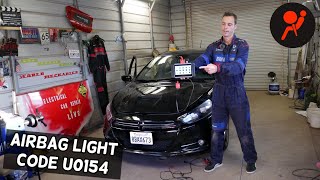

The information in this article is provided for general reference and educational purposes only. Vehicle specifications, procedures, and part compatibility can vary by production date, trim level, and region. Always consult your vehicle's factory service manual and verify part numbers before purchasing or performing repairs. Safety-critical components such as airbags, seat belts, and braking systems should be installed by a qualified professional.
- 🎬 Helpful Videos
- What Does U0154 Mean?
- Can I Drive With U0154?
- Common Causes
- Symptoms
- Diagnostic Flowchart
- Common Fixes & Costs
- Used vs. New Parts: Buying Guide
- What Happens If You Wait — Timeline
- Cost of Not Fixing It
- Diagnosis Steps
- When This Code Triggers (Freeze-Frame Conditions)
- Related Codes
- Climate & Environmental Factors
- How to Talk to a Mechanic About This Code
- Where to Take It: Dealer vs Independent vs Chain
- When to Walk Away From the Repair
- What Scan Tool You Need for This Code
- How to Clear the Code After You Fix It
- Will This Fail Emissions / State Inspection?
- Most Commonly Affected Vehicles
- Manufacturer-Specific Notes
- Real Owner Stories
- 2015 Dodge Charger - The Easy Fix
- 2013 Nissan Altima - A Recall Story
- 2012 Range Rover Evoque - The Intermittent Gremlin
- 2010 Chevrolet Cruze - Misdiagnosis Avoided
- How to Prevent This Code From Triggering
- Frequently Asked Questions
- What is the Occupant Classification System (OCS)?
- Will my airbags work in a crash if I have a U0154 code?
- What is the most common misdiagnosis for U0154?
- Can I fix code U0154 myself?
- Can I just clear the U0154 code?
- Can a low battery cause a U0154 code?
- Why is it so expensive to replace the OCS module?
- What's the difference between U0154 and a B-code for the airbag system?
- Key Takeaways
- 🎟️ Get 5% Off