

OBD-II Code U0142: Lost Communication With Body Control Module 'B'
The Ultimate Guide to What U0142 Means, Why It Triggers, and How to Fix It for Good
- Code U0142 indicates the Body Control Module 'B' has dropped off the CAN bus network, disabling critical safety features like headlights, wipers, and door locks.
- Always test the battery and inspect the BCM's dedicated fuses first; a voltage drop below 12.4V is the leading cause of this communication error.
- A flood of 3 or more 'U' codes appearing simultaneously points to a shared network failure—like a broken CAN bus wire or bad ground—rather than multiple failed modules.
- Replacing a faulty BCM costs between $450 and $1,350 and requires dealer-level software to program the new module to your vehicle's specific VIN.
What Does U0142 Mean?

Code U0142 signifies your car's primary computer network lost its connection to the Body Control Module 'B' (BCM 'B'). The BCM acts as a central command hub for comfort, convenience, and security features, including lights, power windows, and door locks. When communication drops, these systems fail completely or behave erratically.
Technical definition: Lost Communication With Body Control Module 'B'. This Diagnostic Trouble Code (DTC) sets when the Controller Area Network (CAN bus) stops receiving expected data messages from BCM 'B'. It also triggers if the module fails to respond to diagnostic requests from other essential network modules, indicating it is offline.
Can I Drive With U0142?
Yes, But With Caution. You can drive the vehicle, but doing so poses a severe safety risk. This code indicates a failure in systems controlling headlights, wipers, door locks, and the anti-theft system. If the BCM handles the security handshake, the vehicle will not start, leaving you stranded and adding $100-$300 in towing costs to your final bill.
Common Causes

- Failing or Weak Battery (Very Common) — Modern vehicles require precise system voltage. A weak battery dropping below 12.0 volts during cranking causes unpredictable communication errors between modules long before it fails to start the engine.
- Blown Fuse (Very Common) — A blown fuse supplying power to the BCM instantly knocks it offline. Always check the BCM and body system fuses in both the interior and under-hood panels first.
- Poor Power or Ground Connection (Common) — The BCM requires a stable voltage supply and a solid ground. A loose or corroded ground wire (like the G218 ground on GM trucks) 🎬 Watch: How to find and fix common vehicle ground wires easily disrupts the module's network connection.
- Damaged Wiring or Water Intrusion (Common) — CAN bus wiring harnesses chafe, pinch, or break near firewalls and under seats. Water leaking from bad window seals or clogged sunroof drains seeps into connectors, causing severe corrosion and short circuits.
- Aftermarket Accessory Interference (Less Common) — Improperly installed aftermarket alarms, remote starters, or audio equipment tapped directly into the CAN bus wiring disrupt network communication and generate multiple 'U' codes.
- Faulty Body Control Module (BCM) (Less Common) — Outright internal electronic failure of the BCM is rare compared to wiring or power issues. Reserve this diagnosis until all power, ground, and network wiring tests are exhausted.
Symptoms

- Body Accessory Failures (Lights, Wipers, Locks) — Headlights, turn signals, wipers, and power windows fail completely or behave erratically. The key fob and interior door lock switches become inoperative.
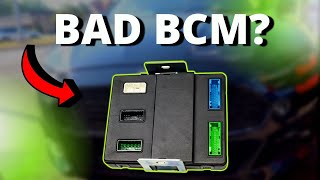
- Security System and Starting Problems — The factory alarm triggers randomly, the security light stays illuminated, and the vehicle refuses to crank if the BCM handles immobilizer key verification. 🎬 Watch: Common symptoms of a failing Body Control Module
- Erratic Instrument Cluster Behavior (also visible on scanner) — Dashboard gauges fluctuate wildly, drop to zero, or warning chimes sound intermittently. Multiple warning lights (Check Engine, ABS, Airbag) illuminate simultaneously.
Diagnostic Flowchart

Tap your situation to follow the diagnostic path that matches what you're seeing on this code.
Common Fixes & Costs
- Replacing a Weak or Dead Battery — Parts: $150-$350, Labor: $0-$50, ~0.5 hr book time (DIY)
- Replacing a Blown Fuse and Cleaning Grounds — Parts: $1-$10, Labor: $50-$150, ~1.0 hr book time (DIY)
- Repairing Damaged Wiring or Connectors — Parts: $10-$50, Labor: $200-$600, ~2.5 hr book time (Professional)
- Replacing and Programming the BCM
— Parts: $300-$900, Labor: $150-$450, ~2.0 hr book time
(Professional)
Ford F-150 (2018-2020): OEM JU5T-15604-MAR (Alt: Dorman (Varies by specific model and options))
Chevrolet Silverado (2014-2015): OEM 13594692 (Alt: Cardone (73-2990F), Dorman)
Ram 1500 (2016): OEM 68245054AC (Alt: Cardone, Dorman (Remanufactured options are common))
Used vs. New Parts: Buying Guide
When a used part is worth it: A used BCM is a budget-friendly option for older vehicles, but ONLY if you have a confirmed plan for programming. It is never a plug-and-play part.
Donor-vehicle mileage cap: roughly under 100000 miles for the part to have meaningful remaining life.
Donor quality checklist:
- Match the part number EXACTLY. Even a slight variation means different features or programming.
- Ensure the seller has a good return policy in case the module is faulty or cannot be reprogrammed.
- Avoid modules from flood-damaged or heavy-collision vehicles, as they have hidden damage.
Decision logic:
- If The vehicle is still under warranty or is a newer model → Buy a new OEM part. The cost is justified by the guaranteed compatibility and warranty.
- If You lack access to a dealership or a mechanic with advanced programming tools → Do not buy a used BCM. It is useless without VIN-specific programming.
- If The cost of a new BCM is more than 25% of the vehicle's value → A used BCM from a reputable salvage yard, paired with a confirmed programming appointment, is a reasonable choice.
Warranty tradeoff: Used parts typically offer a 30-90 day warranty for the part only. A new OEM BCM installed by a dealer carries a 1-2 year parts and labor warranty.
Worst-case if a used part fails: $300-$600 if a used BCM is dead on arrival or can't be programmed, covering the repeat labor and diagnostic time.
What Happens If You Wait — Timeline
- 0-2 weeks: Code U0142 is stored, and the Check Engine Light is on. You notice intermittent glitches with interior lights, power locks, or the key fob. (MPG impact: 0%% · Added cost: $0)
- 2 weeks - 3 months: Glitches become frequent. The vehicle occasionally hesitates to start. A parasitic drain from the faulty circuit begins to weaken the battery. (MPG impact: 0%% · Added cost: $150-$350 if the battery is prematurely damaged by the parasitic drain.)
- 3-6 months: A critical failure occurs. You experience a no-start condition that leaves you stranded. Safety systems like headlights or wipers fail unexpectedly during operation. (MPG impact: 0%% · Added cost: $100-$300 for a tow and emergency diagnostic.)
- 6+ months: Cascading failure. Unstable communication or voltage on the network corrupts software or damages internal electronics in other modules. (MPG impact: 0%% · Added cost: $1000-$3000+ to replace the BCM plus other modules damaged by the prolonged network fault.)
Cost of Not Fixing It
- Immediate: Loss of power locks, windows, and remote start. High risk of intermittent no-start conditions. (Added cost: $100-$300 for a tow and emergency diagnostic fee.)
- 1-3 months: Severe safety risks from unexpected headlight or wiper failures while driving at night or in rain. (Added cost: $0, but the risk of an accident or being stranded increases significantly.)
- 3+ months: An unstable BCM causes erratic network voltage, stressing and permanently damaging other sensitive electronic modules. (Added cost: $1000-$3000+ to replace multiple control modules damaged by the initial fault.)
Diagnosis Steps
- Check Battery and Fuses
Ensure the battery reads at least 12.4 volts with the engine off. Locate all fuse boxes and visually inspect every fuse related to the BCM and interior electronics. Replace blown fuses.
Tools: Multimeter, Fuse Puller (Beginner) - Perform a Full Network Scan
Use an all-system OBD-II scanner to read codes from every module. If BCM 'B' does not appear on the module list, it is completely offline. Multiple 'U' codes indicate a network-wide problem.
Tools: Advanced OBD-II Scanner (Beginner) - Visual Inspection for Damage and Water
Locate the BCM (usually under the dash or kick panel). Inspect connectors and surrounding wiring for water damage, green corrosion, or chafed wires. Check under carpets for moisture.
Tools: Flashlight, Trim Removal Tools (Intermediate) - Check BCM Power and Ground
Using a wiring diagram, identify the BCM's power and ground pins. With the key on, verify >12.4V at the power pins and <1 ohm resistance between ground pins and the negative battery terminal.
Tools: Multimeter, Vehicle Wiring Diagram (Advanced) - Test CAN Bus Resistance
With the battery disconnected, measure resistance between CAN High and CAN Low at the OBD-II port (pins 6 and 14). A 60-ohm reading means the network wiring is intact. 120 ohms indicates a broken wire or missing terminating resistor.
Tools: Multimeter (Advanced) - Verify CAN Bus Voltages
With the battery connected and ignition on, back-probe the CAN wires at the BCM. A healthy network shows ~2.5V idle. During communication, CAN High jumps to ~3.5V and CAN Low drops to ~1.5V.
Tools: Multimeter, Back-probe Kit, Wiring Diagram (Professional) - Perform a Harness Wiggle Test
With the engine running and scanner monitoring communication, carefully flex the wiring harness near the BCM and major junctions. If the code appears or disappears, you found the wiring fault location.
Tools: Advanced OBD-II Scanner (Professional)
When This Code Triggers (Freeze-Frame Conditions)
- Module Voltage: 10.5-12.0V (A reading below 12.0V strongly indicates the fault stems from a weak battery or charging system issue during engine cranking.)
- Ignition Status: Key On, Engine Off (Logged at 'Key On, Engine Off' means the failure occurred during the initial network check-in, pointing to a hard electrical fault rather than an intermittent driving issue.)
- Fault Occurrence Counter: >1 (A count greater than 1 suggests an intermittent problem occurring frequently during driving, typically caused by a loose wire or corroded connector.)
Related Codes
- U0140 — Lost Communication With Body Control Module (BCM 'A'). If U0140 and U0142 appear together, the problem is a systemic network failure, such as a broken main CAN bus wire or a shared power/ground circuit failure.
- U0155 — Lost Communication With Instrument Panel Cluster (IPC). The IPC often acts as a central gateway. If you have U0155 alongside U0142 and a dead dashboard, the IPC is the primary suspect and should be diagnosed first.
- U0073 — Control Module Communication Bus 'A' Off. This indicates the entire CAN bus has shut down. The fault lies in the network's core infrastructure—the main backbone wiring or a terminating resistor—not a single subordinate module.
- U0100 — Lost Communication With ECM/PCM 'A'. When this appears with U0142, it signals a severe network-wide failure. Diagnosis must focus on the network infrastructure itself rather than individual modules.
Climate & Environmental Factors
- High Humidity & Temperature Swings: Prolonged exposure to high humidity and rapid temperature changes causes condensation inside modules and connectors. This moisture accelerates corrosion on circuit boards and creates intermittent communication failures.
- Cold Climates & Road Salt: In regions where road salt is used, a highly corrosive brine mixture sprays onto the vehicle's undercarriage. This mixture seeps into wiring harnesses along the frame, causing severe corrosion that increases electrical resistance.
How to Talk to a Mechanic About This Code
Say this: "I have a U0142 communication code. Please check the battery, fuses, and the main power and ground connections to the BCM before looking at any expensive modules."
This signals that you are an informed customer. It directs the technician to follow a logical, cost-effective diagnostic path rather than immediately suggesting an expensive BCM replacement.
Avoid saying:
- 'Just fix whatever's wrong'
- 'My check engine light is on, can you look at it?' (too vague — invites upsell)
- 'I think I need a new Body Control Module' (Don't diagnose for them)
Questions to ask before authorizing the repair:
- What were the results of the power and ground tests at the BCM connector?
- What was the CAN bus resistance reading? Did you perform a network-wide scan?
- If you're recommending a BCM replacement, what specific tests did you perform to rule out wiring and grounds?
- Can you show me the damaged wire or corroded connector you found?
- Does the repair estimate include the cost of programming the new module?
Where to Take It: Dealer vs Independent vs Chain
- Dealer:
A safe but expensive choice. They are the best-equipped for BCM programming, which is often required. Best for warranty work or when you've exhausted other options.
Best for: Vehicles under warranty, Confirmed BCM replacements requiring manufacturer-specific programming tools
Downsides: Highest labor rates, May be quicker to replace a module than to spend hours tracing a wiring fault (Typical cost: +50% vs. baseline) - Independent Shop:
The best fit, IF you find the right one. Seek out a shop with a reputation for electrical diagnostics and ask if they have the tools to program modules for your specific make.
Best for: Out-of-warranty vehicles where cost is a factor, Shops that specialize in electrical or diagnostic work
Downsides: Quality and diagnostic capabilities vary greatly. Not all indies have the expensive tools for BCM programming. (Typical cost: +0% vs. baseline) - Chain Shop:
AVOID. This type of complex electrical diagnosis is far outside the scope of what chain shops are designed to handle.
Best for: Simple, unrelated maintenance like oil changes or tires.
Downsides: Technicians are generally not trained or equipped for complex network diagnostics., High risk of misdiagnosis, leading to unnecessary parts replacement. (Typical cost: -10% vs. baseline)
When to Walk Away From the Repair
If the estimated repair cost exceeds 50% of the car's private-party value, you should seriously consider selling or trading it in rather than repairing it.
- Car worth $4000, fix is $2100: Walk away. A repair costing over half the car's value is a poor investment, especially since other age-related failures could be next.
- Car worth $12000, fix is $1400: Fix it. The repair cost is well below the 50% threshold and restores critical vehicle functions.
- Car worth $2500, fix is $1400: Walk away. The repair cost is nearly 60% of the vehicle's value. It's not financially sound to proceed.
What Scan Tool You Need for This Code
Minimum: An 'All-System' or 'Full-System' scanner that can read codes from the Body Control Module (BCM), not just the engine computer.
A $20 code reader only tells you about engine (P-codes) and emissions issues. It cannot see the BCM or other modules on the network, making it useless for diagnosing a U0142 code.
Budget: FOXWELL NT301 / ANCEL AD310 (~$40) — NOTE: These are basic engine code readers and are NOT sufficient for U0142. They are listed to show what to avoid. You must step up to a full-system scanner.
Mid-range: BlueDriver Pro or FOXWELL NT510 Elite (~$120-180) — This is the minimum effective level. These tools perform an all-system scan to confirm the BCM is offline and provide live data to monitor module voltage.
Professional: Autel MaxiCOM MK808Z / Launch CRP919E BT (~$350-450) — Adds bidirectional control, allowing you to command the BCM to perform actions (like turn on headlights) to test its functionality directly. Essential for confirming if the module is bad or if it's a wiring issue.
Rent vs buy: AutoZone's free 'Loan-A-Tool' service is typically for basic code readers. For a complex issue like U0142, it is more cost-effective to pay a professional for 1-2 hours of diagnostic time than to buy a high-end scanner you may only use once.
How to Clear the Code After You Fix It
- Reconnect the battery if it was disconnected for the repair.
- Use a quality OBD-II scan tool to formally clear all Diagnostic Trouble Codes (DTCs).
- Perform the recommended drive cycle to allow the vehicle's readiness monitors to run and confirm the fix.
Drive cycle (~20 minutes): A general drive cycle to reset readiness monitors involves: 1. A cold start (engine off for 6+ hours). 2. Idle for 2-3 minutes. 3. Drive for 10-15 minutes in mixed city/highway conditions, including several steady-speed cruises and stop-and-go situations. 4. Allow the vehicle to coast down without brakes where safe. 5. A final idle period before shutting off. This may need to be repeated over 2-3 days of normal driving.
Readiness monitors affected: Comprehensive Component Monitor, Misfire Monitor, Fuel System Monitor
Before emissions retest: drive at least 50 miles to fully set monitors.
Watch out for:
- Disconnecting the battery clears the code but resets all readiness monitors to 'Not Ready', guaranteeing an emissions test failure.
- The code returns immediately upon the next key cycle if the underlying electrical fault remains unaddressed.
Will This Fail Emissions / State Inspection?
Yes — this code typically fails an OBD-II emissions inspection.
- California: An illuminated Check Engine Light is an automatic failure. After repair, a drive cycle must be completed to set readiness monitors before re-testing.
- New York: The NYS DMV inspection includes an OBD-II scan. Any active 'U' code that illuminates the Malfunction Indicator Lamp (MIL) results in an automatic failure.
- Texas: In counties requiring emissions testing, an illuminated Check Engine Light is an automatic fail. Clearing the code right before the test is also a failure.
Most Commonly Affected Vehicles
- Ford F-150 (2017-2020) — Highly prone to communication codes per Ford SSM 48563, pointing to a chafed transmission wiring harness causing multiple 'U' codes. Also check for water intrusion in the Side Obstacle Detection (SOD) modules.
- Chevrolet / GMC Silverado, Sierra, Tahoe, Yukon (2007-2014) — Covered by TSB 08-07-30-021H for widespread GMLAN network issues. Common causes include backed-out terminals in the main transmission connector and a poor ground at G218 behind the driver's kick panel.
- Dodge / Ram / Jeep Grand Cherokee, Ram 1500, Durango (2008-2018) — Often suffer from CAN bus issues due to weak batteries or fuses backing out of the TIPM (fuse box). Leaking third brake lights cause water damage to modules behind the rear seats.
- Hyundai / Kia Tucson, Santa Fe, Sorento (2016-2021) — Low battery voltage is a highly common trigger for network communication codes across the entire model line.
- Subaru Outback, Forester (2015-2019) — Issues trace to poor connections in the CAN bus wiring, frequently triggered by improperly installed aftermarket remote starters or stereos.
- Volkswagen Jetta, Golf, Tiguan (2012-2018) — Prone to communication codes due to issues with the CAN Gateway module or corroded connectors under the carpet caused by water leaks.
Manufacturer-Specific Notes
- Ford: A suffix like '-87' often appears with the code (U0142-87). This indicates a 'Missing Message' failure type, confirming the module is not sending its expected data packets on the network.
- General Motors (Chevy/GMC): GM vehicles are highly sensitive to poor connections at large inline harness connectors. TSB 08-07-30-021H points to these specific locations as common failure points for GMLAN network issues.
- Chrysler/Dodge/Jeep/Ram: Technicians diagnose CAN bus issues by accessing the 'star connector' (a central wiring junction). By disconnecting branches from this hub, they isolate which leg of the network contains the shorted module or wire.
- Toyota: U0142 is defined specifically as 'Lost Communication with Main Body ECU'. A large number of 'U' codes appearing at once points to a single failing module dragging the network down or a central wiring problem.
Real Owner Stories
2023 Harley-Davidson Ultra Limited with 1,200 miles
Bike failed to start intermittently. All lights came on, but it would not turn over. Code U0142 was present in all diagnostic modules.
What they tried:
- Letting the bike sit for 30 minutes, after which it started.
- Took photos of the diagnostic screen to show the dealership.
Outcome: The owner took the bike to the dealership for warranty diagnosis. Documenting the intermittent fault with photos helped technicians verify the issue.
Lesson: On a new vehicle under warranty, document intermittent electrical faults with photos. Don't clear the codes permanently; let the dealer see the history.
2013 Harley-Davidson Softail Slim after DIY work
After relocating front turn signals, the bike would not start and hazard lights failed. Code U0142 was present and could not be cleared.
What they tried:
- Clearing the codes.
- Inspecting work related to the turn signal relocation.
Outcome: The issue was directly caused by the recent DIY electrical work affecting the right-hand control module's communication.
Lesson: If a communication code appears immediately after performing DIY electrical work, the new installation is the most likely cause. Re-check all connections for pinched wires.
2018 Ford F-150 with multiple 'U' codes
Check engine light appeared with code U0142 and other communication codes. The owner found Ford SSM 48563 related to this issue.
What they tried:
- Researching the code and finding the relevant Technical Service Bulletin (TSB).
Outcome: The cause was a chafed transmission wiring harness, a known issue described in the Ford TSB. Repairing the damaged wires cost approximately $500.
Lesson: Always search for TSBs related to your specific vehicle and code. Manufacturers release these documents to fix known problems, saving hours of diagnostic time.
2014 Chevy Silverado with various electrical issues
Owner experienced a flood of communication codes, erratic gauge behavior, and random electrical problems.
What they tried:
- Initial diagnosis pointed towards a faulty BCM.
Outcome: The root cause was a corroded G218 ground connection behind the driver's kick panel. Cleaning and securing this single ground point resolved all codes.
Lesson: A large number of 'U' codes appearing at once almost always points to a single point of failure on the network's foundation. Check major ground points before condemning a module.
How to Prevent This Code From Triggering
- Perform a battery health check and terminal cleaning (Every 6-12 months) — Modules require stable voltage to communicate. A weak battery is a primary cause of 'U' codes. Cleaning terminals ensures the BCM receives full voltage.
- Inspect and clean common water drain paths (sunroof, cowl) (Annually, especially before rainy seasons) — Clogged drains cause water to overflow into the cabin, dripping directly onto fuse boxes and control modules like the BCM, causing corrosion.
- Apply dielectric grease to critical electrical connectors (Whenever a connector is disconnected for service) — Dielectric grease protects connector pins from moisture and oxygen, preventing the formation of corrosion that creates high resistance and communication faults.
- Avoid frequent short trips; take a longer drive weekly (Weekly) — Short trips don't allow the alternator enough time to fully recharge the battery, leading to a chronically undercharged state that stresses electronic modules.
Frequently Asked Questions
Can a bad battery cause code U0142?
Yes. A weak battery with low or unstable voltage is a primary cause of communication codes like U0142. Electronic modules require stable voltage to communicate properly. Always test the battery first.
Does a replacement BCM need to be programmed?
Yes, 100% of the time. A Body Control Module is not a plug-and-play part and must be programmed to your vehicle's specific VIN. Without dealer-level programming, the car will not function and likely won't start.
What is the most common misdiagnosis for U0142?
The most common mistake is replacing the BCM when the actual fault is a bad ground wire or blown fuse. Technicians frequently find the root cause is a simple power delivery issue. Always diagnose the entire network before condemning an expensive module.
My scanner shows U0142 and a dozen other 'U' codes. What does that mean?
A flood of U-codes from multiple modules almost never means all those modules failed simultaneously. This pattern points to a single, shared problem on the network infrastructure. The cause is typically a broken CAN bus wire, a bad shared ground, or a failed gateway module.
How much does it cost to fix a U0142 code?
A simple fix like a blown fuse or cleaning a ground wire costs under $150. Repairing damaged wiring ranges from $250 to $800 for diagnosis and labor. Replacing and programming a new BCM costs between $450 and $1,350 depending on the vehicle.
Can I fix U0142 myself?
A DIYer can handle basic checks like testing the battery, inspecting fuses, and looking for water damage. Diagnosing network faults with a multimeter or replacing the BCM requires professional tools. Stop DIY and consult a shop if the battery and fuses are intact.
Will clearing the code fix the problem?
No, clearing the code only erases the fault record temporarily. If the underlying electrical problem still exists, the code returns immediately upon the next key cycle. You must diagnose and repair the root cause to keep the code away.
What happens if I ignore a U0142 code?
Ignoring this code leads to escalating safety and reliability problems. You risk unexpected headlight or wiper failures while driving, creating a severe hazard. It also frequently progresses to a permanent no-start condition, leaving you stranded.
Key Takeaways
- Code U0142 indicates the Body Control Module 'B' has dropped off the CAN bus network, disabling critical safety features like headlights, wipers, and door locks.
- Always test the battery and inspect the BCM's dedicated fuses first; a voltage drop below 12.4V is the leading cause of this communication error.
- A flood of 3 or more 'U' codes appearing simultaneously points to a shared network failure—like a broken CAN bus wire or bad ground—rather than multiple failed modules.
- Replacing a faulty BCM costs between $450 and $1,350 and requires dealer-level software to program the new module to your vehicle's specific VIN.
Helpful Videos
![Ford Lost Communication Problems [The U-Codes]](https://img.youtube.com/vi/h04Cyo78bBU/mqdefault.jpg)

The information in this article is provided for general reference and educational purposes only. Vehicle specifications, procedures, and part compatibility can vary by production date, trim level, and region. Always consult your vehicle's factory service manual and verify part numbers before purchasing or performing repairs. Safety-critical components such as airbags, seat belts, and braking systems should be installed by a qualified professional.
- 🎬 Helpful Videos
- What Does U0142 Mean?
- Can I Drive With U0142?
- Common Causes
- Symptoms
- Diagnostic Flowchart
- Common Fixes & Costs
- Used vs. New Parts: Buying Guide
- What Happens If You Wait — Timeline
- Cost of Not Fixing It
- Diagnosis Steps
- When This Code Triggers (Freeze-Frame Conditions)
- Related Codes
- Climate & Environmental Factors
- How to Talk to a Mechanic About This Code
- Where to Take It: Dealer vs Independent vs Chain
- When to Walk Away From the Repair
- What Scan Tool You Need for This Code
- How to Clear the Code After You Fix It
- Will This Fail Emissions / State Inspection?
- Most Commonly Affected Vehicles
- Manufacturer-Specific Notes
- Real Owner Stories
- 2023 Harley-Davidson Ultra Limited with 1,200 miles
- 2013 Harley-Davidson Softail Slim after DIY work
- 2018 Ford F-150 with multiple 'U' codes
- 2014 Chevy Silverado with various electrical issues
- How to Prevent This Code From Triggering
- Frequently Asked Questions
- Can a bad battery cause code U0142?
- Does a replacement BCM need to be programmed?
- What is the most common misdiagnosis for U0142?
- My scanner shows U0142 and a dozen other 'U' codes. What does that mean?
- How much does it cost to fix a U0142 code?
- Can I fix U0142 myself?
- Will clearing the code fix the problem?
- What happens if I ignore a U0142 code?
- Key Takeaways
- 🎟️ Get 5% Off