

U0141 on 2018-2026 Porsche Cayenne: Lost BCM Communication Causes & Fixes
On a 2018-2026 Porsche Cayenne, code U0141 means the Body Control Module (BCM) has stopped communicating. The most common causes are a weak or failed 12V lithium battery (especially on 2019+ models), water damage corroding wiring under the cabin carpet, or a simple blown fuse. Always check the battery and for signs of water ingress before suspecting an expensive BCM replacement.
- Code U0141 means the Body Control Module (BCM) is offline.
- Before any other diagnosis, fully charge and test your Cayenne's battery, as low voltage is a very common trigger for this code.
- The most likely vehicle-specific cause is corroded wiring under the carpet due to water leaks from clogged drains. Check for dampness under the floor mats.
- Always check the simple things first: fuses for the BCM and related systems can be a quick and inexpensive fix.
- Do not replace the BCM unless you have professionally ruled out all power, ground, and wiring issues. A replacement BCM requires expensive dealer-level programming.
What's Unique About the 2018-2026 Porsche Cayenne
While U0141 is a universal code, the Porsche Cayenne platform has a specific vulnerability that often leads to this issue: water ingress. Clogged drains, particularly from the sunroof or the cowl area under the windshield, can cause water to leak into the cabin and saturate the carpets. Major wiring harnesses and critical factory wire splices run along the floor in the driver and passenger footwells. This moisture leads to severe corrosion on these non-waterproofed splices, breaking the delicate network wires and causing communication failures like U0141. This has been a documented problem across all Cayenne generations.
🎬 Watch: How to clear every water drain port on your Cayenne.Symptoms You May Notice
- Erratic or non-functioning interior and exterior lights.
- Power windows, door locks, or remote keyless entry not working.
- Multiple, seemingly unrelated warning lights on the dashboard, such as 'Brake Proportioning Faulty' or 'Ignition Lock Faulty'.
- Windshield wipers behaving erratically or not working.
- A parasitic battery drain that causes the battery to die overnight.
- In some cases, a no-start condition if the BCM is linked to the immobilizer system.
- Total loss of power where the vehicle is completely unresponsive and cannot be jump-started (specific to lithium battery failure).
- Porsche Communication Management (PCM) system losing connection or showing errors.
- Replacing the Body Control Module (BCM) without first thoroughly checking for a failed/locked-out lithium battery, blown fuses, or corroded wiring under the carpets. These are far more common and cheaper to fix.
- Assuming the battery is dead and needs replacement when it is a 2019+ lithium model that has entered its protective lockout state and simply needs the 'wake-up' procedure performed.
Most Likely Causes
- Weak or Failed 12V Lithium (LiFePO4) Battery 🔴 High Probability Starting in 2019, many Cayennes use a 12V lithium starter battery that is highly sensitive. Low voltage from sitting, or even using the wrong battery charger, can cause an internal relay to open, completely shutting the car down and making it appear dead. This loss of all power triggers communication codes like U0141 across the vehicle. These batteries are known to fail prematurely, sometimes requiring replacement costing $2,000-$4,000. A Porsche workshop campaign (WRV3) was released to reprogram the battery sensor to correct charge state calculations.
How to confirm: Test voltage at the under-hood jump posts. If it's near zero, the battery's internal protection is likely active. A Porsche-specific scanner (PIWIS) is needed to command the gateway to close the relay and 'wake' the battery. Standard battery tests may be misleading. A scan may also show fault P1B0200 for '12 Volt battery monitoring, not functioning'.
Typical fix: First, attempt the 'wake-up' procedure with a PIWIS or advanced scanner. If successful, the battery must be charged with a lithium-specific charger. If the battery is faulty, it must be replaced and coded to the vehicle using PIWIS. Some owners opt for a conversion kit to a more robust AGM battery.
Est. part cost: $1800-$4200 - Corroded or Damaged Wiring Harness 🔴 High Probability The Cayenne is notorious for clogged cowl and sunroof drains, causing water to leak into the cabin and soak the carpets. This directly corrodes the main wiring harness splices that run along the floor, causing open circuits in the CAN bus network. The factory splices are often just taped with cloth tape, not waterproofed, making them highly susceptible.
How to confirm: Lift the carpets and under-padding on both the driver and passenger sides. Check the floor pans for dampness and inspect the large wiring looms for signs of moisture, or green/white crusty corrosion on the wires and where they are spliced together.
Typical fix: The damaged section of the harness must be carefully repaired by cutting out the corroded splices and installing new, waterproof heat-shrink butt connectors. In severe cases, the entire harness may need replacement, which is a very labor-intensive job.
Est. part cost: $50-$2000 - Blown Fuse for BCM or Gateway 🟡 Medium Probability Electrical spikes or a shorted component can blow the fuse that supplies power to the Body Control Module, instantly taking it offline. Water intrusion can also cause shorts that lead to blown fuses.
How to confirm: Consult the owner's manual for the fuse box diagrams (located in the dashboard and/or luggage compartment). Visually inspect and test the fuses related to the 'Body Control Module', 'Vehicle Electrical System', or 'Gateway'.
Typical fix: Replace the blown fuse with a new one of the exact same amperage rating. If the fuse blows again, it indicates a short circuit that must be diagnosed.
Est. part cost: $1-$5 - Faulty Body Control Module (BCM) ⚪ Low Probability While less common than wiring or power issues, the BCM itself can fail internally due to component failure or, more likely on a Cayenne, internal corrosion from water damage. The front BCM is located under the dashboard, typically above the driver's knee area.
How to confirm: This is a process of elimination. If the BCM has proper power, a solid ground, and the CAN bus wiring tests good with an oscilloscope, but the module still won't communicate, the BCM itself is condemned.
Typical fix: Replace the Body Control Module. The new module must be programmed online by a dealer or a specialized shop to match the vehicle's VIN and options. A used module may also require coding or cloning.
Est. part cost: $650-$950
Diagnosis Steps
- Check Battery Health & Type: Start by identifying your battery type. If it is a 2019+ model, it may have a LiFePO4 lithium battery. If so, a dead appearance may be a protective lockout, not a failed battery. Test voltage at the under-hood posts. If near zero, a special 'wake-up' procedure is needed. If it's a standard AGM battery, ensure it has a full charge (at least 12.4V) and that the charging system is working correctly (13.0V - 14.5V when running).
- Full System Scan: Use a Porsche-compatible scanner (like PIWIS) to scan all modules. Note all other 'U' (network) codes and any faults mentioning low voltage or databus errors, as they can help pinpoint the fault.
- Inspect for Water Ingress: This is a critical step for the Cayenne. Pull back the driver and passenger side carpets and physically check the floor pans and foam padding for any signs of dampness or moisture.
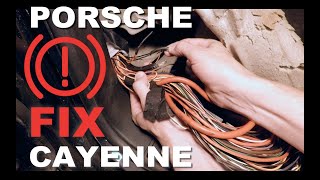
- Inspect Wiring Harness: If moisture is found (or even if not, as a precaution), carefully unwrap the large wiring harnesses running along the floor. Look for green or white crusty corrosion on the wires, especially at factory splice points which are often just wrapped in cloth tape. Gently tug on individual wires at the splices to see if they pull apart. 🎬 Watch this walkthrough on repairing corroded floor wiring harnesses.
- Inspect Fuses: Check all fuses related to the Body Control Module (BCM), Vehicle Electrical System Control Unit, and Gateway module. Fuse boxes are typically located at the ends of the dashboard and in the luggage compartment.
- Check BCM Connections: Locate the Body Control Module (Front BCM is typically under the dash on the driver's side). Inspect its connectors for corrosion, damage, or loose pins.
- Test CAN Bus Network (Professional): With the battery disconnected, use a multimeter to check resistance between Pin 6 (CAN High) and Pin 14 (CAN Low) at the OBD-II port. A healthy network should read approximately 60 Ohms. A reading of 120 Ohms indicates a break in the bus or a missing terminating resistor. With power on, an oscilloscope should show CAN High switching near 3.5V and CAN Low switching near 1.5V.
- Isolate the BCM: If all wiring, power, and grounds are confirmed to be good, the fault is likely internal to the BCM itself, which will require replacement and programming.
Parts You'll Likely Need
- Vehicle Battery — Low system voltage is a leading cause of module communication errors. The 2019+ 12V lithium (LiFePO4) battery is a particularly common failure point, with replacements costing thousands.
Trusted brands: Genuine Porsche, Varta, Bosch, Interstate
OEM price range: $1800-$2800 (Lithium)
Aftermarket price range: $250-$400 (AGM) - Body Control Module (BCM)
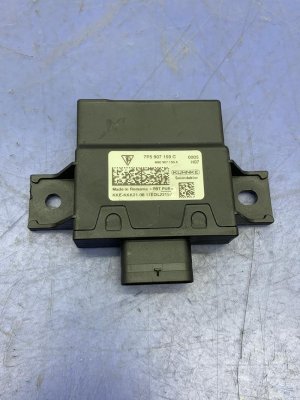
(OEM #Family: 958-907-064-J (supersedes multiple older numbers))— If power, ground, and network wiring are all intact, the module itself has likely failed internally. This is the final step after ruling out all other causes. Part number may also appear as 7PP907064xx or 9A7907064xx.
Trusted brands: Genuine Porsche, Continental
OEM price range: $650-$950
Aftermarket price range: $100-$300 (Used, requires programming) - Waterproof Butt Connectors / Splice Kit — Required for properly repairing corroded wires in the floor harness caused by water ingress. Using non-waterproof connectors will lead to a repeat failure.
Trusted brands: 3M, Ancor
Aftermarket price range: $15-$50
Related Codes That Often Appear With This One
- U0100 — Lost Communication with ECM/PCM. If the main network is compromised, communication can be lost with multiple modules simultaneously.
- U0155 — Lost Communication With Instrument Panel Cluster (IPC). The instrument cluster can sometimes act as a gateway module, so its failure can interrupt communication to other modules like the BCM.
- U0073 — Control Module Communication Bus 'A' Off. This indicates the entire network bus is down, rather than just a single module, pointing to a more widespread wiring or gateway module issue.
- U112300 — Databus error value received. This is another common network fault code seen alongside communication losses on modern VW/Audi group vehicles.
- P1B0200 — 12 Volt battery monitoring, not functioning. This code specifically points to a problem with the battery management system on the sensitive lithium batteries and was the subject of a workshop campaign (WRV3).
Technical Service Bulletins (TSBs) & Recalls
- Porsche ATI 2216.0: This Advanced Technical Information bulletin specifically addresses the no-start / no-power condition on 2019-2022 models with the 12V lithium battery. It outlines the procedure for technicians to 'wake up' the battery using a diagnostic tool after its internal protection relay has opened.
Platform-Specific Known Issues
- A well-documented issue on all generations of the Cayenne is the clogging of sunroof drains and cowl drains (under the front windshield). This causes rainwater to overflow into the vehicle's interior, soaking the foam under the carpets and corroding the main wiring harness, which contains the CAN bus network wires.
- Models from 2019 onwards equipped with the 12V lithium (LiFePO4) starter battery are prone to a unique failure mode where the battery's internal management system will disconnect it completely if the voltage drops too low, making the car seem entirely dead and unresponsive to jump-starting. This requires a special diagnostic procedure to 'wake up' the battery.
Mechanic-Grade Diagnostic Values
- CAN Bus Network Resistance — expected: Approximately 60 Ω. Failure: A reading of ~120 Ω indicates an open circuit or a single missing terminating resistor. A reading near 0 Ω indicates a short between CAN High and CAN Low wires. A reading of ~40 Ω could indicate a third terminating resistor is improperly on the network.
- CAN High Voltage (Key On, Engine Off) — expected: Switches between ~2.5V (recessive) and ~3.5V (dominant).. Failure: Stuck high, stuck low, or no signal indicates a bus fault.
- CAN Low Voltage (Key On, Engine Off) — expected: Switches between ~2.5V (recessive) and ~1.5V (dominant).. Failure: Stuck high, stuck low, or no signal indicates a bus fault.
- Main Engine to Chassis Ground Strap Resistance — expected: 0.0 - 0.2 Ω. Failure: Any reading higher than 0.2 Ω indicates excessive resistance, which can cause widespread, intermittent electrical faults mimicking module failures.
Hidden / Shadow Codes Worth Checking
- P1B0200: 12 Volt battery monitoring, not functioning. This fault is specific to the 40AH A123 manufacturer lithium battery and indicates the charge state is not being calculated correctly. (see via A Porsche-specific scanner like PIWIS. This fault was the target of workshop campaign WRV3.)
Scan Tool Commands That Help
- PIWIS III: Gateway -> Maintenance Repairs -> Battery Change — This function must be used after replacing the 12V battery (both AGM and Lithium) to register the new battery's capacity, type, and serial number with the vehicle's energy management system. Failure to do so can lead to improper charging and premature battery failure.
- PIWIS III: Automatic Coding / Control module replacement — When a new or used BCM is installed, it must be coded to the vehicle. This function, often requiring an online connection, programs the vehicle's VIN and specific equipment configuration into the module, allowing it to communicate with other control units.
- PIWIS III: Commission Immobilizer — After replacing and coding a BCM that is part of the immobilizer system, this function is used to teach the keys and align all security-relevant control units. Without this step, the vehicle will not start.
Wiring & Ground Locations
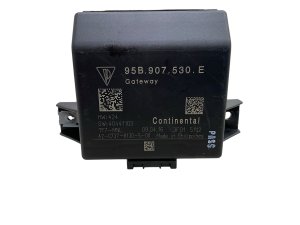
- Gateway Control Module — On older (9PA) Cayennes, it was behind the glove box. On the 9YA generation, the central gateway module (part number may start with 4K0) is located in the front left floor area, under the carpet.. The Gateway is the central router for all CAN bus traffic. If it loses power, has a bad ground, or fails internally, communication between all modules, including the BCM, will cease.
- Main Wiring Harness Splices — Within the large wiring looms that run along the floor in the driver and passenger side footwells, under the carpet and foam padding.. These are the most common failure points due to water ingress. The factory splices for the CAN bus and other critical wires are often poorly protected and corrode, causing an open circuit and leading to U0141.
- Main Chassis Ground Straps — One key ground strap runs from the engine to the strut tower in the engine bay. Another runs from the bottom of the engine to the frame on the front right side.. A corroded or loose main ground strap creates high resistance, causing unstable voltage supply to all modules. This can lead to random communication faults, no-start conditions, and a dashboard full of unrelated error messages, mimicking a failed BCM.
- Ground Point GP828 — On the right spring strut dome in the engine bay (for E-Hybrid models, may vary on others).. This is a grounding point for various actuators and sensors. While not directly for the BCM, a bad ground here can introduce noise onto the network, potentially causing communication issues.
Real Owner Repair Stories
- YouTube video by '911 FIXED' (Porsche Cayenne (generation not specified, but demonstrates the common issue)) — Vehicle was a 'paper weight' with an ignition fault and multiple communication errors.
❌ Tried (didn't work) Initial diagnosis was confusing due to the number of unrelated fault codes.
✅ What actually fixed it The root cause was water intrusion in the driver's footwell. The technician lifted the carpet, dried the area, and found approximately 12 corroded wires within the main harness splices. Several wires were completely broken. The fix involved cutting out the corroded sections, soldering the wires back together, and protecting them with heat shrink tubing. This restored communication and resolved all the fault codes. - YouTube video by 'OGS Mechanics' (Porsche Cayenne (generation not specified)) — Non-starting condition after another garage replaced the rear BCM.
❌ Tried (didn't work) A new rear BCM was installed but was not programmed.
✅ What actually fixed it The original rear BCM was destroyed by water ingress from a suspected sunroof drain leak. The new module had to be programmed using the Porsche dealer tool (PIWIS) with an online connection. The process involved first performing 'automatic coding' to configure the module, followed by a separate 'immobilizer realign procedure' to teach the keys and sync security data. This cleared the immobilizer faults and allowed the car to start.
OEM Part Supersession History
7PP907064xx (multiple suffixes)→958-907-064-J, which itself supersedes many previous versions like 7PP907064HP, 7PP907064KM, etc.— Revisions for hardware improvements and bug fixes.
Heads up: While many part numbers are superseded, it is critical to match the part number exactly when sourcing a used module, as a module from a car with different options (e.g., with/without air suspension) may cause features to malfunction even after coding. The 9YA generation uses BCMs with part numbers often starting in 9Y0, such as 9Y0907064EK.
Model Year Variations Within This Range
- 2019+: Introduction of the 12V Lithium (LiFePO4) starter battery. These models are uniquely prone to a total power loss state where the battery's internal protection trips, causing widespread communication faults including U0141. This requires a specific 'wake-up' procedure with a PIWIS scanner and is not serviceable with a standard jump start. A workshop campaign (WRV3) was issued to reprogram the battery sensor for these models.
Diagnostic Flowchart
Other Known Issues on This Vehicle
Issues unrelated to this code that are worth knowing about as an owner of this generation:
- Premature 12V Lithium (LiFePO4) Battery Failure 🔴 High — Common on 2019-2022 models. Can fail with little warning, even within the first few years of service. (Ref: Porsche ATI 2216.0 addresses the lockout state, but not the underlying failure.)
- Air Suspension Faults 🟠 Medium — Can occur as the vehicle ages (typically after 50,000 miles). Common failures include leaking air springs/struts, faulty height sensors, or a worn-out compressor.
- Transmission Oil Pipe / Cooler Leaks 🔴 High — A recall was issued for some 2020 models for a transmission oil pipe with an insufficient weld. Leaks can also occur from a cooler adaptor on top of the transmission. (Ref: NHTSA ID: 20V271000 / Porsche Recall ALA5)
- PCM / Infotainment Glitches 🟡 Low — Owners of 2024+ models report various software bugs, including loss of data connection to the Porsche app, which may require a PCM reset or dealer software update to resolve.
- High-Pressure Fuel Pump Fastener Recall (V8 Models) 🔴 High — Affects certain 2024-2026 V8-equipped models. Fasteners may not be properly tightened, leading to a potential fuel leak. (Ref: Porsche Recall ASA9)
Used vs. New Parts: Buying Guide for This Vehicle
When a used part is the smart pick: A used Body Control Module (BCM) can be a cost-effective option, but ONLY if you have access to a specialist with advanced tools capable of cloning or coding it. Some high-end aftermarket tools (like Autel) and specialized services can clone the data from your original BCM to the used one, making it plug-and-play.
Donor-vehicle mileage cap: roughly under 80000 miles for the part to have meaningful remaining life.
What to inspect on the donor part:
- Verify the part number matches your original BCM EXACTLY.
- Obtain the VIN of the donor vehicle if possible, as it can sometimes help with programming.
- Inspect the module's connectors for any signs of corrosion (green/white powder), bent pins, or heat damage.
- Ask the seller if the donor vehicle had any signs of water damage, as this is a primary cause of BCM failure.
OEM-only on this vehicle (don't cheap out):
- Body Control Module (BCM): While used OEM modules are an option, aftermarket (new, non-Porsche) BCMs are not available. You must use a genuine Porsche part, either new or used.
- 12V Lithium (LiFePO4) Battery: Due to the complex integration with the vehicle's charging and safety systems, only the OEM lithium battery or a specifically designed AGM conversion kit should be used. A generic battery will cause faults.
Brands owners have reported issues with on this vehicle:
- Avoid any 'new' non-OEM Body Control Modules. They do not exist for this platform and are likely scams.
Real Owner Stories
Aggregated from forums and TSBs cited above. Mileages and costs reflect what owners reported in those sources.
2019 Porsche Cayenne
Symptoms: The vehicle was completely dead and unresponsive due to a lithium battery failure, which caused widespread communication issues.
What fixed it: The dealer replaced the 12V lithium starter battery.
Cost: $3200-$3200
Source hint: Rennlist: '2019 Cayenne Lithium battery failure'
2018 Porsche Cayenne
Symptoms: Multiple, seemingly unrelated warning lights on the dashboard and erratic electrical functions after finding the carpets were soaked with water.
What fixed it: The corroded splice points in the main wiring harness running along the floor were cut out and repaired with waterproof heat-shrink butt connectors.
Cost: $50-$2000
Source hint: Rennlist: '955/957/958 Cayenne DIY: Wiring problems due to moisture'
Related OBD-II Codes
Frequently Asked Questions
My 2019 Cayenne is completely dead and won't even jump-start. Is this related to the U0141 code?
I found water on the floor of my Cayenne. Could this cause all the strange electrical problems and the U0141 code?
Is there a service campaign for the lithium battery problems on my Cayenne?
The dealer quoted me over $3,000 for a new lithium battery. Is this price correct?
Can I replace the expensive lithium battery with a standard AGM battery to avoid this problem in the future?
What is the Porsche TSB for the dead lithium battery issue?
Helpful Videos




We Have This Part in Stock

The information in this article is provided for general reference and educational purposes only. Vehicle specifications, procedures, and part compatibility can vary by production date, trim level, and region. Always consult your vehicle's factory service manual and verify part numbers before purchasing or performing repairs. Safety-critical components such as airbags, seat belts, and braking systems should be installed by a qualified professional.
- Porsche Cayenne:
- 🎬 Helpful Videos
- 🛍️ Shop This Part
- What's Unique About the 2018-2026 Porsche Cayenne
- Symptoms You May Notice
- Most Likely Causes
- Diagnosis Steps
- Parts You'll Likely Need
- Related Codes That Often Appear With This One
- Technical Service Bulletins (TSBs) & Recalls
- Platform-Specific Known Issues
- Mechanic-Grade Diagnostic Values
- Hidden / Shadow Codes Worth Checking
- Scan Tool Commands That Help
- Wiring & Ground Locations
- Real Owner Repair Stories
- OEM Part Supersession History
- Model Year Variations Within This Range
- Diagnostic Flowchart
- Other Known Issues on This Vehicle
- Used vs. New Parts: Buying Guide for This Vehicle
- Real Owner Stories
- 2019 Porsche Cayenne
- 2018 Porsche Cayenne
- Related OBD-II Codes
- Frequently Asked Questions
- 🎟️ Get 5% Off