

U0140 on 2018-2025 Jeep Wrangler: Lost Communication With Body Control Module Fixes
This code means the Body Control Module (BCM) is offline. On a Jeep Wrangler, this is frequently caused by a weak or failing battery, especially the small auxiliary battery used for the start/stop system. Start by load testing both batteries before checking for wiring issues. Many owners on forums like jlwranglerforums.com report that replacing both batteries simultaneously resolves the issue.
- U0140 on a JL Wrangler means the Body Control Module has lost communication.
- Before any other diagnosis, fully load test BOTH the main and auxiliary batteries. This is the most common fix.
- If batteries are good, carefully inspect wiring and connectors for corrosion or damage, especially if the Jeep is used off-road or has aftermarket accessories.
- Replacing the BCM is the last resort and requires professional programming.
- This code can cause a no-start condition, so it should be addressed promptly.
What's Unique About the 2018-2025 Jeep WRANGLER

The Jeep Wrangler (JL generation) has a unique dual-battery setup to manage its Engine Start-Stop (ESS) system. The small, secondary auxiliary battery is a known weak point and its failure often causes widespread electrical issues, including communication codes like U0140. Forum discussions are filled with owner experiences where a failing auxiliary battery leads to a cascade of seemingly unrelated electrical problems and warning lights. Furthermore, as Wranglers are frequently modified and used in harsh off-road environments, their wiring harnesses and connectors are more susceptible to damage, corrosion, and loose connections, which are primary causes for network faults.
Diagnostic Flowchart

Tap your situation to follow the diagnostic path that matches what you're seeing on this vehicle.
Generation note: The 2018 model year was a transition period. This guide primarily applies to the Wrangler JL generation (sold from 2018 to 2025). The older JK generation was also sold in 2018 and may have different BCM locations and diagnostic paths. Some early JL models were also noted to have a plastic bag around the BCM from the factory, which is unusual but not necessarily a fault.
Symptoms You May Notice

- Check Engine Light is on
- Warning lights on the dashboard (ABS, Traction Control, Air Bag)
- Message indicating "Auto Start/Stop Not Available" or "Service Start/Stop System"
- Power windows, door locks, or mirrors not working
- Interior or exterior lights behaving erratically or not turning on
- Wipers operating incorrectly
- Vehicle will not start or crank
- Radio or infotainment screen glitches
- Horn not working
- Security system light flashing
- Replacing the BCM without first load-testing both batteries. This is the most common and costly mistake according to owner forums.
- Replacing other control modules (like the PCM or ABS module) that have stored communication codes, when the root cause is the BCM not being online.
- Replacing only one of the two batteries, leading to a repeat failure shortly after.
Most Likely Causes

- Failing or Weak Dual Batteries 🔴 High Probability The JL Wrangler's auxiliary battery for the ESS system has a high failure rate. When it fails, it can cause voltage instability across the entire electrical system, leading to communication dropouts. Forum members on jlwranglerforums.com frequently cite this as the root cause for U0140 and other electrical gremlins.
How to confirm: Perform a load test on both the main and auxiliary batteries separately. A simple voltage check is not sufficient, as a battery can show 12V but fail under load. Many auto parts stores can do this for free. To test the auxiliary battery, you must first isolate it by disconnecting the negative cable that runs from the main battery's negative terminal to the aux battery.
Typical fix: Replace both the main and auxiliary batteries at the same time. 🎬 Watch: Step-by-step guide to replacing both batteries on your JL. It is a widely accepted best practice in the Wrangler community that a failing auxiliary battery can quickly degrade a new main battery, and vice-versa. Some owners opt to bypass or eliminate the auxiliary battery entirely.
Est. part cost: $250-$500 for both batteries - Loose or Corroded Wiring/Connectors 🟡 Medium Probability Off-roading, water exposure, and vibrations can lead to loose grounds, corroded connector pins, or chafed wires. Aftermarket accessories are also often tapped into BCM circuits, creating potential failure points. There are numerous grounding points in the engine bay, kick panels, and rear quarter panels that should be checked.
How to confirm: Visually inspect the wiring harnesses and connectors at the BCM (located behind the glove box area), main fuse block (PDC), and key grounding points for signs of damage, corrosion, or looseness. TSB #9100216 specifically advises checking all module connections. A wiring diagram showing ground locations can be invaluable.
Typical fix: Clean corroded terminals with a contact cleaner, repair damaged wires, and ensure all connectors are fully seated with their locking tabs engaged. Ensure ground bolts are tight and free of paint or corrosion. 🎬 See how to repair common ground wire issues on a Wrangler.
Est. part cost: $10-$100 for cleaning supplies or wiring repair materials - Faulty Body Control Module (BCM) ⚪ Low Probability While less common, internal failure from moisture intrusion, vibration, or component fatigue can occur. The BCM is located in a tight spot behind the glove box, making it somewhat protected but difficult to access.
How to confirm: This is a process of elimination. If the batteries and all related wiring (power, ground, CAN bus lines) test perfectly, the BCM itself is the likely culprit. An advanced scan tool that can attempt to communicate directly with the BCM is needed for definitive diagnosis. If the scan tool cannot communicate with the BCM at all, it points strongly to a BCM failure or a complete loss of its power/ground.
Typical fix: Replace the Body Control Module. This new module will need to be programmed to the vehicle's VIN and specific configuration by a dealer or a properly equipped independent shop using tools like wiTECH.
Est. part cost: $300-$600
Rare But Worth Checking
- Blown Fuse: A simple but sometimes overlooked cause. The BCM has multiple fuses powering its various circuits. Check the fuse panels in the engine bay (Power Distribution Center) and inside the cabin. On JL Wranglers, owners report that checking if all fuses are fully seated, not just visually intact, can solve strange electrical issues.
- Faulty Aftermarket Accessory: Improperly installed lighting, alarms, or remote start systems can interfere with the CAN bus network and cause communication faults. Temporarily disconnecting these can help isolate the issue. This is a common problem when accessories are not wired to a dedicated power source.
- Other Failing Module on the Network: Rarely, another module (like the ABS or radio) can fail in a way that it 'shouts' on the network, preventing the BCM from communicating. This requires advanced diagnostics to isolate by unplugging modules one by one. A failing wheel speed sensor, for example, can sometimes flood the network with bad data.
Diagnosis Steps
- Scan for all DTCs in all modules to see the full scope of the communication problem. Note which modules are not responding.
- Perform a full load test on both the main and auxiliary batteries. This is the most critical first step. Replace both if either one fails or is more than 3-4 years old.
- Inspect the battery terminals and main grounding straps for cleanliness and tightness. Key ground locations are near the battery, in the driver/passenger footwell kick panels, and near the brake booster.
- Check all fuses related to the Body Control Module in both the engine compartment (PDC) and interior fuse panels. Physically push on all fuses to ensure they are fully seated.
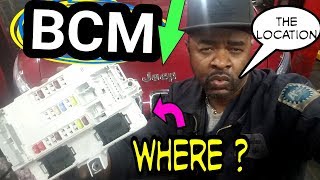
- Locate the BCM. On the JL Wrangler, it is tucked up high behind the glove box area. 🎬 Watch this video to locate and replace your Body Control Module. Inspect its connectors for corrosion, moisture, pushed-out pins, or physical damage.
- If any aftermarket electronics are installed (lights, winch, stereo, alarm), disconnect their power source temporarily, clear the codes, and see if the fault returns.
- Using a multimeter and a vehicle-specific wiring diagram, verify good power (B+) and ground at the BCM connector pins. Check for continuity on the CAN bus wires (CAN C and CAN IHS) between the BCM and the OBD-II port.
- If all else is good, the final step is to suspect a faulty BCM, which should be confirmed by a professional before ordering a replacement, as it requires programming.
Parts You'll Likely Need
- AGM Auxiliary Battery
(OEM #68647042AA, 56029759AB, BBAUX101AB)— This is the most frequent failure point on 2018+ Wranglers that leads to electrical and communication faults like U0140.
Related Codes That Often Appear With This One
- U0121 — Lost Communication With Anti-Lock Brake System (ABS) Control Module. Often appears with U0140 as part of a wider network communication failure, especially when batteries are failing.
- U0125 — Lost Communication With Dynamics Sensor. Often appears with U0140 as part of a wider network communication failure, as cited in TSB #23-033-25.
- U0129 — Lost Communication With Brake System Control Module. Also cited in TSB #23-033-25 as a related network code.
- U0151 — Lost Communication With Occupant Restraint Controller (ORC). Also cited in TSB #23-033-25.
- U0155 — Lost Communication With Instrument Panel Cluster. Also cited in TSB #23-033-25, indicating a broad network failure.
Technical Service Bulletins (TSBs) & Recalls
- Bulletin #23-033-25: Lists U0140-00 along with several other 'Lost Communication' codes related to a potential ABS Control Module issue, indicating a network-wide problem.
- Bulletin #9100216: Specifically mentions DTC U0140 and advises following standard diagnostic procedures with an emphasis on ensuring all module connections are secure.
- Bulletin #08-007-19 REV. A: While not directly for U0140, this TSB for the Jeep Grand Commander (a related platform) deals with flashing the Electric Power Steering module, showing how software updates can fix communication issues on the CAN bus.
- Customer Satisfaction Notification Y40: This notice involved software updates for the PCM on 2018-2020 Wranglers with the 2.0L engine to resolve other issues, demonstrating that module software is a key part of the vehicle's network health.
Platform-Specific Known Issues
- The dual-battery system is a known weak point. The smaller auxiliary battery often fails prematurely, causing a cascade of electrical problems and communication codes. Owners on jlwranglerforums.com report an average battery life of only 2-4 years before issues arise.
- An owner of a 2018 Wrangler reported receiving the U0140 code, confirming its presence on this platform.
- A thread on jlwranglerforums.com titled 'Issues after replacing both batteries' highlights the complexity, with one owner's Jeep at the dealer for 6 months for a similar issue that was ultimately battery-related.
- Another owner on the same forum noted that even with a new main battery, a bad auxiliary battery can cause a no-start or intermittent start condition on early 2018 models.
Mechanic-Grade Diagnostic Values
- CAN C Bus Resistance — expected: Approximately 60 Ω. Failure: A reading of 120 Ω indicates a loss of communication with one of the two terminating resistors (one is in the BCM). An open circuit (OL) or short to ground (0 Ω) indicates a wiring fault.
- CAN Bus Voltage (Key On, Engine Off) — expected: CAN-H (Pin 6) and CAN-L (Pin 14) should both read approximately 2.5V relative to ground.. Failure: CAN-H significantly lower than 2.5V or CAN-L significantly higher than 2.5V suggests a short between the lines or a short to power/ground. During active communication, CAN-H should toggle toward 3.5V and CAN-L toward 1.5V.
Hidden / Shadow Codes Worth Checking
- U0140-00: The '-00' suffix, as seen in TSB #23-033-25, is the standard FCA designation for 'No Sub Type Information'. While not a hidden code, it confirms the fault is a general communication loss rather than a specific circuit-high or circuit-low condition, which would have a different suffix. (see via Most professional scan tools, including Chrysler's wiTECH, will display this suffix.)
Scan Tool Commands That Help
- wiTECH (or equivalent high-end scanner): Proxi Configuration / Proxi Alignment — This function is mandatory after replacing the Body Control Module. It synchronizes the new BCM with the vehicle's existing modules and configured options (e.g., lighting type, keyless entry). Failure to perform this will result in a persistent U0140 code and malfunctioning features.
- wiTECH (or equivalent high-end scanner): Network Test — This command polls all modules on the network and provides a topology map or list showing which modules are communicating and which are not. This is a crucial first step to confirm if only the BCM is offline or if multiple modules are affected.
Wiring & Ground Locations
- G905 — In the passenger side footwell/kick panel area, near the A-pillar.. This is a major grounding point for many interior electronics, including circuits related to the BCM. A loose or corroded G905 ground is a known cause of U0140 and other seemingly random electrical issues.
- STAR Connector / Splice Pack — Located behind the glove box, often near the BCM. It's a junction block where multiple CAN bus wire pairs connect.. This is a central hub for CAN bus communication. A single loose pin, corrosion from water intrusion, or damage to this connector can sever communication between the BCM and the rest of the vehicle, directly causing a U0140 code.
Real Owner Repair Stories
- jlwranglerforums.com user report (2018 Jeep Wrangler JL) — U0140, dashboard lit up with multiple warnings, 'Start/Stop Unavailable' message.
❌ Tried (didn't work) Dealer checked batteries and said they were fine., Dealer cleared codes but they returned immediately.
✅ What actually fixed it The owner found a loose ground bolt in the passenger footwell (G905). After tightening the bolt, all codes disappeared and did not return. - jlwranglerforums.com user report (2018 Jeep Wrangler JL Unlimited) — U0140 and a cascade of other communication codes (U0121, U0151, etc.), no-start condition.
❌ Tried (didn't work) Checking all fuses., Testing the main battery (it tested good).
✅ What actually fixed it The dealer diagnosed a faulty Occupant Classification Module (OCM), located under the passenger seat. The failed OCM was shorting out the CAN bus, preventing the BCM and other modules from communicating. Replacing the OCM and clearing codes resolved the issue. - jlwranglerforums.com user report (Jeep Wrangler JL) — U0140 after installing aftermarket LED headlights.
❌ Tried (didn't work) Clearing the code (it would return instantly).
✅ What actually fixed it The aftermarket anti-flicker harness supplied with the LED lights was creating electrical noise on the CAN bus. Removing the aftermarket headlights and harnesses and reinstalling the factory lights immediately cleared the U0140 code.
When the Usual Fixes Don't Work
- While failing batteries are the most common cause, multiple owner-confirmed repairs show that U0140 can persist even after replacing both batteries. In these cases, the root cause was often an entirely different module failing and disrupting the network, such as the Occupant Classification Module (OCM) under the passenger seat. Another confirmed fix, after batteries were ruled out, was finding and tightening a loose primary ground bolt in the passenger footwell (G905). This demonstrates that if new batteries do not solve the problem, a thorough network and wiring integrity check is required before condemning the BCM.
Model Year Variations Within This Range
- 2021-2025 (4xe Models): The Wrangler 4xe Plug-in Hybrid does not use the small auxiliary battery for start-stop functions. Its 12V system is maintained by a DC-to-DC converter from the high-voltage hybrid battery. For U0140 on a 4xe, diagnosis should focus on the health of the main 12V AGM battery and the function of the DC-to-DC converter, rather than a failing auxiliary battery.
- 2018-2025: Various Technical Service Bulletins (TSBs) have been released that involve software updates (flashing) for the BCM to correct electrical anomalies. A vehicle that has never had its BCM software updated may be more prone to setting spurious codes. Checking for applicable BCM flash updates with a dealer is a valid diagnostic step.
Helpful Videos
We Have This Part in Stock



The information in this article is provided for general reference and educational purposes only. Vehicle specifications, procedures, and part compatibility can vary by production date, trim level, and region. Always consult your vehicle's factory service manual and verify part numbers before purchasing or performing repairs. Safety-critical components such as airbags, seat belts, and braking systems should be installed by a qualified professional.
- Jeep WRANGLER:
- 🎬 Helpful Videos
- 🛍️ Shop This Part
- What's Unique About the 2018-2025 Jeep WRANGLER
- Diagnostic Flowchart
- Symptoms You May Notice
- Most Likely Causes
- Rare But Worth Checking
- Diagnosis Steps
- Parts You'll Likely Need
- Related Codes That Often Appear With This One
- Technical Service Bulletins (TSBs) & Recalls
- Platform-Specific Known Issues
- Mechanic-Grade Diagnostic Values
- Hidden / Shadow Codes Worth Checking
- Scan Tool Commands That Help
- Wiring & Ground Locations
- Real Owner Repair Stories
- When the Usual Fixes Don't Work
- Model Year Variations Within This Range
- 🎟️ Get 5% Off