

U0140 on 2011-2015 Dodge Grand Caravan: Lost Communication With Body Control Module Fixes
This code means the van's main computer has lost contact with the Body Control Module (BCM), which controls electronics like lights, locks, and windows. The most common causes are wiring issues near the BCM/TIPM, a weak battery, or a faulty BCM/TIPM unit itself. However, for this specific vehicle, the most frequent manufacturer-documented fix is a Powertrain Control Module (PCM) software update to correct communication glitches.
- U0140 means the Body Control Module (BCM) has stopped communicating.
- Before replacing any parts, check the battery, fuses, and all wiring/connectors related to the BCM/TIPM for damage or corrosion.
- Several official Dodge TSBs state that a PCM software update can fix this code; check with a dealer to see if your van needs one.
- Due to the complexity of network diagnostics and the need for potential module programming, professional service is highly recommended.
- Do not immediately assume the BCM is bad; the problem is often simpler, like a bad ground or a wiring fault.
What's Unique About the 2011-2015 Dodge GRAND CARAVAN
On this generation of Grand Caravan and its platform mates (Chrysler Town & Country, Ram C/V), the BCM is closely integrated with the Totally Integrated Power Module (TIPM), a known weak point for many Chrysler products of this era. While TIPM failure can cause a host of electrical problems, the U0140 code is very frequently caused by a software logic error. Dodge has issued several Technical Service Bulletins (TSBs) for this exact code, with the primary solution being a software update for the Powertrain Control Module (PCM) to resolve communication glitches, rather than immediate hardware replacement. [Bulletin #18-001-15, #18-069-15 REV A, #18-085-15]
Diagnostic Flowchart
Tap your situation to follow the diagnostic path that matches what you're seeing on this vehicle.
Symptoms You May Notice
- Check Engine Light (Malfunction Indicator Lamp) is on.
- Malfunctioning or inoperative power windows, door locks, or interior lights.
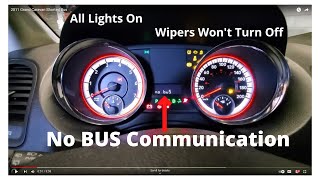
- Erratic or non-functional windshield wipers; may stay on continuously.
- Exterior lights (headlights, turn signals) flickering or not working.
- Harsh shifting from Park to Drive or between gears. [Bulletin #18-069-15 REV A]
- Vehicle may not start or has a no-crank condition.
- Multiple other warning lights (ABS, Traction Control, Airbag) may illuminate simultaneously.
- Backup camera not working.
- Radio may ask for a security PIN or reboot unexpectedly.
- Replacing the BCM/TIPM without first checking for applicable software updates. Many TSBs show that a simple reflash is the correct and intended fix.
- Replacing the battery without load testing it or checking the charging system. A good battery can be drained by a parasitic draw, and the low voltage is the symptom, not the root cause.
Most Likely Causes
- Outdated Powertrain Control Module (PCM) Software 🔴 High Probability Dodge has issued multiple TSBs (e.g., 18-001-15, 18-069-15 REV A) confirming that a PCM software update is the required fix for communication logic errors that falsely trigger a U0140 code, often accompanied by other seemingly unrelated DTCs.
How to confirm: A Dodge dealership or a well-equipped independent shop using wiTECH software can check the current software calibration ID on your PCM against the latest version available from the manufacturer as specified in the TSBs.
Typical fix: Reprogram (flash) the PCM with the updated software. This is a 0.2-0.5 hour labor operation at a dealership.
Est. part cost: $0-$250 - Wiring Harness or Connector Issue 🟡 Medium Probability The BCM is located behind the glove box and can be susceptible to water damage from a bad windshield seal. Wires in the main harness can also chafe or corrode, especially at the large connectors on the TIPM/BCM in the engine bay.
How to confirm: Visually inspect the wiring harnesses and connectors at the BCM (behind glove box) and TIPM (in engine bay) for corrosion, water stains, pushed-out pins, or physical damage. Use a multimeter to check for continuity and for shorts to power or ground on the CAN bus wires (pins 6 & 14 at the OBD-II port).
Typical fix: Repair the damaged section of wiring or clean/replace the corroded connector. Applying dielectric grease can help prevent future moisture intrusion.
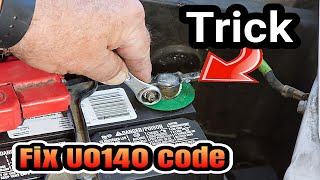
Est. part cost: $10-$100 - Low Battery Voltage or Poor Ground Connection 🟡 Medium Probability These vehicles are highly sensitive to voltage. A weak or failing battery is a very common cause of random communication codes as modules fail to initialize properly. Ground straps from the battery to the chassis can also corrode.
How to confirm: Test the battery voltage with a multimeter; it should be above 12.4V with the engine off and 13.7-14.7V when running. Load test the battery to confirm its health. Inspect the main battery ground strap and BCM ground connections for tightness and corrosion.
Typical fix: Replace the weak battery or clean/tighten the ground connections.
Est. part cost: $150-$250 - Faulty Totally Integrated Power Module (TIPM) ⚪ Low Probability The TIPM on these vans is a notorious failure point, leading to a host of bizarre electrical problems, most commonly a no-start due to a failed internal fuel pump relay. 🎬 Watch: Diagnosing intermittent no-start issues caused by the TIPM fuel relay. While it can cause communication codes, for U0140 specifically, it's a less likely cause than software or wiring.
How to confirm: After confirming software is updated and all wiring/power/grounds are good, the TIPM is a likely culprit. This is best confirmed with an advanced scan tool that shows the BCM (part of the TIPM) is unresponsive. Owners on forums report symptoms like wipers staying on or a no-start after driving in heavy rain as signs of a failing TIPM.
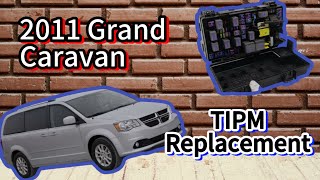
Typical fix: Replace the TIPM. This part must be programmed to the vehicle's VIN and options. Some owners report that when replacing a TIPM, wires in a connector may need to be rearranged per an instruction sheet 🎬 See this walkthrough on how to replace the TIPM yourself. included with the new part.
Est. part cost: $500-$900
Rare But Worth Checking
- Faulty module on the CAN bus: A different module on the vehicle (e.g., ABS module, passenger door module) can short out the CAN bus network, preventing the BCM from communicating and setting a U0140. A technician can diagnose this by unplugging modules one by one 🎬 Watch: How to diagnose a shorted CAN bus on a Caravan. to see if communication is restored.
- Faulty Powertrain Control Module (PCM): It is rare for the PCM itself to fail, but if it's unable to communicate with any modules, it could be at fault. This should be the last item to consider after all other possibilities are exhausted.
Diagnosis Steps
- Check for applicable TSBs. This is the most critical first step. A Dodge dealership can confirm if your vehicle's PCM software is up to date based on your VIN. The fix may be a simple reflash per TSBs like 18-069-15 REV A or 18-017-15.
- Check the battery and charging system. Ensure the battery has a full charge (12.4V+ engine off) and that the alternator is charging correctly (13.7V-14.7V engine on). Load test the battery.
- Use a professional scan tool to check for any other DTCs and to see which modules are communicating on the network. Attempt to communicate directly with the BCM. Note if other modules are also offline.
- Inspect fuses for the BCM and TIPM in the engine bay fuse box.
- Visually inspect the wiring and connectors at the TIPM/BCM. Look for signs of corrosion, water intrusion, or physical damage. Pay close attention to the large connectors on the TIPM.
- If wiring looks good, use a multimeter to verify the BCM has proper power (12V+) and a solid ground (<0.1 Ω resistance to chassis ground).
- Check the CAN bus wiring for correct resistance (should be ~60 ohms between CAN C High and CAN C Low with the battery disconnected) and for shorts to power or ground. This can be tested at the OBD-II port (pins 6 and 14).
- If all wiring, power, grounds, and software are confirmed to be good, the TIPM/BCM assembly is the most likely failed component.
Parts You'll Likely Need
- PCM Software Reflash — This is not a physical part, but a service. It is the most common manufacturer-recommended fix for the U0140 code on this platform, as documented in numerous TSBs.
Trusted brands: Mopar (via dealership)
OEM price range: $150-$250
Aftermarket price range: N/A - Totally Integrated Power Module (TIPM) / BCM
(OEM #68226576AB, 68170747AB (example numbers, must be verified by VIN))— This module is a common failure point on this platform and is the root cause after software, wiring, and power issues are ruled out.
Trusted brands: Mopar, Dorman (remanufactured), Circuit Board Medics (repair service)
OEM price range: $500-$900
Aftermarket price range: $350-$600
Related Codes That Often Appear With This One
- P0456 — TSBs #18-050-16 and #18-099-15 list U0140 alongside P0456 (Evap System Small Leak), indicating a PCM software update is designed to address both simultaneously. [Bulletin #18-050-16, #18-099-15]
- P0300 — TSB #18-017-15 (which supersedes 18-001-15) notes that U0140 can appear with P0300 (Multiple Cylinder Misfire) on a cold engine, pointing to a PCM software issue. [Bulletin #18-001-15]
- P06DD — TSB #18-085-15 links U0140 with P06DD (Engine Oil Pressure Control Circuit Stuck Off), again pointing towards a required PCM software update for 2011 models. [Bulletin #18-085-15]
- P0335 — TSB #18-050-16 shows U0140 appearing with P0335 (Crankshaft Position Sensor Circuit), which can also be related to PCM software or wiring harness issues. [Bulletin #18-050-16]
Technical Service Bulletins (TSBs) & Recalls
- 18-017-15 (Supersedes 18-001-15): For 2015 models, addresses U0140, P0300, and camshaft position codes, recommending a PCM software update.
- 18-069-15 REV A: For 2014 models, addresses U0140 and harsh shifting from Park to Drive, recommending a PCM software update.
- 18-050-16 REV A: For 2013 models, lists U0140 with P0335, P2610, and P0456, all fixed by a PCM software update.
- 18-085-15: For 2011 models, addresses U0140 along with oil pressure codes (P06DD, P0522), fixed by a PCM flash.
- 18-099-15: For 2013 models, links U0140 with P0456, recommending a PCM software update.
Platform-Specific Known Issues
- PCM Software Updates: Multiple Technical Service Bulletins (TSBs) exist for the 2011-2015 Grand Caravan that specifically address the U0140 code. The solution in many of these TSBs is to reprogram the Powertrain Control Module (PCM) with updated software, not to replace any hardware.
- TIPM Failures: The Totally Integrated Power Module (TIPM) is a well-documented weak point. Owners on forums like DodgeForum.com and Reddit describe a wide range of electrical gremlins, from no-start conditions to wipers that won't turn off, often traced back to a faulty TIPM, sometimes triggered by water intrusion.
Mechanic-Grade Diagnostic Values
- CAN Bus Network Resistance — expected: ~60 Ω between pins 6 (CAN-H) and 14 (CAN-L) of the OBD-II port with the battery disconnected.. Failure: A reading of ~120 Ω indicates an open circuit or a missing terminating resistor (one in the TIPM, one in the cluster). A reading near 0 Ω indicates a short between the CAN High and Low wires.
- BCM Power Supply Voltage — expected: 12.2V - 12.8V at the BCM power input pin with the ignition on.. Failure: Voltage significantly below 12V indicates a power supply issue (fuse, wiring, TIPM output).
- BCM Ground Resistance — expected: < 0.1 Ω between the BCM ground pin and a clean chassis ground point.. Failure: High resistance indicates a corroded or loose ground connection, a primary cause of module communication issues.
- CAN Bus Voltage (Key On, Engine Off) — expected: CAN High (Pin 6) should be ~2.5V to 3.5V. CAN Low (Pin 14) should be ~1.5V to 2.5V. The two voltages should mirror each other during data transmission.. Failure: Voltages stuck high, low, or at battery/ground potential indicate a short on the network. No activity can mean the bus is down.
Scan Tool Commands That Help
- wiTECH: Network Test (Bus Diagnostics) — This is a primary function to see which modules are actively communicating on the network and which are not responding. It's the first step in confirming the BCM is truly offline.
- wiTECH: Restore BCM Proxi Configuration / Proxi Configuration Alignment — This function is required after replacing the BCM/TIPM to align the new module with the vehicle's existing modules and features. Failure to perform this can result in a U0140 code or other feature malfunctions.
- wiTECH: ECU Reset & Reflash — Used to update the PCM or BCM software as specified in Technical Service Bulletins. This is often the primary fix for a U0140 code on this platform.
Wiring & Ground Locations
- G300 — Base of the left 'B' pillar (the pillar between the driver's door and the sliding door).. This is a major chassis ground point for multiple interior modules and harnesses. A loose or corroded G300 can cause intermittent communication issues for various components, including the BCM.
- G101 / G103 — G101 is on the left side of the engine compartment; G103 is on the left rear of the engine compartment.. These are primary engine bay grounds. While not directly for the BCM (which is inside), a poor main ground can introduce electrical noise and voltage stability problems that affect all modules.
- Engine Mount Ground Strap — A braided strap connecting the engine/transmission to the chassis, often near the upper engine mount.. A broken or corroded main engine ground strap can cause widespread electrical havoc as modules seek alternative ground paths. This can lead to communication codes like U0140.
- TIPM Connector C7 — One of the large multi-pin connectors on the bottom of the TIPM in the engine bay.. Service manuals reference checking the (N4) Fuel Level Signal circuit at the C7 connector. While for a different code, it shows that critical sensor data passes through this specific connector, making it a point of interest for any TIPM-related communication fault.
Real Owner Repair Stories
- DodgeForum.com user (2010 Jeep Wrangler (shares TIPM architecture with Grand Caravan)) — Dead TIPM, multiple electrical failures.
❌ Tried (didn't work) Sourcing the exact part number for the Wrangler TIPM.
✅ What actually fixed it Installed a used TIPM from a 2010 Dodge Grand Caravan for $25 from a junkyard. The vehicle was fixed with no codes and no programming required. - Reddit user r/Dodge (2014 Dodge Grand Caravan SXT) — U0140 code, flashing instrument cluster, ABS, power steering, and shifter failure warnings after driving through water. Intermittent loss of power steering.
❌ Tried (didn't work) Letting the vehicle dry out, which only provided a temporary fix.
✅ What actually fixed it The user was still in the process of diagnosing in a remote location, but the strong correlation between water exposure (both from a flood and a bad windshield seal) and the immediate onset of U0140 strongly points to water intrusion into the TIPM or a related connector as the root cause.
When the Usual Fixes Don't Work
- While replacing the TIPM/BCM often requires programming by a dealer, there are anecdotal reports from owners and mechanics who have successfully swapped a used TIPM from a vehicle with similar options (or more options) without needing to perform a 'Proxi Alignment'. One user reported fixing a 2010 Jeep Wrangler with a TIPM from a 2010 Grand Caravan. This suggests that in some cases, particularly with used parts from the same model year, a direct swap might work, although it is not the officially recommended procedure and carries risk.
OEM Part Supersession History
68226576AA→68226576AB— Revision update for a Body Control Module used in 2014-2015 Dodge Journey, which shares architecture with the Grand Caravan.
Heads up: While this specific part is for a Journey, the supersession from AA to AB indicates a hardware or software revision. It is critical to verify the correct part number by VIN, as multiple TIPM versions exist depending on vehicle options.
Helpful Videos

We Have This Part in Stock



The information in this article is provided for general reference and educational purposes only. Vehicle specifications, procedures, and part compatibility can vary by production date, trim level, and region. Always consult your vehicle's factory service manual and verify part numbers before purchasing or performing repairs. Safety-critical components such as airbags, seat belts, and braking systems should be installed by a qualified professional.
- Dodge GRAND CARAVAN:
- 🎬 Helpful Videos
- 🛍️ Shop This Part
- What's Unique About the 2011-2015 Dodge GRAND CARAVAN
- Diagnostic Flowchart
- Symptoms You May Notice
- Most Likely Causes
- Rare But Worth Checking
- Diagnosis Steps
- Parts You'll Likely Need
- Related Codes That Often Appear With This One
- Technical Service Bulletins (TSBs) & Recalls
- Platform-Specific Known Issues
- Mechanic-Grade Diagnostic Values
- Scan Tool Commands That Help
- Wiring & Ground Locations
- Real Owner Repair Stories
- When the Usual Fixes Don't Work
- OEM Part Supersession History
- 🎟️ Get 5% Off