

U0140 on 2011-2018 Chrysler 300: Lost Communication With Body Control Module Fixes
This code means the Body Control Module (BCM) has stopped communicating with other computers in the car. For the 2011-2018 Chrysler 300, the most common fix is a software update performed by the dealer, as specified in multiple Technical Service Bulletins (TSBs). Before heading to the dealer, check the battery, fuses, and ground connections, as these are simple and common failure points that can cause identical symptoms, including a dashboard lit up with multiple warning lights.
- For the 2011-2018 Chrysler 300, U0140 is very often caused by a software glitch that requires a dealer to update the Powertrain Control Module (PCM).
- Before assuming a costly module has failed, always check the basics: battery health, charging system output, and all related fuses.
- Visually inspect wiring harnesses for obvious damage, especially where they pass through the firewall or into doors.
- This code can cause unpredictable behavior in lighting and wiper systems, so exercise caution if you must drive the vehicle.
- Do not replace the Body Control Module (BCM) without first confirming that all software updates have been performed and that power, ground, and network wiring are intact.
What's Unique About the 2011-2018 Chrysler 300

On the second-generation (LD) Chrysler 300 and its platform mates, the U0140 code is frequently addressed by manufacturer-issued software updates. Chrysler has released several Technical Service Bulletins (TSBs) for this specific issue, indicating that a PCM reflash can resolve the communication loss. In some cases, the TSBs note that the U0140 code will be impossible to clear until this software update is performed, making a trip to the dealer a likely necessity. This software-first approach is critical, as it prevents the unnecessary replacement of a perfectly functional BCM.
Diagnostic Flowchart
Tap your situation to follow the diagnostic path that matches what you're seeing on this vehicle.
Symptoms You May Notice

- Check Engine Light is on
- Multiple other warning lights may illuminate (ABS, Traction Control, Airbag), often called a "Christmas tree" dash
- Exterior lights (headlights, turn signals) flicker, stay on, or don't work at all
- Interior lights do not work
- Power windows and door locks are inoperative
- Wipers operate erratically or not at all
- Key fob and remote start may not function
- Vehicle may not start or may stall
- Transmission may not shift correctly (limp mode)
- "No Bus" message on the instrument cluster
- Parasitic battery drain, causing a dead battery overnight
- A/C may blow hot on one side and cold on the other
- Replacing the BCM when the actual problem is a software issue that requires a reflash.
- Replacing the BCM when the problem is a simple corroded ground wire, a weak battery, or a faulty star connector.
- Replacing other modules (like the power steering pump module) when they are simply losing communication due to the primary BCM network fault.
Most Likely Causes
- PCM Software Requires Update 🔴 High Probability Multiple TSBs (#18-084-16, #18-073-20, #18-102-15, #18-070-16, #18-088-16 REV. A) have been issued by Chrysler to fix this exact code with a software reflash. TSB #18-102-15 explicitly states the U0140 code may be impossible to clear until the update is performed.
How to confirm: A Chrysler dealer or a shop with a subscription to OEM service information can check your vehicle's VIN against available TSBs. They will connect a wiTECH scan tool to verify the current software calibration.
Typical fix: Reprogramming the Powertrain Control Module (PCM) with the latest software version using the dealer's wiTECH scan tool.
Est. part cost: $0 - Weak or Failing Battery / Poor Charging System 🟡 Medium Probability Modern vehicles are highly sensitive to voltage. Low battery voltage (below ~12.4V) can cause modules to drop off the network and generate communication codes. A failing alternator can also cause these issues.
How to confirm: Test the battery voltage with a multimeter. It should be approximately 12.4-12.6V with the engine off and 13.7-14.7V with the engine running. Many auto parts stores will test your battery and charging system for free.
Typical fix: Recharge or replace the battery. If the charging voltage is low, the alternator may need replacement.
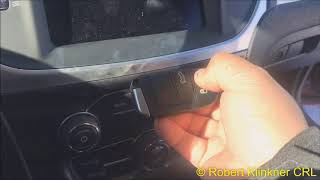
Est. part cost: $150-$350 - CAN Bus Wiring or Connector Issue 🟡 Medium Probability Wiring can become damaged, corroded, or chafed over time. On these cars, the CAN bus splice connectors (often called star connectors or junction blocks) are a known point of failure. There is one located under the glove box and another in the trunk near the battery. 🎬 Watch: Locate star connectors and get programming tips for your 300. Water intrusion from a worn windshield cowl seal has also been reported to cause issues.
How to confirm: Visually inspect wiring harnesses between the PCM and BCM. Check for corrosion in the star connectors. Advanced diagnosis involves using a multimeter to check for 60 ohms of resistance across the CAN bus (with battery disconnected) or a lab scope to analyze the network signal.
Typical fix: Repairing the damaged section of wire or cleaning/replacing the corroded connector or star connector block.
Est. part cost: $10-$100 - Poor BCM Ground Connection ⚪ Low Probability Ground straps can corrode or become loose, depriving the module of a stable ground reference needed for proper operation. These vehicles have multiple critical ground points under the dash and in the engine bay that can degrade over time.
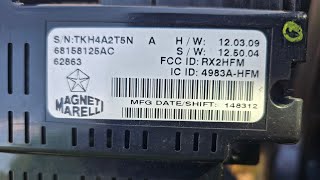
How to confirm: The BCM is located under the driver's side dashboard, to the left of the steering column. Locate the BCM's ground points (consult a service manual for specific ground numbers like G905) and inspect them for corrosion or looseness. Test resistance between the BCM ground pin and the chassis; it should be near zero ohms.
Typical fix: Clean the ground connection point and terminal with a wire brush, then tighten securely. Applying dielectric grease can prevent future corrosion.
Est. part cost: $1-$5 - Failing Body Control Module (BCM) ⚪ Low Probability
How to confirm: This is typically diagnosed by exclusion. If all wiring, power, grounds, and software are confirmed to be good, the module itself is the likely culprit. A high-end scan tool may show the BCM as 'offline' or non-responsive.
Typical fix: Replace the Body Control Module. The new module must be programmed to the vehicle's VIN and specific configuration by a dealer or a specialist shop.
Est. part cost: $250-$500
Rare But Worth Checking
- Aftermarket Electronics Interference: Poorly installed remote starters, alarms, or audio equipment can tap into the CAN bus improperly, creating signal noise that disrupts communication and can trigger a U0140 code.
- Failing Powertrain Control Module (PCM): While less common than a BCM failure for this code, the PCM is the module logging the fault, and an internal failure can, in rare cases, be the root cause. A faulty PCM can cost $800-$1000 to replace and program.
Diagnosis Steps
- Check Battery and Charging System: Ensure battery voltage is above 12.4V (engine off) and the alternator is charging correctly (13.7-14.7V engine on). A weak battery is a very common cause of communication codes.
- Scan for All Codes: Use a quality OBD-II scanner that can read codes from all modules (BCM, ABS, TCM, etc.), not just the PCM. Note all communication 'U' codes.
- Check for TSBs: This is a critical step for this specific vehicle and code. Have a dealer or qualified shop check your VIN for applicable software updates like TSB #18-102-15 or #18-070-16. This should be done before replacing any parts.
- Inspect Fuses: Check all fuses related to the BCM and other control modules. Fuse boxes are typically in the engine bay and in the trunk near the battery.
- Inspect BCM and Grounds: Visually inspect the BCM, located under the driver's side dash to the left of the steering column. Check its connectors for corrosion or backed-out pins. Locate and check the main BCM and chassis ground connections for tightness and corrosion.
- Inspect CAN Bus Star Connectors: Check the CAN bus splice packs (star connectors). One is typically under the passenger side dash/glove box, and another may be in the trunk. Look for any signs of corrosion or damage.
- Check CAN Bus Integrity: If you have the tools, disconnect the battery and measure the resistance between pins 6 (CAN-High) and 14 (CAN-Low) on the OBD-II port. A healthy network should read approximately 60 ohms.
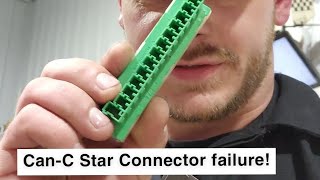
- Isolate Modules: For advanced diagnosis, a technician may disconnect modules one by one from the CAN bus star connectors to see if the communication fault disappears, which would isolate the faulty module or wiring branch. 🎬 Watch: A pro technician diagnoses a failed CAN bus star connector.
- Professional Diagnosis: If the steps above do not reveal the cause, professional diagnosis with a lab scope and OEM scan tool is required to analyze network data and confirm module failure.
Parts You'll Likely Need

- Body Control Module (BCM)
(OEM #68242015AD, 68354145AC (Varies by year/options, VIN match required))— If the module has failed internally due to water damage or electronic failure, it will need to be replaced. This is only done after ruling out software, power, ground, and wiring issues. Replacement requires programming.
Trusted brands: Mopar
Related Codes That Often Appear With This One
- P0573 — TSB #18-102-15 and #18-070-16 specifically link U0140 with 'Brake Switch 1 Stuck Off', indicating a software update is needed to resolve both.
- P0335 — Mentioned alongside U0140 in TSBs #18-084-16, #18-073-20, and #18-070-16 as a code that can be resolved with a PCM software update.
- P0456 — TSB #18-070-16 and #18-088-16 REV. A list this EVAP leak code with U0140 as being part of a group of faults fixed by a PCM reflash.
- P2610 — TSB #18-070-16 and #18-088-16 REV. A include 'PCM Internal Engine Off Timer Performance' with U0140 in a list of codes addressed by a software update.
- U0100 — This code indicates 'Lost Communication with ECM/PCM'. It can appear alongside U0140 if the network issue is severe, affecting multiple modules.
Technical Service Bulletins (TSBs) & Recalls

- 18-084-16
- 18-073-20
- 18-102-15
- 18-070-16
- 18-088-16 REV. A
Platform-Specific Known Issues
- A number of Technical Service Bulletins (TSBs) exist for the 2011-2018 Chrysler 300 platform where the U0140 code is present. TSBs like #18-102-15 and #18-070-16 explicitly state that a PCM software update is the required fix and that attempting to clear the code without the update will be unsuccessful.
Mechanic-Grade Diagnostic Values
- CAN Bus Network Resistance — expected: ~60 Ω. Failure: A reading of ~120 Ω indicates an open circuit or one of the two terminating resistors is offline. A reading significantly below 60 Ω (e.g., <45 Ω) suggests a shorted module or an extra terminating resistor on the network.
- CAN Bus Voltage (Key On, Engine Off) — expected: CAN-High (Pin 6) to Ground: ~2.5V to 3.0V. CAN-Low (Pin 14) to Ground: ~2.5V to 2.0V.. Failure: Voltages that are stuck high, low, or at 0V indicate a short to power, a short to ground, or an open circuit on that line.
- BCM Ground Resistance — expected: < 0.1 Ω. Failure: High resistance indicates a corroded or loose ground connection, which can cause the module to malfunction.
Scan Tool Commands That Help
- wiTECH 2.0 (FCA Dealer Tool): Vehicle Topology View — This is the first diagnostic step. It provides a color-coded map of all vehicle modules, instantly showing which are responsive (green), non-responsive/offline (red), have DTCs, or require a software update (lightning bolt icon). It immediately helps visualize the scope of the communication failure.
- wiTECH 2.0 (FCA Dealer Tool): Network Check Utility — Before attempting to reflash a module, this function is used to verify the diagnostic station has proper network connectivity to FCA's servers, which is required to download the software updates.
- wiTECH 2.0 or advanced scan tool: View Active DTCs in All Modules — Used to see which other modules are setting 'Lost Communication' codes against the BCM. If many modules have lost communication, it points to a network-wide issue rather than a single module failure.
Wiring & Ground Locations

- Body Control Module (BCM) — Under the driver's side dashboard, to the left of the steering column.. This is the module that has lost communication. Physical access is needed to check its connectors for corrosion and to test its power and ground wires.
- CAN Bus Star Connector (Splice Pack) #1 — Under the passenger side dashboard, often near or behind the glove box.. This is a central hub where many modules' CAN bus wires connect. Corrosion here can disrupt the entire network. It's also a key diagnostic point for isolating which module might be causing the network to crash.
- CAN Bus Star Connector (Splice Pack) #2 — In the trunk, near the battery and rear fuse box. A video shows it can be accessed by folding down the rear seat and lifting the trunk floor cover.. This is the second central hub for the CAN network. Like the front connector, it's a critical point for inspection and diagnosis.
- Rear Fuse Box / Power Distribution Center — In the trunk, next to the battery under the floor cover.. This panel contains fuses and relays critical to the BCM and other modules located in the rear of the vehicle.
- G306 (Ground) — A common ground point located on the right side of the engine compartment.. While not the BCM's primary ground, poor engine bay grounds can introduce electrical noise and voltage stability issues that affect sensitive modules.
Real Owner Repair Stories
- YouTube channel 'Advanced Level Automotive' (2012 Chrysler 300 with 3.6L V6) — Numerous communication codes between all different modules; scan tool could not communicate reliably.
❌ Tried (didn't work) Focusing on a single trouble code instead of diagnosing the network as a whole.
✅ What actually fixed it The technician diagnosed the issue by connecting a lab scope to pins 6 and 14 of the DLC and saw a noisy, glitching signal. He then accessed the CAN bus star connector under the glove box and began disconnecting modules one by one. This process isolates the module that is corrupting the network; when the faulty module is disconnected, the signal on the scope becomes clean and communication is restored. The final fix is to replace the specific module that was identified as the source of the noise.
OEM Part Supersession History
68154472AB→Unknown, but multiple part numbers exist for this generation.— Part numbers like P68164835AD (fits 2011-2014) and 68500900AB (fits 2021) show that different modules are used across the vehicle's life.
Heads up: A replacement BCM is NOT plug-and-play. It must be programmed by a dealer or a properly equipped independent shop using a tool like wiTECH to match the vehicle's VIN and factory-installed options. Failure to program will result in a no-start condition or malfunctioning features.
Model Year Variations Within This Range
- 2015-2018: The 2015 model year refresh introduced significant electronic changes, including a new 8.4-inch Uconnect system, a 7-inch digital instrument cluster, a rotary shift dial, and electric power steering. These changes mean the BCM, wiring, and software for 2015-2018 models are different from the 2011-2014 models. Parts are generally not interchangeable across this refresh boundary.
Helpful Videos
We Have This Part in Stock



The information in this article is provided for general reference and educational purposes only. Vehicle specifications, procedures, and part compatibility can vary by production date, trim level, and region. Always consult your vehicle's factory service manual and verify part numbers before purchasing or performing repairs. Safety-critical components such as airbags, seat belts, and braking systems should be installed by a qualified professional.
- Chrysler 300:
- 🎬 Helpful Videos
- 🛍️ Shop This Part
- What's Unique About the 2011-2018 Chrysler 300
- Diagnostic Flowchart
- Symptoms You May Notice
- Most Likely Causes
- Rare But Worth Checking
- Diagnosis Steps
- Parts You'll Likely Need
- Related Codes That Often Appear With This One
- Technical Service Bulletins (TSBs) & Recalls
- Platform-Specific Known Issues
- Mechanic-Grade Diagnostic Values
- Scan Tool Commands That Help
- Wiring & Ground Locations
- Real Owner Repair Stories
- OEM Part Supersession History
- Model Year Variations Within This Range
- 🎟️ Get 5% Off